The Power of Two
Eldad and Meidad are infused with the spirit of God, and they go about the camp in an ecstatic state (in last week’s parasha, Beha’alotecha). Joshua is concerned, but Moses doesn’t see the two as a threat to his leadership or to the community. In fact, he expresses the wish that everyone would be so graced.
Caleb and Joshua scout the Promised Land along with ten other spies. In contrast to the ten who see the challenges presented by their destination as insurmountable, the two urge the community to trust in God and to take what God promises to deliver (this week’s parasha, Shlach).
We often reflect on the difference that one person can make in the world. The influence of our actions ripple across distance and time. The work, however, is not easy. Though it might not be our individual obligation to finish the task in which we engage (“Lo alecha hamlacha ligmor…” Pirkei Avot 2:21), it is challenging to remain engaged when we feel alone, isolated, unsupported, suspect in others’ estimation, and perhaps even doubt in our capabilities.
Perhaps that is why the Torah presents so many examples of people working in tandem—for good or bad—to achieve a common goal. The solitary figures are often models of the exceptional. The duos, however, find strength and support, clarity and confidence, in each other. “Two are better off than one, in that they derive greater benefit from their efforts. For if they should fall, the one will raise up the other, as opposed to if one falls when there is no one to raise him” (Ecclesiastes 4:10-11).

Moses struggles with frustration and anger in his efforts because he is so alone. Time and time again we see that the weight of the burdens he bears is too much for him to carry alone. And delegating only goes so far in its effectiveness. God also experiences this frustration: “How long will they frustrate me? I’ll destroy them and start over with you,” says God. But Moses doesn’t want a new people to lead; Moses wants a partner. I imagine that when Moses calls upon God to show God’s strength through a display of compassion, he is actually saying to God: “We are both frustrated, we are in this together, we need to hear each other, learn from each other, and make this work.” God heeds Moses’ plea, anger is assuaged, and a partnership is born.

We can’t bear the burdens of our challenges alone. Creating partnerships and finding allies helps us become more self-aware, more reflective. Sharing our passion for a cause with another affords us the luxury of checking ourselves, of measuring our opinions and responses, of learning from another’s experience how to better achieve our goal.
As a faith community, we take our role of being a prophetic voice to the world seriously. While we are made up of many individual and diverse voices, we tackle issues and challenges as one. But working as a community alone can feel isolating and frustrating, often leading to feelings of anger, resentment and hopelessness. And that is why we have been so dedicated this year, and are so dedicated for the future, to building organizational partnerships. In the past week alone, we have partnered with the Rockland County Pride Center, Moms Demand Action for Gun Sense, and VCS (Volunteer counseling Services) to create opportunities for education, advocacy and empowerment and to serve those who find themselves on the margins of our society. We have stood for equality, learned how to better protect and advocate for the innocent, and feed the hungry. Thanks to these other organizations, our capacity to serve has increased.
As our tradition demands, we will love our neighbors, we will pursue justice, we will serve as a light to others in darkness. As these times demand, we will extend our hands in partnership to those who seek to do the same. And as we do so, our compassion, our power, our confidence and our love will only grow. And the Promised Land will not appear to us as an unattainable goal.
Shabbat shalom,
Rabbi Craig Scheff
Lo Levad, You are Not Alone…easier said than done.
When I think about my dad at home through all the years of my growing up, I think of him as alone. And when I think about my mom through those same years, I think of her as lonely.
Living with bipolar disorder, my dad spent months at a time inside our house, often in his bed, almost always alone. My mom went out to work every day, and my brother and I went to school. When we got home, there he was, on the couch, watching television. I was a kid. It never occurred to me to wonder about how alone he was.

In the 1950s and 1960s, no one understood my father’s mood swings. My parents’ friends wondered and perhaps pitied, but mostly stayed away. My dad‘s parents fretted that they had done something wrong to cause such brokenness. My mother’s parents urged her to leave my dad, and bring my brother and me to live in their house. Instead, my mother stood by my father, the love of her life. She held him and us together. There were no support groups for her; synagogue was not a safe place; and her friends were not equipped to understand. I wonder who could have possibly listened to her without judgment even if she could have articulated her sorrow and her rage. She must have been very lonely.
I thought a great deal about my parents yesterday as we celebrated a beautiful Shabbat of mental health awareness at OJC.

Thanks to the dedication and planning of #OJCSupportsU chairs Miriam Suchoff and Mark Brownstein, congregants experienced a wealth of opportunities to open our hearts and minds, and to create feelings of well-being and happiness – keystones to nurturing and sustaining good mental health. Through meditative prayer, singing, text study, and guided building of relationships, we practiced experiences that promote resilience.
We walked in silent meditation from the Daily Chapel to the bima in the Sanctuary to receive Torah, a powerful reenactment of Mount Sinai where everyone received Torah in his or her own way. God does not see anyone as broken; everyone is created in God’s image. We walked together as a community, from the four-year-old twins skipping to the 90-year-old couple walking carefully with canes. Being together in a community where everyone is accepted as “just fine,” just the way they are, is a most powerful sustainer of mental wellness. Everyone who was in synagogue yesterday felt this crucial teaching in our very souls.
But what about everyone who was not able to be in synagogue with us? What about the people who struggle with mental illness in their homes or in facilities and cannot leave, trapped there, unable to enter into our community of faith? What about the caregivers of those people, too exhausted and fearful of stigma to come out and join us in community? They probably do not see a sanctuary, rather they see an unbearable barrier to entry. How can we begin to change this reality for Jewish people who feel isolated due to mental illness?
We must continue to speak out. We must work hard to enable people to feel safe enough to be vulnerable in our sanctuary spaces.
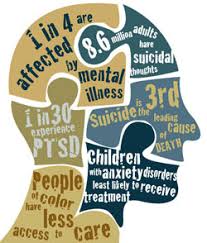
There are many opportunities in the month of May, #MentalHealthAwareness.
Wednesday, May 15 at 7:00 pm at the Rockland Jewish Community Campus, Rockland Jewish Family Service and Board of Rabbis present Lo Levad, You are Not Alone.
Thursdays, May 16, 23 and 30 at 7:30 pm at OJC, join Rabbi Scheff to study Jewish sources and mental health issues.
Thursday, May 30 at 6:30 pm at OJC, join me and Amichai Margolis for a spring time service of healing and harmony.
If you are struggling with mental health issues and you feel alone, reach out to your rabbis or to #OJCSupportsU in any way that you feel able so that we can meet you halfway. Even if you can only reach out a very short distance, we will meet you the rest of the way.
If you are lonely because you are a caregiver for someone you love struggling with mental health issues, we invite you in to listen, share and strengthen yourself.
You might feel alone and you might feel lonely. We want to provide a community for you in whatever way we can, not just in the month of May, but always.

Yesterday, before the Musaf Amidah, Mark Brownstein read Merle Feld’s poem, “Dreaming of Home.” To me, it reads as a clarion call to all homes of worship to be places where people are safe and known.
We want so much to be in that place
where we are respected and cherished,
protected, acknowledged, nurtured, encouraged, heard.
And seen, seen
in all our loveliness,
in all our fragile strength.
And safe, safe in all our trembling
vulnerability. Where we are known
and safe, safe and known —
is it possible?
In closing, I dedicate this post on Mother’s Day to my mother, Frances Weisberg Mack z”l, a woman of extraordinary strength and dedication.
With prayers for a refuah shlayma, a complete healing, a healing of body and healing of spirit,
Rabbi Paula Mack Drill
Local Jews
It’s a cold Sunday morning in February, the time is 8:55am. Sitting by the window in our Daily Chapel, I have a good view of the synagogue driveway.
Unfortunately, there are no cars entering. From my spot, I can actually see two blocks down the main street that approaches the driveway. Not a car in sight.
And we have 8 people in the room.
And 2 of the 8 are saying Kaddish.
Just up from shiva for their loved ones, they have come to the synagogue on this morning to find solace in community, and I am afraid we are about to fail them.
I pick up my phone, open my texts, and call up my chat group “Local Jews.” These are the families with younger children who have moved into our synagogue neighborhood over the last few years. They walk to synagogue on Shabbat. They tailgate with Rabbi Hersh and his wife Loni in the parking lot after services when the weather is nice. Their children wait around for me to change my clothes and bring out the boxes of Good Humor eclairs. They share coupons to the food store in our text group, and debate whether hot dogs are sandwiches. They wish each other a Shabbat shalom.
I’ve never used this particular forum to seek support for the synagogue, so I hesitate. I don’t want my neighbors to feel that I don’t respect the boundaries between the social neighborly connection we share and the synagogue connection we have in common. I don’t want them to feel any sense of guilt if they must turn down a rabbi’s request.
But time is growing short. And the window of opportunity is closing. So I text:
“Good morning! Don’t usually (ever) do this, but there are a couple of people saying Kaddish this morning and we are 2 short of a minyan. Can anyone drop by for 15 minutes?”
I hold my breath.
Seconds later my phone buzzes: “Gives us a few minutes. Dragging kids from beds.”
Ten minutes later, mom and her two young teens walk into the room, smiles on their faces, siddurim in hand. Imagine that, I think to myself. Teenagers who have just rolled out of bed, leaning into and giggling at their mother’s side. On a Sunday morning at 9am.
The sight takes me back to my own youth, to the many Sunday mornings I spent sitting under my father‘s right arm, surrounded by people a generation (or two) ahead of me. I recall how they greeted me with warm smiles and expressions of appreciation for my presence. They made me feel seen. They made me feel important. They made me feel connected.
My guilt over crossing some imaginary boundary dissipates, as I remember why this family moved into the neighborhood in the first place, around the corner from the OJC. They chose to make the synagogue and its community a focal point of their lives. For their own benefit and for the benefit of others.
Do I wish that people would want to come to services on Sunday morning for a half hour without prompting? Of course I do. But I’ll take neighbors who eagerly answer the call when they are needed any day of the week. And I’ll always cherish that moment when a teen sees the look on the face of an adult, telling them they’ve made a difference in someone’s life.
Local Jews, I promise not to abuse the privilege of having you as neighbors. Unless you give me permission to do so!
Rayna and Zev, I see you. You are more important to us than you know. And while you may not be able to name the feeling now, I hope that someday you will look back and recognize the way connection to community was cultivated in your lives. Mom, great job.

Rabbi Craig Scheff
You don’t know me
Thank you to the hundreds who showed up for Shabbat this past weekend to hear our message, and to know and to love one another a little better. The following is the message I shared:
You don’t know me.
As I stand here on this Shabbat morning welcoming those who have come to celebrate with our Bar Mitzvah and his family, those who chose to show up for Shabbat with their synagogue community, and those who have come from our neighborhood or larger community, Jewish or not, in order to pledge solidarity and unity in the face of hatred, I realize you probably don’t know me. Not the way I’d like you to.
If you did, you’d know that last Saturday, while I was reading a story in my synagogue about my ancestor Abraham—how he welcomed strangers into his tent, providing them food and shelter from the heat of the day—eleven members of my extended Jewish family were being executed for no reason other than that they were Jewish, and that they were learning the value of welcoming the stranger.
You don’t know me.
If you did, you’d know that while I was learning this week about my ancestor Abraham and how he purchased a burial place for his wife Sarah, how he saw himself as a stranger amongst his neighbors and thus insisted on paying the full price for his plot so no one would ever question the legitimacy of his presence in their midst, my extended family was burying its dead, suddenly feeling very much like strangers themselves and, by extension, shaking my own sense of belonging.
You don’t know me.
If you did, you’d know the pain I feel as a result of having been offered more wishes of congratulations on my favorite baseball team’s victory than wishes of condolence on my sense of personal loss because of the murders in Pittsburgh.
You don’t know me.
If you did, you’d know that in the week ahead I’d be commemorating the 80th anniversary of Kristallnacht, the Night of Broken Glass, a night that signaled the start of the Holocaust, sending my grandparents into flight from their home in Poland, to Russia where my mother would be born in a labor camp, then to a displaced person camp in Germany, and finally to the shores of these United States.
You don’t know me.
If you did, you’d know that this past week I made a donation to HIAS (the Hebrew Immigrant Aid Society), the same organization that my fellow Pittsburgh community supported, because I too believe in protecting refugees, and because without its support my family would not be here today.
You don’t know me.
If you did, you’d know that this past Tuesday Rabbi Drill and I took our sixth and seventh grade students around our OJC neighborhood to extend personal invitations to our 35 neighboring homes to join us this Shabbat in solidarity, and again on our Mitzvah Day in two weeks for breakfast, just to know one another and share in doing some good.
You don’t know me.
If you did, you’d know that when I was growing up here in this community, I knew my neighbors by name, but my children have grown up in this neighborhood not knowing the people who lived across the street.
Winter is coming. (Yes, I am a fan of Game of Thrones.) And while this winter may not be ushering in the ultimate battle between the forces of good and evil, I do believe we are on a dangerous path. When I was a child, winter meant shoveling my own driveway and going to my neighbors with a friend to ask if they wanted their driveways cleared or their cars cleaned off. Today, winter means locking your doors, lowering your shades and communicating with a friend virtually.
I do not believe that we find ourselves today in the winter of 1938 Nazi Germany. Most importantly, the police and the law are here to stand with us and to protect us, as they have been throughout this week. Our Town Supervisor and neighbor Chris Day is with us today to assert that an act of hatred against one of us is an act of hatred against us all. Our sisters from the Dominican Convent in Sparkill are here with us to share our pain and our mission in combating violent acts of hate with loving acts of kindness. Our Rockland Human Rights Commissioner Constance Frazier is with us today to share our outrage and determination not to let our community be home to those who target the weak, the aged, the young, those of a particular religion, gender, race, sexual identity or political persuasion.
If you don’t know me by now, I bear partial responsibility for not knowing you, for not introducing myself and giving you the chance to know me and what I value.
If you don’t know me by now, let me share with you that my faith commands me to love my neighbor and my tradition teaches me that I cannot love whom I do not know. In the days ahead may we come to know one another, so that our love for one another and for our neighborhoods, communities and country will truly come to be stronger than the hatred that seeks to tear us apart.
I can go to the polls this Tuesday and vote according to my values and who I am, but that is not going to change my relationship with you. And so I beg of you—as we leave here today and as we head to the polls in the week ahead to elect those with the power to shape our communities on a policy level—to knock on a neighbor’s door this week, to make an introduction, to maybe even extend an invitation, so that we may know one another again.

Confronting the Unthinkable
This blog post is dedicated with love to the memory of Daniel Ae Roo Beer, age 11 years and six days. And it is dedicated to his grief-filled parents and brother as they put one foot in front of the other, moment by moment, day by day. I pray that my words are healing to the Beer family, to the many communities who mourn Daniel, and to anyone who faces sudden, traumatic loss. May we all be comforted among the mourners of Zion and Jerusalem.
There is suffering and sorrow in the world. We do not look it in the face every day; we push it away because we have lives to live and children to raise and joy to seek. We know that suffering exists in this world, but thank God, we choose life.
So when sorrow hits us hard, when the loss is personal, breaking our hearts, we are in shock. We ask, “How could this be? How could this happen?”
Some of us believe we have answers based on our experience or belief or non-belief. I am familiar with the theories and the theologies. But when I face suffering as a member of a community, when I am a part of the sorrow, there is only one thing that I know. I know that I do not know why.
The loss of Daniel cannot be fixed. Answers to the question of why it happened cannot fix the reality of Daniel’s being gone from our lives. It cannot be fixed. But it can be healed.
Judaism teaches us how to heal: we heal by choosing life. Daniel showed us how by embracing life for 11 years, every moment of it, and all its fullness and luxury and joy. How can anyone in the community who loved Daniel find the way back to that kind of living from out of suffering and sorrow?
How does anyone find a way back toward life from out of the depths of loss?
Each one of us understands that we are part of concentric circles of caring. An immediate family, in the grip of loss, is the innermost circle. That is where our focus must go.
From our place outside of the most inner circle…
We choose to be quiet rather than offer theories.
We choose to be silent rather than offer opinions.
We listen first, with open hearts, without judgment, rather than distract with details and stories and any conversation other than that which is before us.
We understand the unique nature of every loss rather than offer our own experience without being asked for it.
Ultimately, Judaism teaches that healing begins when we offer nothing but our presence. Think of all the concentric circles. Imagine the power of everyone offering loving presence, directed inward toward the innermost circle, hoping to begin the process of healing.
All of us who knew and loved Daniel Beer learned from him that the world is a joyous place. Daniel’s life taught us that curiosity, limitless love, humor and kindness are the best way to live a life. Everything has changed now, except for one important thing: Daniel’s life lessons remain. The healing begins when we turn toward the joy that defined Daniel’s life.
HaMakom y’nachem etchem b’toch sha’ar avelei Tzion v’Yerushalayim. May the One who is the Place of Comfort give comfort to you among all of those who mourn in our communities.
L’shalom, Rabbi Paula Mack Drill
Leading a faith community
The traditional names for the synagogue–beit knesset, beit tefilah, beit midrash–connote a house of assembly, a house of worship and a house of inquiry and learning. These days, the synagogue is also considered the center of a faith community.
What does it mean to me to be a faith community? It means collectively embracing a hopeful and optimistic view of the world, where faith in God, in people, and in the potential Godliness of every person shapes values, morals and personal choices. In keeping with the ethical codes of our sages, it means giving others the benefit of the doubt without taking unreasonable risk to one’s own well being.
Judaism’s prophetic tradition envisioned a world order where all people would ultimately see God as one and recognize one another as the creation of that one God. In post-Biblical times, this vision of an era to come (olam ha-ba) was transformed into an other-worldly vision, one that could only arrive through divine intervention. Some even embraced the idea that a super-human or semi-divine figure would be needed to bring about this new world order.
Our sages of Rabbinic Judaism brought us back to our emphasis on human agency. We don’t rely on divine fiat to bring about the days of the era to come. Our messianic age is not ushered in by God, but by those of us here doing the work of God.
Israel and America are two potential entities through which this new world order can be brought about. There is nothing wrong with America or Israel wanting to put themselves “first” in this new order, so long as being first doesn’t mean being exclusive. Being first in this order means leading the way for all of humanity to ultimately be a part of the same vision, the same order. If I am first, and no one is following, then I am also last. Isolation and exclusivity did not fit with the prophets’ notion that Judaism’s values would serve as a light drawing humanity to unite as one.
As a leader of a faith community, I will continue to have faith in God; in people; and in policies that move us closer to a world order where all people search for the image of God in others. Our assembly, our worship, our inquiry and learning all point us in this direction as a worldview. Your vision of where we need to go as a society, as a country, as a world or as Jews may differ from mine; but as someone (who doesn’t see the world as I do) recently told me, I must speak the words that are in my heart. They are the wisdom of my experiences and my truths, and my responsibility to espouse in leading a faith community.
I don’t seek to be political in my views or to take sides. Different times demand that different values be prioritized and championed. I will speak out against Islamic fundamentalism that threatens my security and I will call out Jewish fundamentalism that chips away at my identity. I will warn against Islamophobia and I will defend against anti-Semitism. I will advocate for the rights of women to control their own bodies and I will demand the need for people to make responsible choices. I will educate for Jewish continuity and I will explore new ways to welcome interfaith households. I will support the rights of countries to protect their citizens, and I will march to demand the protection of the stranger, the vulnerable and those who can’t protect themselves. I will teach towards a greater awareness of the needs of people with disabilities and I will push for us to see one another as people first. I will own responsibility for my actions and I will accept the collective responsibility we have to our neighbors.
These are the values, among others, that I believe our faith community must advance in moving our world toward a better era for humankind. May that time come soon and in our day.

Shabbat shalom,
Rabbi Craig Scheff
Deep Listening
Join me now to consider four possible levels of conversation: Conform, Confront, Connect, and Co-Create as taught by Dr. Otto Scharmer, Senior Lecturer at MIT and co-founder of the Presencing Institute. https://www.presencing.com/
This past week, I spent two days continuing my work of visioning a new identity for the Rabbinical Assembly, the professional organization of Conservative Rabbis worldwide. We were challenged by Liz Alperin Solms and Marie McCormick, our change project facilitators, www.insytepartners.com, to understand and experience deep levels of productive conversation.


Our work over the past year has been anchored in a passion to re-envision a new path for the RA, ensuring a vital and vibrant future for Conservative Judaism.
Over the past year, I have been part of this exciting Vision Team of fifty rabbis representing a variety of years of experience and professional paths.


Throughout the work, I have been sensitive to the fact that the change work we are doing for the RA is translatable to our OJC community. I share with you now the ideas of deep conversations so that we can apply them to our synagogue life.
At the first level of conversation, Conforming, we talk “nice,” speaking to try and provide what the other person wants to hear. We use polite routines and empty phrases to conform to expectation. “Yes, of course, what you care about is important to me.” “No, of course, I don’t think that you are being difficult – I am glad to hear your thoughts.” “Sure, that’s just fine with me.”
Next, Confronting. We talk tough. We speak from an unshakable position of our own beliefs and understandings. Because we are our point of view, we become defensive. In these conversations, I am right and therefore you are not.
At the third level, Connecting, our conversations are reflective inquiries. Now I speak from a place where I see myself as part of the whole. I might still think differently from you, but now I want to know why. Rather than defend my position, I want to connect with you and come to understand your viewpoint. “I may not agree but I hope that you will tell me more about that.” “I have never thought about the issue in that way before.”
Finally, Co-Create is the fourth level. At this deep level of experience, conversation is a generative flow. I understand my place as being part of a collective, I practice stillness and experience the flow. This final level of conversation leads to collective creativity. In co-creating conversations, we might feel that something extraordinary has entered the space.
When I learned about collective creativity, I suddenly saw that our Rabbis of Tradition understood generative flow. Talmud teaches that when two people sit together to study Torah, the Shekhina, the nurturing aspect of God, rests upon their shoulders. The students of Torah lose their sense of separateness in the connection through Torah.
Our project facilitators explained that most conversations in our lives happen at one of the first two levels, and indeed, both are necessary to live successfully in the world. Sometimes we have to just be polite. Sometimes we just have to say what we really think and stand by it.
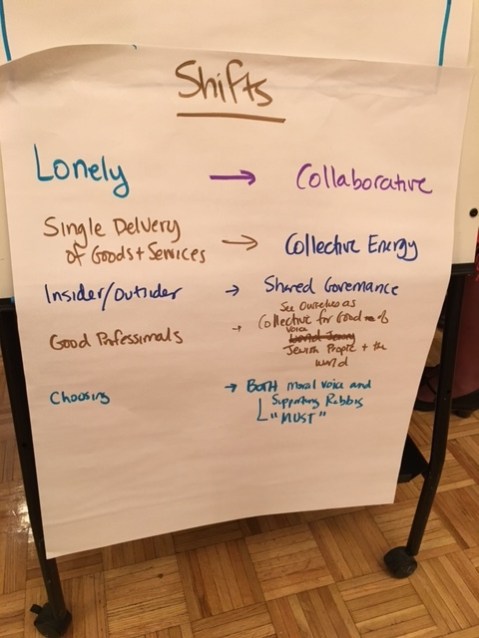
But if we want something to change and grow, we must dig deeper in our conversations. If we want our synagogue to prosper and thrive in adaptive and exciting ways, we must practice conversations at the third or even fourth level.
Scharmer’s theory about conversations for change feels very Jewish to me. To succeed as a community, we must let go of the inclination to begin every conversation from our own point of view. For success, we must say: I am part of something bigger than myself: this synagogue, this history, this particular people, this covenant with God. To fully participate in such a collective endeavor, I must listen carefully for clues about what you think and remain open to the possibility that my thinking is not enough. Together, we are stronger, wiser and more creative.
I look forward to continuing the conversation,
Rabbi Paula Mack Drill
A successful work in progress
This past Sunday night, our OJC community and friends celebrated our community. Yes, Rabbi Paula Drill was the honoree for the evening, but—sorry—the night was only in part about her. It was a love-fest that spanned the generations: a night of Jewish learning, music, food and appreciation of one another. The night was about our community: our heart, our simplicity, our humility, our relationships, our Torah, our mission and our vision.

In trying to summarize our community’s success, I realize that we have not relied upon any new strategies. We haven’t created any unique ways of doing business; nor have we abandoned our commitment to traditional models of Jewish life. It is the Jewish values exhibited in the building of the Mishkan (the Israelites’ portable sanctuary), described in this week’s Torah portion, that serve as the blueprint for our own community.
The very idea that the people can participate in a process that will invite God’s presence is enough to inspire participation. Perhaps there is an element of guilt or a desire for repentance in their motivation, but after the debacle of the Golden Calf, the Israelites have a chance to merit a legacy. And the project is as much about the process as it is about the ultimate edifice that is constructed. The freewill service to a higher calling adds meaning and the sense of God’s presence to a life that is otherwise enslaved to fear and uncertainty.
God instructs Moses to engage the community by inviting them to donate to the project whatever they are moved to share. Several opportunities are created for that giving by virtue of the many types of materials being collected and utilized in the project. Engagement is transformed into empowerment as each individual becomes a participant in the processes of manufacturing, design and construction.
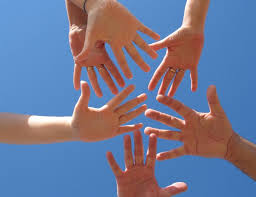
The appointment of Betzalel as project manager, the inclusion of artisans, and the participation of the broader community creates a new dynamic for the Israelites’ engagement with the Divine One. Before this change, leadership was purely hierarchical, and the population was steps removed in relation to God. As a result of the new appointee, the community operates in partnership with its leadership. In partnerships, the success of one is the success of all. Relationships deepen between the volunteers who recognize that they are working together towards a shared vision; relationships also deepen between the volunteers and the leadership, who now recognize the value of the other’s contributions towards a shared goal.
Finally, there is the matter of expectations and of how we define our success. Success can’t be about the number of people who participate or about the amounts they contribute. Success is found in the knowledge that the process of building—serving, empowering, partnering and relating—is an ongoing effort.

On Sunday night, we celebrated a milestone for a community in process. God said, “Let them build Me a sanctuary that I may dwell among them.” As we continue the process of building a world deserving of God’s presence, may we continue to merit God’s presence among us.
Rabbi Craig Scheff
Festival of the Daughters

What is a group of women doing in someone’s living room one night each month, introducing themselves with their matriarchal line and passing a candle from one to the next? We are celebrating Rosh Chodesh, the Jewish new month, a time designated by the rabbis as a festival for women. Rosh Chodesh Celebrations began this year to bring together women who are raising children at home for evenings of study, sharing and celebrating.
Each month our gatherings have been uplifting and meaningful. Through tears and laughter these women have found support and understanding in a close circle of OJC congregants, luxuriating in the gift of time dedicated to self and community.
Last night was a special Rosh Chodesh celebration as the group of younger moms met together with Sisters in Spirit, a group of OJC women whose nests are empty facilitated each month by Sally Kagan and Miriam Suchoff.
Rosh Chodesh Tevet is unique as it falls in the middle of a holiday, on the seventh night of Chanukah each year. Among the Jewish communities of North Africa, this auspicious night was designated as the Festival of the Daughters — a time for the generations to celebrate together. And so that is what the two Rosh Chodesh groups of the Orangetown Jewish Center did last night: we brought the generations together to celebrate.
One of the Rosh Chodesh Celebrations participants wrote about how much she enjoyed the special evening, “I always look to learn from the older, wiser and more experienced women (and men) in the world and often say that those sage people (like my dad) are hard to find these days. Their simple advice is so enlightening and comforting.”

Together we lit the chanukiah and immediately felt the magic begin.


After our opening ritual, Sally told the story of brave and wise Judith who saved the Jews who were under siege by the evil Holofernes. Sally’s storytelling technique was engaging and fun; you’ll have to ask her for a synopsis, but be sure to ask what she pulled out of her basket at the end of the story!
We used the lighting of seven candles to open us to seven questions about women we admire, blessings we would bestow on daughters, our own gifts to family, and more.

There were tears and words of support and much laughter. We concluded the evening with each woman offering a blessing to the woman to her right.


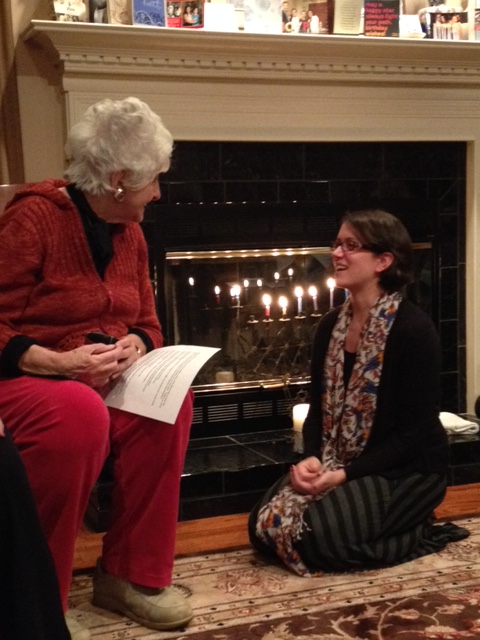
Without a doubt, there is magic in a Rosh Chodesh group. A group of women empowers one another to reach inside and tap into a place we often ignore. The group energizes us so that people not only feel good about themselves, but about the women surrounding them! As Sally Kagan says, “This is the essence of women gathering for Rosh Chodesh: that we all have the ability within our souls to capture the roots of our faith, the belief that we can nurture and be nourished by one another, and to understand what those first women in the red tents knew: that through the camaraderie and learning we are stronger!”
If you are a woman of the Orangetown Jewish Center, we hope that you’ll join one of the Rosh Chodesh groups. Contact me at Rabbi.Drill@theojc.org for more information. If you are a blog reader who is not connected to the OJC, be in contact for information on how to create a group of your own. And if you are a man, be happy for the women in your life that there is a safe and nurturing place for us to grow in a Jewish context.
Enjoy this eighth night of Chanukah. I pray that the lights in the darkness bring optimism to your hearts.
Chag Chanukah Sameach and Chodesh Tov, Happy Chanukah and Happy New Month,
Rabbi Paula Mack Drill
On the third night of Chanukah, my rabbi said to me…
A past-president of our synagogue, Nohra Leff, once said to me, “I don’t just believe in miracles, I EXPECT THEM!” What a great way to go through life. Expecting miracles means that we engage in behaviors that ultimately create an environment where what some perceive as the “miraculous” becomes that much more possible.
In the fall of 1995, I took a job as part-time cantor at the OJC. Still a full-time student and father of two young boys, I treated the job like it was the fulfillment of a dream. A year later, I was negotiating my first contract to be Student-Rabbi and to stay on as Rabbi after my ordination. I was advised by people “in the know” to avoid such a commitment. After all, the synagogue had gone through so many rabbis in its relatively short history, and I “could do better,” according to the more experienced. Three years later, another past-president, Michael Scolnick, would ask me how long I thought the honeymoon could last. I am glad to say that, even in my 20th year, I still feel like we met just yesterday. Okay, maybe just the day before yesterday.
When I speak to rabbinical students in their final years at JTS, I try to emphasize that every synagogue community has the potential to be a place that can be transformed and re-dedicated to Torah, service and deeds of loving kindness. That can only happen, however, if the rabbi is willing to see him or herself as spending the rest of their professional life serving that one community. If we invest ourselves in a plan believing that we have only two years to work toward achieving our goals, then we doom ourselves to failure; but if we invest ourselves planning for the long term, we can create an environment where the seemingly impossible is indeed achievable.

In the midst of Chanukah, we consider the nature of miracles, and the role that “dedication” (the literal meaning of the word Chanukah) plays in making one day’s worth of oil last for eight, or in leading one small band of soldiers to victory against overwhelming odds. I am so proud of what we have achieved and how we have continued to grow as a Conservative egalitarian community. Beyond our impressive numbers, we have attained a level of learning, service to the broader community, participation and spirit of which we can all be proud. The dedication that has brought us to this place in our history, however, has also given us the wisdom to understand that we must continue striving to build and to deepen relationships; to reach in to our membership and to reach out to those still searching; to develop more pathways into our OJC community, into a life of purpose and meaning, and into relationship with God; and to lookto the future with faith, optimism and vision. Some people might call our success a miracle. Perhaps we have witnessed something miraculous as a community; if so, the miracle only happened because of the wise people–presidents, boards, volunteers, congregants, professionals and clergy–who were looking for one, who expected one, and who acted to create the environment where such a miracle could take root.

Chag Urim Sameach,
Happy Festival of Lights,
Rabbi Craig Scheff
 Three Rabbis Walk Into A Shul
Recent Comments