Making a Minyan because of Kindness
My teacher, former Chancellor of the Jewish Theological Seminary, Dr. Ismar Schorsch, likes to say that the requirement of a minyan is the secret of Jewish survival throughout the centuries of dispersion.
Every week in News You Need to Know, we remind you to fulfill your obligation to attend a morning or evening minyan.

Every OJC member is assigned a number which represents the day of the month that one is required to attend the minyan at the synagogue.
With regard to a prayer quorum, we singularly use the language of obligation and responsibility. On the one hand, these words are appropriate. Gathering ten to say prayers that praise God’s name publicly is a mitzvah, a commandment of Judaism. On the other hand, perhaps we should instead employ the language of loving kindness. Gathering for a minyan provides a setting for chesed (loving kindness). How so? One of the most painful elements of modern life is a sense of isolation and loneliness which it can foster. A minyan just might be an antidote. I formulated this idea over the past week as I davened with different kinds of OJC minyanim.
Last Tuesday morning, ten of us gathered at Esplanade on the Palisades to make a minyan for Estelle Sollish, our much loved congregant who recently moved there. Bringing the minyan to her was a sign of devotion and our desire to ease her transition to a new living situation.


On Thursday morning as we stood at the Torah, one of the people of the minyan added the name of a loved one during the prayer for healing. The tears in his eyes bespoke a concern and worry that he was not yet able to articulate. But the minyan allowed him a safe space to be vulnerable.
On Saturday afternoon I chanted the words of the memorial prayer on behalf of a congregant’s mother whose twentieth yahrzeit falls this week. As I prayed that her mother’s neshama would have an aliyah, I saw that the gathering of fellow congregants gave her permission to express her grief even after all these years.
Last night there was a minyan at a shivah house. As the family gathered close for comfort, the arrival of fellow congregants brought the sure sense that they were not alone.
Admitting what we need, asking for help, showing our vulnerability — can lead us out of isolation and into community. A twenty-minute prayer service can accomplish all that. Mark Nepo has written: “As water fills a hole and as light fills the dark, kindness wraps around what is soft, if what is soft can be seen.” It is indeed the obligation of a community to create minyanim so that people can pray together. I have no doubt that Dr. Schorsh is correct in his estimation that the minyan has kept the Jewish people together. But perhaps the most important reason for a minyan is that gathering together allows others to be vulnerable, to know one another, to seek a path away from loneliness. Gathering to be one of ten allows us to be our very best selves through this act of loving kindness.
Elie Wiesel, True North
Like so many, I felt great sorrow upon hearing of the death of Elie Wiesel on July 2. I felt bereft at the loss of such an iconic man, one who served as a moral compass for the world almost against his own desire. In the two weeks that followed his death, I have read many meaningful eulogies and tributes and decided that I had no insights of my own to offer. I never met Mr. Wiesel. I did not study with him or serve on a board with him. I only heard him speak publicly once though I read every book Wiesel authored. His wisdom holds an indelible place in my Jewish identity. How many of us could claim the same? What did I have to add to the conversation?
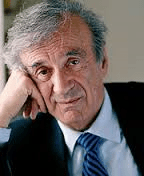
In the two weeks since Wiesel’s death, the world has continued to implode in a myriad of frightening and devastating ways. It feels like we have entered a dangerous, stormy night in a rudderless ship. . . and we have lost our compass. For many of us, Elie Wiesel represented our True North. Bracing myself with each new piece of information about bombings, murders, demonstrations, ugly campaigning and economic threats to stability, I realized that I do have something to say.
I was only 12 years old when my older cousin Beth gave me Night to read on the flight from Florida back to Maine.

When I got off the plane, I collapsed into my parents’ arms sobbing. They thought that I had missed them during my week-long vacation, but I soon explained that the tears were a response to the book I had just completed. I had come to understand in my very soul the horrors of the Holocaust and its implications for me as a Jew. Reading Night was most definitely my awakening to the reality of a world with evil in it and to the precariousness of life as a Jew.
Twenty-four years later, as I sat in a hospital room witnessing my mother’s dying, it was Wiesel’s memoir, All Rivers Run to the Sea that I read. That haunting book of hope and disaster is forever entwined in those lonely frightening days. Wiesel’s book and my mother’s death taught me that life followed by death is a reality we cannot deny.
Wiesel’s lessons thus form bookends for my first awareness of loss when I was a child and my acceptance of loss as an adult. Acceptance does not mean indifference. Acceptance dictates that life must be fully embraced in every moment. Wiesel said, “I had all the reason in the world to be angry at the world, at God and at the Other,” but he refused anger as his response to his life story. He chose education, advocacy and memory.
I am struck by the fact that Orangetown Jewish Center began a campaign to fund a memorial to the Shoah at the entrance of our building in the same week that we lost Wiesel. How beautiful that we are creating a place to congregate, contemplate and educate. Each of us will be able to embrace and draw strength from the fact that none of us stands alone. At the OJC, we are all part of a caring community committed to ending intolerance and injustice. We are committed to remembering for the sake of creating a safer, better world. I know that we will carry on the legacy of this great moral leader.

As long as Elie Wiesel lived in this world, we could count on his opinions, his humble yet powerful statements, his decisive writing, his willingness to scold world leaders if necessary. The world feels like we have entered a dark and stormy night indeed without a True North. But together, we will find our way out of the darkness, out of the Night. By remembering and acting on memory, we will ensure a better world for our children and grandchildren, nieces and nephews, for all the children of tomorrow.
Join me as I dedicate myself to acting in his memory. No one person can replace such a moral giant. But each one of us can do our best to stand up for the values that he held most dear. In this way, we will continue Wiesel’s legacy of repairing the world.
Never forget. Always remember.
Rabbi Paula Mack Drill
49 Days of the Omer; 49 Innocent Victims
When this past Saturday turned into Sunday, it was the first day of the holiday of Shavuot. We had finished counting 49 days since Passover. It was time to receive Torah. Together with about eighty congregants, I was cozy in the synagogue, studying words of Torah in groups of four, eating coffee ice cream with chocolate sprinkles.

When the sun rose on a new day, I was sleeping for a few hours before holiday services began again at 9:00 a.m. I was a bit groggy as I began chanting the blessings of the morning, but I felt happy and fulfilled in one of my favorite holidays, when we would be celebrating the giving of the Torah at Mount Sinai. I was blissfully unaware of the outside world.
When this past Saturday turned into Sunday in Orlando, Florida, a mad man whose soul was poisoned with hatred and a fanatical view of life was holding more than 100 people hostage in a nightclub intended as a gathering place for celebration. While I was studying words of Torah, he was shooting 49 people dead and wounding 53 others. In the morning, the world that was attached to media started reeling from the news of yet another mass murder, another act of terrorism, a horrifying targeting of the LGBTQ community, an attempt to bring down the joy of Pride Month.
As Saturday turned to Sunday, I was discussing the meaning of: “You shall be holy because I the Lord your God am holy.” In my havruta (study group), we thought that if we could possibly agree on a definition of holiness, we would know exactly what God expects of humanity and particularly of Jews. We would have the key to making our world a better place. At 1:30 in the morning on Sunday, it all felt so simple and uplifting. And all the while, a terrorist was shooting people dead.
How can there possibly be any sense in the world? How can God possibly expect us to be holy?
Since Sunday, people I have spoken with want to know how goodness can possibly matter in the face of evil. My stubborn answer is that goodness is the only thing that does matter.
Every act of kindness takes away the power of hatred and cruelty. I refuse to become a nihilist or a pessimist. Being an optimist is not frivolous or naïve or weak. Being an optimist in days like these requires immense courage.
Author Rebecca Solnit says: “Hope is not a lottery ticket you can sit on the sofa and clutch, feeling lucky. It is an axe you break down doors with in an emergency. Hope should shove you out the door, because it is going to take everything you have to steer the world away from endless war, from the annihilation of the earth’s treasures and from the grinding down of the poor and marginal.”
This past Sunday, the Jewish people celebrated Shavuot, the Festival of Revelation. In our all night study at the OJC, Rabbi Scheff taught that creation and revelation lead us toward redemption. Redemption will not fall out of the heavens above. The promise of redemption is in our hands, and it is what keeps us moving forward with optimism and hope, believing against all odds that we can repair the world. Join me please. Act by act, moment by moment, we can bring redemption to a world desperately in need of repair.
Rabbi Paula Mack Drill
Wedding Day on The Border
After a wedding errand in Sederot with Sagi’s mom Racheli, we waited for a long line of trucks to go by before we could turn left onto the highway back to Mefalasim. When I asked her where all the trucks were coming from, she shrugged and said, “from Gaza”. Why? “They are returning from dropping off the day’s humanitarian aid, food and medicine.” Every day? “Sure. We bring them supplies every day.”
Stymied, I tried to wrap my mind around the simple fact of Israel’s taking care of people in Gaza, the neighbors who are still trying to build terrorism tunnels under the kibbutzim where Sagi grew up.
Racheli says that she does not think about missiles or terrorist attacks when it has been relatively quiet for a period of time. She tells me that she blocks it all from her mind. I am just a visitor, and I am the opposite in my response. When I am here in the south, all I can do is think about that long period of time when missiles fell every day on Sederot and the surrounding kibbutzim of Shaar HaNegev. Long before Iron Dome, missiles reached the ground and took away peace of mind and people’s lives. Since the miraculous protection of Iron Dome, still no one here lives with a complete sense of security.
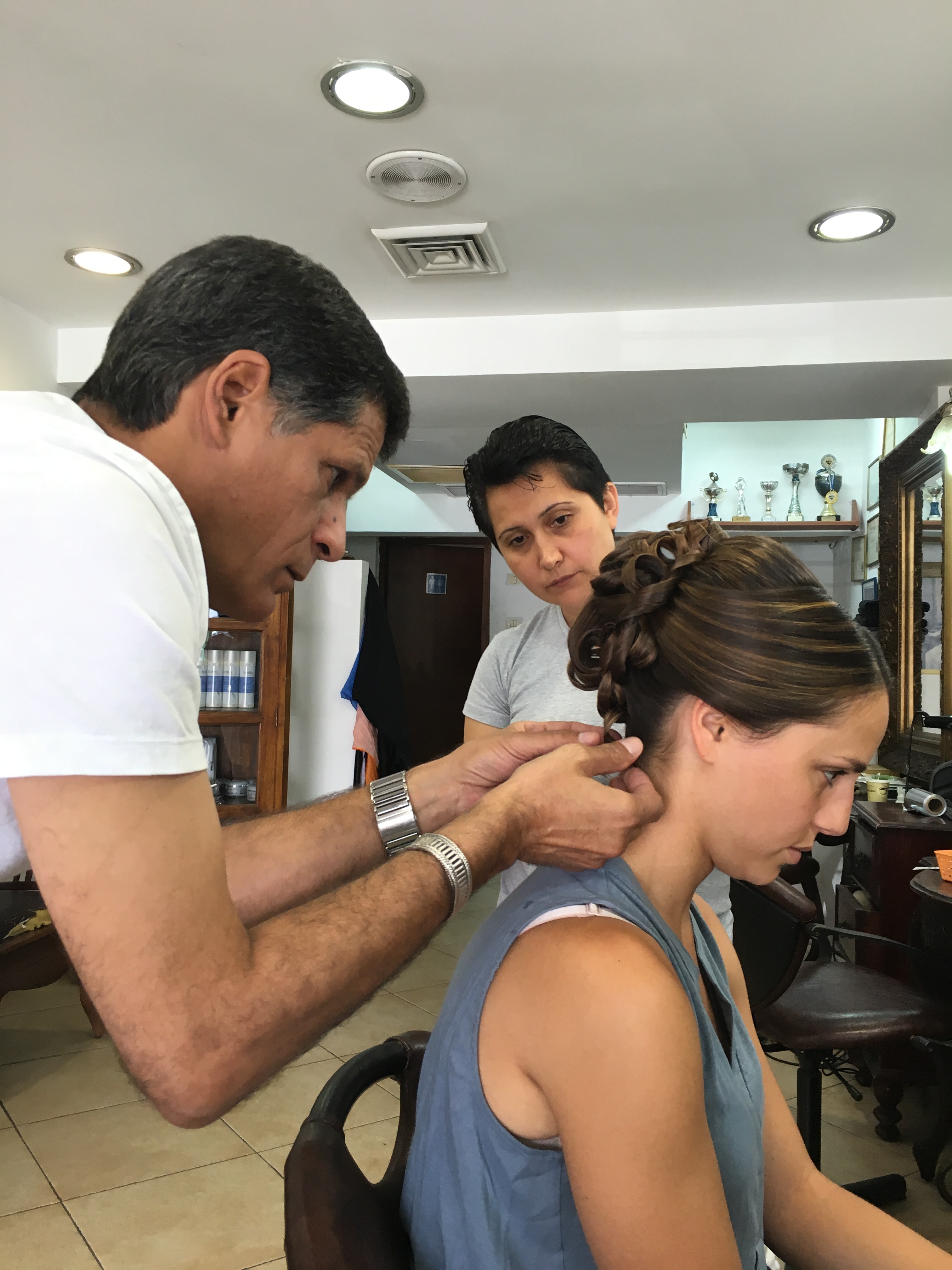
I think about it all the time. I look at the waitress at the restaurant in Sederot and imagine her as a young girl, running for shelter with 15 seconds notice. I sit with Sarah as she has her hair done for the wedding later today and wonder how Shupan kept his business running through those years.

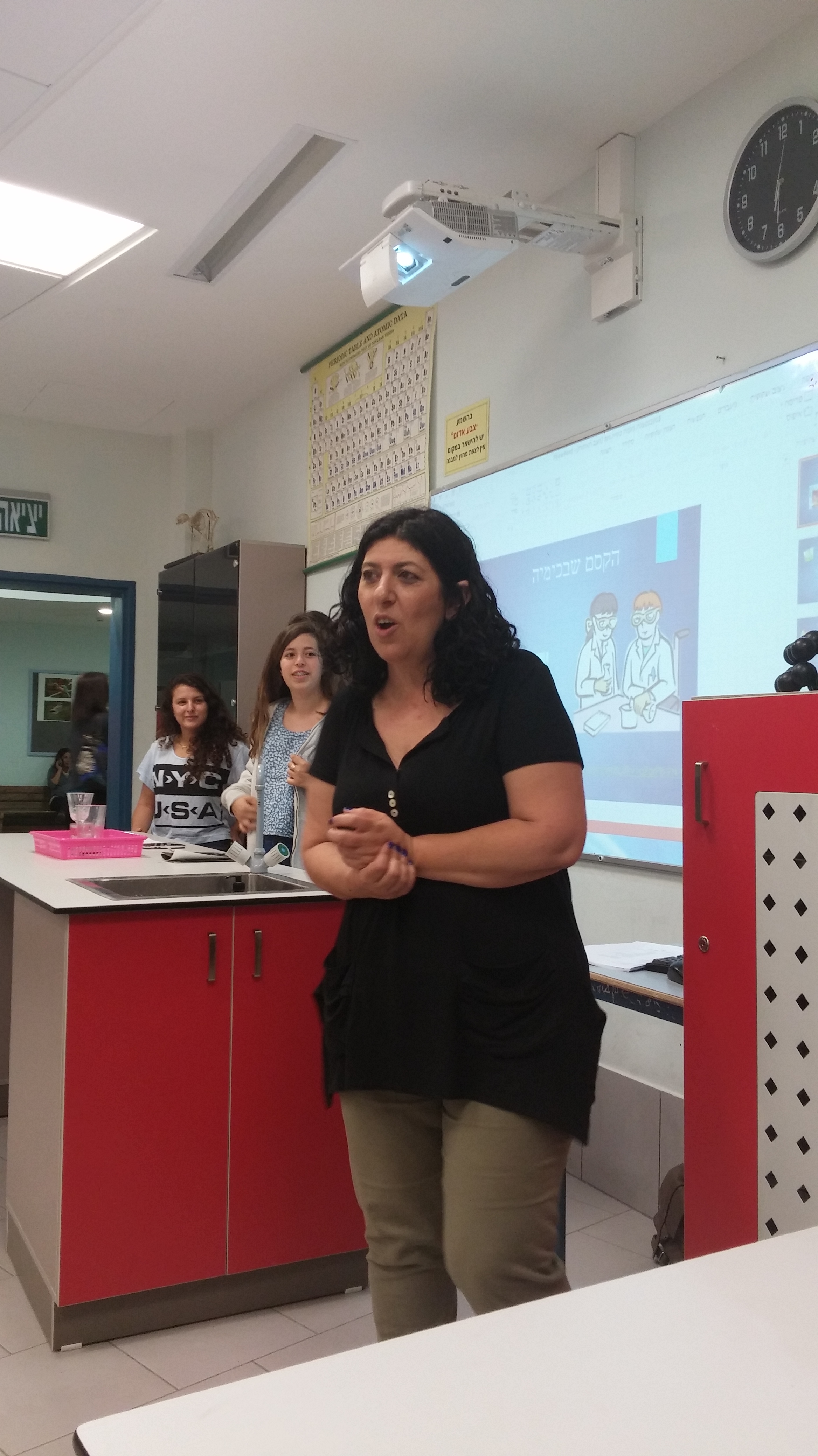
I sit in Racheli’s classroom at Shaar HaNegev High School as she presents an experiment to her chemistry students and notice the sign just next to the whiteboard. It is a sign we would never see in America: in case of tzeva adom, a red alert, do not leave the building. I observe Racheli’s students and acknowledge to myself that they have never lived in a world without threat from their neighbors.

At the entrance of Kibbutz Nir Am, on the way into the guest cottage, I pause to think about the very beginning of Protective Edge… and of two Israeli soldiers who were killed here. On my morning run, I cannot avoid looking at the barbed wire surrounding the entire kibbutz.

But then, I see a sign. I mean that I see a sign and also that I see a sign! It says: Beware! Narrow Bridge.
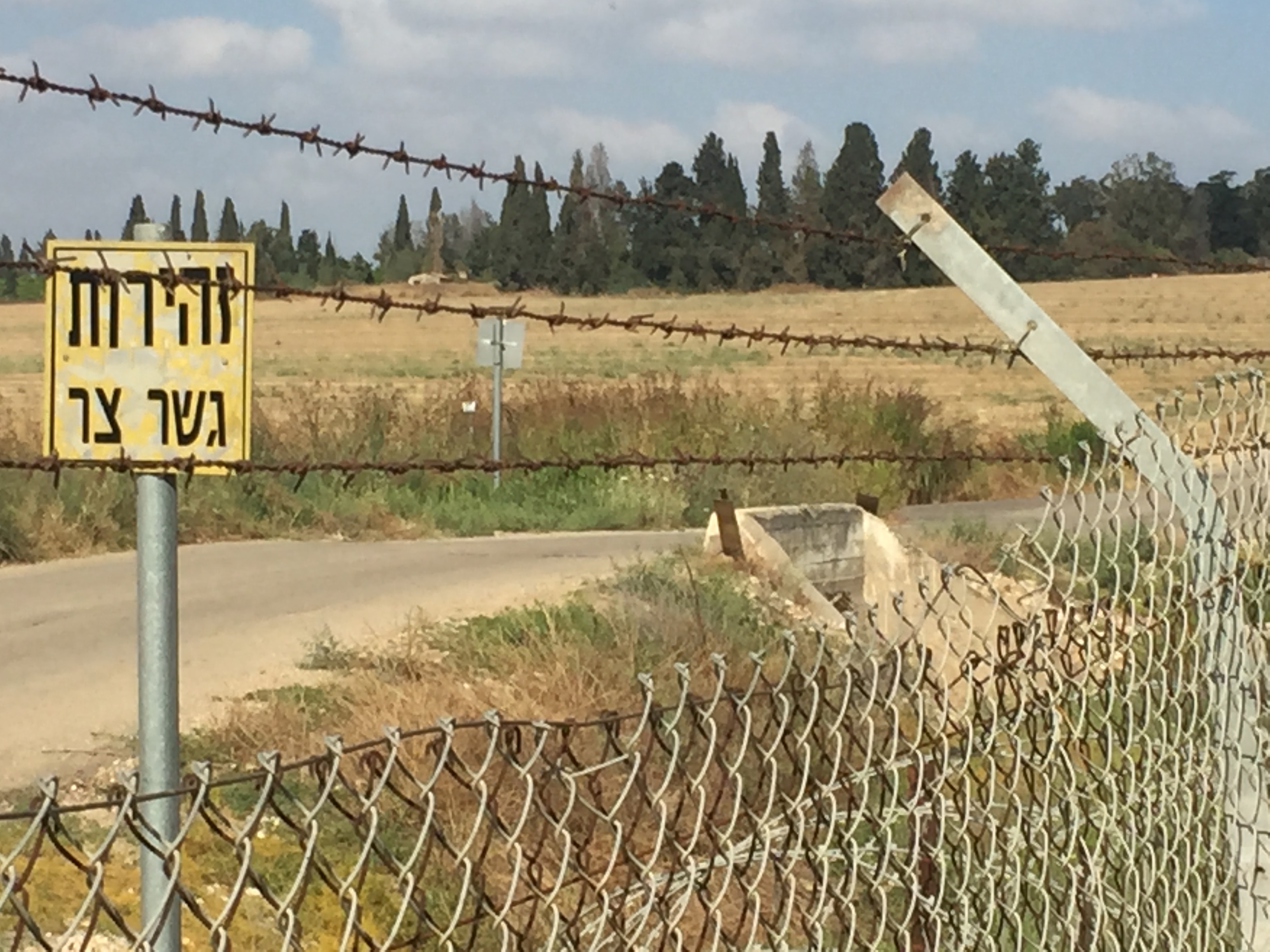
And I complete the significance for myself: all of the world is just a narrow bridge, and the most important thing is not to be afraid.
Praying every day for peace for Israel, Rabbi Paula Mack Drill
Shabbat Here and There and Now and Later
One of my favorite Talmudic teachings asks what one should do if she is lost in the desert and does not know what day it is. How can she know when it is Shabbat? The rabbis answer that she should count six days from the time she remembers and the seventh day will be Shabbat. [Talmud Bavli Shabbat 69b] I love this response because it reminds me that Shabbat is not just a day on a calendar but a sacred time we can enter once a week… and a time that enters us. When Tradition tells us that we receive neshama yeteira (an additional soul) every Shabbat, I think it is talking about this mystical, tangible quality time takes on when it becomes holy.
I was thinking about this Talmudic source as we entered into Shabbat here in Tel Aviv. When I am away from Orangetown Jewish Center for Shabbat, I picture myself sitting in the sanctuary before our stained glass windows and colorful ark curtain as the room fills up with people I love. But of course, I also enter into Shabbat where I am.

Wherever I go and whatever is happening around me, Shabbat enters me and I enter Shabbat… even in Tel Aviv, the City that Never Sleeps. (Ask any Israeli and they will tell you that New York comes in second to Tel Aviv.) On Friday afternoon, as we made our last minute purchases of challah and fruit in the shuk (market) and I dashed back to Sarah and Sagi’s apartment to check on the chicken soup,


young people in Tel Aviv were settling into pubs and cafes for the beginning of their weekend.

We ate Shabbat dinner on the roof of Sarah and Sagi’s apartment and Ben’s voice reciting motzi mixed with the sounds of a band playing at a bar just outside the Kerem haTemanim neighborhood. In the quiet peace of our Shabbat, I blessed my children and we ate our meal.
On Shabbat morning, we walked to a Masorti synagogue, Kehillat Sinai, where we were warmly greeted and where I was asked to help out as a gabbai. The chanting was different, the faces were new, but the atmosphere was friendly and open. It reminded me of the OJC in its lively community feel.
We spent Shabbat afternoon on the Tel Aviv beach, admittedly one cannot do that in Orangeburg! But while I was here in Israel for Shabbat, I was also in New York for Shabbat, and this is where the teaching from Shabbat 69b comes in handy. When I entered Shabbat, my community was in the midst of busy Friday afternoons back home. When I was hearing the Torah reading of Behar, everyone in New York was sound asleep. When I was relaxing on the beach, the congregation was hearing our intern Paula Rose give her sermon. And when Shabbat went out and I counted the twenty-ninth day of the Omer, my friends at the OJC were beginning their Shabbat naps! How could I be two places at once?
Shabbat enters me and I enter Shabbat. It’s not just time on the clock or a day on the calendar. Shabbat is far more than that. Shabbat is a place I go once a week to replenish my soul. Whether here or there, whether surrounded by people keeping Shabbat or having Saturday morning eggs at a café on Dizengoff, it’s all Shabbat. What more do I need?
See you all next Shabbat at the OJC! Blessings from Israel,
Rabbi Paula Mack Drill
Thoughts on Joy: Moadim l’Simcha
The first two holy days of Passover came to an end last night and with the holy days, so went my children. As we made Havdalah, Josh left for the airport to return to Israel and his IDF unit. Noah returned to Maryland, Ben to college finals, and soon Sarah and Sagi will return to Israel as well. Moadim l’simcha, we say, may these middle days of Passover be filled with joy. Forgive me if my joy feels a bit diminished.
And I really mean: Forgive me. I have so many reasons to be filled with an abundance of joy. Like Elijah’s cup at the seder, the joy should be flowing over the top of the cup.
All four of my children became “all five of my children” this year as we added Sagi, a son by marriage to our ranks. On the Sunday before Passover, our daughter Sarah and Sagi stood under the chuppah with Rabbi Craig Scheff officiating. For anyone who might have been second guessing attendance at a simcha on the last really great cleaning/preparation day before Pesach, Rabbi Scheff told us that celebrating the wedding was exactly the kind of Passover preparation we should be doing. The ruach of the wedding was an experience of simcha that no one in our families will ever forget, pouring joy into my cup.

My own preparations for Pesach were put into perspective with absolute clarity. I could not have angst and agita because there was simply no time. On Monday we were serving bagels to thirty out of town guests. On Friday, we were sitting down to our family seder. The lived-understanding that my best was good enough and that the seder is meant to be completely a time of rejoicing freed me from years of self-imposed rigor.

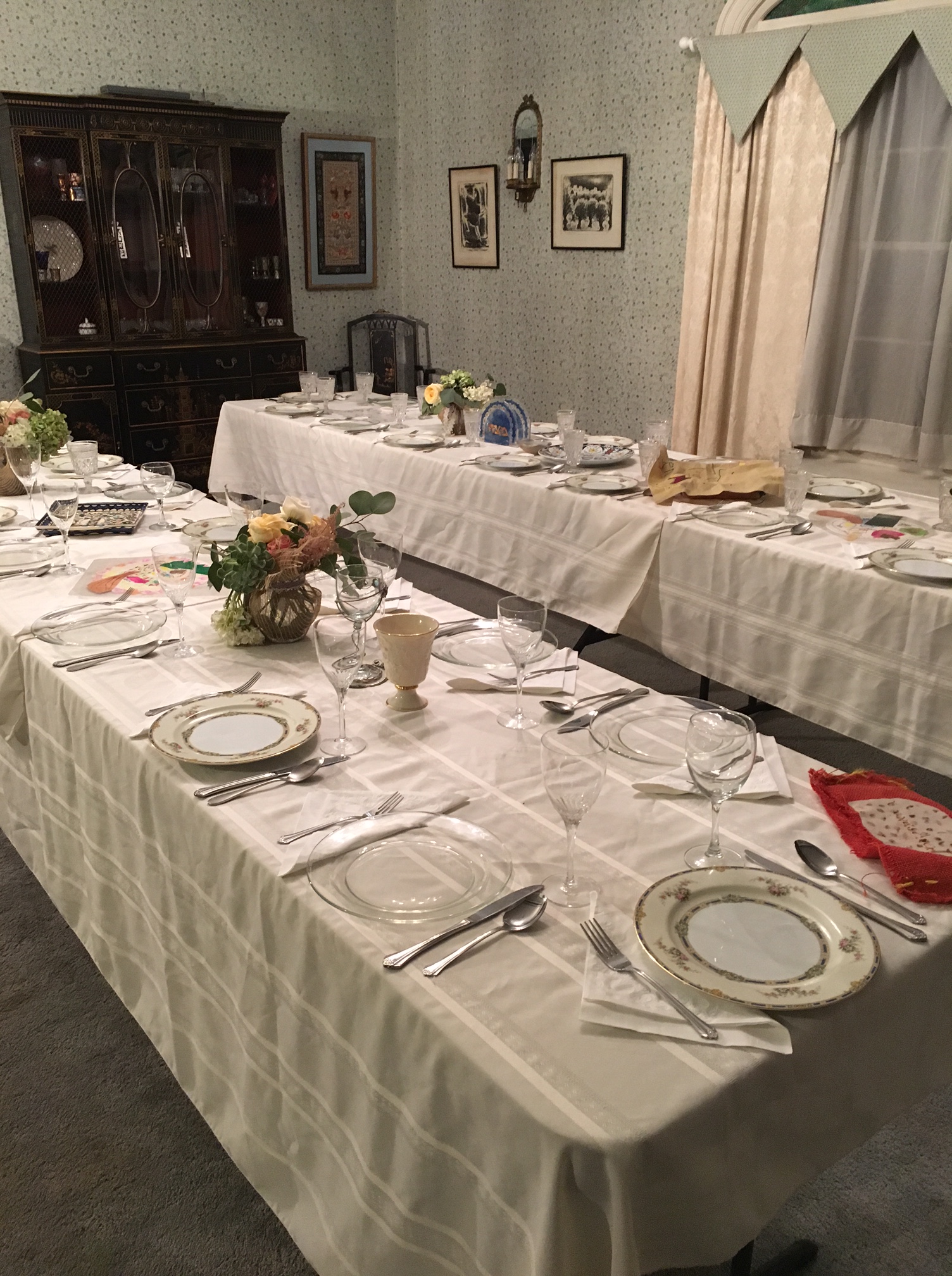
I have taught for years that we don’t need to be tortured in our Passover preparations. This year I walked my talk. The sense of freedom of the seder was another level of simcha poured into my cup.
It was a blessing to celebrate the first two days of Passover with such an abundance of old and new family, a blessing that I don’t take for granted.
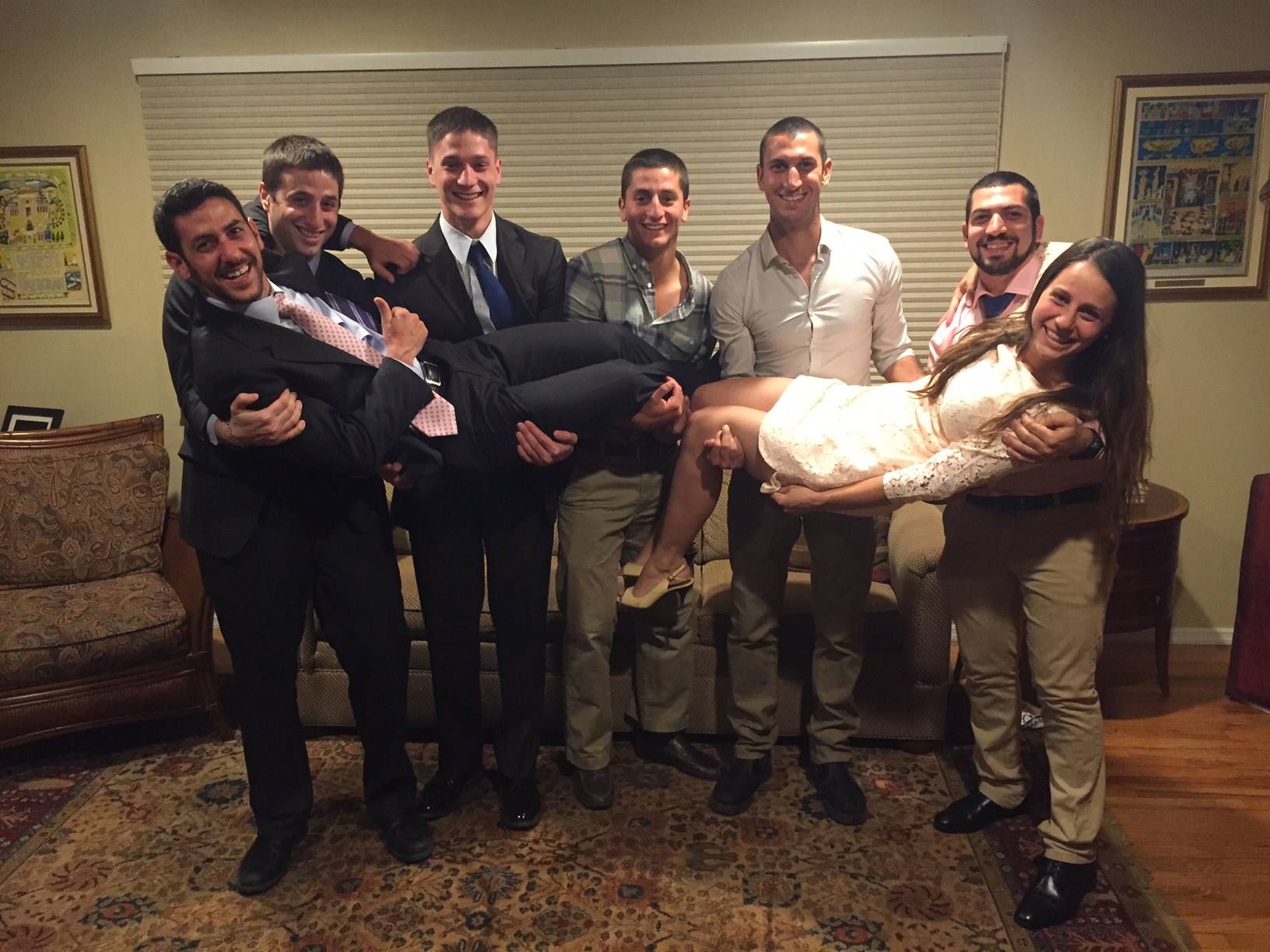
Two wonderful seders, sunny days, lunches of matza lasagna with friends, long walks with my new machatenasta (Yiddish for mother of my son-in-law) enhanced the beauty of the chag. The sense of quiet contentment is another kind of simcha to add to my cup.
Still, as the holy day ended last night and the middle days of Pesach began, I felt the diminishment of my joy as one by one, the Drill children and members of the Fainshtain family started peeling away, leaving us with great memories and (forgive me) matzah crumbs. But here is where Jewish ritual came to the rescue, reminding me that given a choice between feelings of loss and feelings of gratitude, I can choose gratitude.
Last night we counted the second day of the Omer. As we continue on the calendar arc from Passover to Shavuot, from redemption to revelation, we count up, not down. Each day toward the holiday of Shavuot reminds us that we choose to make every day one of meaning, to make every day count. I can let go of the lessons learned about simcha or I can hold fast to joy by being grateful. Forgive me If I choose joy!
Moadim l’simcha! Rabbi Paula Mack Drill
Choosing Not to Listen
18,000 of us converged on Washington for three days: Jews of every stream, nationality and political persuasion; Jews who are high school kids, college students, Holocaust survivors, rabbis. Also gathering were delegates who are Hispanic, people of color, Evangelical Christians, main line Christians, politicians. We came to AIPAC’s Policy Conference because all of us are supporters of the Israel–America alliance.

Imagine it: 18,000 filling the hallways and meeting rooms of the Washington Convention Center. 18,000 dramatically filling the arena of the Verizon Center to hear Vice President Biden, Israel’s Prime Minister Bibi Netanyahu, and most of the candidates currently running for president.
The person sitting next to me in a session about the refugee crisis in the Middle East may not have agreed with me about most things, but we are both similarly committed to Israel’s right to exist as a free, secure, Democratic nation. The people on either side of me during the campaign speeches may be voting differently than me, but we all agree on the necessity of friendship between Israel and America. The rabbis at my table listening to Natan Sharansky speak about the rise of anti-Semitism and the insidiousness of BDS may have different politics from mine, but we all agree that Israel is as necessary to American security as America is to Israel’s.
As always at AIPAC events, I listened to thinkers and politicians from the left and the right. Stav Shafir, Member of Knesset and one of the founders of the Israeli social justice protest (Mechaat Tzedek Hevrati), shared her idealistic vision for a progressive and optimistic future for Israel.

Author of My Promised Land, Ari Shavit criticized the current government in Israel, saying that Religious Zionists are endangering our home and Ultra-Orthodox Jews are endangering our religion. From the other side of ideology, Pulitzer Prize winner Bret Stephens shared his vision of security for Israel. Writer for The Atlantic, Jeffrey Goldberg, discussed his critique of the Obama administration’s Middle East policy.
The voices were a cacophony of harmonious disagreement. For me, this fact is the power of AIPAC.
As delegates, we listen respectfully to learn about a variety of perspectives and make up our own minds. Learning from the diversity of thought at AIPAC has enhanced my understanding of one of the most complicated situations in our world today. Over time, I have definitely changed my mind about certain things. But never have I wavered from the belief that when Israel and America are strong, the world is more stable.
This year for the first time in nine AIPAC Policy Conferences, I chose NOT to listen to one of AIPAC’s guests. I did not stage a protest or a walkout. Together with Rabbi Scheff, our intern Paula Rose, and fifty other rabbis, I chose to study Torah rather than to be in the arena when Donald Trump spoke. We gathered in a restaurant inside the center to hear words of Torah and sing Olam Chesed Yibaneh, (with loving kindness the world is built).

I do not judge the choices that others made with regard to Mr. Trump’s speech. Some walked out but did not gather with others, other delegates stayed in to listen to his words. Some maintained silence and others clapped politely. Some clapped enthusiastically. I acted according to my own conscience and not in anyone else’s name. I acted, but not in order to judge others.
I understood from the outset that AIPAC’s mission requires all presidential candidates to be invited and I support the invitation to Mr. Trump among all of the presidential candidates. But I could not in good conscience listen to a person whose rhetoric has been anchored in racism, Islamophobia, xenophobia, misogyny and calls to violence. Judaism’s most fundamental value teaches us that all people are worthy of respect because we are created in God’s image. As a rabbi and as a Jew, I felt a moral obligation NOT to listen, to refrain from lending legitimacy to a candidate for the highest office in America who engages in hateful speech.
Over my 10 years of participation in AIPAC, I have been taught to welcome all speakers with dignity and respect. No one boos or heckles a guest of AIPAC. We clap if we agree and we are quiet if we disagree. I have listened to policy with which I agreed and sharply disagreed. I have always listened. At Policy Conference 2016 I chose not to listen.
In so doing, I pray that my fellow rabbis and I made space for words of loving kindness.
I pray that words of loving kindness will disarm words of recrimination and anger flying on social media regarding AIPAC, Donald Trump, Israel’s supporters and her detractors as well.
Today is a fast day, Ta’anit Esther, commemorating Queen Esther’s request of the Persian Jewish community to join in solidarity with her as she faced the challenge of her lifetime. I dedicate my fast to similar solidarity of the Jewish community. Too much is at stake for us to stand apart in judgment of each other.
Rabbi Paula Mack Drill
Reflecting on a Month of Awareness and Inclusion
As February draws to a close, it is time to look back to consider the Orangetown Jewish Center’s commemoration of Jewish Disabilities Awareness and Inclusion Month #JDAIM.
By the end of the month, we will have posted seven spotlights of congregants who have eloquently reflected on lives impacted by disabilities. Rabbi Scheff and I have blogged, taught and reflected in our classes on Jewish values with respect to people who have disabilities. Tonight, congregants will join with our Education Director, Sandy Borowsky, to view and discuss the important film “How Hard Can This Be.”
This coming Shabbat, February 26 and 27 will be dedicated to Disability Awareness as fellow congregant Scott Salmon speaks on Friday evening at 7:00 services. His topic is “Ask Me: the Challenges of Inclusion.” On Shabbat morning, Rabbi Scheff’s sermon will be dedicated to the topic of awareness and inclusion. After kiddush, I will be facilitating a text study tracing Jewish attitudes toward people who are Deaf or hearing impaired from the Torah through Rabbinic texts, leading up to the 2011 watershed Responsa of the Committee on Jewish Law and Standards which grants full obligation and rights to Deaf people and which affirms that ASL is a language by which people can fulfill mitzvot.
At the OJC, we have much of which we can be proud. The month of February and #JDAIM, however, will only prove its lasting value if we reflect carefully on what we have learned and continue to strive toward being an ever more inclusive community.
I offer here the lessons that I have learned and look forward to your adding more to my list:
1. “Persons with a Disability” is not a useful catch-all phrase. People are first and foremost people. To paraphrase a powerful idea of the autism advocacy movement, if you know one person who has a disability . . . you know one person who has a disability. We cannot unilaterally provide services “to the disabled” as there is simply no such thing.
2. Along the spectrum of people and their families whose lives are affected by disability, there are those at one end who never identify themselves or their loved ones according to disability. They go about their lives without regard to hearing loss or the inability to walk. At the other end of the spectrum are those whose identity or whose family is subsumed by the insurmountable challenges of disability. I often think of one congregant who said to me, “We can never see a flier of an OJC activity and make plans to go and enjoy. We always must ask ourselves first, ‘What about our child? Will she be able to handle the program? And our answer is usually no. So then we ask ourselves which one of the parents will stay home.'”
3. We owe gratitude to the congregants who opened up their lives to us through their beautiful words in our spotlights. Sharing vulnerability requires courage and strength. (If you would like to write next year, let Rabbi Scheff or me know. If you do not receive emails from the OJC, you can find all of the spotlights on our Facebook page, Orangetown Jewish Center.)
4. Creating circles of inclusion is hard work. It requires the very best of ourselves. It requires us to take risks and step out of our own circles of comfort. But one thing is certain after a month of awareness: We have created a community of safety and thoughtfulness where anything is possible!
Here’s to making February all year long! B’yedidut,
Rabbi Paula Mack Drill
Jewish Disability Awareness and Inclusion Month SH’MA

When we teach the Sh’ma to children at the OJC, we often use sign language to provide an important pathway into the meaning of “Hear O Israel, Adonai is our God, Adonai is One.” The sign for “hear” is not used; rather, we teach “pay attention.” Hands on either side of our face draw out, focusing our attention on what is important.
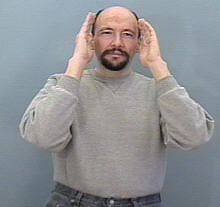
As we enter the month of February, we will honor Jewish Disability Awareness and Inclusion Month with postings and congregant highlights to remind all of us to pay attention. If God is truly One, then we are all connected. A holy community like ours is not complete if we do not ensure the inclusion of all of God’s children, all created in God’s own image.
We invite you to join with us as we pay attention. May the month of February remind us to be aware and inclusive throughout the entire year!
Rabbi Drill and Rabbi Scheff
Deep Listening
Join me now to consider four possible levels of conversation: Conform, Confront, Connect, and Co-Create as taught by Dr. Otto Scharmer, Senior Lecturer at MIT and co-founder of the Presencing Institute. https://www.presencing.com/
This past week, I spent two days continuing my work of visioning a new identity for the Rabbinical Assembly, the professional organization of Conservative Rabbis worldwide. We were challenged by Liz Alperin Solms and Marie McCormick, our change project facilitators, www.insytepartners.com, to understand and experience deep levels of productive conversation.


Our work over the past year has been anchored in a passion to re-envision a new path for the RA, ensuring a vital and vibrant future for Conservative Judaism.
Over the past year, I have been part of this exciting Vision Team of fifty rabbis representing a variety of years of experience and professional paths.


Throughout the work, I have been sensitive to the fact that the change work we are doing for the RA is translatable to our OJC community. I share with you now the ideas of deep conversations so that we can apply them to our synagogue life.
At the first level of conversation, Conforming, we talk “nice,” speaking to try and provide what the other person wants to hear. We use polite routines and empty phrases to conform to expectation. “Yes, of course, what you care about is important to me.” “No, of course, I don’t think that you are being difficult – I am glad to hear your thoughts.” “Sure, that’s just fine with me.”
Next, Confronting. We talk tough. We speak from an unshakable position of our own beliefs and understandings. Because we are our point of view, we become defensive. In these conversations, I am right and therefore you are not.
At the third level, Connecting, our conversations are reflective inquiries. Now I speak from a place where I see myself as part of the whole. I might still think differently from you, but now I want to know why. Rather than defend my position, I want to connect with you and come to understand your viewpoint. “I may not agree but I hope that you will tell me more about that.” “I have never thought about the issue in that way before.”
Finally, Co-Create is the fourth level. At this deep level of experience, conversation is a generative flow. I understand my place as being part of a collective, I practice stillness and experience the flow. This final level of conversation leads to collective creativity. In co-creating conversations, we might feel that something extraordinary has entered the space.
When I learned about collective creativity, I suddenly saw that our Rabbis of Tradition understood generative flow. Talmud teaches that when two people sit together to study Torah, the Shekhina, the nurturing aspect of God, rests upon their shoulders. The students of Torah lose their sense of separateness in the connection through Torah.
Our project facilitators explained that most conversations in our lives happen at one of the first two levels, and indeed, both are necessary to live successfully in the world. Sometimes we have to just be polite. Sometimes we just have to say what we really think and stand by it.
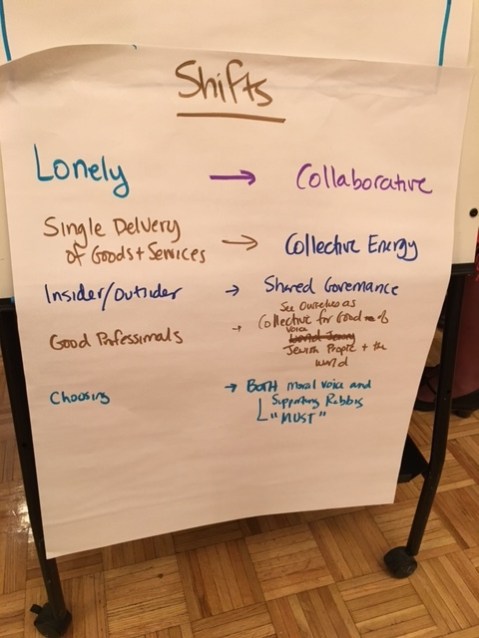
But if we want something to change and grow, we must dig deeper in our conversations. If we want our synagogue to prosper and thrive in adaptive and exciting ways, we must practice conversations at the third or even fourth level.
Scharmer’s theory about conversations for change feels very Jewish to me. To succeed as a community, we must let go of the inclination to begin every conversation from our own point of view. For success, we must say: I am part of something bigger than myself: this synagogue, this history, this particular people, this covenant with God. To fully participate in such a collective endeavor, I must listen carefully for clues about what you think and remain open to the possibility that my thinking is not enough. Together, we are stronger, wiser and more creative.
I look forward to continuing the conversation,
Rabbi Paula Mack Drill
 Three Rabbis Walk Into A Shul
Recent Comments