Yet More Thoughts on Covid-19: It’s Difficult to Think of Much Else These Days
My youngest son Josh flew back to Israel this afternoon after three months in the United States following completion of his army service.

As soon as he lands, he will go straight to his apartment where he will begin 14 days of quarantine. His roommates will leave food for him outside his bedroom door and whenever he emerges, he will need to wipe down every surface he touches. Josh has a great attitude about the quarantine, explaining that he has a lot to read and will have plenty of time to prepare for his entrance exams for Tel Aviv University. The quarantine is inconvenient and worrisome, but it is required by Israeli law and certainly not devastating for Josh.
My in-laws are 87 and 92 years old. Earlier tonight, I brought dinner over as is our Wednesday night custom. We sheepishly bumped elbows and it felt very strange not to embrace them. They told me that they had sold their tickets to see the Philadelphia Philharmonic this Sunday, and my mother-in-law regrets missing her favorite conductor. It is isolating and worrisome to be an elder through this time of Covid-19 precautions, but the precautions are necessary and not devastating for them.
My niece and her roommate moved into my guestroom tonight since their college announced its closure just three days after they had returned from spring break. They brought most of their stuff here with them, not sure if their college will reopen this year. Online courses are beginning for them next week, but they wonder how much learning they’ll accomplish. College and university closures are extraordinary and difficult for everyone involved, but they are prudent and not devastating for my niece or her roommate.

Throughout this roller coaster of a growing national medical emergency, I have tried to maintain balance and perspective for myself and on behalf of the OJC community. I am proud of our president, Michael Pucci, and our professional staff, who have made very difficult decisions in a reasonable, calm, and careful manner. If we err, we err on the side of safety. The decisions that we make impact every age and stage of our congregation.
WNBC Coverage of OJC Livestreaming Purim
It was disappointing to cancel festivities for Purim – a carnival for children, a dance party for which our in-house band rehearsed for months, an adult night club, and a grand seudah on Purim day. Volunteer committees had worked for months to plan all of these joyful programs, and everything except for the Megillah readings was canceled. Disappointing, yes. Devastating? No.

But let’s consider together what truly is devastating about the Coronavirus pandemic.
People are becoming very ill with this terrible flu, especially elderly people and those with compromised immune systems. We pray for speedy recoveries.
People who live on the edge financially will be pushed over that edge by weeks of quarantine or illness. Those who are paid daily wages, who punch a clock, who do not have adequate sick leave, will struggle mightily to recover long after the flu is gone.
People with inadequate medical insurance will struggle to pay for prescriptions and doctors’ bills. People who are undocumented will hesitate to go to hospitals or doctors.
Many of the children whose schools are closing will miss their free breakfasts and lunches, dependable nutrition for 2/3 of their daily meals. Many parents will have a difficult time replacing those meals for their children. Many parents will be left figuring out how to go to work without childcare now that schools are closed.

Elderly people, adults with developmental disabilities or mental health issues, the youth who attend the twice weekly drop-in program at the Rockland Pride Center, family members who attend support groups, all will be impacted by the closure of community centers and other gathering places.
It is always true in our society that those who are most vulnerable suffer first and suffer the greatest amount when difficult times hit. I pray that we keep all of these people in mind and take action if we are able to help.
Reach out with phone calls to the elders of our community who are experiencing social distancing now. Many are staying at home as advised. Others live in nursing homes and assisted care residences where visiting is currently discouraged. Be sure they know that you are thinking of them.
Write an extra check to Meals on Wheels. Drop off more food than usual for People to People or Rhoda Bloom Kosher Food Pantry, great Rockland organizations that help those in need make ends meet.
Write a supportive note to friends who are at high risk from Covid-19 because of their professional work – hospital emergency room workers, EMTs, nurse aides in facilities for the elderly, doctors and nurses.
At the very time when we need to be close to one another, we are counseled toward a necessary “social distancing.” When the world feels unpredictable, we yearn to be in community, yet we are canceling gathering after gathering. We are used to planning ahead, but we cannot prepare because we do not know what will happen next.
But for the most part, most of us are among the privileged few. If we are quarantined, our community and friends will ensure that we have food to eat. If we need to miss work, we will not risk losing our jobs. If our children’s schools close, they will have plenty to eat for breakfast and lunch. If we grumble about doctors’ bills, we can eventually pay them without going under. And if these things are not all true for you and your family, but you are a part of the OJC, you belong to a supportive, sacred community that will help. You are not alone.
Maintaining an attitude of gratitude will help us get through these confusing and difficult times.
Kol Yisrael arevim zeh bazeh – All of Israel is responsible one for the other. When we say bazeh (in each other) instead of lazeh (to each other), we add a deeper truth to this foundational rabbinic teaching. Not only are we responsible, we are intertwined.
With friendship, Rabbi Paula Mack Drill
Unite the Fight (against Hate)


Earlier this evening, more than two hundred people gathered at the Allison-Parris County Office Building in New City to speak out against the rise in hateful action and rhetoric. After the terror of Neo-Nazi white supremacists spewing anti-Semitic, racist and xenophobic speech in Charlottesville, VA, Rockland Pride Center joined forces with the Jewish and African American communities to stand up for acceptance and understanding. You can read more on Facebook and watch a video of the rally at Unite the Fight, #UnitethefightRockland.


I share with you here, in part, my words in the hope that it will motivate all of us to take action in some large or small way, every day.
When I was a kid of twelve or thirteen, some of my friends got into a big fight, choosing up sides and being mean to each other. I remember growing so tired of the whole situation and complaining to my dad, “I just don’t want to deal with it anymore!”
My dad answered, “Tough. You have to deal with it… because they are your friends and they matter.”
I’ve gotten a little bit older since then, and my circle of concern has gotten a bit broader. Today, not just my friends and family matter. All people, because we are all created in God’s image, matter. But some days, I really want to say, “I just don’t want to deal with it anymore!”
That’s when I hear my dad’s voice reminding me: You have to deal with it, because people matter.
We have gathered on an auspicious day, the first day of the new month of Elul, when Jewish people look forward to the New Year and attempt to return to our best selves in a process called teshuva, repentance. We cannot do it all at once. But each of us can effect change one degree at a time.
This hopeful thought can allow us to say, “If we are able to change ourselves by one degree, then all of us together can change the direction of our country with that same one degree of change.
Consider the fact that we all showed up here in New City today. Instead of turning on our neighbors, instead of finding differences, we are committed to identifying all that brings us together.
We have gathered for freedom, democracy, and our trust in justice. This week in the Torah portion we read: צדק צדק תרדוף
Justice, justice you shall pursue. The way that we pursue justice now is by rallying together and uniting the fight.
When Brooke Malloy, Executive Director of the Rockland Pride Center, asked me to speak tonight, she suggested that I share how the Jewish community is feeling now after the events of Charlottesville a week and a half ago. I can’t speak for the Jewish community as a whole, but I can tell you how I am feeling. My response is encapsulated in the story of the president of the Charlottesville synagogue who stood on the front porch with two hired guards while white supremacists and neo-Nazis walked by shouting, “There’s the synagogue. Let’s burn it down!” and “Jews will not replace us!” As a congregational rabbi, nothing steals my breath as much as the fact that fifty people inside, finishing their Shabbat morning prayers, were told to sneak out the back door of their synagogue for their safety. In the United States of America.
As I thought about what Brooke asked me to do here, however, I realized that sharing my story is only the beginning. My work against hate must continue by asking questions instead of telling. What does this violence and hatred mean to you as a gay person? As an African-American? an Hispanic or Asian or a person who came from Haiti or Dominican Republic?
Our task is to prove that love truly is stronger than hatred despite the evidence of the past weeks. Love arises from knowing the other. Rabbi Jonathan Sacks has written: “The test of faith is whether I can make space for difference. Can I recognize God’s image in someone who is not in my image, whose language, faith, ideal, are different from mine? If I cannot, then I have made God in my image instead of allowing God to remake me in His.”
Let me return to the idea of one degree of change. As Rabbi Scheff taught in his sermon this past Shabbat, we could create change if all of us dedicate ourselves to get to know one new person every day, a person we do not know, a person who might look different from us. Try looking someone in the eyes who is in your office or in your class or at the store where you shop… someone you have never spoken with before. Say hello. Tell them who you are. Ask them who they are. And let us change the world together one degree at a time.
Because love is stronger than hate.
With prayers for peace, Rabbi Paula Mack Drill 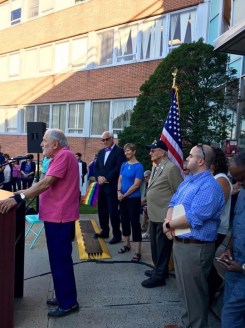
 Three Rabbis Walk Into A Shul
Recent Comments