Making a Minyan because of Kindness
My teacher, former Chancellor of the Jewish Theological Seminary, Dr. Ismar Schorsch, likes to say that the requirement of a minyan is the secret of Jewish survival throughout the centuries of dispersion.
Every week in News You Need to Know, we remind you to fulfill your obligation to attend a morning or evening minyan.

Every OJC member is assigned a number which represents the day of the month that one is required to attend the minyan at the synagogue.
With regard to a prayer quorum, we singularly use the language of obligation and responsibility. On the one hand, these words are appropriate. Gathering ten to say prayers that praise God’s name publicly is a mitzvah, a commandment of Judaism. On the other hand, perhaps we should instead employ the language of loving kindness. Gathering for a minyan provides a setting for chesed (loving kindness). How so? One of the most painful elements of modern life is a sense of isolation and loneliness which it can foster. A minyan just might be an antidote. I formulated this idea over the past week as I davened with different kinds of OJC minyanim.
Last Tuesday morning, ten of us gathered at Esplanade on the Palisades to make a minyan for Estelle Sollish, our much loved congregant who recently moved there. Bringing the minyan to her was a sign of devotion and our desire to ease her transition to a new living situation.


On Thursday morning as we stood at the Torah, one of the people of the minyan added the name of a loved one during the prayer for healing. The tears in his eyes bespoke a concern and worry that he was not yet able to articulate. But the minyan allowed him a safe space to be vulnerable.
On Saturday afternoon I chanted the words of the memorial prayer on behalf of a congregant’s mother whose twentieth yahrzeit falls this week. As I prayed that her mother’s neshama would have an aliyah, I saw that the gathering of fellow congregants gave her permission to express her grief even after all these years.
Last night there was a minyan at a shivah house. As the family gathered close for comfort, the arrival of fellow congregants brought the sure sense that they were not alone.
Admitting what we need, asking for help, showing our vulnerability — can lead us out of isolation and into community. A twenty-minute prayer service can accomplish all that. Mark Nepo has written: “As water fills a hole and as light fills the dark, kindness wraps around what is soft, if what is soft can be seen.” It is indeed the obligation of a community to create minyanim so that people can pray together. I have no doubt that Dr. Schorsh is correct in his estimation that the minyan has kept the Jewish people together. But perhaps the most important reason for a minyan is that gathering together allows others to be vulnerable, to know one another, to seek a path away from loneliness. Gathering to be one of ten allows us to be our very best selves through this act of loving kindness.
A prayer in the wake of disaster
Tonight, however, this open heart is a curse. Because I feel the suffering of my sisters and brothers. And I absorb the taunts of those who wish my children harm. And I shudder at the sounds of laughter and rejoicing over spilled blood. And I don’t see in the face of my neighbor another who is content with being my neighbor. And the voices of reason that provided me with hope just hours ago have been drowned out by the crowd applauding the gun shots in the theater of the absurd.
So in this moment I find myself closing my open heart to protect myself from the pain of all that suffering. And as the heart closes, I feel it hardening in anger and despair.
Please, God, slow my racing heart and grant me a few hours’ rest. And in my sleep, soften my heart again. Because I need to love. And I can’t truly love–even my own children–so long as this hardened heart beats within me. And once I can feel again, let the blessing-curse of my empathy move me to heal the sick, to comfort the mourner, and to set out rebuilding a shattered world.
In the words of Jeremiah from this past week’s haftarah, “Heal me, Adonai, and I will be healed; save me and I will be saved.” Give me reason to praise You.

You are invited to not pray!

That’s right, you read the title correctly. I am inviting you to not pray. Come to synagogue tomorrow morning, sit for an hour, or two, or three, and don’t pray. I am allowed to say that because, frankly, I have no idea what the English words “to pray” mean. The meaning of the words, I believe, will necessarily change depending on what is our definition of God. Implicit in the word “prayer” is some recognition that we are engaging in an effort to connect to something beyond ourselves, whether that something is above us, beyond us or within us. Are we asking for something, actually expecting a response? Are we seeking the granting of a wish? Are we hoping to gain a perspective that puts our lives into a context of something greater, thereby either maximizing or minimizing our significance, our achievements, or even our wrongdoings? Prayer is not necessarily an act of petition, supplication or thanksgiving. It may be all these things, it may be none of these things.

In our Siddur Lev Shalem, the new prayerbook published by the Rabbinical Assembly which we introduced to the congregation two weeks ago, the phrase Barukh Atah Adonai, commonly translated as “Praised are You, Lord,” is intentionally left untranslated. In the English text, the phrase appears simply as Barukh Atah Adonai. I love the affirmation of the idea that the words cannot be translated easily, if at all. How do we approach sacred purpose? How do we express shared values and shared search for meaning? How do we establish a space for safe vulnerability? How do we sing in gratitude for our freedom and in lament of those things that still enslave us? How do we find inspiration and comfort in the company of others who are as imperfect and broken as we are? That which we can’t translate into words is left to the service of the heart.
The beauty of our new siddur is found in its acknowledgment that there is no single way to pray. The book is an invitation to a dialogue with God, certainly, but it is also an invitation to meditation, to study, to quiet contemplation, to communal song. It is as modern, creative, and untraditional as we need our expression of faith to be. It is as ancient, as set and as traditional as we need our expression of faith to be. It is an invitation to explore our desire to connect emotionally, intellectually and socially to purpose, values, tradition, shared history and shared mission.
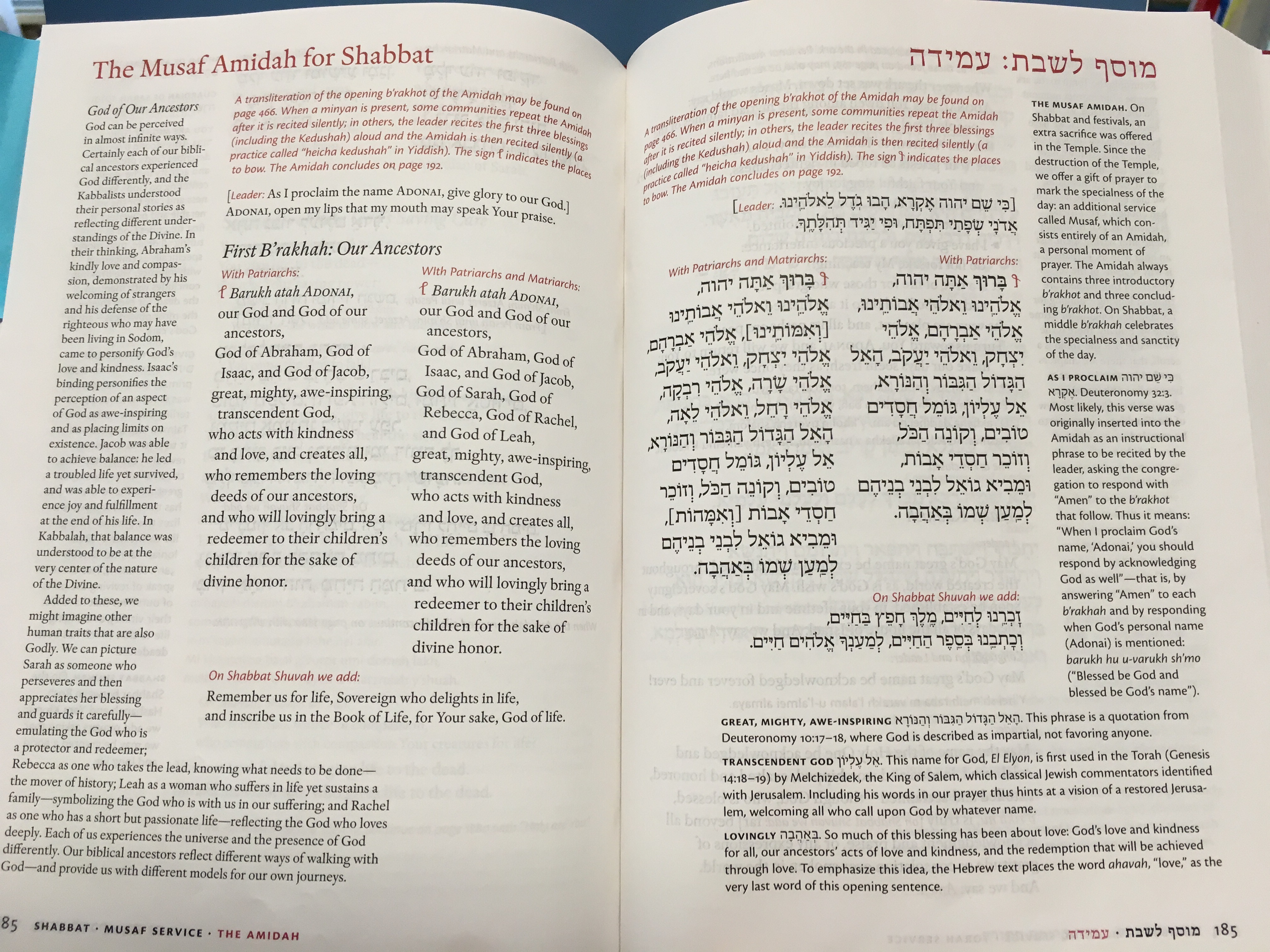
Jewish tefillah–self-examination–is time set aside from the mundane distractions in our lives. The siddur serves as the open doorway to that time–time for perspective, time for growth. Join us tomorrow morning for an hour or two or three. Join us for you. Join us to learn more about this new magnificent resource and our own personal searches for meaning. Join us to sing, learn, connect, and be. Join us, you know, to pray.
Shabbat shalom,
Rabbi Craig Scheff
True Solidarity
In an extraordinary display of unity, a broad cross-section of American Jewish organizations have joined to declare this coming Shabbat, beginning the evening of Friday, June 26 and ending the evening of June 27, to be a “Shabbat of solidarity with the African-American community.” In light of the horrific act of violence in Charleston, South Carolina, leaders across the North American Jewish community are asking their members to participate in this Sabbath of solidarity.
Among the suggested actions for rabbis, congregations and organizations, are to speak out in synagogues this coming Shabbat on the issue of racism in society and to express rejection of hateful extremism. All rabbis and congregations are encouraged to reach out to AME churches in their communities with expressions and demonstrations of support.
So would it surprise you to learn that our synagogue is not participating?
Solidarity is defined as “unity or agreement of feeling or action, especially among individuals with a common interest; mutual support within a group.” It would indeed be important for our own synagogue community to come together in a feeling of unity about our rejection of hateful extremism. And it certainly is nice that a large cross-section of the Jewish community is showing displaying unity about something! The solidarity we sorely need, however (and especially here in Rockland County), is the solidarity between our communities. This solidarity can only happen beyond the walls of our synagogue – not on a Sabbath, when we are far less likely to extend an open invitation to our brothers and sisters from across the spectrum of religions to a 2- or 3-hour service. It must happen during the week, in the synagogues, churches, mosques and streets. It must happen in places where we can all speak the languages of our own prayers at the same time, wear our particularity, share our melodies, join hands in a unified chorus, be identified clearly for who we are, and be seen just as clearly for what we advocate.

On Sunday night, at the First Baptist Church of Spring Valley, nearly a quarter of the crowd of 200 who came together to pray for the victims and their families was Jewish. We stood, we held hands, we watched people sway and cry out in devotion, and we cried ourselves (okay, at least Nancy and I did) at the sight of gratitude trumping hatred and God’s love overcoming retribution. The four rabbis sitting in the congregation were asked to rise, be acknowledged and join the ministers and choir on the stage. And the largely African-American crowd cheered when Rabbi Ariel Russo was invited as a female rabbi – something many of the Spring Valley residents had never seen – to offer words of blessing. I was grateful that my sons experienced something so transformative in their teens; it was so apparent how moved they were. They learned the true meaning of solidarity, and I believe they will never be the same for the experience.

On Monday night, at Spring Valley’s Memorial Park, hundreds gathered to demand a vote on legislation that would bring state oversight to the embattled school district of East Ramapo. One of our congregants consciously chose to wear his kippah. He wanted to be certain he would be identified in the crowd as a Jew standing for the values we cherish as Jews. We marched through the streets of Spring Valley – young and old, black and white, Christian and Jewish. It was so apparent how moved his thirteen year-old son was to be a part of the experience, and to be acknowledged by so many for being a Jewish person willing to step up for a cause.
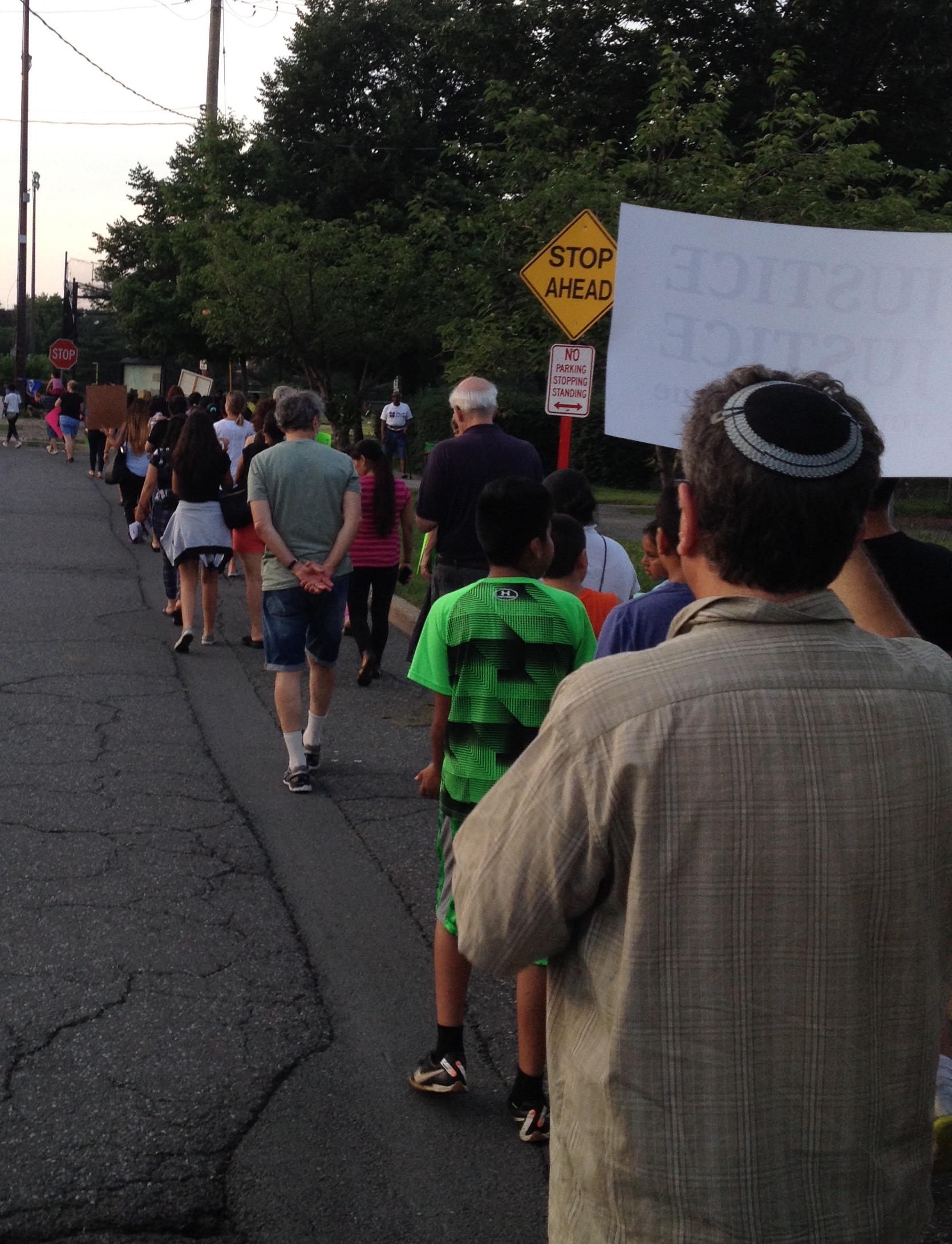
Whether our prayer vigil effected change or our legislative efforts in the short run are successful, I believe we have established a new framework for future community relations. We have expressed our shared values in more than words. We have stood together for consideration, deliberation, transparency, education and tolerance. We have stood together against discrimination, extremism, and political favoritism. And at least in the minds of some, we have shattered stereotypes that have supported ignorance, suspicion and hatred.
Solidarity Shabbat? I say Solidarity Sunday to Friday. And on Shabbat, all will be One.
Rabbi Craig Scheff
 Three Rabbis Walk Into A Shul
Recent Comments