Mission Accomplished
At 6:00 this morning, I returned to the Orangetown Jewish Center after participating for five days on the Jewish Federation of Rockland County Lily Steuer ATID Leadership Mission. Atid means future and this mission fulfilled its call to set our sights on the future. As I write this, I am filled with tikvah (hope) that the future of Jewish Rockland and of Israel is bright.

I felt tikvah when we visited Susan’s House, an on-the-job training workshop for youth at risk in Jerusalem. Teens learn to make jewelry, glass plates, wooden objects and macramé as they learn life skills and self esteem. There I met a young woman named Aliana who slouched in her chair as the other teens brightly showed off the art that they were creating. When we started shopping, many of us chose beautiful wire jewelry, the work of Aliana, who joined us in the shop and proudly took pictures with each of us who were purchasing her creations. Aliana was standing up straight. I felt tikvah because I know that thanks to our Jewish Federation dollars, the vulnerable in Israel won’t be left behind.

I felt tikvah when we visited Har Hertzl, the national military cemetery of Israel. We stood, weeping, before a line of new graves from this past summer’s Protective Edge Operation. We stood before the grave of American lone soldier Max Steinberg. I felt tikvah because I know that Israel will defend our right to a Jewish home. Thanks to the support of Jews world wide, Israel will never stand alone.
I felt tikvah when we danced at the Sol and Bea Kramer Senior Center in Kiryat Ata. Elders enjoy support, socialization, hot meals and warmth thanks to Elana, the dedicated and passionate director, and thanks to Rockland Federation support from the Kramer family and from the Lily Steuer Fund. Languages from all over the world – Hebrew, Yiddish, Russian, Hungarian, Spanish – could be heard as Day Center participants sang and danced with us. I felt tikvah because I know that thanks to our Jewish Federation dollars, the mitzvah of honoring our elders will be fulfilled in Israel just as it is here in Rockland County.

I felt tikvah when we visited the Mevaseret Tzion Absorption Center to meet with new olim (immigrants to Israel) from Ethiopia. We experienced awe as we watched Mission Mentor and Federation Campaign Chair Bob Silverman meet family members with whom he flew from Ethiopia to Israel one and a half years ago.  I felt tikvah because I know that we in Rockland County help to ensure that all Jews are responsible one for the other.

The experience of our trip was heightened for all of us (but for me most of all!) by the participation on the mission of my son Josh, a student in Mechinat Rabin (a preparation year for the Israel Defense Forces). Josh’s passion for Israel, his questions and many conversations with mission participants made me proud as a mom and made me feel tikvah for the future of the Jewish people.
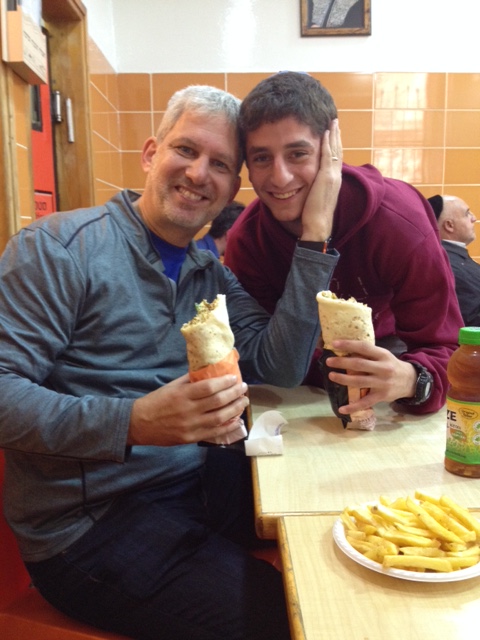
I thank Diane Sloyer and the staff of Jewish Federation of Rockland County for educating us, lifting us and giving us hope.
It is easy to be a cynic. Things go wrong and one can say, “See, I told you so.” But it takes courage to be an optimist. We continue, against all odds, to find hope and possibility in our world. Our plans and dreams might fail and we are often disappointed, but still we get up the next day and start again. It takes courage to be an optimist.
The 2014 ATID Mission gave us all many reasons to be optimists.
Shabbat shalom, Rabbi Paula Mack Drill
Remember
The 2013 Pew Research Center’s recent survey of the American Jewish community reported that, among those people who identify themselves as Jewish, a whopping 73 percent say that remembering the Holocaust is an essential part of what being Jewish means to them. That element of Jewish identity received the highest response rate, outpacing other suggested elements such as leading an ethical life (69 percent), caring about Israel (43 percent) and being part of a Jewish community (28 percent). Why does this element of Jewish identity receive such prominence? Is it the guilt that would accompany not remembering, the notion that we might afford Hitler (may his name be blotted out) a posthumous victory if we forget? Is it the particularistic notion that we must remain vigilant against our enemies who are constantly seeking to eliminate us? Is it the universal lesson that makes us better human beings because we will not idly stand by the persecution of any group?
This past Sunday night we commemorated Kristalnacht, the 76th anniversary of the Night of Broken Glass, the event that many say was the official starting point of the Holocaust. German Jewish shops were destroyed, men were beaten, detained and killed, synagogues burned. And rescue workers stood by to make sure that the fires didn’t spread to the neighboring non-Jewish homes and businesses.
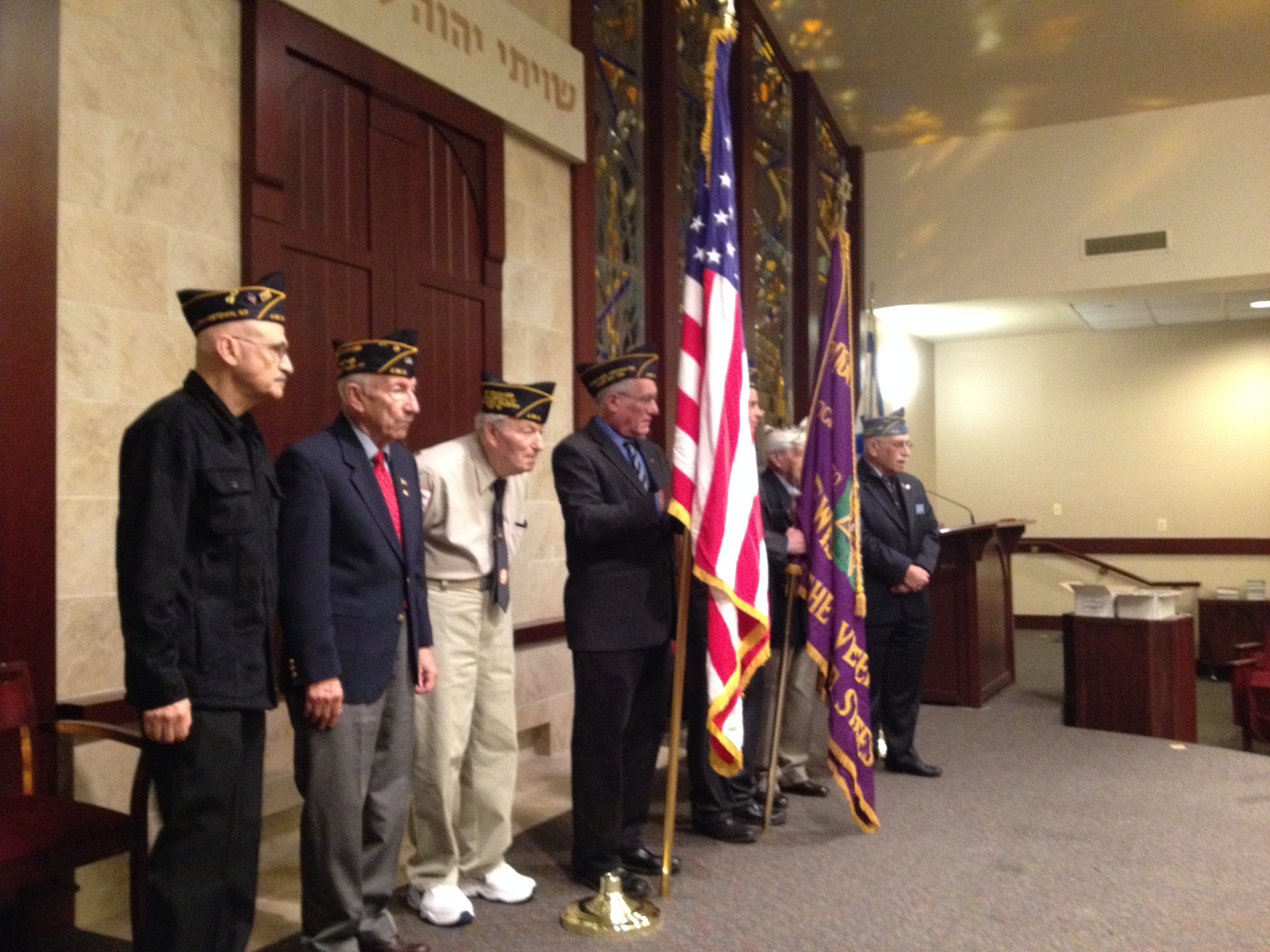
The Rockland community observed the commemoration ceremony this year at the OJC. Over 200 people gathered to see the presentation of colors by the Jewish War Veterans, to hear the words of County Legislator Harriett Cornell and the personal testimony of survivor Paul Galan, and to stand in solemn solidarity with the 30 teens holding candles as the words of El Maleh Rachamim, the Jewish memorial prayer, filled the sanctuary.

As I think about the surprising Pew survey statistics, I can understand the relatively high importance we place on remembering the Holocaust in light of what I witnessed Sunday night. I felt our children’s hearts swell with pride as they watched our Jewish veterans salute the American flag, pledge allegiance and sing Hatikvah.
I felt our children’s souls ignited by the memorial candles they held. I felt our children’s minds understand at a level beyond words what it means to remember. Our children recognized that Jewish remembering is not passive. Our remembering is an obligation we fulfill that shapes our Judaism, our identity as Americans, and our humanity. For our children, the lessons of the Holocaust also inform their obligation to defend the values for which they stand, and shape their responses to social issues they confront on a regular basis, like bullying and intolerance. The Holocaust is six million individual Jewish stories of vulnerability, fear, insecurity, cruelty, powerlessness, hope, courage, faith, redemption and love. It is the story of our people as much as the exodus from Egypt, and it is a part of our narrative that must be told.
How will you remember? Participate in our Kaddish project. Match yourself with an individual who died in the Holocaust with no one left to observe their yahrzeit. Learn their story. Say Kaddish for them. Contact Larry Suchoff, our Holocaust Remembrance Committee chairperson, or just walk into the OJC office, to adopt a story. Perhaps remembering the Holocaust will become an essential part of what being Jewish means to you.
Rabbi Craig Scheff
Sukkot Success by the Numbers
Here I am, heading into the month of Heshvan this week, not a holiday in sight after four intense weeks… and there is only one question on my mind: How do we measure the success of celebrating Sukkot at the OJC?
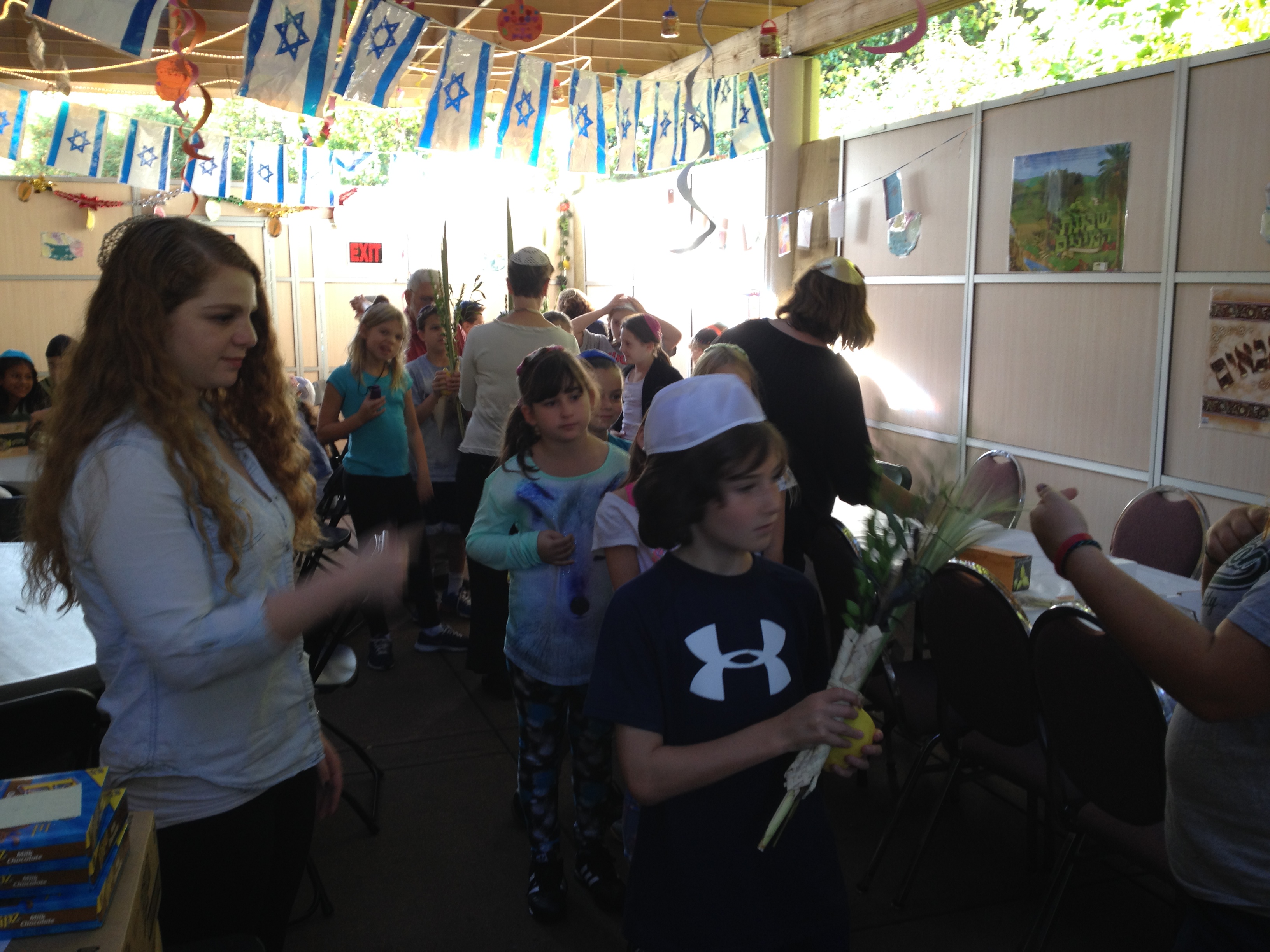
I could try to count the hundreds of congregants and guests who spent time in our sukkah. I might count the number of times we gathered to pray together as a community, marching with lulav and etrog or dancing with the Torahs. I’d count the number of programs and classes in the sukkah that we all enjoyed (eight, by my count!).

I’d certainly count the number of young children and their grown-ups who attended one of Rabbi Hersh’s programs: EKS with spaghetti in the sukkah, grilled cheese supper before Simchat Torah eve and ice cream party on the day. I would add in the number of Religious School children who tried to keep up with Rabbi Scheff’s My Sukkah it has Three Walls routine.

I could absolutely count our success by these numbers.
And I would have it all wrong.
Success in a synagogue community is about holiness, moments of Godliness, and the joyful heights reached through ritual.
I cannot measure such success by counting to eight or one hundred and fifty students or three hundred.
I can only measure holy success with the number one.
I count one congregant who joyfully bentsched (said the blessings for shaking) lulav and etrog at a rehabilitation center. He told his rabbis that October 17 had been his goal for release after surgery because he didn’t want to miss Simchat Torah at the OJC. He could not make it this year, but promised himself and us that he’d be dancing with a Torah next year.
I count one congregant who came to celebrate the holidays with her family each holy day. She is mourning her mother, but rose to the joy of the days. Just as she was kept home from school to attend synagogue when she was a child, so she now keeps her children home from school.
I count one congregant who came into the sukkah after Shabbat evening services to make Kiddush with us and was so entranced by the little ones celebrating that he joined in for a plate of spaghetti and meatballs.
I count one congregant who danced while holding onto her walker with a four year old who danced by jumping with both feet to the rhythm of the Orangetones at our annual Sukkot dinner.
I count one congregant who read Torah at Simchat Torah for the first time (and second, third and fourth) as everyone in the synagogue received an aliya.
I count one congregant who told me that he had never before celebrated the festival and was so excited by the energy and joy that he was going to plan now to take off these days from his busy medical practice next year to celebrate again.
I can only measure holy success with the number one:
One holy moment experienced by one cherished congregant.
One moment of eternity, one moment of Torah.
One community together celebrating joy as commanded by One God.
It is what we are all about at the Orangetown Jewish Center.
May this new year be one of holy moments for each and every one of us,
Rabbi Paula Mack Drill
Open the Gates of Justice (in Albany)
At 6:00 am this morning, Ariella Rosen, our Rabbinic Intern, and I boarded a bus together with thirty interfaith clergy bound for Albany. The Rockland Clergy for Social Justice fulfilled our pledge to call on Governor Cuomo and legislative leaders to initiate immediate fiscal and administrative oversight in the East Ramapo Central School District and to revise the structure, governance and financing of that school district. On the two hour ride up the Thruway we were briefed about our mission and the many advocacy meetings that we would have. Just after a stop for coffee, I davenned the prayers of Rosh Hodesh, the New Month. When I reached Hallel, I sang softly to myself: Pitchu li sha’arei tzedek – Open for me the Gates of Justice. “How perfect,” I thought to myself, “the Jewish calendar can be so in sync with the world.
The day was a big success. I will be sharing information with everyone about the ways in which each one of us can become involved in this issue that is of concern to so many of our congregants in the days ahead. Today we met with Larry Schwartz, Secretary to Governor Cuomo, Speaker Sheldon Silver, Senate leaders Dean Skelos, Jeffrey Klein and John Flanagan, and Senator Andrea Stewart-Cousins. Throughout the day we were accompanied by Senator David Carlucci, Assemblywoman Ellen Jaffe and Assemblyman Kenneth Zebrowski; all three are champions of our cause and deserve our thanks.
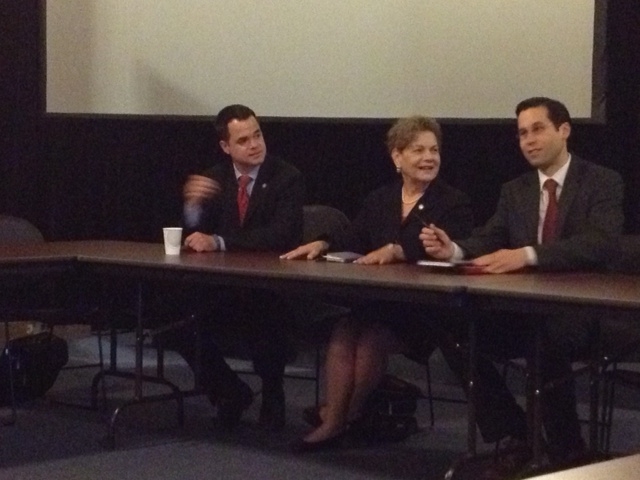

For tonight, I would like to share with you the words that I spoke at the Prayer Vigil/Press Conference, to give you a sense of the impact felt in Albany when a unified band of rabbis, ministers, pastors and imams raised our voices together for justice.
I am proud to stand before you this afternoon representing the Orangetown Jewish Center, a congregation of more than 500 families who are concerned about the issue of fair and meaningful access to education for all young people in our county.
On the Jewish calendar, today is Rosh Hodesh, the first day of a new month. It is appropriate to be here today because Rosh Hodesh is a day of introspection and renewal. It is a day of optimism. Interestingly, it is also a day set apart for women and today as the sole woman clergy in attendance, I raise my voice for all of the mothers who send their children to school in the East Ramapo Central School District and for the teachers in that school district, the vast majority of whom are women.
Rosh Hodesh is a day of witnessing. In history, a new month was not declared until witnesses saw a new moon in the sky. Now this witnessing was by necessity subtle because what was being seen in the sky was actually the absence of the moon. Today, we stand before you as witnesses to important things that are absent from the lives of the families in the East Ramapo Central School District. Absent is protection for the children. Absent is fair governance of their schools. Absent is the education that is the Constitutional right of every child in the State of New York.
I stand today as a witness.
Consider the student in Spring Valley High School who has no Child Psychology and Day Care class to take because it was eliminated from the budget. Her dream to begin a career in Day Care will not be fulfilled. I am a witness to her dream.
Consider the student in Ramapo High School whose dream of a college scholarship in swimming or wrestling or tennis is crushed because those teams were eliminated from the budget. I am a witness to his dream.
Consider the mother sending her children to school each day who has sidelined her dreams of their succeeding in a competitive world thanks to education. Now she is more concerned that they return from school safely each day. Security guards were eliminated form the budget. I am a witness to her dreams for her children.
Consider the father who is a mathematician or a musician or … fill in the blank. Like any father, he had dreams of his children’s following in his footsteps. But there are no math electives, not even Advanced Algebra. There are no music programs at all in the Elementary Schools and the award winning marching band no longer exists. All were cut from the budget. I am a witness to his dreams.
Consider the guidance counselor in the high school or the sports coaches in the middle schools or the kindergarten teaching assistant. They were committed to careers in education but their jobs were eliminated. I am a witness to their dreams.
All that I witness leads me to the only possible response: a cry for justice. Here in Albany, I pray that you hear the same call. We clergy of every faith have gathered together as witnesses. We represent our congregations who stand as witnesses. We cannot and will not look away. You are our elected officials. We pray that you join us as witnesses so that we can take action together.
A Circle of Chesed
 At a recent meeting with the volunteers of our Chesed Committee, I suggested that one goal of the committee was to need such a committee no longer. Won’t it be great when we are a Chesed Community, and everyone’s needs are taken care of by each one of us doing our part. Until that day arrives, however, we still have a lot of work to do.
One fact that makes me proud and yet also stymies me is why we have fifty volunteers on the Chesed Committee. Fifty is a great number of committed people who make meals anonymously, drive people to appointments, call on the phone and visit shut-ins. Those fifty, however, are not available for every need that arises. In a community of more than 500 families, how do we ensure that the number grows?
Another fact that has surprised me over time is how many people hesitate to ask for help. Many congregants have a broad and steady support network of family and friends and so do not need the support offered by the OJC Chesed Committee. But I have found that many people simply do not want to ask for help. A willingness to ask for help completes the circle of Chesed (loving kindness): today I need your help but tomorrow I’ll be able to offer mine. The work of loving kindness completed by the Chesed Committee is done so discreetly and compassionately. Performing a mitzvah quietly gives a unique feeling of pride. This kindness that I do — I do simply to bring an uplift to someone else.
Perhaps you say that you’d love to help but cannot because you have a full time job and a long commute. Perhaps you say that in a few years you’ll help when the kids are older. Maybe you think that you have too many hard issues of your own. To each of you, I say: your life will be enriched by the good that you will do. There are volunteer positions that range from ten minute phone calls once a week to preparing a meal for one or two – once every six weeks or so. Some families complete their friendly visiting with kids in tow; the children learning from their parents’ modeling how to be a true mentsch. And if you yourself are struggling, helping another is a  powerful prescription for healing.
Please consider finding out how you could become a part of the dream of the OJC as a Community of Chesed … by becoming a part of the Chesed Committee. Get in touch with our Chesed chairs, Adele Garber (Ahg19@optonline.net) or Maddy Roimisher (845-359-4846), before you close this blog! You’ll be part of a circle of loving kindness, and who couldn’t use that in our lives?
Kol tuv, All the best, Rabbi Paula Mack Drill
Beyond the Walls of the OJC to the DC Convention Center
Truth is, on a daily basis, there is no where I would rather be than at the Orangetown Jewish Center. My creative energy runs high at the shul, interactions feel profound, learning feels new, and God feels close. My rabbinate makes sense when I am with you in the classroom, my office or the sanctuary.
It is necessary, however, to throw open the windows of our synagogue and look around at the world we inhabit. And it is important to go out into that world to learn about what is going on. If you are with us on Shabbat or in a class, you know that one of the values of the OJC is that our Torah moves from the text to the lives we lead. The lives we lead are fulfilling when we are having an impact on the world: improving families, communities, Jewish organizations and secular institutions. You hear it in our teaching and in our sermons. Find a passion and pursue it! We begin in Torah, but we use Torah to move to issues about Israel, the Jewish world, Conservative Judaism, and social justice.
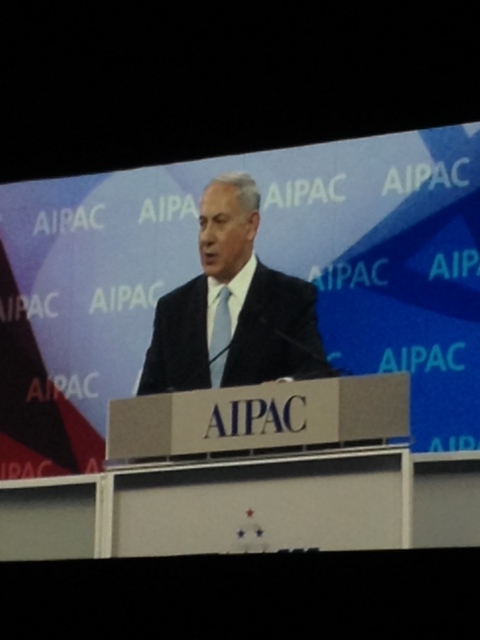
This past week, I spent time in the wide world beyond Independence Avenue in Orangeburg, New York. I returned today renewed, re-energized and ready to bring all that I learned back to the synagogue. I spent three days with twenty four OJC congregants and 14,000 of our pro-Israel allies at the AIPAC Policy Conference. 
At AIPAC, many of the messages resonated with all that I have experienced and learned over eight years of participation in Israel advocacy through AIPAC. Our elected officials on both sides of the aisle unambiguously support Israel as a valued friend. Israeli leadership is grateful to feel the power of our support. People of color and leaders of many faith movements join with us every year to add their voices with ours as important allies in support of Israel. 2300 college leaders, Jewish and not Jewish, join us to state clearly that young people are learning how to advocate for Israel.
The rabbinic leaders of the Reform, Conservative and Modern Orthodox streams stood together on the dais and proclaimed, “Jewish life is not about singing in unison but rather in harmony.” Rabbi Steve Wernick, CEO of United Synagogue of Conservative Judaism stated, “We are not asserting the perfect nature of Israel. There is no perfect country. But we are here to protect the precious relationship between Israel and America.” The ideal of shared values and creating relationships rings true to all of us who have heard Israel sermons in our sanctuary or traveled to Israel on an OJC trip.
Something new was ringing loud and clear throughout the Policy Conference. We have heard the message before at AIPAC, but now it feels like a central theme ino all that we are doing: Despite being in the middle of seemingly intractable conflicts, Israel is a dynamic country filled with innovators who are improving life around the world. We heard from Israeli scientists, technology gurus, and medical researchers breaking through to new frontiers in medicine, security, communication and economic cooperation. There is another story of Israel being played out and we had an opportunity to feel its power. The Israeli Ambassador to the U.N. had a clear answer to the magnificent success of Israeli progress. Ron Prosor said that the secret is The Jewish Mother who believes that her child is a genius and the world just does not yet know it. So if that child takes a risk and fails, the Mother says, “Just go and try again.” And thus we have the Start-Up Nation! It’s a brilliant theory, no?
There was optimism in the air despite the heaviness of world realities right now. John Kerry said, “When Bibi looks me in the eyes and says, ‘We cannot accept a treaty that does not make Israel safer than she is right now,’ he and I agree 100%.” On Monday morning, Netanyahu was downright buoyant (honestly!). He claimed that Israel must be strong to make peace, but peace will make us stronger. 
World events change on the hour and I am no prophet. Three days of learning and advocacy, however, allows me to believe that our Torah will lead us eventually to a stable Israel. As Rev. Dr. DeeDee Coleman shouted to an AIPAC crowd that loves her dearly, “Am Yisrael Chai! The people of Israel live!”
I am grateful to have gone out to learn. I am grateful to return home and share it with all of you.
Rabbi Paula Mack Drill
Lessons Learned from Loss
I dedicate my writing this week to the memory of Abraham Mordecai Akselrad, z”l
It is fair to say that I attend more funerals than the average person. I am usually in the room with the family tearing the black ribbon, standing behind the lectern, driving the first car behind the hearse in the processional. The honor of performing the mitzvah of kavod la-met (honor to the dead) or of nichum avelim (comfort to the mourners) is very great but it is also very difficult. As rabbi, I gain strength knowing that I can truly help in many ways: standing steady for a family when the world is tilting, explaining a ritual with compassion, educating a community about how to pay a shiva call, or calling a grieving daughter a month after shiva has ended.
This past week, I remembered with full force what it means to perform these mitzvot, but without the designation of “Rabbi” as I did so. I realized with humility how performing kavod la-met or nichum avelim as a rabbi provides a layer of protection to me as a person in such sad times.
Just before Shabbat last week, Jonathan and I lost a dear friend of thirty years after a heroic battle with cancer. Abe Akselrad loved life completely and fought for every day and every hour he could spend with his wife Claire, his four children, son-in-law, and two grandchildren. The entire community of our synagogue in Caldwell attended Abe’s funeral this past Sunday, and he was buried in a downpour.
As friend in the pews rather than rabbi at the podium, I learned many lessons that I want to share with you. I believe that in the OJC community, we are supportive, appropriate and understanding of the laws of mourning and comfort. But we can also improve and grow. In that spirit, I share my learning of this past week.
One of my friends called me on Friday midday and asked how she could help the family who were overwhelmed by people stopping by with their sorrow, their condolences and their fruit platters. I suggested that they hang a sign on the door: “According to Jewish custom, it is not traditional to visit a family until after the funeral has taken place.” When Jon and I entered the funeral chapel, we saw long lines waiting to enter the room where the family sat before the service. We chose to enter the chapel directly instead and sit quietly. After the service, I saw friends clinging to Claire, crying with her, when I thought that she probably wanted to just get into the limousine and prepare herself for the cemetery. I thought about the way all of us have a need to ensure that the bereaved know we are there for them. Sometimes our need to be known outweighs common sense about what true comfort means. Claire and her family would never complain. I know that they have felt the love of family and friends. My first lesson is that all of us need to check our motivation in comforting very carefully: are we acting out of our own need or what we believe to be the needs of the bereaved?
As Jonathan and I sat in a row waiting for the service to begin, we were joined by friends from the Caldwell synagogue. At the end of my row was our friend Rabbi Michael Jay. Both of us have been well-schooled by Rabbi Scheff to sit silently in the presence of the dead. As rows all around us filled with chatting people, our row, anchored by Michael’s and my respectful silence, remained relatively quiet. The second lesson is that we can carry our learning wherever we go and model behavior that shows compassionate understanding of mourning ritual.
Presiding at the funeral was Rabbi Alan Silverstein of Congregation Agudath Israel, the Drill family’s rabbi for more than thirty years. He spoke about Abe as a congregant and as a cherished friend; he presided at the baby namings and bris and b’nai mitzvah of all four Akselrads, and at the oldest, Aviva’s wedding. His words brought comfort and an uplift of the heart not just because they were beautiful, heartfelt words, but because Rabbi Silverstein was speaking from a true relationship with the family. The third lesson I share today is that I came away from the funeral affirmed in the rabbinate that Rabbi Scheff and I have created at the Orangetown Jewish Center. We know you. We know your passions and your sorrows, your celebrations and your questions. “Relationship” is the mantra of our rabbinates. . . and for good reason. Truly knowing you allows us to be there with our full selves, as rabbi and as person, in your greatest joys and times of need. If we don’t yet “truly know” you, call one of us for a cup of coffee or a meeting at the shul. We do not want to wait for a time of loss to establish our relationship with you. Visit with us to make a meaningful relationship so that we can continue to build our community together.
Shabbat shalom, Rabbi Paula Mack Drill
Women Rabbis Lean In at JTS
I was one of sixty women, all members of the Rabbinical Assembly of Conservative Judaism, who gathered at the Jewish Theological Seminary on Monday and Tuesday, December 9 and 10 to connect, learn and replenish our minds and souls. The title of the conference was “Leaning In, Leaning Out, Learning from Each Other.” The learning, prayer, and opportunity to connect were all valuable.

But that is not what is on my mind as I think about the conference in the days since it ended. I am thinking about what it means to be present, completely and wholly present. In her opening talk, Rabbi Amy Eilberg, the first ordained woman of the Conservative Movement of Judaism, explained to us that her work has been about cultivating compassion. That work, she asserted, can only happen through true listening, through being present to another and thereby to God. She reminded us that careers in the rabbinate are guided by what we believe God wants of us more than by ambition.
I spent the rest of the day asking myself how I could ever know what God wants of me. As I listened to fellow rabbis, talked in small groups, and took notes, I asked myself the question about what God wants. And then the answer came to me as I pictured myself in our sanctuary at the OJC. Above the ark, the words are carved: “Shiviti Adonai l’negdi tamid.” I place God before me always.
I can know what God wants of me by being quiet enough, in the sanctuary of my soul, to listen. And to do that? I must be present. I must be in the moment with each of you, with the children of the Religious School, with the youngest children and their grown-ups at Early Kabbalat Shabbat. I must be fully present in your loved one’s hospital room, at your kitchen table or across the table from you at Starbucks. I must be present in the moments we share on the telephone.
And then, at the end of our moment, I must listen to my soul deeply enough to reassure myself that I am doing what God wants of me. Did I listen to you? Was I fully present to you?
It is not easy to be fully present in the year 2013. As we rabbis sat in a room, sharing our dreams, our insecurities, our prayers, many of us focused on the faces of whoever was speaking. If I place God before me always, then I must look for God in the faces of my fellows.
But a great number of us were typing away on i-pads, laptops, phones. Several in the room were tweeting. A difficult conversation erupted about this fact when confidentiality was breached with tweets that quoted what specific women were saying. Those who were tweeting defended their actions by stating the importance of sharing what was happening in the room with the public. I wonder how we can be in this moment, however, when we are already shaping it to share it with a nameless public. I understand that tweeting is meant to connect us, but doesn’t it distance us instead?
One rabbi said that she is more focused when she is tweeting than when she is just listening. There is a difference, however, between being focused and being present. Rabbi Eilberg had just told us that we must remember to be present to others. The result of the conversation was to shut down the tweeters. Sometimes it is valuable and important to get the word out. I understand the value of social media; after all, here I am blogging to you all! But sometimes it is much more important to get the word in. Lean in, lean out. Utimately, we chose to lean in, to lean within, to be present to each other and to ourselves — with the hope and prayer of being present to God.
A new year, a new web site, my first blog…

 Three Rabbis Walk Into A Shul
Recent Comments