Open the Gates of Justice (in Albany)
At 6:00 am this morning, Ariella Rosen, our Rabbinic Intern, and I boarded a bus together with thirty interfaith clergy bound for Albany. The Rockland Clergy for Social Justice fulfilled our pledge to call on Governor Cuomo and legislative leaders to initiate immediate fiscal and administrative oversight in the East Ramapo Central School District and to revise the structure, governance and financing of that school district. On the two hour ride up the Thruway we were briefed about our mission and the many advocacy meetings that we would have. Just after a stop for coffee, I davenned the prayers of Rosh Hodesh, the New Month. When I reached Hallel, I sang softly to myself: Pitchu li sha’arei tzedek – Open for me the Gates of Justice. “How perfect,” I thought to myself, “the Jewish calendar can be so in sync with the world.
The day was a big success. I will be sharing information with everyone about the ways in which each one of us can become involved in this issue that is of concern to so many of our congregants in the days ahead. Today we met with Larry Schwartz, Secretary to Governor Cuomo, Speaker Sheldon Silver, Senate leaders Dean Skelos, Jeffrey Klein and John Flanagan, and Senator Andrea Stewart-Cousins. Throughout the day we were accompanied by Senator David Carlucci, Assemblywoman Ellen Jaffe and Assemblyman Kenneth Zebrowski; all three are champions of our cause and deserve our thanks.
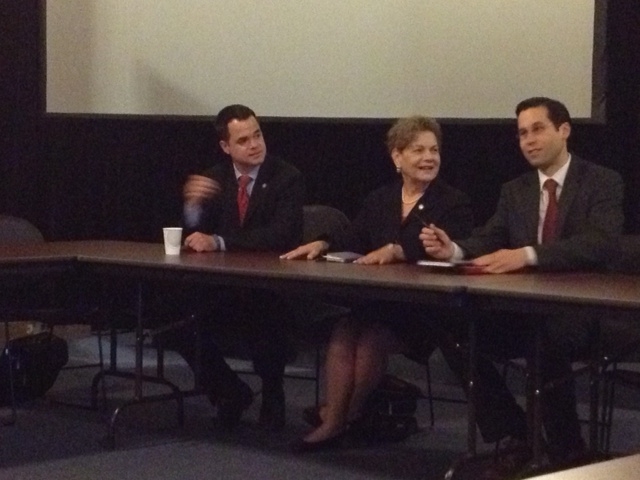

For tonight, I would like to share with you the words that I spoke at the Prayer Vigil/Press Conference, to give you a sense of the impact felt in Albany when a unified band of rabbis, ministers, pastors and imams raised our voices together for justice.
I am proud to stand before you this afternoon representing the Orangetown Jewish Center, a congregation of more than 500 families who are concerned about the issue of fair and meaningful access to education for all young people in our county.
On the Jewish calendar, today is Rosh Hodesh, the first day of a new month. It is appropriate to be here today because Rosh Hodesh is a day of introspection and renewal. It is a day of optimism. Interestingly, it is also a day set apart for women and today as the sole woman clergy in attendance, I raise my voice for all of the mothers who send their children to school in the East Ramapo Central School District and for the teachers in that school district, the vast majority of whom are women.
Rosh Hodesh is a day of witnessing. In history, a new month was not declared until witnesses saw a new moon in the sky. Now this witnessing was by necessity subtle because what was being seen in the sky was actually the absence of the moon. Today, we stand before you as witnesses to important things that are absent from the lives of the families in the East Ramapo Central School District. Absent is protection for the children. Absent is fair governance of their schools. Absent is the education that is the Constitutional right of every child in the State of New York.
I stand today as a witness.
Consider the student in Spring Valley High School who has no Child Psychology and Day Care class to take because it was eliminated from the budget. Her dream to begin a career in Day Care will not be fulfilled. I am a witness to her dream.
Consider the student in Ramapo High School whose dream of a college scholarship in swimming or wrestling or tennis is crushed because those teams were eliminated from the budget. I am a witness to his dream.
Consider the mother sending her children to school each day who has sidelined her dreams of their succeeding in a competitive world thanks to education. Now she is more concerned that they return from school safely each day. Security guards were eliminated form the budget. I am a witness to her dreams for her children.
Consider the father who is a mathematician or a musician or … fill in the blank. Like any father, he had dreams of his children’s following in his footsteps. But there are no math electives, not even Advanced Algebra. There are no music programs at all in the Elementary Schools and the award winning marching band no longer exists. All were cut from the budget. I am a witness to his dreams.
Consider the guidance counselor in the high school or the sports coaches in the middle schools or the kindergarten teaching assistant. They were committed to careers in education but their jobs were eliminated. I am a witness to their dreams.
All that I witness leads me to the only possible response: a cry for justice. Here in Albany, I pray that you hear the same call. We clergy of every faith have gathered together as witnesses. We represent our congregations who stand as witnesses. We cannot and will not look away. You are our elected officials. We pray that you join us as witnesses so that we can take action together.
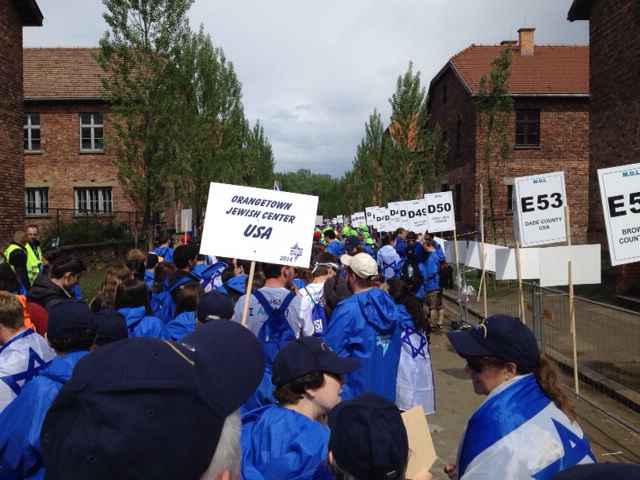
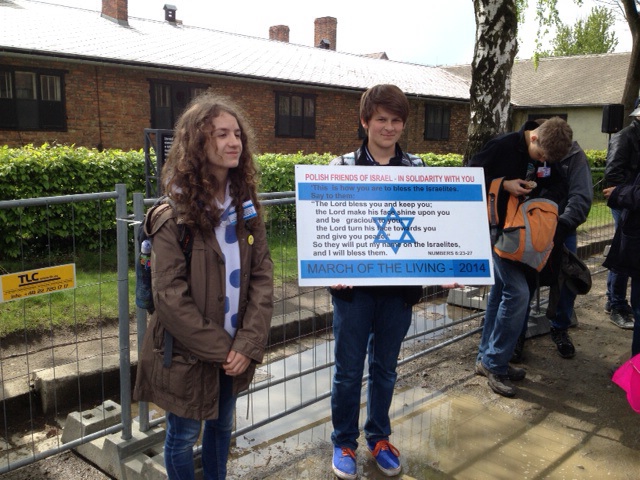
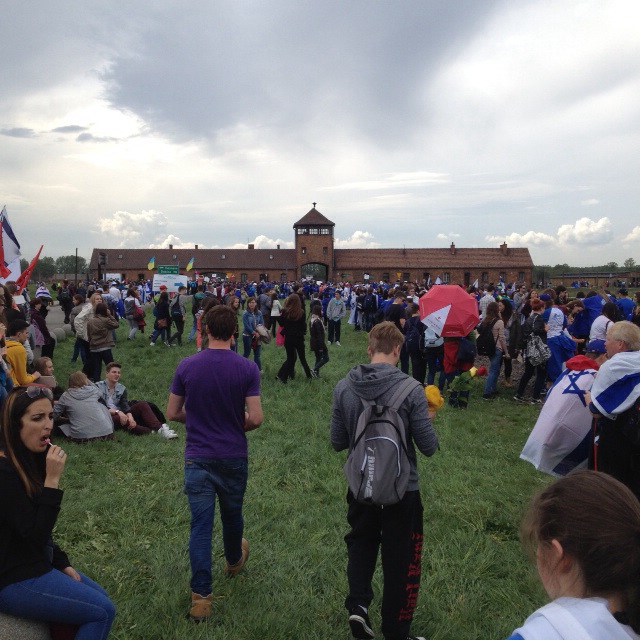
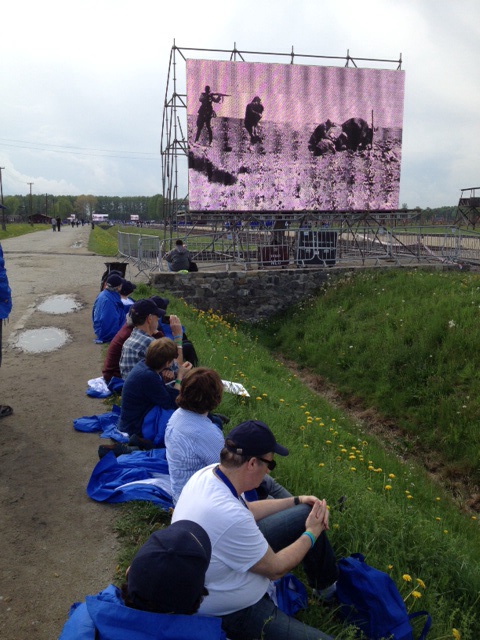
OJC’s March of the Living, Day 5, The March
I am not taking the easy way out. Today was a day far more about images than words. And so I have chosen to share images with you. Images of a wet and dreary day at Auschwitz that evolved into a bright afternoon upon our entrance into Birkenau, the death camp that we filled today with life. Friends and families were reunited today in spirit and in person. Tears were shed for the horrors, and laughter was shared to protect us and to reaffirm life. A Torah scroll was completed at the end of the march in front of 12,000 people, and we sang Hatikvah firmly committed to our hope and faith in the future. Horrific reminders of death were balanced by personal encounters with resilience and courage. I hope the images below can provide a small measure of what we will carry in our minds and hearts forever.

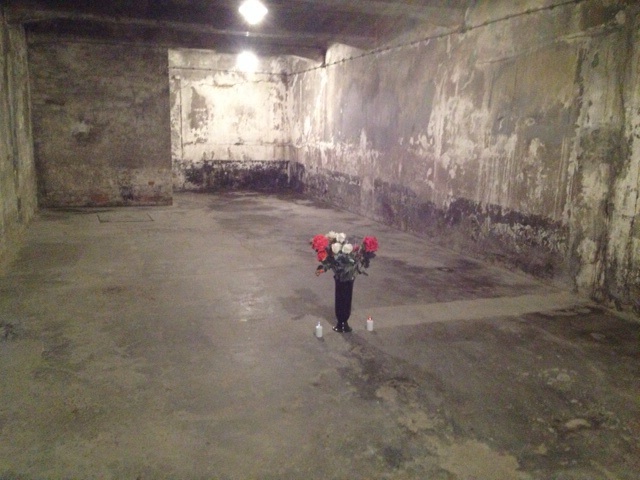
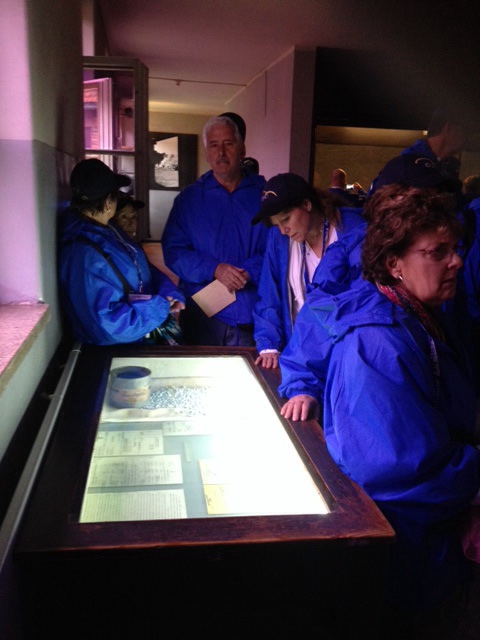


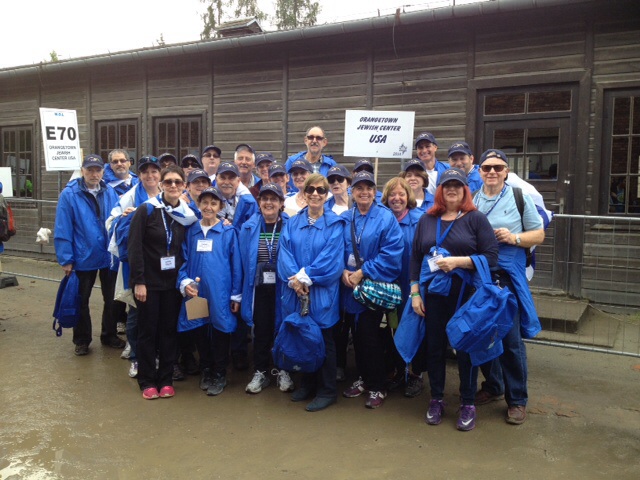






Tomorrow morning we depart for Budapest. It will be a long bus ride through the hills of Slovakia. You will here from me again, God willing, on Wednesday. I leave you with a thought from Anne Frank that Rabbi Drill shared with me: A candle both defines and defies the darkness. If the soul is the lamp of God, then we too can both define and defy the darkness. And that is why we are here.
Am Yisrael Chai,
Rabbi Craig Scheff
Atypical Shabbat in Warsaw – Day Three
Cold. Wet. Gray. Like the grainy images we have all seen of past Jewish life in Poland. That is the way I imagine Warsaw, and every other city in which Jews were crowded into just 70 years ago on the eve of their destruction. And that is the city of Warsaw that we experienced today.
After a Shabbat morning service and Torah study, we headed to explore the new Museum of Jewish Life in Poland, slated to open in October. We were all deeply affected by our docent, Martha, who clearly had not anticipated our questions. Sure, she could describe the construction and architecture of the museum. She could address each period of Jewish life in Poland. But when asked about her own identity, she seemed taken aback. The daughter of a Catholic father and a Jewish mother, she was raised in a home where Communism was the official family religion. A class trip to Israel reintroduced her to her ancestry, and after five years in Israel and a brief stay in America, she returned to Poland to reclaim her past. Now, she sees it as her mission to restore the place of the Jews in Poland’s historical narrative. It was powerful to see a personal struggle to rediscover an identity; it was inspiring to learn this perspective on why we are here.
While the museum’s emphasis is the many contributions of Jewish life in Poland, our walking tour of the monuments to Jewish life in the Warsaw ghetto certainly took us back to the suffering of the Jewish people in this place. We were cold and wet as we sloshed through the gray landscape. But we did not dare complain. We were all acutely aware that we had sturdy shoes, multiple layers of clothing, some of us had gloves, and all of us were fed and headed ultimately for shelter. Who were we to complain, especially standing in the footsteps of those whom we were here to remember.
The topic of our Torah study this morning, from today’s parasha Kedoshim, was the Torah’s commandments not to stand idly by the suffering of our brothers, not to hate others in our hearts, and to love our neighbors as ourselves. Tonight, as we put our heads to our feathery soft pillows, we are confronted by challenges that make sleep elusive. How can we begin to empathize with the suffering of the Holocaust’s victims without feeding the flames of anger and hatred? How do we formulate an active and instructive response to these events such that we become more attuned to the suffering of others, be they Jewish or not? How do we own this victimization without victimizing others?
Tonight, international stage and synagogue star Dudu Fisher sang us songs of lament, prayer and hope. It was a poignant way to bring in the new week and the difficult commemoration ahead. I pray I can find the one melody that will bring me just a little sleep before the sun rises to the new day.
Laila tov,
Rabbi Craig Scheff
Bashana haba-ah B’Yerushalayim
 If we say, “Next year in Jerusalem” at a seder in New York, what do we say when we make a seder in Jerusalem? The answer is that we still say, “Next year in Jerusalem” because we pray to be in Yerusalayim L’Malah, Jerusalem on High, the future Utopian time when all will be peace. Singing about being in Jerusalem is a moment of hope and open-heartedness every year at the end of the seder, but this year, actually sitting at a seder in Jerusalem, I felt even more optimistic.
We made our seder with my brother Eric and lots of my cousins at a hotel in Jerusalem. As I looked around the large ballroom, I saw tables of thirty and tables of three. There were Jews in white shirts and black pants, Jews dressed in high fashion, and Jews in jeans. As each table began to sing “Dayenu,” we heard more different tunes than I thought possible. There were tables that were being served dinner before our table asked even the second of the four questions. While we sat at the table singing for a long time, we still were not the last table in the room. Every kind of Jew in Israel celebrates Pesach. Walking back through the streets of French Hill to our apartment at close to 1:00 a.m. I felt that anything is possible. Next year in Jerusalem.
We have been spending Chol HaMoed (the middle days of Passover) with Sarah’s boyfriend Sagi’s family on Kibbutz Mefalsim (next to Sederot, in the south), mountain biking and hiking. Everywhere we go, we see Israeli families enjoying the Passover vacation. It is the gift of Israel to be on the same calendar with everyone else! If I am hoping for next year in Jerusalem, so are all the other Jews I see.
 Our youngest, Joshua, announced his intention to make aliya and follow his sister’s footsteps into the IDF. We couldn’t be more proud. With the great possibility of two out of four of the Drill children making lives in Israel, it will really be true for many years to come that we’ll be saying, in a real way, “Next year in Jerusalem.” As a Jew with faith, optimism and a belief in Jewish destiny, I will always say, “Next year in Jerusalem.” I’ll say it when I am here for Pesach, here among people living according to the Jewish calendar, here as a mother of Israeli offspring. I’ll say it when I am with all of you at the OJC for Pesach, among the people in the congregation that I love. My task never sways from working to bring about a better day for all humanity. Bashana haba-ah B’Yerushalayim.
L’hitraot, See you all soon! B’yedidut, with friendship,
Rabbi Paula Mack Drill
Fifty days (and ways) to meet your Lover
Make a new plan, Stan.
While Paul Simon sang of this and 49 other ways to leave your lover, this coming Tuesday night begins a period of time when Jews begin counting the ways to draw nearer to God, one day at a time. Seven complete weeks of counting, beginning with Day One at our second seder, brings us to the celebration of Shavuot on Day Fifty, the day we stood with God at Sinai, as if (as our sages imagined) beneath a bridal canopy.
Our mystics have assigned special qualities to each one of these days, and each quality is meant to explore another aspect of our relationship with God. Personally, if I were away from the one I loved, I would count down with each passing day until the day I am reunited with my love. That, however, is the very point of counting up! We are not wishing days away. Each day presents another opportunity to add another dimension–to offer another gift–to the relationship that we share with God. Each day is another bauble we add to the collection of treasures that reminds us of the courtship that began the day we left Egypt and headed for the Promised Land. The fifty days represent fifty ways to meet our Lover. What started centuries ago as the gift of a measure of grain (an omer) for the priesthood each day has evolved into a personal exercise in mindfulness.
So get off the bus of your daily routine, Gus! Download an Omer counter app for your phone! I’ve even provided a link for you (click here) to a fun way to track the days of the Omer. Count each day with the blessing “Baruch atah adonay eloheynu melech ha’olam asher kidshanu bemitzvotav vetzivanu al sefirat ha’omer” when the stars come out, and make each day count as a blessing. If you miss an evening, you can still count during the day that follows. But If you miss an entire day (evening and the day that follows) of counting, then you don’t get to say the blessing anymore! The blessing is only said with each evening’s counting so long as you haven’t skipped a day.
Such is love. It requires commitment, obligation and constancy. It also, however, makes us feel valued and valuable. It gives us comfort and security. It inspires us to strive to be our best selves. It motivates us to show gratitude and to express ourselves through words and deeds that we didn’t know we even possessed. Start on Tuesday night at the end of your second seder, and get yourself free.
Chag kasher v’sameach,
Rabbi Craig Scheff
Community as a Salve to Loss
If you read the Orangetown Jewish Center emails, you have seen that we have experienced an inordinate amount of loss in our community in these weeks leading up to Pesach. Answering the needs of every loss in a community includes support for the immediate family, answering the questions of loving friends and acquaintances, advising regarding traditional practices and personal decisions, preparing for a funeral, coordinating shiva houses and minyanim, being present for the mourners in the days and weeks and months following the death. “This must be the hardest part of your job,” say loving, concerned congregants. They ask Rabbi Scheff and me how we cope.
There are two answers to the question. The first answer is that responding to the needs of a family at the time of loss is one of the holiest things that rabbis do. Families open the doors to their hearts and share their stories with us. They depend on us to answer some of the most important questions that humans can ask. And when we can be helpful, it is indeed sad but also uplifting.
The second answer is unique to our community. And the answer is: This community. Without the OJC community, we would not be able to help our families in the loving, respectful way that we do. Sometimes our president or Krista in the office are the first to know of a death. They respond as part of a team and find one of the rabbis immediately. The Ritual Committee delivers chairs and books, finds davenners, alerts Minyan Captains of the alternate sites for minyanim. In these past three weeks, we cannot thank Steve Richter and Jonathan Cohen enough for their responsible and caring attention to every detail. Sisterhood delivers some food for the condolence meal, Chesed finds out if there are any special needs for each family. And then all of you come out to the homes of fellow congregants. Some of you turn plans upside down in order to be there for another. I cannot remember making very many shiva calls without an OJC congregant coming to pay condolences at the same time. Tomorrow night, we will have four shiva homes in addition to the minyan here at the OJC. Some people are understandably hesitant about going to the home of a mourner they do not know. Not every mitzvah is easy. But the hard thing is almost always the right thing to do.You can be a part of the compassionate outreach of our synagogue by attending one of those minyanim. You might just be the tenth.
If you would like to know of a shiva house that would benefit from your attendance Sunday evening, please email one of your rabbis at Rabbi.Scheff@theojc.org or Rabbi.Drill@theojc.org.
B’yedidut, With friendship, Rabbi Paula Mack Drill
A Circle of Chesed
 At a recent meeting with the volunteers of our Chesed Committee, I suggested that one goal of the committee was to need such a committee no longer. Won’t it be great when we are a Chesed Community, and everyone’s needs are taken care of by each one of us doing our part. Until that day arrives, however, we still have a lot of work to do.
One fact that makes me proud and yet also stymies me is why we have fifty volunteers on the Chesed Committee. Fifty is a great number of committed people who make meals anonymously, drive people to appointments, call on the phone and visit shut-ins. Those fifty, however, are not available for every need that arises. In a community of more than 500 families, how do we ensure that the number grows?
Another fact that has surprised me over time is how many people hesitate to ask for help. Many congregants have a broad and steady support network of family and friends and so do not need the support offered by the OJC Chesed Committee. But I have found that many people simply do not want to ask for help. A willingness to ask for help completes the circle of Chesed (loving kindness): today I need your help but tomorrow I’ll be able to offer mine. The work of loving kindness completed by the Chesed Committee is done so discreetly and compassionately. Performing a mitzvah quietly gives a unique feeling of pride. This kindness that I do — I do simply to bring an uplift to someone else.
Perhaps you say that you’d love to help but cannot because you have a full time job and a long commute. Perhaps you say that in a few years you’ll help when the kids are older. Maybe you think that you have too many hard issues of your own. To each of you, I say: your life will be enriched by the good that you will do. There are volunteer positions that range from ten minute phone calls once a week to preparing a meal for one or two – once every six weeks or so. Some families complete their friendly visiting with kids in tow; the children learning from their parents’ modeling how to be a true mentsch. And if you yourself are struggling, helping another is a  powerful prescription for healing.
Please consider finding out how you could become a part of the dream of the OJC as a Community of Chesed … by becoming a part of the Chesed Committee. Get in touch with our Chesed chairs, Adele Garber (Ahg19@optonline.net) or Maddy Roimisher (845-359-4846), before you close this blog! You’ll be part of a circle of loving kindness, and who couldn’t use that in our lives?
Kol tuv, All the best, Rabbi Paula Mack Drill
Beyond the Walls of the OJC to the DC Convention Center
Truth is, on a daily basis, there is no where I would rather be than at the Orangetown Jewish Center. My creative energy runs high at the shul, interactions feel profound, learning feels new, and God feels close. My rabbinate makes sense when I am with you in the classroom, my office or the sanctuary.
It is necessary, however, to throw open the windows of our synagogue and look around at the world we inhabit. And it is important to go out into that world to learn about what is going on. If you are with us on Shabbat or in a class, you know that one of the values of the OJC is that our Torah moves from the text to the lives we lead. The lives we lead are fulfilling when we are having an impact on the world: improving families, communities, Jewish organizations and secular institutions. You hear it in our teaching and in our sermons. Find a passion and pursue it! We begin in Torah, but we use Torah to move to issues about Israel, the Jewish world, Conservative Judaism, and social justice.
This past week, I spent time in the wide world beyond Independence Avenue in Orangeburg, New York. I returned today renewed, re-energized and ready to bring all that I learned back to the synagogue. I spent three days with twenty four OJC congregants and 14,000 of our pro-Israel allies at the AIPAC Policy Conference. 
At AIPAC, many of the messages resonated with all that I have experienced and learned over eight years of participation in Israel advocacy through AIPAC. Our elected officials on both sides of the aisle unambiguously support Israel as a valued friend. Israeli leadership is grateful to feel the power of our support. People of color and leaders of many faith movements join with us every year to add their voices with ours as important allies in support of Israel. 2300 college leaders, Jewish and not Jewish, join us to state clearly that young people are learning how to advocate for Israel.
The rabbinic leaders of the Reform, Conservative and Modern Orthodox streams stood together on the dais and proclaimed, “Jewish life is not about singing in unison but rather in harmony.” Rabbi Steve Wernick, CEO of United Synagogue of Conservative Judaism stated, “We are not asserting the perfect nature of Israel. There is no perfect country. But we are here to protect the precious relationship between Israel and America.” The ideal of shared values and creating relationships rings true to all of us who have heard Israel sermons in our sanctuary or traveled to Israel on an OJC trip.
Something new was ringing loud and clear throughout the Policy Conference. We have heard the message before at AIPAC, but now it feels like a central theme ino all that we are doing: Despite being in the middle of seemingly intractable conflicts, Israel is a dynamic country filled with innovators who are improving life around the world. We heard from Israeli scientists, technology gurus, and medical researchers breaking through to new frontiers in medicine, security, communication and economic cooperation. There is another story of Israel being played out and we had an opportunity to feel its power. The Israeli Ambassador to the U.N. had a clear answer to the magnificent success of Israeli progress. Ron Prosor said that the secret is The Jewish Mother who believes that her child is a genius and the world just does not yet know it. So if that child takes a risk and fails, the Mother says, “Just go and try again.” And thus we have the Start-Up Nation! It’s a brilliant theory, no?
There was optimism in the air despite the heaviness of world realities right now. John Kerry said, “When Bibi looks me in the eyes and says, ‘We cannot accept a treaty that does not make Israel safer than she is right now,’ he and I agree 100%.” On Monday morning, Netanyahu was downright buoyant (honestly!). He claimed that Israel must be strong to make peace, but peace will make us stronger. 

World events change on the hour and I am no prophet. Three days of learning and advocacy, however, allows me to believe that our Torah will lead us eventually to a stable Israel. As Rev. Dr. DeeDee Coleman shouted to an AIPAC crowd that loves her dearly, “Am Yisrael Chai! The people of Israel live!”
I am grateful to have gone out to learn. I am grateful to return home and share it with all of you.
Rabbi Paula Mack Drill
Including Jews of All Abilities
My friend Anne* recently told me a story about her eighteen year old son, Samuel. “When David (her husband) davens, Samuel loves to be in the room. He sits quietly and most often seems to be completely detached from the prayers. If David pauses, however, Samuel inserts the next word in the prayer. Often, David includes Sam in his prayers by pausing throughout, letting Sam add the next word in order. . . with perfect pitch! Sure enough, Sam seems to know the entire morning service by heart.” 
David’s prayers are enhanced by sharing them with his son. Sam is multiply disabled and autistic. One might assume that religious connections are beyond his level of comprehension. David and Sam’s shacharit experience tells a different story. Judaism is an anchor for Sam, a point of connection to his family and his people. Sam has a spiritual life that is expressed through his participation in his father’s morning prayers. His synagogue, however, was not a place of engagement for Samuel. His requirements for participation proved too difficult for the synagogue to meet his needs. There is a limit to what an organization can do to accommodate one individual, but I wonder if the synagogue could have tried harder.
Certainly, most synagogues pride themselves on opening their doors wide to all Jews and believe that they are welcoming, inclusive places. I believe that the Orangetown Jewish Center is indeed a welcoming, inclusive place where congregants and clergy alike are focused on ensuring that all are comfortable in our synagogue. We have large-print prayer books, ramps for wheelchair accessibility, and interpreters of American Sign Language. The Nefesh program, under Renee Price’s leadership, offers evenings of education around topics of serving children with a variety of disabilities. In recent years, we have welcomed worshippers from the Rockland Psychiatric Hospital and from county adult group homes to Shabbat services, Na’aseh programs and Sukkot experiences. A loyal troupe of Chesed volunteers visits at an ARC group home for holiday celebrations and a group of teens visits bi-monthly at Jawonio’s Salmon House to bake, play games and do crafts. At the OJC, we do a good job. We can, of course, do more and do better.



We are proud of our Inclusion Committee, chaired by Ellen Abramson and Marianne Brown, that meets to consider accommodations such as a hearing loop system for our sanctuary, free access front doors and ASL interpretation. They need your energy and ideas. Please contact them to get involved. Contact Ellen: ema2@optonline.net and Marianne: mariannebrown@verizon.net.
February is Jewish Disabilities Awareness Month. The OJC joins with Jewish Federations, National Jewish Education Organizations and synagogues across the United States to recognize and increase the awareness of the needs, strengths, opportunities and challenges of people with disabilities in our Jewish community. I will be speaking on the topic of inclusion this coming Shabbat to acknowledge and honor our efforts and to encourage our further accomplishments in this arena.
“The question is not how we can help people with disabilities (which is an important question). A more important question is how people with disabilities can give their spiritual gifts to us. — Henri Nouwen, Theologian and Author 
*The names in this story have all been changed to protect anonymity at my friends’ request.
I look forward to sharing Shabbat with you! Rabbi Paula Mack Drill
Israel Bonds Rabbinic Cabinet Mission, Day Two
When it comes to a “mixed” group of rabbis (Reform, Conservative and Orthodox, male and female) traveling together on a mission like ours, I can always tell how successful the trip will be based on who shows up for the first morning’s minyan. And this morning’s minyan surpassed my expectations. Nearly every rabbi arrived within the first 10 minutes of our 7am start time! Yes, a couple slept in and a couple got there a bit later, but the tone for the group was set.
After breakfast, we were addressed by Gidi Grinstein, president and founder of the Reut Institute, a non-profit think tank focused on effecting political and social change within Israeli society. (See http://www.Reut-Institute.org for more.) He was engaging and challenging, as he highlighted many issues that Israel confronts in defining what it means to be a Jewish nation-state in todays Jewish world. He shared that the success of the Jewish project for 26 centuries has been based upon a societal structure of a broad network of smaller units, all struggling to be adaptable to changing social, economic and political conditions while trying to hold onto our traditions and values. He coined the term “flexigidity” to characterize our behavior. Interestingly, he surprised us all by asserting that, with more than half the world’s Jews living in Israel and most of the rest living in the United States, the resulting model has hurt the relationships that Jews have shared with each other inside of Israel, and the relationship that Jewish communities of the Diaspora share with Israel. The solution he suggests? Relationships, of course! One to one, and community to community.
We took our comments and debriefing onto the bus and headed to our next stop. CheckPoint is an Israeli start up software company that invented the first firewall, and now claims all 500 of the Fortune 500 as its clients. As an internet security technology company, CheckPoint represents the best of Israeli ingenuity, innovation and competitive strategy on a global scale, and addresses threats that range in scale from script kiddie hackers to cyber-terrorists. Cool!
After lunch, we visited another cutting edge company changing the world for the better. Would you believe I am talking about a sewage treatment facility? And can you believe I am not making any potty jokes??? In all seriousness, water shortage is a major issue in Israel and in many other areas of the world that find themselves on the edge of the desert. The Shafdan Wastewater Reclamation Facility recycles an astounding 85 percent of its waste water as potable. (Compare that with the second leading country in the world, India, at 15 percent!) We had a Disneyworld-like tour through the facility and an actual city pipeline (it was dry, carpeted, and lit!), and learned how Israel’s ingenuity is solving issues of water shortage, and contamination for the Negev and the world.
Back on dry land, we concluded our day with an emotional visit to the Western Wall. The egalitarian rabbis among us prayed together in the new area of the Kotel, the Azarat Yisrael, where men and women are given access to the Wall together. For the first time in the history of the Cabinet’s missions, a woman led the rabbis in prayer. The significance of the moment was not lost on any of us.
The snow should be coming to you once again just as we start our new day. Be safe. More tomorrow.
Rabbi Craig Scheff
 Three Rabbis Walk Into A Shul
Recent Comments