OJC Hazak Israel Adventure – Post II
This Shabbat in Jerusalem, we turned toward the Wall itself, at Ezrat Yisrael, the Egalitarian platform of the Western Wall. As our voices rose together in the prayers of Kabbalat Shabbat, our hearts were intended toward friends and loved ones back at the Orangetown Jewish Center. We brought into our minds all those we wish could have been with us on such a beautiful evening.
Shabbat dinner at our hotel was enhanced by our guests, Sarah Machlis, Drill-bits, and two lone soldiers. We each shared a highlight of our week and the hardest thing was choosing just one thing to say. Shaya, one of the soldiers, adopted Eileen Rogers as his grandmother before he left us. Who could blame him?

Shabbat morning, we were welcomed to the Masorti synagogue attached to the Fuchsburg Center for Conservative Judaism, Moreshet Yisrael. The chanting of Chazzanit Saralee Shrell Fox lifted us through the entire service, but especially as we joined her in singing Hallel. Rabbi Adam Frank moved us with a drash about the command: Be fruitful and multiply. Why did God so badly want humanity to continue that God made it a positive command? And why do we humans bring children into a world that is so difficult? Rabbi Frank suggested that we believe we can continue to improve the world into the next generations. Judaism teaches that we can.
After lunch, we learned Torah with a Conservative Yeshiva student, Liza Bernstein. She challenged us with a comparison of Noah, a pure man who walked with God, to Abraham, a pure man who walked before God. Participants on our trip brought honor to the OJC through their insightful and enthusiastic participation in the Torah study. Liza will begin rabbinical studies next year at the Hebrew college in Boston, and she will make a wonderful rabbi one day.

After just a little bit of time to relax in the afternoon, we gathered for Havdalah.

We separated from the holy to re-enter the weekday, but we will surely carry holiness with us as we continue our adventures.

Chazzanit Shrell Fox, who led us on Shabbat morning, happens to be an old friend. Among many other talents, she creates beautiful women’s kippot. After Shabbat, she met us in our hotel lobby with samples of her work.
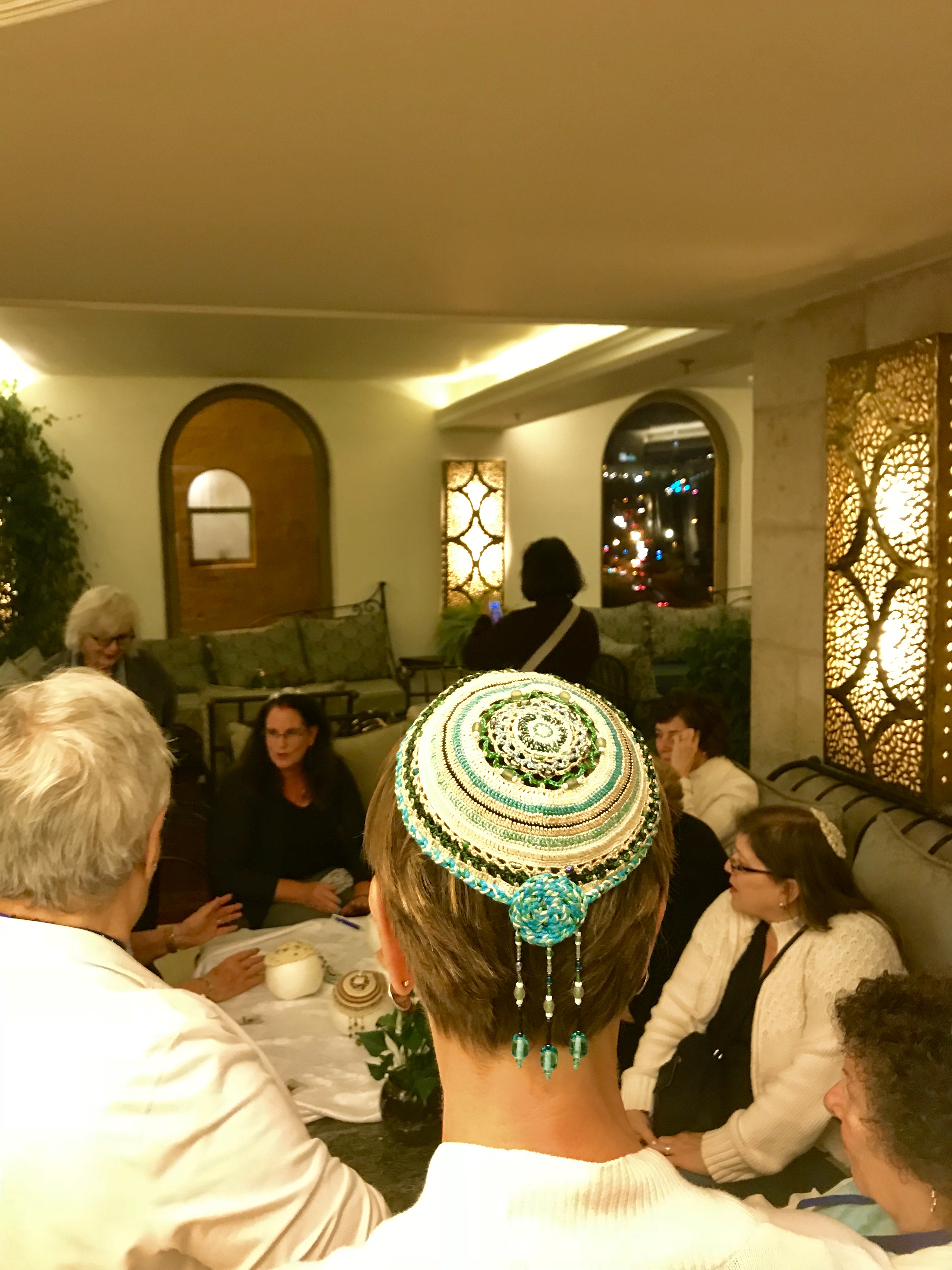
When you see our new kippot in synagogue over the next next weeks, you will be wanting one of your own or one for a woman in your life! Luckily, I will gladly share her website with you:

Shavua tov from Jerusalem,
OJC Hazak Israel Adventure – Post I
Our current OJC Hazak Israel trip possesses a unique blessing of radical amazement and appreciation because more than half of our group has waited 60, 70 or more years to travel to our homeland for the first time. Almost all of the rest of our group has not been in Israel for 20 or 30 years.
Each experience of these first three days feels precious. Each moment is over-filled with emotion and joy. Like the rabbis of medieval Europe who waited a lifetime to fulfill the mitzvah of putting their feet in the holy land, our pilgrims too are filled with gratitude and pride to be here.
As we approach each experience, we acknowledge its place in Jewish and Israeli history, geography, and spirituality.
Afterward, we share our thoughts — about the layers of history at Caesarea, an introduction to Kaballah through making candles (“The human soul is the candle of God”) in Tzefat, wine tasting at Dalton Winery, the awesome safari to the middle of the Hula Preserve to watch firsthand the migration of thousands of birds coming to rest for the night in the swamp, and a meaningful visit to the residence for children at risk, Kfar Ahava.


Our thoughts are filled with the special element of gratitude. Not one moment is taken for granted.

There is present in each experience a great tourist moment, and embedded in that same moment, there is a pilgrim’s experience, emerging from connection to Rabbinic thought, Torah, and the stories we tell ourselves.

I share just two moments among countless others, pilgrims’ midrash about our tour of Israel:
1. During our hour-long visit to the Hula Preserve, we watched thousands of birds land to rest for the night along their migration route. The air was filled with the calls of cranes and the dramatic flight of thousands of birds of many varieties. After our visit, we read “I Want Always to Have Eyes to See” by Natan Zach, excerpted here:
I want always to have eyes to see
The world’s beauty; and to praise
This marvelous faultless splendor; to praise
The One who made it beautiful to praise,
And full, so very full, and beautiful.
… And then we recited a blessing: Praised are you Adonai our God, Ruler of the universe Whose world is like this! (Shekakha Lo b’Olamo).

2. During our walking tour of Kfar Ahava, we turned a corner and suddenly there we were – in the peaceful space created by OJC volunteers to remember Rob Katz z”l and Danny Klein z”l. The ability to speak about these two beloved people in the context of a visit to a healing program with powerful ties to OJC was meaningful to all of us.

And now – up to Jerusalem!
Am Yisrael Chai!
Rabbi Paula Drill
Addiction: A Jewish Problem, Not a Punchline

When I was a child, I overheard conversations about the shanda of my Poppy’s brother, Uncle Jake “the Horse Thief,” his jail time and his drinking issues. The implicit and explicit messages I received growing up were: Jews don’t do illegal things. Jews aren’t alcoholics. Jews drink a bit of wine in moderation for celebrations. But Jews don’t lose control; Jews aren’t addicts.
On Rosh Hashana this year, I spoke about addiction because Jews can, and obviously do, develop life-threatening problems with drugs and alcohol. To believe otherwise leads to an unwillingness to ask for help. The “shame” of having a problem Jews aren’t supposed to have prevents many from seeking support and treatment.
I chose to speak about addiction because addiction is an issue in our OJC community. On Rosh Hashana I spoke about addiction because the path of teshuva – redemption – is parallel to the path toward sobriety.
Most of all, I spoke about addiction because people struggle and suffer quietly, in isolation, with a profound sense of loneliness. They and their families carry a burden of shame and embarrassment because of the stigma attached. When I listen to their stories, I want them to know that the Jewish community is here for them, that we can hold it, that we will fight against the stigma and sorrow. I want them to feel affirmed, to hear their stories in public, to know that this Jewish community can speak their truths and not look away.
For our community to be as inclusive as we say we are, we must open our eyes and our hearts to the stories of those who are struggling with addiction to drugs and alcohol. And more than this, we must open our arms to the families of those who are addicts. Their suffering and powerlessness is never ending. Relief is not in sight. . . only endurance will get them through to the next day. I shared the stories of three OJC congregants and their struggles with sobriety, with loved ones’ addiction, and with feelings of extreme loneliness.
People were moved by the stories. I believe that they listened open-heartedly. But now is the time to take action. First, I encourage you to learn more about addiction in the Jewish community. Getting educated is one way to make a tikkun (a repair) in the world. I learned so much in preparing for the sermon. I hope that you will too:
- Olitzky, Rabbi Kerry, Renewed Each Day, Volumes 1 and 2
- Shapiro, Rabbi Rami, Recovery – the Sacred Art: the Twelve Steps as Spiritual Practice
- Steinberg, Rabbi Paul, Recovery, the 12 Steps and Jewish Spirituality
- Twerski, Rabbi Abraham J., MD, Living Each Day
Resources for Help:
- Twelve Step Programs: https://www.na.org/ or http://www.nnjaa.org/ (in Northern NJ) and http://rocklandnyaa.org/meetings (in Rockland County NY)
- JACS (Jewish Alcoholics, Chemically Dependent Persons, and Significant Others) 212-632-4600 and their website: www.jbfcs.org/JACS.
- Smart Recovery, a scientific, behavioral approach to recovery: http://www.smartrecovery.org/?gclid=CjwKCAjwu7LOBRBZEiwAQtfbGNQ_KXOOJWtd0X6Cr8qKmRqxJifgE3qJNfUhKUsdOZM3nLAsr28PMRoCku0QAvD_BwE
- Another useful organization: https://www.chapter9couplesinrecovery.org/
In my sermon, I spoke about another way for our community to make a tikkun, to bring the problem from outside our walls within. Most sobriety programs take place in church basements. If you are interested in working to bring a meeting or a support group here to OJC, please be in contact with me. Our congregation is dedicated to #OJCSupportsU, our program of mental health awareness and support. We are thus perfectly poised to open our doors to those in need of sobriety support. What a shift that would be for us here at the synagogue, knowing that we are not just acknowledging that addiction exists, but offering our holy space to be a part of people’s recovery.
The director of counselling services at an inner-city rehabilitation center for teen heroin addicts described why the center is successful: “This is the first place they’ve ever been that gives them unconditional love. We are the first people they’ve met who care enough about them to say No.”
The unconditional love paired with limits and boundaries that supports struggling teens is just what God does for us each year in these days between Rosh Hashana and Yom Kippur. We make mistakes, some small and some devastating. We could carry on like this indefinitely, harming others and ourselves, were it not for the High Holy Days calling us to account for our sins. At this time of teshuva, if we open our hearts, we encounter God. And God offers us unconditional love and cares about us enough to say No.
That ultimate no is tough business. Too often we ignore warning signs that our friends or family, or we ourselves are in trouble. Perhaps we are not aware that there is a problem, or are too embarrassed to seek help. And sometimes, we actually enable our teenagers to indulge in substance abuse, perhaps by buying the alcohol and serving it in our homes, by partying with them, or by driving our teens to and from parties where alcohol is served so they do not “drink and drive.” The message in these parenting choices is that using drugs and alcohol is normal, and harmless. . . which it is… till it isn’t.
“Choose life” is a core Jewish value. Choosing life includes being fully present to the abundance and blessings of our lives. It means not anesthetizing ourselves from the beauty or the pain. It means not causing harm to our bodies, our minds and our spirits.

In this season of repentance and atonement, I pray that we take the first steps toward awareness. Chemical dependency, whether it involves alcohol, narcotics, or cocaine, is a destructive, malignant condition. It claims as its victims not only the user, but the family members as well. Judaism teaches: Choose life. May we do so today and tomorrow and throughout the year 5778. Shana tova.
Rabbi Paula Mack Drill
Unite the Fight (against Hate)


Earlier this evening, more than two hundred people gathered at the Allison-Parris County Office Building in New City to speak out against the rise in hateful action and rhetoric. After the terror of Neo-Nazi white supremacists spewing anti-Semitic, racist and xenophobic speech in Charlottesville, VA, Rockland Pride Center joined forces with the Jewish and African American communities to stand up for acceptance and understanding. You can read more on Facebook and watch a video of the rally at Unite the Fight, #UnitethefightRockland.


I share with you here, in part, my words in the hope that it will motivate all of us to take action in some large or small way, every day.
When I was a kid of twelve or thirteen, some of my friends got into a big fight, choosing up sides and being mean to each other. I remember growing so tired of the whole situation and complaining to my dad, “I just don’t want to deal with it anymore!”
My dad answered, “Tough. You have to deal with it… because they are your friends and they matter.”
I’ve gotten a little bit older since then, and my circle of concern has gotten a bit broader. Today, not just my friends and family matter. All people, because we are all created in God’s image, matter. But some days, I really want to say, “I just don’t want to deal with it anymore!”
That’s when I hear my dad’s voice reminding me: You have to deal with it, because people matter.
We have gathered on an auspicious day, the first day of the new month of Elul, when Jewish people look forward to the New Year and attempt to return to our best selves in a process called teshuva, repentance. We cannot do it all at once. But each of us can effect change one degree at a time.
This hopeful thought can allow us to say, “If we are able to change ourselves by one degree, then all of us together can change the direction of our country with that same one degree of change.
Consider the fact that we all showed up here in New City today. Instead of turning on our neighbors, instead of finding differences, we are committed to identifying all that brings us together.
We have gathered for freedom, democracy, and our trust in justice. This week in the Torah portion we read: צדק צדק תרדוף
Justice, justice you shall pursue. The way that we pursue justice now is by rallying together and uniting the fight.
When Brooke Malloy, Executive Director of the Rockland Pride Center, asked me to speak tonight, she suggested that I share how the Jewish community is feeling now after the events of Charlottesville a week and a half ago. I can’t speak for the Jewish community as a whole, but I can tell you how I am feeling. My response is encapsulated in the story of the president of the Charlottesville synagogue who stood on the front porch with two hired guards while white supremacists and neo-Nazis walked by shouting, “There’s the synagogue. Let’s burn it down!” and “Jews will not replace us!” As a congregational rabbi, nothing steals my breath as much as the fact that fifty people inside, finishing their Shabbat morning prayers, were told to sneak out the back door of their synagogue for their safety. In the United States of America.
As I thought about what Brooke asked me to do here, however, I realized that sharing my story is only the beginning. My work against hate must continue by asking questions instead of telling. What does this violence and hatred mean to you as a gay person? As an African-American? an Hispanic or Asian or a person who came from Haiti or Dominican Republic?
Our task is to prove that love truly is stronger than hatred despite the evidence of the past weeks. Love arises from knowing the other. Rabbi Jonathan Sacks has written: “The test of faith is whether I can make space for difference. Can I recognize God’s image in someone who is not in my image, whose language, faith, ideal, are different from mine? If I cannot, then I have made God in my image instead of allowing God to remake me in His.”
Let me return to the idea of one degree of change. As Rabbi Scheff taught in his sermon this past Shabbat, we could create change if all of us dedicate ourselves to get to know one new person every day, a person we do not know, a person who might look different from us. Try looking someone in the eyes who is in your office or in your class or at the store where you shop… someone you have never spoken with before. Say hello. Tell them who you are. Ask them who they are. And let us change the world together one degree at a time.
Because love is stronger than hate.
With prayers for peace, Rabbi Paula Mack Drill 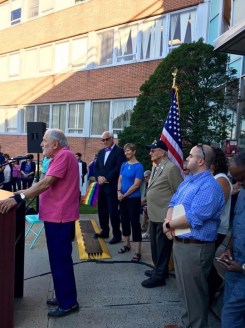
Confronting the Unthinkable
This blog post is dedicated with love to the memory of Daniel Ae Roo Beer, age 11 years and six days. And it is dedicated to his grief-filled parents and brother as they put one foot in front of the other, moment by moment, day by day. I pray that my words are healing to the Beer family, to the many communities who mourn Daniel, and to anyone who faces sudden, traumatic loss. May we all be comforted among the mourners of Zion and Jerusalem.
There is suffering and sorrow in the world. We do not look it in the face every day; we push it away because we have lives to live and children to raise and joy to seek. We know that suffering exists in this world, but thank God, we choose life.
So when sorrow hits us hard, when the loss is personal, breaking our hearts, we are in shock. We ask, “How could this be? How could this happen?”
Some of us believe we have answers based on our experience or belief or non-belief. I am familiar with the theories and the theologies. But when I face suffering as a member of a community, when I am a part of the sorrow, there is only one thing that I know. I know that I do not know why.
The loss of Daniel cannot be fixed. Answers to the question of why it happened cannot fix the reality of Daniel’s being gone from our lives. It cannot be fixed. But it can be healed.
Judaism teaches us how to heal: we heal by choosing life. Daniel showed us how by embracing life for 11 years, every moment of it, and all its fullness and luxury and joy. How can anyone in the community who loved Daniel find the way back to that kind of living from out of suffering and sorrow?
How does anyone find a way back toward life from out of the depths of loss?
Each one of us understands that we are part of concentric circles of caring. An immediate family, in the grip of loss, is the innermost circle. That is where our focus must go.
From our place outside of the most inner circle…
We choose to be quiet rather than offer theories.
We choose to be silent rather than offer opinions.
We listen first, with open hearts, without judgment, rather than distract with details and stories and any conversation other than that which is before us.
We understand the unique nature of every loss rather than offer our own experience without being asked for it.
Ultimately, Judaism teaches that healing begins when we offer nothing but our presence. Think of all the concentric circles. Imagine the power of everyone offering loving presence, directed inward toward the innermost circle, hoping to begin the process of healing.
All of us who knew and loved Daniel Beer learned from him that the world is a joyous place. Daniel’s life taught us that curiosity, limitless love, humor and kindness are the best way to live a life. Everything has changed now, except for one important thing: Daniel’s life lessons remain. The healing begins when we turn toward the joy that defined Daniel’s life.
HaMakom y’nachem etchem b’toch sha’ar avelei Tzion v’Yerushalayim. May the One who is the Place of Comfort give comfort to you among all of those who mourn in our communities.
L’shalom, Rabbi Paula Mack Drill
Interfaith Weddings: Responding to the Questions
My daughter called from Israel yesterday at about 4 o’clock in the afternoon. “Mom, where have you been? Our family has been texting for hours about all of the social media regarding Conservative rabbis and interfaith weddings. We haven’t heard from you at all.”
It was one of those days, trying to get everything done before leaving for a week of vacation. I had not checked into our family text group or Facebook all day. When I finally opened the texts, there they were – my kids waiting for their mom, the family Rabbi, to offer an opinion.
The family discussion was mostly a furious-paced posting and re-posting of various statements that had been published by my colleagues throughout the day. So I read many of the opinions all at the same time. The idea that struck me first was how proud I am to be a rabbi. As I read the comments and opinions, I observed that rabbis ask more questions than offer absolute answers. For the most part, rabbis advocating officiating at interfaith weddings and those opposed wrote with thoughtful consideration and respect for each other. In the modern day pages of Talmud that we call Facebook, I did not see very much disparagement or lack of respect (though I did certainly read some of that). The same cannot be said about the pages of our esteemed Talmud!
I was not available for the family conversation yesterday, but today I am ready to answer my children and their questions. (Full disclosure: They are all in unanimous agreement that Conservative rabbis should not officiate at interfaith weddings.)
Dear Drill kids,
Dad and I are grateful for and proud of the people you have chosen, and are choosing, to spend your lives with. You have fallen in love with good people whose core values match your own. And you have all chosen Jewish people as your partners. We do not take these facts for granted.
I do not say that I am grateful for your choosing Jewish partners out of prejudice or closed mindedness. I do not say that I am proud as if somehow your parents did all the right things that led you to choosing these people. Many people raise their children just as we raised you and not all of them choose to marry or partner with Jewish people. Falling in love is a very personal matter. I could never take credit. The four of you have taken the foundation we provided and moved forward in your own ways.
Still I am grateful and proud. Judaism is a particularistic religion in a world that seems to prefer universal open-mindedness. Being counter-cultural is not easy. It leaves one open to criticism of backwardness, naïveté or bigotry. But as you, my children, have heard me say since you were very young: Judaism is a very long chain and I do not want to be the one to break it.
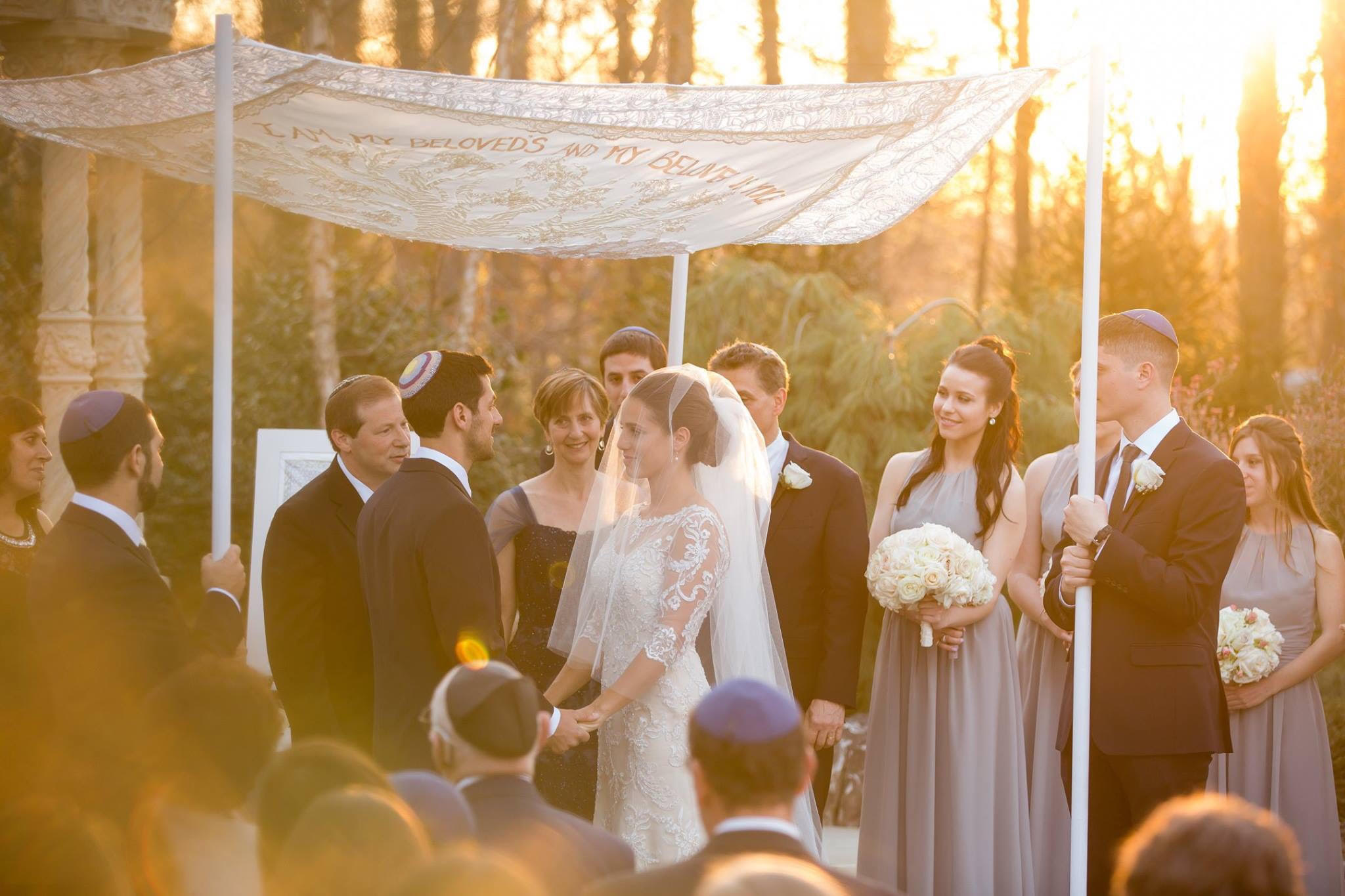
I love my children more than anything in the world. If you had chosen (or choose one day in the future) a non-Jewish partner, neither I nor your Rabbi, Craig Scheff, will officiate under a chuppah with you. The blessings recited and the ritual enacted there contain holiness when they are completed by two people who share the same covenant with God. It is my obligation as a rabbi and also as a Jewish mother to draw the lines of distinction even when they are painful.
And yet I think you know, that if you chose a non-Jewish spouse, I would welcome that person into our family circle and teach him or her to love and respect Judaism. I would hope that with family and community influence, your future home would be a Jewish one. I know that is not easy, but I have seen many examples in my synagogue of non-Jewish partners supporting a Jewish family.
As the texts were buzzing yesterday on my unattended phone, one of the many things I was busy with was taking photographs with a bat mitzvah and her family – her Jewish mom and her non-Jewish dad. I have been attached to this family since the bat mizvah girl’s naming, seeing them through her older brother’s bar mitzvah, the funeral of her grandfather and her own bat mitzvah studies. Her non-Jewish father calls me his rabbi and I consider him my congregant.
In between the snapping of photos on the bimah, I shared with them the conversation that was going on in social media and with my family. My bat mitzvah’s mother said to me: “I know that as a rabbi you could not have married my husband and me, but as a person, you would have wanted to.”
She said that because she knows how much I respect and cherish her family. But as I thought about it last night, she was not actually correct. As a person and as a rabbi, I cannot officiate at a Jewish wedding ceremony if both people are not Jewish.
I do not think that I will change my mind even if some rabbis of the Rabbinical Assembly move toward officiating at some kind of interfaith wedding ceremony.
My job as a rabbi is to build relationship. It is also to protect a sacred obligation to the holiness of my particular religion. I know that it is possible to be a rabbi to interfaith families, to welcome interfaith couples and to raise their children as Jewish in my synagogue community. I am willing to continue asking questions and hearing the stories of real people. That is my calling.
A wedding is a sacred moment in time, but a marriage is for a lifetime. As a rabbi, in relationships where one partner is not Jewish, I won’t be under the chuppah, but I will be there for the marriage.
Rabbi Paula Mack Drill
Under the Wings of the Shechina

It is a unique command of Judaism that we not only remember but must experience history as if we were a part of it. The Passover seder instructs us about the Exodus from Egypt as if we ourselves were slaves in Egypt. Soon at Shavuot, we will once again stand at the foot of Sinai to receive Torah. At each moment in our Jewish lives, ritual bypasses our intellect and goes directly to our hearts, requiring us to remember and re-experience. We fulfill this mitzvah of remembering well, we Jews.
But then Yom Hashoah arrives each year. The command to remember becomes so painful that it takes our breath away. We weep for what we never knew, or as Sister Maureen of the Dominican Ministry said today as we gathered to dedicate our Shoah Memorial, we feel physically ill. With regard to the Shoah, the command to remember requires opening our hearts only to have them broken.
When Rabbi Scheff began teaching his sixth graders about the Holocaust this year, he brought them to the front door of the synagogue and asked how we remember things that we never experienced. He showed his class our memorial, then under construction, and asked them how we should remember.

Today, one hundred and fifty of us dedicated our memorial, thanking Dr. Larry Suchoff and the Holocaust Remembrance Committee for their perseverance and passion to see the project to fruition. Survivors, children of survivors, guests, nuns from the Dominican Sisters, congregants old and young, all gathered to hear shofar blasts and to dedicate ourselves to ensuring that we remember as a community. “Never again” is a goal toward which we will continually strive.

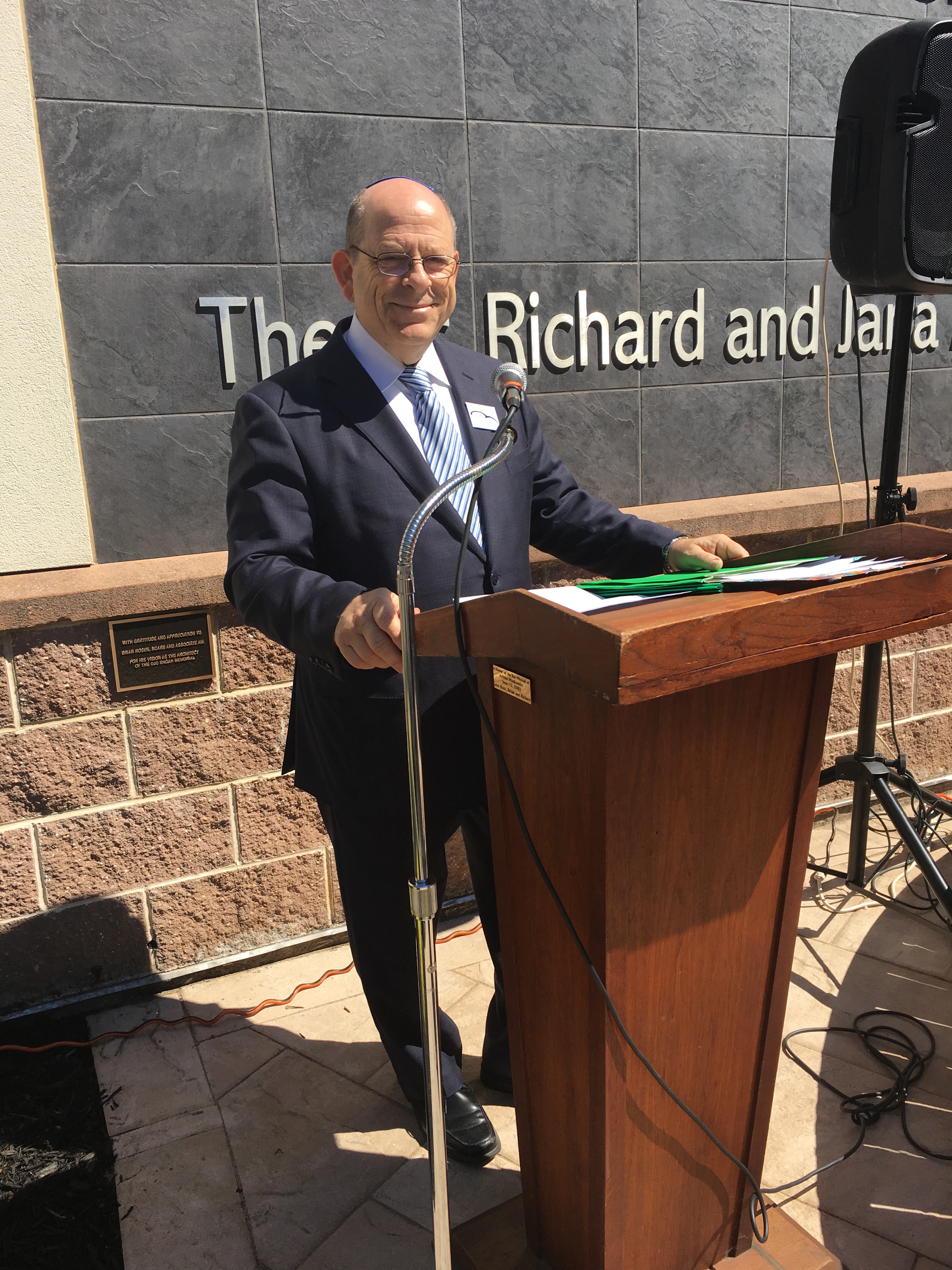
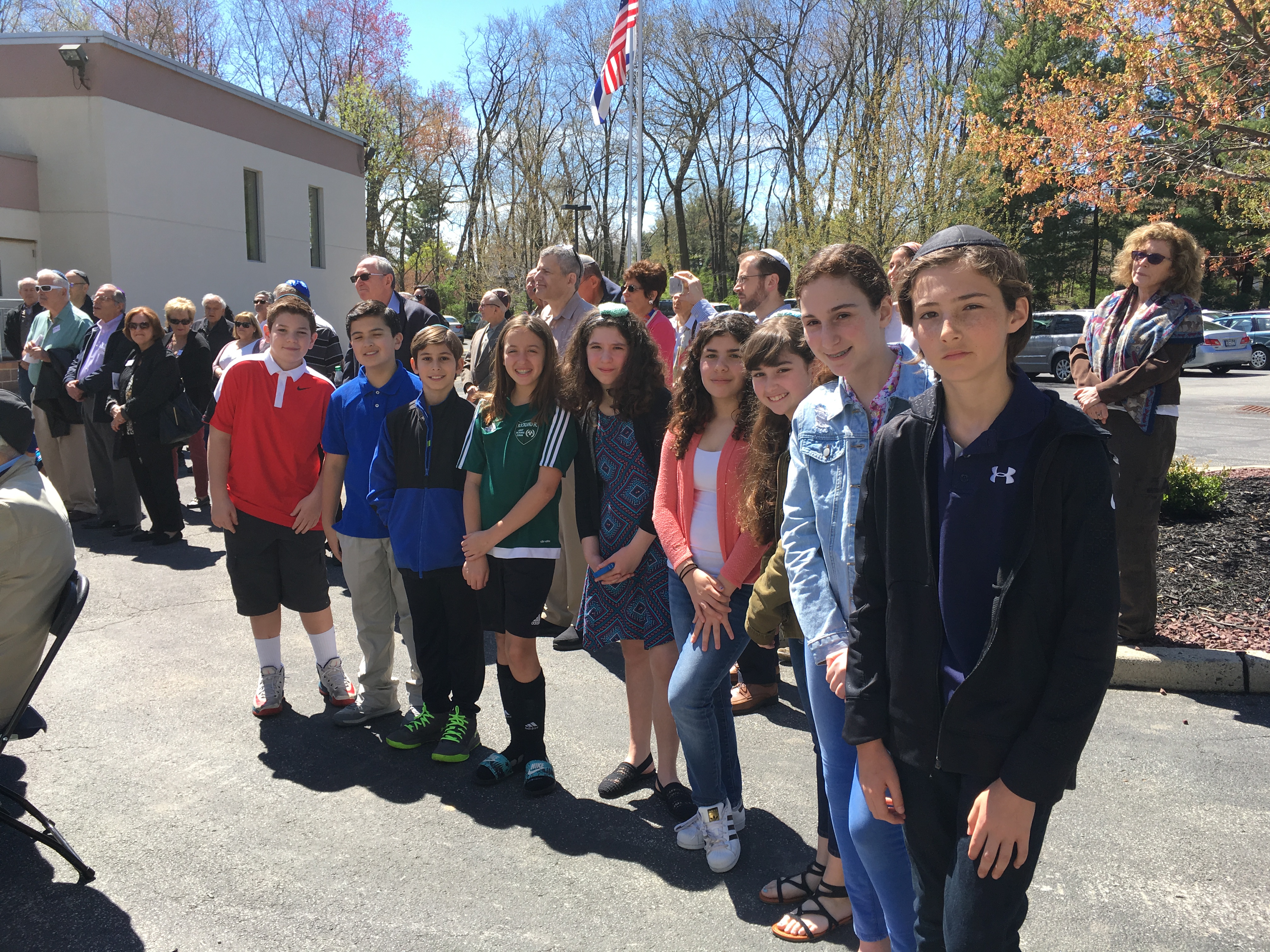
Today, Rabbi Scheff’s sixth graders showed how well they had learned the lessons he taught them. Students read short biographies they had written about survivors who are or were members of the OJC. Each student ended his or her brief statement with: “It is an honor to know you.” Spouses and children accepted the simple statements of these eleven-year old children as gifts. I watched the faces of Frieda and Marie as they listened to their stories being told, and I saw fresh grief, but also validation and hope.


From today forward, we will sit on the benches, reminiscent of train tracks. And we will look at the mosaic which depicts either six candles or six chimneys, depending on your understanding. We will teach and meditate and rest in the sunshine. And we will cherish the wall art chosen for the memorial where under the wingspan of the flying bird, our OJC logo, we read: tachat kanfei haShechina, under the protective wings of God’s Presence. And then, we will enter into our sanctified home knowing that we must act in every moment with remembrance in our hearts.
Through the night and all through tomorrow, we will pass by the memorial and quietly enter the sanctuary where six memorial candles burn as we fulfill our ritual of Keepers of the Flame.

For how long do we need to read and teach about the Shoah? Until the end of days. Until then, we will follow the command to remember m’dor l’dor, from generation to generation. Today’s sixth graders will one day teach their own children.
May Yom HaShoah call us to actions of love and understanding and the overcoming of hate and fear. As Frieda Seidner said, as quoted by her biographers today, “The key is to love all people, but love our people most of all.”
May the memory of six million be sanctified and remembered. Rabbi Paula Mack Drill
Read more and watch the video on LoHud News: http://www.lohud.com/story/news/2017/04/23/orangetown-center-dedicates-holocaust-memorial/100695178/
#JDAIM Spotlight 4 – Beth Steinberg, Director of Shutaf
Beth is our Scholar in Residence this Shabbat, February 24 and 25, as we honor Jewish Disabilities Awareness and Inclusion Month. Join us for Friday evening services at 6:00 pm, Shabbat morning at 9:00 am and stay after Kiddush for more learning with Beth.
My son’s challenges are significant but I’m not afraid.
I am unsure about the future. His happy adulthood, my happy years as an older adult. What are his rights, what do I deserve, what will be the responsibilities his older brothers will shoulder? Will he be happy?
I worry he might not be happy. But he’s almost always happy. That makes me less afraid.
When I write about Akiva – his needs, his challenges, my challenges – I choose my words carefully but I am not afraid. Except for when I hit ‘publish.’
When I talk about our journey as a family – the tough moments, the tearful moments, the moments that I just wish it were different – I try to be honest. I know honesty is important. I know many people pity us, pity him, don’t truly understand what it means to be his parent, his full-time advocate, his person, his people, his caring community. We’re the people who help him shower and dress, who care for him when he is sick, who sing songs with him. We’re the people who love him. Sometimes, I wish it were different but I am not afraid.
When I post a picture of Akiva, I choose the happy ones, the ones where his cute, uneven teeth, his often crossed-eyes, his sometimes grubby face, are softened by the happy smile on his face. He’s kinda funny-looking but aren’t we all?
I am not afraid to show the face of disability – his disabilities that is – via my son. I am not taking advantage of his well-being. I am letting the world know that disability is happy, disability is every emotion and more. Just like not having a disability is so many things and so many emotions and so many experiences.
I am not afraid of exposing us, of sharing him. While I know he’s unaware of this exposure, I know that showing him to the world, my extended world, will help ease fears and misconceptions about disability. I hope.
But I am afraid of a world that treasures beauty. Where skinny bodies and 6-pack abs, along with being blonde and gorgeous, is regurgitated on television and in movies. There are few positive images shown of real people who look different, as opposed to actors playing a part.
I’m afraid for other parents of children, teens and adults with disabilities. Those who feel unsure that the world will appreciate their loved ones. That the world will look kindly on their stories. Their tales of difference and challenge, of unusual beauty lost and found.
I’m afraid of a world that divides people up according to who can and who can’t. A world that divides those with disabilities according to who’s got this and who’s got that. A world that decides who’s high-functioning – whatever that really means – and who’s not. A world that sentences you and judges you for your difference without knowing what that really means.
So, I work past the fears. I tell his story. I tell our story. I invite you in, to read, listen and comment, so that you can understand and appreciate. So you can smile at the different-looking-behaving-whatever person the next time you see them on the street and be glad that they’re a member of your community. Because their people, those who love them, need you to try to be less afraid.
“And a rock feels no pain. And an island never cries.” Paul Simon
Beth Steinberg
http://blogs.timesofisrael.com/i-am-not-afraid-finding-strength-in-difference/
Forward March… and then…
I offer the words of this post just as I offered the words of my sermon this past Shabbat: as a prayer. Shabbat Parashat Sh’mot was the day after the inauguration of the 45th president and on the day of the Women’s March on Washington. I began with an intention from a poem by Neshama Carlebach written for this past Shabbat: “May we sing and pray with all that we are, loud enough for the whole world to hear, but soft enough to hear the Angels join us.” Writing words both loud and soft enough requires that I write with humility but also with confidence. Words offered with heartfelt integrity have the potential to be unifying and healing.
There are many reading these words now who believe that the world is ending. I remind you of President Obama’s words when he told us that the only thing that is the end of the world is the end of the world. If you are one who is worrying about the new administration in Washington, I am writing for you.
There are also those reading these words who believe that perhaps Washington needs a bit of a shake up and that something good could happen from a little less business as usual. If you are one who is optimistic about our new president, I am writing for you too.
Because regardless of how we voted, the thing that unites all of us is a belief in acceptance, tolerance, and protection of the vulnerable among us.
Twenty-five members of my extended family marched in New York City on Saturday, from my five-year old nephew to my mother-in-law’s best friend who is in her eighties.
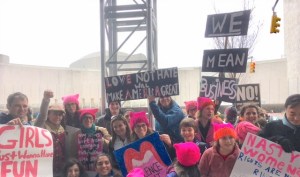
Many OJC congregants marched in Washington and in New York. Many marchers were gathered by organizations with which I am affiliated: National Council of Jewish Women, American Jewish World Service, Planned Parenthood, Hazon, National Organization of Women (NOW), and National Association of Social Workers. In sum, there were more than 600 marches around the world, on every continent. Estimates suggest that there were one million five hundred thousand marchers world-wide.
There is a difference between a march and a protest: one moves forward, the other pushes back.
I shared with my congregation the Women’s March Statement of Principles; ideals to make us a great nation, not to devolve into anger. https://www.womensmarch.com/principles/ The Mission Statement of the March explains that when we walk together, we recognize that our vibrant, diverse communities are the strength of our country. Defending the most marginalized among us is defending all of us. To me, these ideas sound a lot like Jewish values of protecting the widow, orphan and stranger among us.
I asked my sister-in-law Rebecca to share with me why she organized our family and then took a train from Boston to march together down Fifth Avenue. She wrote that she was marching to support women and women’s rights, but not just for women. By marching, she wrote: “I am being visible, making a declaration, being heard. All humans’ rights and dignity matter to me and that is why I felt compelled to do something more active and visible this year. I don’t want to remain silent about something that really matters.”

Ideas about the march connect powerfully to the Torah portion we read this past Shabbat. In Sh’mot, we begin to hear the story of Moshe who ran out of Egypt to Midian and then walked back in to take his people out, to take the Israelite slaves on a walk toward redemption. Moshe is certainly the hero of the entire book, but a counter narrative exists just below the surface, the story of five heroines who put the Exodus into motion. (Read more about these women in Sh’mot Chapter 1:15 through 2:10.)
Midwives Shifra and Puah are ordered by Pharaoh to kill newborn Israelite boys but they refuse to follow through. In their refusal to obey, they teach that there are moral limits to power and serve as models of civil disobedience.
Yocheved gives birth to a baby boy. Seeing in him beauty and promise (as all mothers see in their children), she refuses to throw him in the Nile. Her actions to hide her baby show bravery and resilience. Placing her child in a basket on the river shows a stubborn refusal to relent in the face of an unfair fate.
Miriam, who later gains the appellation of Prophetess, runs along the side of the river to make sure her baby brother survives. She has the chutzpah to approach the daughter of the Pharaoh and offer a nursemaid, her mother, for the baby drawn from the Nile by the princess. She refuses to be helpless in a hopeless situation.
Bat-Paro, the daughter of Pharaoh, is perhaps the most courageous of all these women. When she opens the tiny basket and takes the baby to be her own, she is showing disobedience toward her father, the very one who decreed the infanticide. She knew who that baby was, yet still she saved its life. A midrash imagines God speaking to Bat-Paro, “Moses was not your son yet you called him your son. You are not my daughter but I shall call you my daughter.” In rabbinic tradition, she is one of the few characters of the Torah who is so righteous that she entered into paradise in her lifetime.

As Jews, our ancestors moved from slavery in Egypt toward freedom. They were not freed by standing still; they had to walk toward their redemption, one step at a time. For those of us today who wish to make history, we too must walk. This past Saturday was not about having a symbolic march in Washington as an end-goal. Success for this march began the day after January 21.
Success will be measured by the way that we stand for people at risk: people of color, identify with the LGBTQ community, belong to religious minorities, or are people with disabilities. Success will be measured in our strong statements against acts of hatred and violence against minority people, including anti-Semitic actions such as the bomb threats against JCCs nationwide. Success will be measured by the ways in which those of us who disagree about policy find compassionate and empathic ways to listen to each other, to hear the differences but recognize that we all want a United States where everyone feels secure and at home. And success will be measured by how quickly we awaken from our leisure induced comas to become alert and active participants in our government.
Jewish history is about our people’s moving from one place to another, from one reality to another. I’m ready to walk into this new chapter of American history. I choose to do it through marching forward. I hope that you will join me. There is a difference between a march and a protest: one moves forward, the other pushes back.
I look forward to the conversation,
Rabbi Paula Mack Drill
Breast Cancer Awareness Does Not End on October 31
Time collapses each time I have my annual mammogram. Months and years fold in upon themselves like an accordion. My last mammogram was a year ago and yet, as I signed in at the reception desk today, it felt like I had just checked in not a month before. How does the just-been-here-just-done-this feeling surface every year?

Millie Ibarra walked 39 miles for Avon Breast Cancer Walk 2016
Millie Ibarra, our family nanny and dear friend, is a ten-year breast cancer survivor. I made my mammogram appointment today, November 30, to honor her birthday. I know that it has been more than ten years since Millie’s diagnosis, but when I put on the robe before the mammogram, time collapsed for me. It felt like just a moment ago that I was sitting in an office at UMDNJ with her, listening to Dr. Clark tell us that Millie had stage four breast cancer.
My mother and maternal aunt both died of metastasized breast cancer. I bring them with me into the cold, antiseptic room with the spaceship-like imaging machine every year, wishing that they had benefited from all the advances in breast cancer diagnosis and treatment of the past decades. Although my mother’s twentieth yahrzeit is in two weeks, it feels like just a minute ago that she was on the phone, telling me that the cancer had spread and that it was time for me to come home to help her. I packed up Josh, just five months old, left the older three at home with Jon and flew to Maine. Time collapses.
For my mom and my aunt and Millie and my friends, and for the scores of women at the Orangetown Jewish Center who are fighting or have fought breast cancer, I religiously make my annual mammogram appointment . And I go on time. I say a prayer, smile bravely through the test and leave, hearing the precious words, “Looks good! We’ll mail the report.” The Breast Center provides bouquets for every woman and I always choose yellow roses, my mother’s favorite.
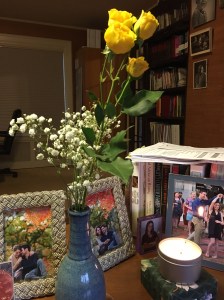
One year, the technician could not find any yellow roses amidst the pinks and reds. When I burst into tears, she put her arm around me. “Don’t take any roses this year,” she said. “Next year, take two”. I am one of the lucky ones; the seven in eight, not the one in eight.
Breast cancer awareness does not end on October 31st each year. Women (and men who are at risk) must stay vigilant all through the year. The courageous women of Orangetown Jewish Center who established the Pink Bag Project take care of each other and anyone who is diagnosed as time goes on.


On December 9 and 10, they are bringing Pink Bag Project Shabbat to us at Orangetown Jewish Center. Melissa Rosen, Director of National Outreach of Sharsheret, will join us for Shabbat to teach about breast and ovarian cancer awareness, research, treatment and family support. The purpose of this Shabbat is to share ways to support caregivers of family and friends who are ill. Join us on Friday, December 9 at 6:00 pm for services and Dinner and Dialogue (RSVP today to Diane Goldstein, dolphin99@optonline.net) and on December 10 for Shabbat learning during services and after kiddush.


And if it has been more than a year, if you have let time slip by, consider making your mammogram appointment today.
With prayers for good health,
Rabbi Paula Mack Drill
 Two Rabbis, One Voice, Three Opinions
Recent Comments