Yet More Thoughts on Covid-19: It’s Difficult to Think of Much Else These Days
My youngest son Josh flew back to Israel this afternoon after three months in the United States following completion of his army service.

As soon as he lands, he will go straight to his apartment where he will begin 14 days of quarantine. His roommates will leave food for him outside his bedroom door and whenever he emerges, he will need to wipe down every surface he touches. Josh has a great attitude about the quarantine, explaining that he has a lot to read and will have plenty of time to prepare for his entrance exams for Tel Aviv University. The quarantine is inconvenient and worrisome, but it is required by Israeli law and certainly not devastating for Josh.
My in-laws are 87 and 92 years old. Earlier tonight, I brought dinner over as is our Wednesday night custom. We sheepishly bumped elbows and it felt very strange not to embrace them. They told me that they had sold their tickets to see the Philadelphia Philharmonic this Sunday, and my mother-in-law regrets missing her favorite conductor. It is isolating and worrisome to be an elder through this time of Covid-19 precautions, but the precautions are necessary and not devastating for them.
My niece and her roommate moved into my guestroom tonight since their college announced its closure just three days after they had returned from spring break. They brought most of their stuff here with them, not sure if their college will reopen this year. Online courses are beginning for them next week, but they wonder how much learning they’ll accomplish. College and university closures are extraordinary and difficult for everyone involved, but they are prudent and not devastating for my niece or her roommate.

Throughout this roller coaster of a growing national medical emergency, I have tried to maintain balance and perspective for myself and on behalf of the OJC community. I am proud of our president, Michael Pucci, and our professional staff, who have made very difficult decisions in a reasonable, calm, and careful manner. If we err, we err on the side of safety. The decisions that we make impact every age and stage of our congregation.
WNBC Coverage of OJC Livestreaming Purim
It was disappointing to cancel festivities for Purim – a carnival for children, a dance party for which our in-house band rehearsed for months, an adult night club, and a grand seudah on Purim day. Volunteer committees had worked for months to plan all of these joyful programs, and everything except for the Megillah readings was canceled. Disappointing, yes. Devastating? No.

But let’s consider together what truly is devastating about the Coronavirus pandemic.
People are becoming very ill with this terrible flu, especially elderly people and those with compromised immune systems. We pray for speedy recoveries.
People who live on the edge financially will be pushed over that edge by weeks of quarantine or illness. Those who are paid daily wages, who punch a clock, who do not have adequate sick leave, will struggle mightily to recover long after the flu is gone.
People with inadequate medical insurance will struggle to pay for prescriptions and doctors’ bills. People who are undocumented will hesitate to go to hospitals or doctors.
Many of the children whose schools are closing will miss their free breakfasts and lunches, dependable nutrition for 2/3 of their daily meals. Many parents will have a difficult time replacing those meals for their children. Many parents will be left figuring out how to go to work without childcare now that schools are closed.

Elderly people, adults with developmental disabilities or mental health issues, the youth who attend the twice weekly drop-in program at the Rockland Pride Center, family members who attend support groups, all will be impacted by the closure of community centers and other gathering places.
It is always true in our society that those who are most vulnerable suffer first and suffer the greatest amount when difficult times hit. I pray that we keep all of these people in mind and take action if we are able to help.
Reach out with phone calls to the elders of our community who are experiencing social distancing now. Many are staying at home as advised. Others live in nursing homes and assisted care residences where visiting is currently discouraged. Be sure they know that you are thinking of them.
Write an extra check to Meals on Wheels. Drop off more food than usual for People to People or Rhoda Bloom Kosher Food Pantry, great Rockland organizations that help those in need make ends meet.
Write a supportive note to friends who are at high risk from Covid-19 because of their professional work – hospital emergency room workers, EMTs, nurse aides in facilities for the elderly, doctors and nurses.
At the very time when we need to be close to one another, we are counseled toward a necessary “social distancing.” When the world feels unpredictable, we yearn to be in community, yet we are canceling gathering after gathering. We are used to planning ahead, but we cannot prepare because we do not know what will happen next.
But for the most part, most of us are among the privileged few. If we are quarantined, our community and friends will ensure that we have food to eat. If we need to miss work, we will not risk losing our jobs. If our children’s schools close, they will have plenty to eat for breakfast and lunch. If we grumble about doctors’ bills, we can eventually pay them without going under. And if these things are not all true for you and your family, but you are a part of the OJC, you belong to a supportive, sacred community that will help. You are not alone.
Maintaining an attitude of gratitude will help us get through these confusing and difficult times.
Kol Yisrael arevim zeh bazeh – All of Israel is responsible one for the other. When we say bazeh (in each other) instead of lazeh (to each other), we add a deeper truth to this foundational rabbinic teaching. Not only are we responsible, we are intertwined.
With friendship, Rabbi Paula Mack Drill
Would you just skip it?
What if you knew for sure that you would see or hear something unusual? What if you knew for certain that you would experience something extraordinary? Would you miss it?
Oh, I know that Saturday mornings are just right for getting errands done, picking up the dry cleaning or purchasing a new shower curtain. Saturdays are perfect for boot camp workouts, kids’ soccer tournaments, or – on crisp sunny days – hiking in Harriman State Park. On Saturday mornings, you can meet your cousin for coffee or visit your niece after surgery. I know… on Saturdays you can even just sleep in after an over-scheduled week.
But what if being in Shabbat on a Saturday morning promised something that transcends all of that? Would you just skip it?
If you come to synagogue on Saturday morning instead of everything else you do…
Perhaps the davenner* will chant El Adon in a different tune, not the expected tune, but in the one that was sung in your childhood when you sat next to your grandfather in shul.*
Perhaps you’ll watch as five-year-old twins run purposefully down the aisle and onto the bima* at the start of the Torah service to be handed silver Torah crowns which they hold up proudly as if they are the whole point of the service. You definitely find yourself grinning as you watch them walk solemnly behind the adult holding the Torah.
Perhaps you’ll see a proud nonagenarian ascend the bima, slow but sure-footed, to accept an aliyah* and receive a blessing for the 80th anniversary of his bar mitzvah.
Perhaps you’ll see a seven-month-old baby girl receive her Hebrew name on the bima and lean forward to send a big, sloppy toothless grin in the direction of her great- grandmother for whose husband she has just been named.

Perhaps you will rise when the Prayer for Healing is chanted and you will have a clear picture in your mind of your friend who is recuperating from surgery. You will sense that your prayer can reach him in his Boston hospital.
Perhaps you’ll be invited to open the ark when the Torah is placed back there after the recessional and when you look at the colorfully decorated Torahs, the congregation sings Hashivenu, “Return us to the days of old.” And you aren’t sure why, but you feel something in your heart unlock.


Perhaps you’ll see a man chant the haftara* to honor his brother’s yahrzeit* and as you follow in the English, you realize that this story of Jonathan and David from the Book of Samuel was your haftara when you became bat mitzvah. As you pay closer attention, you remember all the words.
Perhaps you’ll sit down next to a woman you don’t know well, but has always reminded you from a distance of your mother. And as you silently tear up, missing your mother so much even after 24 years, this fellow congregant hands you a tissue. And you feel your mother’s soul closer than you have in years.
Perhaps the words of the Dvar Torah* will strike a chord deep within you, answering a question that has been lurking in your mind, an important question not yet articulated.
If any one of these transcendent moments were likely to happen on a Saturday morning, would you just miss it?
Holiness does not arrive with trumpets and drums but with quietly perceived moments.
All of these moments do happen. Will you be there with me to experience them? Life holds the promise of being so much more than our own routine.
A community of holiness awaits you every Saturday at nine. I’ll see you there.
Rabbi Paula Mack Drill
*Translations so we’re all on the same page:
Davenner – one who is praying, in this case, the one who is leading the prayers.
Shul – a cozy Yiddish word meaning synagogue.
Bima – platform at the front of a synagogue where the Torah service takes place.
Aliyah – the honor of reciting blessings before and after a portion of the Torah (also called an aliyah) is chanted.
Haftara – a section from the Book of Prophets chanted on Shabbat and holiday mornings.
Yahrzeit – the anniversary of the death of a person according to the Jewish calendar.
Dvar Torah – literally, words of Torah, designates a sermon or a teaching given by a rabbi or a knowledgeable person at Shabbat services.
#OJCSupportsU
We can be proud of OJC.
I do not write that sentence lightly. It is something to be proud of our synagogue, and let me be clear: I am speaking about the people of the place, not the place itself.
This past Shabbat, #ojcsupportsU, under the creative leadership of Miriam Suchoff and Mark Brownstein, once again served our community with a sacred, meaningful consideration of mental illness and mental health. Together, we spent a Shabbat and Sunday putting a face to mental illness.
A Friday evening Neshama service lead by Music Director Amichai Margolis and a community dinner after established the tone of the Shabbaton: Olam hesed yibaneh. We will build a world with loving kindness.
Shabbat morning services were highlighted by a transformative sermon given by one of our own congregants, Sharona Levine: Sharona Levine’s sermon January 2020. In powerful and accessible words, Sharona shared her story. She explained why she decided to tell her community about her family’s struggles with mental illness: “What made me decide to speak up was the day I finally felt empowered. And I wanted to pass that feeling on to someone else. I went from feeling bereft in the beginning stages, to ashamed, from self-blame to angry – to educated – to empowered. Why am I standing here in front of you today? Because I want you to know: If you are the sufferer – you are not alone; if you are the caretaker – you are the key, and you are not alone; and if you are a community member or passerby in anyone’s life with mental illness— you can make all the difference by your language, your non-whispers, and your role modeling to others.”
Those of us who heard Sharona‘s words will be changed forever. So many people approached her after to share their own story. After all, when it comes to mental illness, everyone has a story.

Miriam Suchoff led a special program for the children of our community and their parents about recognizing emotional responses in others. At the end of kiddush lunch, congregants participated in interactive dramatics and discussion. We had a Rabbis’ Tisch for our teens where we discussed how and when to reach out to others. In the afternoon, we practiced a variety of ways to cultivate mental wellness: a walk, a talk, or yoga were the choices.
On Sunday morning, 25 people attended a breakfast roundtable presented by NAMI.
And the weekend was completed by a seasonal healing service led by Amichai Margolis and me.

So what was accomplished?
The people who participated in the Shabbaton experienced insights, gained information, and felt the support of our community.
The committee was invigorated and is busy planning next steps.
The clear message of OJC as an inclusive community was heard loud and clear.
And what of all the people who could have benefited from the Shabbat or the weekend but were not able to attend? The very people who need support so often are not able to come into community. We know this fact to be true.
We just keep trying. We just keep sharing the message that our intention is to stop the stigma. Want to join us? Contact Miriam and Mark: ojccares4u@gmail.com.
When we put a face to mental illness, we look all around and we see that it affects all of us.
With friendship, hope and optimism, Rabbi Paula Mack Drill
Conservative Judaism with 2020 Vision
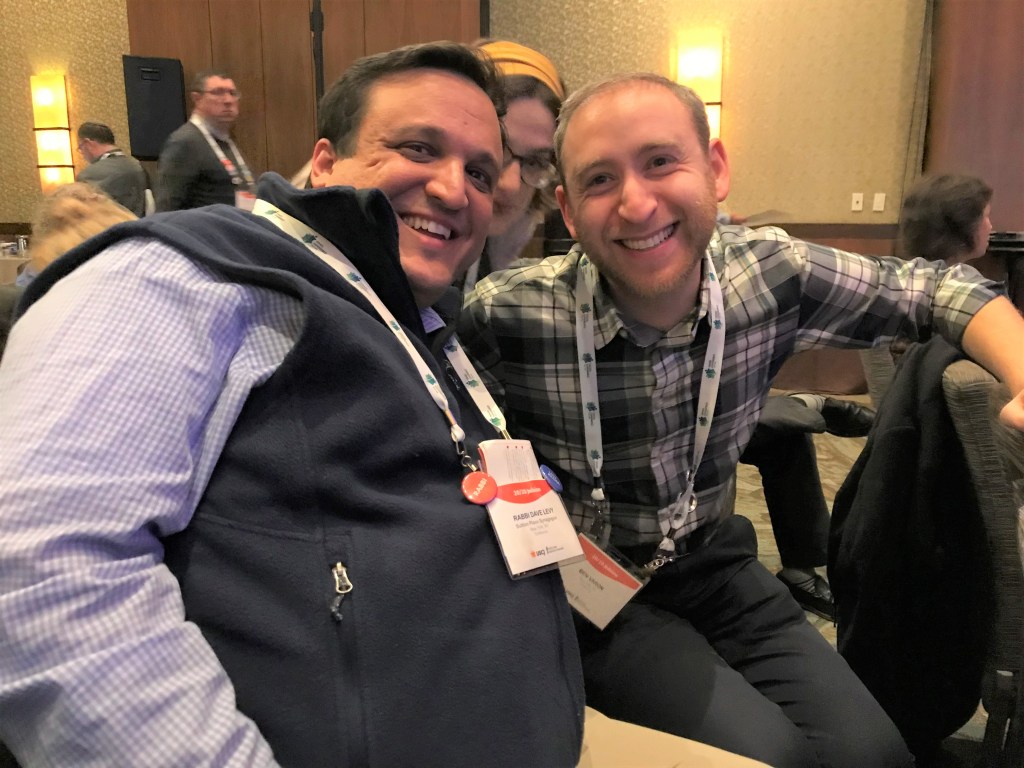
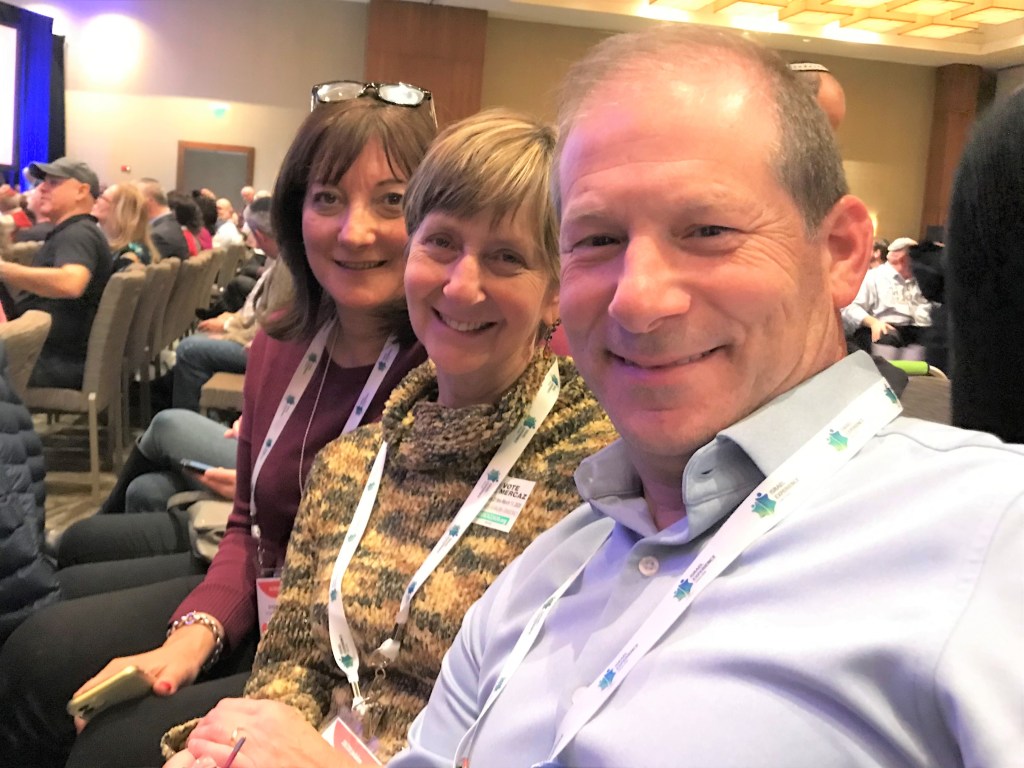
Rabbi Scheff and I arrived in Boston on Sunday afternoon, December 8, 2019 for the USCJ/RA (United Synagogue of Conservative Judaism and Rabbinical Assembly) conference and planned to have our first dinner together with OJC leaders Sharon Aach, Michael Pucci and Hara Hartman. What an additional pleasure to be joined by Michael and Hara’s two daughters, Greta and Sophia, who are both students in Boston. Sophia is a freshman at Northeastern University, and Greta is studying optometry at New England College of Optometry. As Greta filled me in on what it is like to be studying optometry, I reflected on how perfectly apt was the name of this year‘s conference: 20/20 Judaism.

As we are on the cusp of entering a new decade, Conservative Judaism’s leaders, professionals, clergy, and educators need to see clearly. With our vision corrected for 20/20, we will be able to make sense of today’s great challenges.

At this tumultuous time of change, threat, and discord the conference provided an optimistic space for sacred dialogue, for harnessing our collective wisdom and strength.
While there are many who claim that the Conservative Movement is broken, I see us instead in a period of transition. We are the Ramah Camping Movement, United Synagogue Youth, Day Schools, Nativ Year Course, seminaries and graduate schools, synagogues and their supplemental schools. We are powerful communities, institutions, and places of higher education bound together by a collective belief in the covenant we hold with God. Within our movement, there are many ways to understand this covenant, but we are all bound by it.
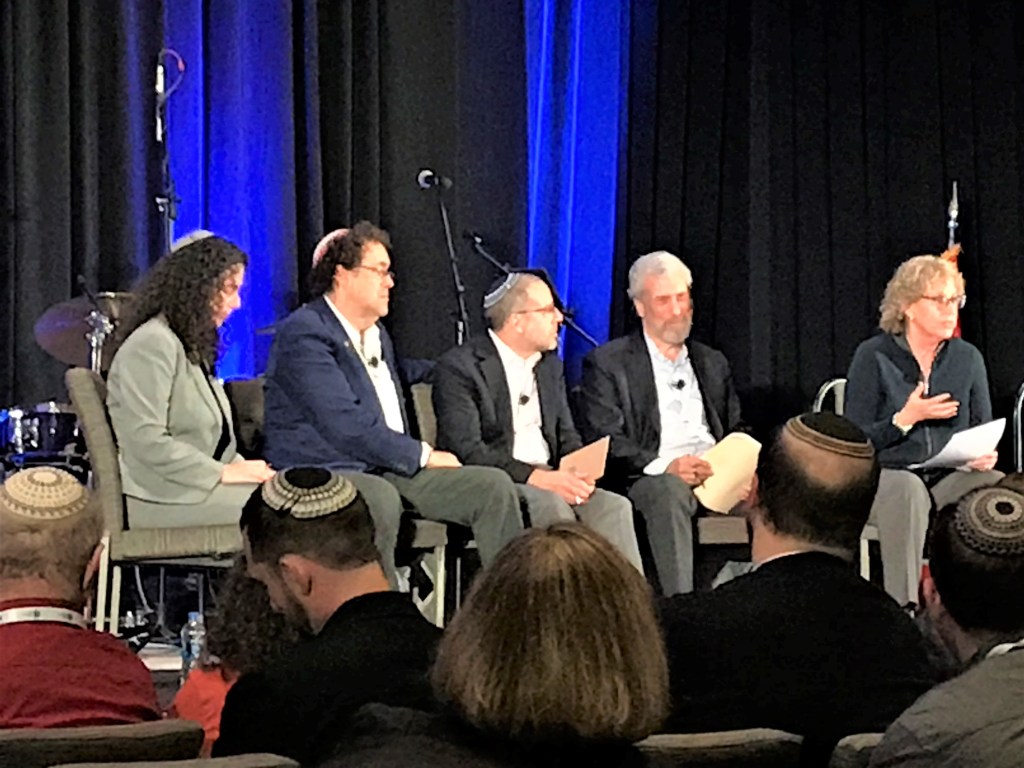
Rabbi Jacob Blumenthal, Dr. Arnold Eisen, Leslie Lichter.
It seems to me that the unique task of Conservative Judaism among the many rich streams of Judaism is to hold the center. Tradition and change, practicality and spirituality, prayer and action, halakha (law) and autonomy… in each pair of values held in tension, we strive to be balanced.
It is not easy to hold the center. It is not as seductive as claiming one side or the other. But after spending days praying, learning, debating, and singing with the people of my particular brand of Judaism, I believe that it is the essential way to live Judaism today.
If the meaning of community has changed, still the need for meaning is stronger than ever. We must go deep and we must be real.
If Judaism is the creative application of Torah across the generations, then Abraham Joshua Heschel was correct: It is not required of us to take a leap of faith but rather a leap of action.
B’yedidut, With friendship, Rabbi Paula Mack Drill
Kulanu Means All of Us
I made plans for dinner with a friend who returned from a year of rabbinical study in Israel. On impulse, I invited him to arrive early to the OJC for our appointment in order to see Kulanu (our children’s education program) in action. At 5:30 on Tuesday, I walked Andrew through the bright, light hallways of our new Kulanu wing, the Walerstein Family Center for Jewish Living and Learning. So much was going on!
Kindergarten,1st and 2nd graders sat on mats in the Daniel Beer Music and Tefillah Room with their teachers and Amichai Margolis, our Music Director. To the lively tunes Amichai played on guitar, they sang enthusiastically (and loudly!), preparing for Mitzvah Day when we’ll be singing for the elders of Esplanade on the Palisades.
In several different rooms, in small clusters, volunteer congregants mentored one or two learners in reading Hebrew. The Yachad program empowers children to conquer the decoding and practice required to read fluently. We saw heads bent toward each other, and heard a low rumble of reading that was punctuated by an occasional “Great!” and even some applause.
Teen madrichim (teacher assistants) were engaged in the Beit Midrash (Learning Center) with Youth Director Sharon Rappaport. Their monthly training in leadership and education skills fosters their sense of dedication and responsibility. I’m not exactly sure what they were doing but it definitely involved Jenga and Oreo cookies!
Rabbinical student Ben Varon teaches a parent education course during Kulanu hours every other week. Parents have the opportunity to model lifelong learning for their children.

At the close of two hours of hevruta (partnered) study, learning in the Jewish living room, and Yachad, all of the learners and several parents gathered in the Sanctuary to sing with Amichai. Rabbi Scheff and Rabbinical student Jesse Nagelberg danced in the aisle! We all stood together to sing HaTikvah, Israel’s national anthem. What an incredible learning experience! This is not your Zayde’s cheder… or my own Hebrew School experience…or even our successful Religious School as it was at OJC for decades. This is something brand new.
Kulanu means All of Us, and as Andrew and I walked amidst all that energy and joy, I felt how aptly the name fits our education program. All of us who identify with the sacred obligation of educating our children can participate in Kulanu. Seeing the program through the eyes of a guest was satisfying.
-

- Self motivated learners achieve real understanding.
-
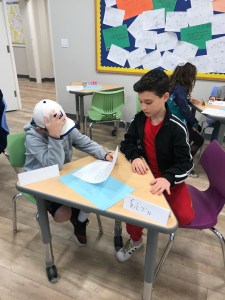
- Learners conquer texts in partnership.
I felt proud of OJC after a year of dreaming, strategizing and working hard to bring this vision to fruition.
If you know a Jewish child who is not currently receiving education or if you are interested in getting involved, contact Rabbi Miriam, Kulanu Director, at Kulanu@theojc.org.
Who will build the Judaism of the next generation? Kulanu! All of us!
Join us!
B’yedidut, Rabbi Paula Mack Drill
My Advice: There is No Advice
There are days that offer us lessons we never forget, as long as we are paying attention. One long, overfilled day several years ago was such a day. I paid a shiva call to a community member whose six-year old child had died. As I sat next to him in a rare moment of quiet during that excruciating week, he told me that a visitor earlier in the day had told him that she had also lost a child. She shared that life was never the same, but that he could look at her and know that life would go on. As he shared the story with me, I saw that he was incredibly angry and hurt. When I asked him to explain his response, he did not try to contain his outrage, “How dare she tell me that my life will not be the same? And how dare she tell me that life will go on? What does she know about me and my loss? She barely knows me.”
That same day, I called my cousin whose child had died earlier in the year after a long bout with cancer. When I asked my cousin how she was doing in this moment, she told me she was feeling quite good. She had gone to the grocery store, no small feat in those difficult days, and had bumped into another mother from her children’s school. This parent shared that she had also lost a child. According to my cousin, the mom told her that life was never the same but here she was, still living, taking care of her family, and even finding moments of joy. My cousin told me that this short conversation had opened her heart to a feeling of hope she had not experienced in all the months since Sami had died. “Can you imagine that?” she wondered aloud. “And this woman barely knows me.”

There are days that teach us necessary lessons if we are paying attention. It was a hard day, that confusing and painful day of reaching out to others with the worst kind of traumatic loss. But I was paying attention.
Here is what I know for sure.
There is no one-size-fits-all answer to the question of how we bring comfort to people who are grieving.
I read well-intentioned advice about how to speak with people who have experienced traumatic loss, and I think back to that day. Two people in similar circumstances experienced similar condolences in completely opposite ways. Why? Because we are all different and so we experience loss differently.
People do not suddenly become the same because they have gone through similar losses – death of a child or divorce or chronic illness. To assume that we can offer support in the same way to all people leads to the kind of hurt I heard about from the man in whose shiva house I sat.
But it also just might lead to the kind of elevation and hope that I heard about from my cousin.
My advice regarding offering condolence or support is that there is no advice. What not to do is straightforward. Don’t preach; don’t share your own sorrows as if that is helpful; don’t tell people what they need to do. Don’t tell stories in a loud voice; don’t do business with other visitors. Don’t stay too long; don’t put yourself into the middle of conversations as an expert. Don’t come to a shiva house for lunch.
But what to do? This question is much more nuanced. We who seek to offer loving kindness must depend upon empathy, humility, and deep listening. Jewish tradition has it right when it teaches us to enter a shiva house and be quiet. We are meant to wait for the mourner to speak first and follow their lead. We must listen before we speak and never assume that what we offer is what the person before us needs.
And we must try. Just because it is hard, we must not give up. Long after shiva, after thirty days, after the unveiling, after years, grief continues. We must continue to be present to people in our lives. If we make a false start, we back up and try again. We say that we are sorry that what we tried seems to have been the wrong thing. As a rabbi, I speak with family members and friends who worry because nothing they offer seems to help. In fact, often what they offer seems to infuriate or hurt their loved one. My advice is consistent: This is not about you. The grieving person is the only one who matters in this configuration.
There is no deadline for grief to be complete. People trying to be supportive say, “But he is still so depressed.” or “She isn’t moving forward.” They may be correct; the person might be depressed or stuck. But it is not our job to “fix” something. There will be a moment when someone will offer with an open-handed wisdom that the mourner might find support in therapy or prayer or travel or exercise. But that wisdom will not be motivated by the supportive person’s own discomfort. This is not about us.
Now we are at the beginning of a brand new year. We love the promise of a fresh start. We want to kindle hope in others and believe that good things will happen because of our desire to help. This year, I have been excited about my own fresh start. I am grateful, prayerful and inspired to do good. But I am also thinking about all the people whose current circumstances cheat them out of the gift of beginning anew. I hope that you will join me in thinking about people in the throes of chronic situations that steal away any promise of a good night of sleep, people whose loss is still so raw that tomorrow will bring no relief, people who struggle with depression that scoffs in the face of hope. I hope that I will be able to sit with their pain, sustain their sorrow and be supportive in a way that may help.
This week, as I open my heart to a glorious new year, I pledge to offer support, condolence and hope in small, humble ways. I will not always get it right. There is no ready answer. There is simply listening well, deeply, as carefully as I can and offering in small gifts and gestures what each person needs.
It is hard work to stay steady, to open our hearts to grief.
When we ask, “How are you?” we hope desperately to hear, “Great” or “Much better” or “I’m getting there.” Two years later or ten years later, we don’t want to hear how deep the pain still goes. But that is what grief does. It does not let go.
The point is, those in pain do not have access to a fresh start. If we are the blessed ones who look forward to the new year with joy, then we must carry them too in our hearts. The new year is not about my teshuva alone. Jewish repentance is about the entire community; we all stand before God: the whole, the broken, the lost and the found. I pray you stand with us this year, bringing whatever is in your heart with you.
With prayers for a new year of peace, Rabbi Paula Mack Drill
Preparation in Elul: I lift my eyes to the mountains…
My horse, Naapi, stepped gently through the trees, stopping now and then to munch on the grasses and wildflowers along the trail. I was supposed to pull his head up and give him a heel to the ribs. Of course, I did not have much heart to do that! He knew in an instant that he had a softie in his saddle. Naapi was named for the Old Man in the Blackfeet Indian origin story; he is the one who designs and shapes the world into being. He is also a trickster. (Maybe it was not only my compassion that kept me from steering him away from his mid-ride snacks – I took his name seriously!)


I asked our guide, Shane, what he thought about a Creator who is also a trickster. Shane laughed, and then turned our light banter immediately to a theological discussion. It turns out that not only is Shane a prize winning rodeo competitor, a high school teacher, and an entrepreneur, but he is also pastor of his church.
He told me about his sense of wonder at the birth of his first child just three days earlier, a funeral at which he had officiated the day before, and community healing he hopes to effect in his church. I told him about my synagogue, the social action and prayer in which we engage, and the serious work of preparation for the High Holy Days that begins (tonight!) with Rosh Hodesh Elul.
Shane was especially moved to learn about the Jewish idea of repentance. I explained that the Hebrew word teshuva does not mean punishment or forgiveness; but rather, return. When I told him about returning to our best selves and to God as the true work of repentance, he thought this would be a good lesson for the people in his church.
I joked that I would be teaching about his church on Saturday and he would be preaching about our synagogue on Sunday!
As our scheduled one hour horseback ride lengthened into two hours, we spoke about obligations to family, privileges of community and our connection to God through nature. Shane told me that he believes that there are more atheists in urban areas than in back country. I understood exactly what he meant. In our normal suburban/urban lives, we are surrounded by the accomplishments of humans: bridges and buildings, roadways and highways. We spend our days connected to electronics and social media. It makes sense that there is not much room for God in our busy, human-centered lives. How different it is in the back country where I was privileged to spend ten days of vacation. I spent my days on a bicycle or in hiking shoes. I rarely used my phone. The tallest things in every direction were the glorious mountains of Glacier National Park. When I considered the Rocky Mountains decorated on top by ever-changing cloud formations, glacial lakes, fast-running rivers, endless plains and deep forests, I felt deeply God‘s presence. Who else could have “invented all of this stuff”?!


It is time to prepare for Rosh Hashanah. We will be hearing the blast of the shofar for the first time on Sunday morning. How will we wake up? OJC is offering several opportunities to do the work of Heshbon haNefesh, taking an accounting of our souls.
Women of OJC are invited to a Saturday evening program on September 7 to Envision a New Year . #OJCSupportsU is hosting a workshop, Hope into the new year, at two different times: Monday, September 16 at 4 o’clock in the afternoon or Wednesday, September 18 at 7:30 pm. Hope into the New Year.
After my amazing experience at Glacier National Park, I have one more suggestion for Elul preparation. Consider preparing your soul by connecting to God in nature. Rockland County, New York and Bergen County, New Jersey have some of the most beautiful outdoor areas in our country. Unplug, disconnect, and find the green spaces to quiet your mind and listen to your soul. Bring with you a prayer book, a poetry collection, a journal or a book of Psalms. Close your eyes and breathe in as the trees breathe out. Listen to the sounds of the woods or the ocean. Be present to yourself in the majesty of God’s creation. On my vacation, every morning when I prayed, I could never figure out if I should read a Psalm about God’s creation or simply look up from the page at God’s creation. Ultimately, I chose to do both. I hope that you will do the same.
Whether on footpath or sandy beach, I wish you luck on your journey toward the High Holy Days. Perhaps you will be rewarded, as I was, with a rainbow. God keeps God’s promises. Do we keep ours?

Do Not Stand Idly By…
For me, this was most definitely a first: a protest chant anchored in daf gemara (a page of Talmud). Rabbi Marcus Rubenstein, of Temple Sinai, Middletown, New York had gathered two hundred Jews and allies from the Orange County Hispanic community to protest inhumane conditions for incarcerated undocumented immigrants throughout the United States.


The Babylonian Talmud, Masechet Sanhedrin 73a asks, “From where is it derived that one who sees another drowning in a river or being dragged away by a wild animal or being attacked by bandits is obligated to save him? We learn it from: ‘You shall not stand idly by the blood of your brother.’ (Vayikra 19:16).” Now Rabbi Rubenstein led us in chanting, “Lo Ta’amod” – “Do not stand.” Do not stand idly by. Do not stand for it!
With police protection and a designated area in which to meet, we stood at the edge of a field, up the road from the Orange County Detention Center which glowed eerily in the evening sunset. A volunteer protest band held our attention and kept us motivated. Rabbi Rubenstein had reached out to the Rockland community to invite us to join the protest. Four carloads of my congregants answered the call.


Why were we there?
For me, the answer is best provided in a famous quotation from Rabbi Abraham Joshua Heschel who asked, “What is a sin?” Heschel’s answer was, “The abuse of freedom. A failure to respond to God‘s challenge.”
This time in which we are living presents just such a challenge from God. How are we responding?
If all of us indeed are created in God’s image, then how can we bear to see children separated from parents and suffering alone? How can we read about overcrowded, hopeless conditions for incarcerated individuals? How can we hear that people are detained without representation and languish, with no clear path forward? We can no longer read the news and just turn the page with a sip of our coffee.
The inhumane treatment of undocumented immigrants in our country is not about political party. It is not about ideology. It is about basic decency.
Anonymous emails and several comments on our synagogue Facebook page focus only on the political quagmire that surrounds the questions of immigrants, asylum seekers and borders. It is easy to use immigration issues for political posturing. American leaders on both sides of the aisle have been doing that for years. Meanwhile, human beings are suffering, human beings created in the image of God. While they keep talking, people in custody are languishing in untenable conditions.
I did not go to Goshen, New York to speak against Republicans or Democrats because this is an American problem. I did not go to speak against ICE who are charged with a problem they have no power to fix because this is a mess created by our government. I did not go to speak about a brand new problem because this situation has been building for more than a decade.
Heschel said that few are guilty, but all are responsible. I feel responsible. And so I went to the protest and brought my congregation along.
I went to the protest because it is time to stop wringing our hands. It is time to stop copying and re-posting to the echo chambers of our Facebook pages, waiting to count the “likes.”
I went to the protest because we are American citizens who have rights that are also obligations. In order to change impossible situations, every individual must exercise his and her right to claim a voice in our government.
I went to the protest to tell everyone that it is time to write and call our representatives as our consciences dictate and to do so in a non-stop persevering manner. We must demand that Congress act quickly and responsibly to address the crisis in the conditions of incarcerated undocumented immigrants.
In the Torah we read, “When a stranger resides with you in your land, you shall not wrong him… You shall love them as yourself, for you were strangers in the land of Egypt.” And in case we have any doubt, this statement is punctuated with: “I am the Lord your God.” (Vayikra 19:33 – 34)


Our leaders can disagree and debate about immigrants, borders, the asylum process. While they are busy talking, however, human beings are languishing. We must write letters. We must make phone calls. We must do so without stopping. We must make a loud noise, loud enough for our elected officials to stop posturing and start acting. Our noise must be loud enough for God to know that we are responding to God’s challenge.
Rabbi Paula Mack Drill
Learning for Today’s Reality
I find it useful to start at the end.
At the conclusion of the American Jewish Committee Global Forum, before we boarded buses for the Hill to complete our advocacy assignments, CEO David Harris told the gathering of 2500 people from 39 countries what the purpose of this forum had been. Rabbi Scheff, Leslie and Allen Levinson and I had travelled to Washington DC from June 2 – 4 for days packed with inspiring plenaries and thought-provoking learning sessions with AJC experts, foreign dignitaries and policy analysts. At the closing plenary, David Harris told us that the days in which we live have created an atmosphere of confusion and conflict for the Jewish community. His goal for this year’s Forum had been to get inside the zeitgeist of the American Jewish community today and offer meaningful education and answers.
He then challenged us: the real test begins now. What will you do with all the information you have gained? My first step is to share my learning with all of you.
With anti-Semitism on the rise, global democracy in disarray, and partisanship at an all-time high, I found AJC’s clarity to be effective and refreshing. I strode past the Capitol and into the Senate Office Buildings for my lobbying meetings feeling empowered and ready.
It is difficult to encapsulate two and a half days of learning, but I will highlight three experiences that will provide a sense of what it was like to learn with AJC.
Sunday evening was the first annual gathering of the Community of Conscience. AJC had envisioned an assembly of people from many faiths and ethnicities to speak to the key values of our day. The event was planned for the Lincoln Memorial, but a hail storm kept us instead inside the Hilton. There in front of a jumbo screen showing the Lincoln Memorial, we listened to invocations from two clergymen who know firsthand the trauma of hatred in our country. Reverend Eric Manning, Senior Pastor of the Mother Emmanuel African Methodist Episcopal Church in Charleston and Rabbi Jeffrey Myers, Rabbi of the Tree of Life Synagogue in Pittsburgh spoke eloquently about the need for diverse communities to stand together.
Dr. Bernice King punctuated their messages by telling all of us that hate is too great a burden to bear. She told us, “I have decided to love. He who hates does not know God, but he who loves has the key that unlocks the door to the meaning of ultimate reality.” As her powerful words rolled over us in a cadence reminiscent of her father, in front of an image of the very place where he gave his famous “I have a dream” speech, I knew with certainty that she was right. It is a long arc toward justice indeed, but love and righteousness will ultimately win over hatred.
Early (very early!) the next morning, Rabbi Scheff and I attended a Rabbinic Round Table on the rise of global anti-Semitism. Simone Rodan-Benzaquen, Director of AJC Europe, and Daniel Elbaum, AJC Chief Advocacy Officer, presented a sobering view of the situation around the world. As Daniel Elbaum said, history does not repeat, but it certainly does rhyme. Our task, of course, is to stay alert, speak out, and parse between the various layers of messages being put out into the world.


One of the most inspiring sessions was called: Ghosts from our Past: The legacy of American Racism and a Call for Unity. We were privileged to learn from Mitch Landrieu, Mayor of New Orleans from 2010 until 2018. Author of In the Shadow of the Statues, he provided an engaging and inspiring story of his personal journey growing up as a white child in the South in a neighborhood of African-Americans. He described how he came to understand entrenched racism and to use his position of power to fight back against it. Put his memoir on your reading list!
All of the conversations and lectures prepared us for lobbying on Capitol Hill. In our senators’ and congressmen’s offices, we asked for support of the Protecting Faith-based and Nonprofit Organizations from Terrorism Act and for the Eastern Mediterranean Security and Energy Partnership Act, a bill that my own Senator Menendez co-sponsored. With the power of AJC behind us, we felt affirmed and acknowledged.

David Harris told us that our work comes down to following the Golden Rule. The problem, he said, is not in finding the right words, but in actualizing them. Because we are all created in the image of God, desecrating even one human being is equal to desecrating God. He charged us to delete and discard the word tolerance. No person or group of persons should merely be tolerated. Rather, we must seek and offer respect, understanding and love. That is the work that lies ahead of each one of us.
That is the work that we must do in every interaction every day.
With friendship,
Rabbi Paula Mack Drill
Lo Levad, You are Not Alone…easier said than done.
When I think about my dad at home through all the years of my growing up, I think of him as alone. And when I think about my mom through those same years, I think of her as lonely.
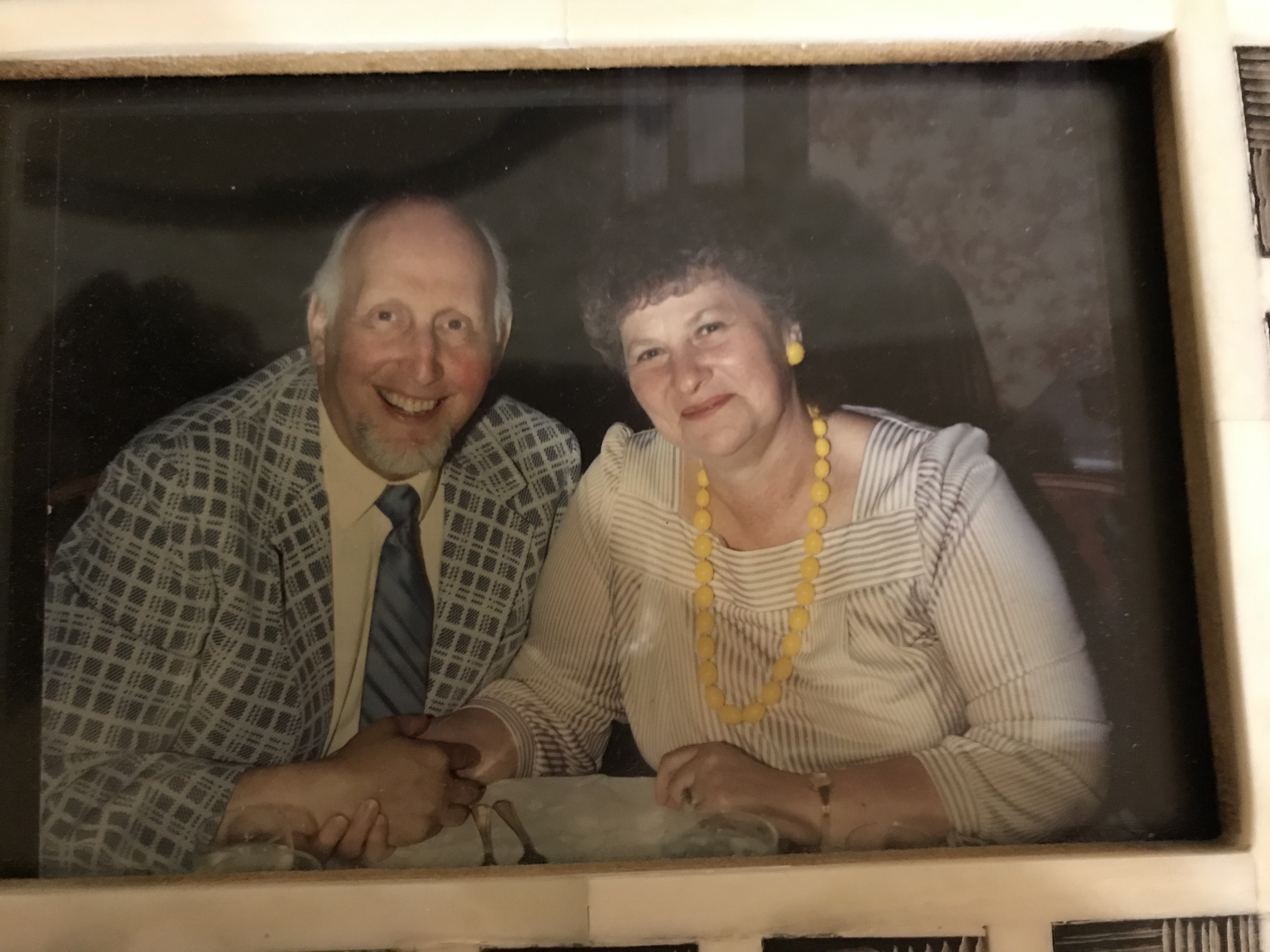
Living with bipolar disorder, my dad spent months at a time inside our house, often in his bed, almost always alone. My mom went out to work every day, and my brother and I went to school. When we got home, there he was, on the couch, watching television. I was a kid. It never occurred to me to wonder about how alone he was.
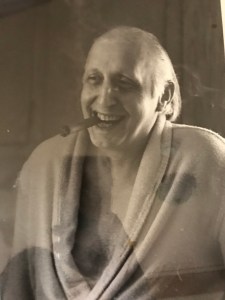
In the 1950s and 1960s, no one understood my father’s mood swings. My parents’ friends wondered and perhaps pitied, but mostly stayed away. My dad‘s parents fretted that they had done something wrong to cause such brokenness. My mother’s parents urged her to leave my dad, and bring my brother and me to live in their house. Instead, my mother stood by my father, the love of her life. She held him and us together. There were no support groups for her; synagogue was not a safe place; and her friends were not equipped to understand. I wonder who could have possibly listened to her without judgment even if she could have articulated her sorrow and her rage. She must have been very lonely.
I thought a great deal about my parents yesterday as we celebrated a beautiful Shabbat of mental health awareness at OJC.
Thanks to the dedication and planning of #OJCSupportsU chairs Miriam Suchoff and Mark Brownstein, congregants experienced a wealth of opportunities to open our hearts and minds, and to create feelings of well-being and happiness – keystones to nurturing and sustaining good mental health. Through meditative prayer, singing, text study, and guided building of relationships, we practiced experiences that promote resilience.
We walked in silent meditation from the Daily Chapel to the bima in the Sanctuary to receive Torah, a powerful reenactment of Mount Sinai where everyone received Torah in his or her own way. God does not see anyone as broken; everyone is created in God’s image. We walked together as a community, from the four-year-old twins skipping to the 90-year-old couple walking carefully with canes. Being together in a community where everyone is accepted as “just fine,” just the way they are, is a most powerful sustainer of mental wellness. Everyone who was in synagogue yesterday felt this crucial teaching in our very souls.
But what about everyone who was not able to be in synagogue with us? What about the people who struggle with mental illness in their homes or in facilities and cannot leave, trapped there, unable to enter into our community of faith? What about the caregivers of those people, too exhausted and fearful of stigma to come out and join us in community? They probably do not see a sanctuary, rather they see an unbearable barrier to entry. How can we begin to change this reality for Jewish people who feel isolated due to mental illness?
We must continue to speak out. We must work hard to enable people to feel safe enough to be vulnerable in our sanctuary spaces.
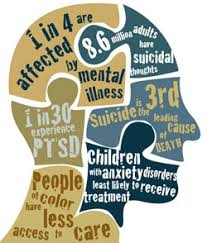
There are many opportunities in the month of May, #MentalHealthAwareness.
Wednesday, May 15 at 7:00 pm at the Rockland Jewish Community Campus, Rockland Jewish Family Service and Board of Rabbis present Lo Levad, You are Not Alone.
Thursdays, May 16, 23 and 30 at 7:30 pm at OJC, join Rabbi Scheff to study Jewish sources and mental health issues.
Thursday, May 30 at 6:30 pm at OJC, join me and Amichai Margolis for a spring time service of healing and harmony.
If you are struggling with mental health issues and you feel alone, reach out to your rabbis or to #OJCSupportsU in any way that you feel able so that we can meet you halfway. Even if you can only reach out a very short distance, we will meet you the rest of the way.
If you are lonely because you are a caregiver for someone you love struggling with mental health issues, we invite you in to listen, share and strengthen yourself.
You might feel alone and you might feel lonely. We want to provide a community for you in whatever way we can, not just in the month of May, but always.

Yesterday, before the Musaf Amidah, Mark Brownstein read Merle Feld’s poem, “Dreaming of Home.” To me, it reads as a clarion call to all homes of worship to be places where people are safe and known.
We want so much to be in that place
where we are respected and cherished,
protected, acknowledged, nurtured, encouraged, heard.
And seen, seen
in all our loveliness,
in all our fragile strength.
And safe, safe in all our trembling
vulnerability. Where we are known
and safe, safe and known —
is it possible?
In closing, I dedicate this post on Mother’s Day to my mother, Frances Weisberg Mack z”l, a woman of extraordinary strength and dedication.
With prayers for a refuah shlayma, a complete healing, a healing of body and healing of spirit,
Rabbi Paula Mack Drill
 Three Rabbis Walk Into A Shul


Recent Comments