Purim fun, or not?
Growing up on the mean streets of New City, New York, I learned the hard way what it meant to be Jewish, short, skinny and unable to jump higher than 8 inches off the ground. In other words … wait for it . . . “scrappy” was my game. The experience hardened me to the outside world’s cold reality. A jaded, chip-on-my-shoulder, eat-or-be-eaten attitude pervaded everything I set out to accomplish. I learned to control most of my impulses, assuming a mild-mannered, soft-spoken persona everywhere I went. Everywhere, that is, except on the basketball court. Between the lines, I could be myself, let go of my inhibitions, run wild, heatedly pursue, charge at the hoop, display my bumps and bruises as badges of honor. Ironically, all that pent up anger, frustration and aggression that found its expression in my game was lauded as something good, something to be admired and copied.

Those of you who have seen me play over the years (with the 9- and 10-year-olds at recess, especially) have called me competitive, like a Mr. Hyde to Rabbi Jekyll. What you see is nothing, however, compared to the dark madness that once lurked in the soles of my high-top Converse sneakers (the white canvas ones). That’s just me having good, clean fun. Once I retired from competitive hoops at the age of 28 (the year I started rabbinical school), the cloud that once enveloped my heart lifted, and the beast was gone forever. Until . . . .

Rabbi Paula Mack Drill, whose thirteen years with the OJC we are celebrating this Purim, began her professional relationship with me at Camp Ramah in Nyack some 15 years ago. She was Program Director as I was Assistant Director, and Assistant Director (a position now full-time held by our own Rabbi Ami Hersh, the topic of another Purim spoof one day soon) as I was Camp Rabbi. We always had a great, easygoing, complementary style of working together. From Day One, people referred to us as the “Craig and Paula Show.” That relationship carried over into her internship here at the OJC, where I functioned formally as her mentor for the Seminary. The day she was ordained was a great day. I should have known something wasn’t quite right, however, when she informed me that her JTS GPA was .0185 higher than mine.

That single fact was the beginning of a disturbing pattern. Two-letter words like “XQ” were suddenly making their way into our Shabbat Scrabble games on triple word scores. She would casually mention to each congregant we met that she was older than me, taller than me (she took up heels), and could stand on her head longer than me. She would give her students colorful stickers and point out that I offered them nothing for their efforts. At the end of a day’s work she would ask me how many hours I had billed, as she filled my e-mail inbox with cc’s of every e-mail she sent out. I lashed back by working later, sleeping less, and leading more trips to Israel. I could feel the old Craig emerging, and it wasn’t pretty.
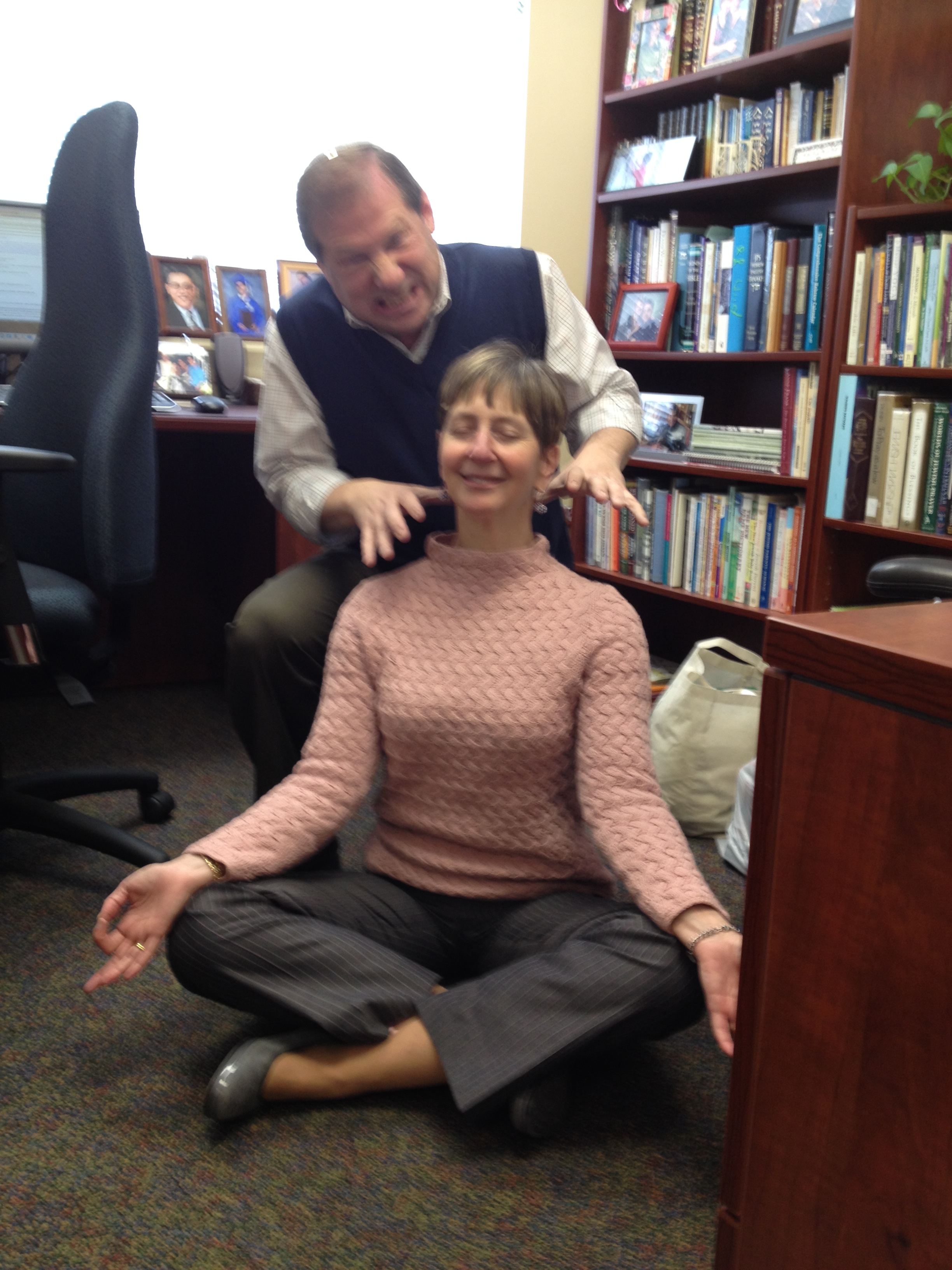
Rabbi Drill’s popularity has grown over the past 13 years. As has my therapy bill. But I have learned how to control the beast. Looking in the mirror each morning, I remind myself that I am good enough, that I am smart enough, and doggone it, people like me. Then I steel myself for the day ahead, trying to appreciate how good each day can be with Rabbi Drill at my side.

And then I pray . . . for the moment I will get her on the basketball court.

Happy Purim to all, and I hope you will join our community in celebrating Rabbi Drill’s 13 years with the OJC and the many ways in which she has enriched each of us and our community!
Rabbi Craig Scheff
Between the lines
Listening to a sports radio talk show this week, I heard Charles Barkley, one of the all-time great basketball players (known for his quote, among many notable quotes, “I am not a role model”), offer an important piece of wisdom. To paraphrase, he said that if we put a bunch of kids on a court together, no matter their color or nationality, they’d do just fine. “It’s the adults who screw everything up.”
Sadly, a group of kids suffered embarrassment this week because of the deeds of their adults. Little League Baseball stripped the U.S. championship from Chicago-based Jackie Robinson West and suspended its coach for violating a rule prohibiting the use of players who live outside the geographic area that the team represents. The kids played their game, had an experience of a lifetime, grew in so many ways, only to be told that their experience was not legitimate. What a crushing disillusionment for such young minds.

I learned so much participating in sports as a teen. I learned that there would always be someone bigger, stronger, faster and more skilled than me. I learned that success requires a lot of hard work and commitment. I learned that heart can take you far, but only so far. I learned that success takes sacrifice. I learned all these things without ever being the hero, leading the team, hitting a buzzer-beater or winning a championship. I even learned these lessons sitting on the bench and not being chosen for the team.
Years later, I would take all these lessons and channel them into a very different competitive endeavor, one that relied upon a very different skill set that didn’t involve my hands or my feet. Those years of competition–and yes, even of losing–taught me how to define success. I learned teamwork; I learned resilience. And the thing I remember most clearly is that my father let me figure it out all by myself.
Thanks Dad, and thanks to all the wonderful coaches out there teaching life lessons between the lines.
Rabbi Craig Scheff
On being a patriot
I am a patriot.
Call me sentimental, but I see the colors of the flag and my chest swells. I stand a bit taller and feel a bit stronger when I see someone in uniform pass by. Seeing that banner wave against the sky, I think of the dedication that so many show to the cause. I take pride in the victories and mourn the losses, even if I have not set foot on the field of battle myself.
As a patriot, I can be critical of my own cause. I can disagree with the strategies utilized, question the personnel employed, and even dislike the individual personalities of those entrusted with the helm. As one on the sidelines, entrusting others to carry the ball for me, I am relied upon to vote with my voice and with my checkbook. Amongst those who share my passion, I can express my frustrations and feelings of persecution. I can find solace in a community of people who believe that the cause is just, and that ultimately we will be vindicated as champions of all that can be good and right in the world.
As a patriot on foreign soil, however, I am far more guarded. I am not so quick to show my true colors. I take personally the barbs and accusations of excessive pride, privilege, self-absorption and insularity. Fending off the parries with rationalizations or excuses only comes across as empty defensiveness. Relativizing any potential wrongdoing by comparing the accusations with the injustices committed under other regimes is dismissed as inconsequential. My standard-bearers are held to a higher standard than most, and any wrongdoing—or potential thereof—is headline news.
Such is the price of those who dare to lead, who shed the label of underdog and take ownership of their place in history.
Wherever I stand, I stand with America; I stand with Israel; I stand with the Jewish people.
Rabbi Craig Scheff
(Go Pats!)
Is it time to go home yet?
In the aftermath of the Charlie Hebdo and Hyper Cacher murderous terrorist attacks just a week ago, Israel’s Prime Minister Netanyahu seized the opportunity during the massive unity rally that followed to invite (actually, to call upon) the Jews of France, 500,000 strong, to return home to Israel. With the fresh images of four Jewish bodies returning to Israel to be buried and armed guards filling the entryways to their children’s schools, along with the collective memory they carry of the events that took place 75 years ago, the Jews of France have good reason to consider flight as their best option. I have heard many say that the handwriting is on the wall, that the times are looking like the 1930’s, that we made the mistake of staying once before and look what it cost us — and I can’t say that I completely disagree. Every individual and family must decide what is best for them.
But this is not 1938. And we are a more powerful international community of Jews than ever before. And we have Israel waiting with open arms. And we have allies, Christians and even Muslims among them. And French President Francois Hollande certainly understands the national and international implications of a mass Jewish exodus. Aside from the “brain drain” that would result, should France lose its Western soul in the battle between radical Islam and modernity, other countries like Belgium, the Netherlands and Sweden are likely to follow soon thereafter. And let’s not forget that France is a nuclear power and a permanent member of the U.N. Security Council. France is already experiencing the annual emigration of thousands of Jews to Israel in recent years. Should the largest European Jewish community be decimated of its own free will, there is little doubt that the other Jewish communities of Europe will suffer a similar fate.

Are we ready for a new demographic reality, where all Jews live in Israel, the United States and Canada? On the one hand, I say why not. On the other hand, the French Jews attending Prime Minister Netanyahu’s appearance at the Great Synagogue followed his oration with an emotional singing of Hatikvah, and concluded with an equally stirring and heartfelt rendition of La Marseillaise. We must also ask ourselves what we would sacrifice and how long we would fight were our American values and freedoms suddenly challenged. And we must also ask ourselves how our mission in the world is fulfilled as Jews if we are only a light unto those who share our values; if we become an insular and insulated community; if we are only for ourselves. That is not, in my opinion, how we were meant to be a blessing.

Israel is our home and, thank God, our haven. But the Jewish experiment was meant to be shared with the rest of the world. And that means fighting and sacrificing for a certain way of life for ourselves and for those who have elected to adopt our values. I fight back by supporting the education of our local community through Rockland’s Holocaust Museum and Study Center; I fight back by using social media to share balanced and accurate reporting; I fight back by participating in AIPAC’s policy conference and lobbying efforts (March 1-3) to make sure that the United States will stand as a partner with Israel in the international arena; I fight back by voting for MERCAZ USA in the World Zionist Congress elections (ongoing) to promote a more progressive social agenda and more pluralistic religious agenda in Israel; I fight back by supporting organizations like the American Jewish Committee to advocate globally for Israel and the world’s Jewish communities; I fight back by leading trips to Israel (informational meeting Wednesday night for our December 2015 trip) so others can feel empowered by the greatest feelings of belonging, strength and hope.
I pray that, should the time come (God forbid) when it is time to go home, I will know it. Until then, I will proudly defend my right to be a Jew right here.
Rabbi Craig Scheff
Counting up to 2016
Okay, I admit that I am not a big fan of the countdown to the new year. I find the experience fairly anti-climactic. Jewish tradition teaches me that time spent anticipating a time to come is wasted time. What matters most is what we do with the time we have.
Our Talmudic sages teach that the reason we ascend from one candle on Chanukah’s first night to eight on the last night, as opposed to counting down the days of the holiday, is that we are meant to ascend in holiness, not to descend. We therefore count up our days after Passover to the day we celebrate receiving the Torah.
The lesson speaks to me. I don’t enjoy counting down the days left in a vacation. I much prefer to look ahead to each day of celebration, adding to the joy, as opposed to counting down the days to its conclusion.
On the eighth night of Chanukah, I lit a chanukiah in my grandparents’ kitchen, reflecting on their 75 years of marriage and a celebration of time that would bring most of their children, grandschildren, great-grandchildren and great-great-grandchildren together. Their lives have not been easy, though they have certainly had many causes for celebration. Surviviors of the Holocaust who have experienced their share of loss, their lives have been enriched by a generosity of spirit and a sincere appreciation for every relationship they share. A phone call today, a lunch date tomorrow, a card game the next day, a get-together with children on the weekend, a great grandson’s bar mitzvah in the summer — each day presents another opportunity to add a deposit to the time bank of our lives.

On this first day of 2015, we can start counting up to 2016. Each day can present an opportunity. Each experience can be a jewel added to a treasure chest of time and experience. May we never wish the time away, may we never miss today by wishing for tomorrow. May 2016 arrive after 365 days completed with a sense of accomplishment, appreciation and ascension.

Wishing you a happy and healthy 2015,
Rabbi Craig Scheff
On the third night of Chanukah, my rabbi said to me…
A past-president of our synagogue, Nohra Leff, once said to me, “I don’t just believe in miracles, I EXPECT THEM!” What a great way to go through life. Expecting miracles means that we engage in behaviors that ultimately create an environment where what some perceive as the “miraculous” becomes that much more possible.
In the fall of 1995, I took a job as part-time cantor at the OJC. Still a full-time student and father of two young boys, I treated the job like it was the fulfillment of a dream. A year later, I was negotiating my first contract to be Student-Rabbi and to stay on as Rabbi after my ordination. I was advised by people “in the know” to avoid such a commitment. After all, the synagogue had gone through so many rabbis in its relatively short history, and I “could do better,” according to the more experienced. Three years later, another past-president, Michael Scolnick, would ask me how long I thought the honeymoon could last. I am glad to say that, even in my 20th year, I still feel like we met just yesterday. Okay, maybe just the day before yesterday.
When I speak to rabbinical students in their final years at JTS, I try to emphasize that every synagogue community has the potential to be a place that can be transformed and re-dedicated to Torah, service and deeds of loving kindness. That can only happen, however, if the rabbi is willing to see him or herself as spending the rest of their professional life serving that one community. If we invest ourselves in a plan believing that we have only two years to work toward achieving our goals, then we doom ourselves to failure; but if we invest ourselves planning for the long term, we can create an environment where the seemingly impossible is indeed achievable.

In the midst of Chanukah, we consider the nature of miracles, and the role that “dedication” (the literal meaning of the word Chanukah) plays in making one day’s worth of oil last for eight, or in leading one small band of soldiers to victory against overwhelming odds. I am so proud of what we have achieved and how we have continued to grow as a Conservative egalitarian community. Beyond our impressive numbers, we have attained a level of learning, service to the broader community, participation and spirit of which we can all be proud. The dedication that has brought us to this place in our history, however, has also given us the wisdom to understand that we must continue striving to build and to deepen relationships; to reach in to our membership and to reach out to those still searching; to develop more pathways into our OJC community, into a life of purpose and meaning, and into relationship with God; and to lookto the future with faith, optimism and vision. Some people might call our success a miracle. Perhaps we have witnessed something miraculous as a community; if so, the miracle only happened because of the wise people–presidents, boards, volunteers, congregants, professionals and clergy–who were looking for one, who expected one, and who acted to create the environment where such a miracle could take root.

Chag Urim Sameach,
Happy Festival of Lights,
Rabbi Craig Scheff
If only our issues were black and white
It would be so easy if our issues were black and white. Unfortunately, all too often we settle on addressing the issue as if it were black and white. We point fingers, we demonize, we stand up self-righteously, we spout rhetoric, we exhaust ourselves spinning narratives, and we pat ourselves on the back for having taken a stand. And in so doing, we fail to take on the real challenge, that of wresting with the grey.
In this week’s Torah portion, our imperfect work-in-progress-of-a-patriarch-Jacob chooses to confront his brother Esau, the man who vowed to kill him the last time they shared company. Jacob can avoid Esau, but at some level he knows that the courageous and potentially dangerous confrontation is the only way for him to grow and to find a greater sense of self and a better prospect for inner and outer peace.
I have wrestled all week with my response to what is taking place in the streets of America and in the Knesset of Israel. At this point, I have no original thoughts. But I have come across one teacher in Gil Troy who has given the best expression I have found to my feelings. Couched in the context of Israel’s nation-state discussion, his conclusions can be extended to the many events around us. Please click here for the link, or read on below.
Gil Troy is Professor of History at McGill University and a Visting Professor at the IDC in Herzliya. His latest book, Moynihan’s Moment: America’s Fight Against Zionism as Racism, just won the 2014 J.I. Segal Non-fiction award for a Jewish Theme. Visit him at www.giltroy.com.
On Jewish State: The Right is Wrong, The Left’s Not Right
The old joke has a rabbi telling one congregant “you’re right”; the congregant’s rival, “you’re right”; and his wife, who complains they both can’t be right, “you’re right, too.” With Right and Left squabbling about a Jewish Nation law, the Right is wrong; the Left isn’t right; and those who think they both can’t be wrong, are wrong, too.
The Right is wrong because the timing is bad, the optics are worse, and in some legislative drafts the balance is off. Prime Minister Benjamin Netanyahu is again playing partisan arsonist rather than statesmanlike firefighter. Politicians should follow the Hippocratic Oath – first do no harm. Israel operates in an hostile world environment, in a flammable region, during an incendiary time. When many Israelis are worrying about personal safety, seeking governmental leadership to calm tensions, unnecessary legislation stirring primal fears and triggering anti-Israel sentiment is reckless.
Israel’s leaders, including Likud backbenchers, have a responsibility to reassure more than two million non-Jewish Israelis during this sensitive time that they are cherished citizens, and will be protected by THIS government. They deserve reassurances that the “medina” the state, will remain democratic as well as Jewish, which is different than saying it is a Jewish state with a democratic mishtar – regime or government. (Unlike most, I read the versions in Hebrew and English before writing).
Israel’s Jewish character should not be a left-right issue. It’s a Zionist issue. Democratic nations have the right to express their majority culture in the public square. Israel’s Declaration of Independence already “declare[s] the establishment of a Jewish State,” mandating the State’s Jewish character, although certain specifics the proposed laws mention, such as Hatikvah as the national anthem, are not spelled out.
While some post-Zionist ideologues and the Supreme Court’s mushrooming power have triggered fears of eroding Israel’s Jewish character, no pressing danger exists. Netanyahu could have affirmed Israel’s Jewish character by quoting the Declaration of Independence, reinforced by a stack of bills and court cases protecting the precedent. Instead, advancing an extreme draft before his more balanced version, is like a husband blatantly housing a mistress in lesser quarters than the wife; while pretending to placate, it only enrages. Approving a bill’s initial reading while vowing to replace it, evokes John Kerry’s infamous 2003 legislative flip-flop, regarding funding Americans troops, when he said, “I actually did vote for the $87 billion before I voted against it.”
Nevertheless, the Left is not right, emitting shrill arguments, straw men, and premature eulogies over Israeli democracy, while hysterically, irresponsibly fueling Israel’s delegitimization. Netanyahu has promised to guarantee “equal rights for all” Israel’s citizens. He has an established track record of protecting Israel’s liberal democratic character as envisioned by his Zionist mentors Ze’ev Jabotinsky and Menachem Begin.
The insane accusations, ranging from familiar libels about Israel becoming an “Apartheid state” to fear-mongering about Israeli Arabs being forced to wear Green crescents – thank you Ha’aretz — tell more about the perverse, paranoid accusers than the accused. Their outrage meter is broken. They rail against potential Israeli breaches while enabling actual Palestinian totalitarianism, terrorism, and Islamism. If a future Palestinian state – or any Arab state — followed the protocols of the most extreme Jewish state Knesset bill (adapted to their national-religious identity) – we would have the first functional Arab democracy.
Israel’s democratic character should not be a left-right issue. It’s a Zionist issue. Israel was founded as a democratic state that “will ensure complete equality of social and political rights to all its inhabitants.” Ironically, liberals opened this legislative can of worms, hoping to enact a law guaranteeing “democracy,” a word missing from Israel’s Declaration of independence.
The need to caricature this government, and Israel, as repudiating democracy and demonizing Arabs proves what Matti Friedman writes in the Atlantic: “The uglier aspects of Palestinian society are untouchable [and I add, nuanced analyses of Israel as a Jewish-democratic state are unfashionable] because they would disrupt the ‘Israel story,’ which is a story of Jewish moral failure.” That popular, stereotypical, castigatory narrative, which many American Jewish elites are embracing, fails to understand that complex, pluralistic, free democracies balance competing ideals. Even America, which in these debates suddenly is held up as perfect, “hold[s] contradictory ideals in suspension,” the historian Michael Kammen wrote in his Pulitzer-Prize-winning People of Paradox.
Totalitarian regimes are simpler, often imposing one overriding idea. Israel, a Jewish democratic state with 25 percent non-Jewish citizens, will always juggle: struggling with maintaining its Jewish character while guaranteeing equal rights for all; wondering whether Arabs – and Haredim, for that matter – prefer individual rights or group rights; navigating between the religious components in Israel’s Jewish identity and its national dimensions.
These important dilemmas demand consideration. Yet the Left treats this democratic debate as threatening democracy, the Right treats this Jewish disputation as unJewish. Both sides should mature. The Right should avoid its “dog whistles” inciting hatred against Arabs; the Left should avoid its equally reprehensible dog whistles inciting hatred against Israel.
The philosopher John Dewey taught that “Democracy begins in conversation.” Let’s have the conversation, calmly, rationally, respectfully, with nuance and without demonization, sensitive to the many dimensions but understanding that to govern is to choose.
Just as Israel needs expansive centrists who can support the widows of Har Nof and the children of the burned classroom in the Max Rayne Hand in Hand Jerusalem School, we need voices saying “you’re right” to the pro-Jewish and pro-democratic sides. Democracy stems from Jewish ideas of equality. A Jewish-Democratic state is as possible as a state with majority rule and minority rights, committed to liberty and equality, fostering individualism amid nationalism. Embracing such valid if occasionally contradictory Zionist and democratic ideals fosters the kind of “you’re right, too” constructive, creative tension that makes democracies great.
Thank you, Gil, and shabbat shalom,
Rabbi Craig Scheff
Mitzvah Mission 2014, Day 5 – Israel is real


 Amid such a day of recognizing that Israel is indeed a real country with real problems, our final stop was among our most rewarding. We descended to the southern end of the Western Wall as an egalitarian community. We prayed the mincha (afternoon) service together, adding prayers for our congregation, the State of Israel, and those suffering illness. We sat together among the ancient stones and offered blessings of thanksgiving for the experience we had shared, we shed a few tears, and we offered each other warm embraces.
 Before any of us had departed for the airport, we had already begun planning the mission for 2015. It will be celebrated as a special mission, in light of the fact that it will be our 10th consecutive annual trip. And just in case you wanted to know, the dates are November 15-20, 2015. Wanna come?
Mitzvah Mission 2014 Day 3
There is a sense of safety that we feel being in the land of Israel. It is so hard to explain logically, especially given the terrible massacre at Har Nof this morning. With the ocean to our west, we faced Jerusalem to daven the morning service, wrapped by the swirling breeze off the Mediterranean.
 There are many troubling aspects about this morning’s terror attack, from the timing to the place, the setting, and the methods. Of particular concern to the Israelis we encountered throughout the day is the fact that this attack did not occur in some West Bank town. The quiet neighborhood in the far west of Jerusalem represents every person’s neighborhood. The synagogue at the time of prayer represents the most secure of hours. That sense of tranquility and security was shattered this morning, and the reverberations were felt throughout the day.
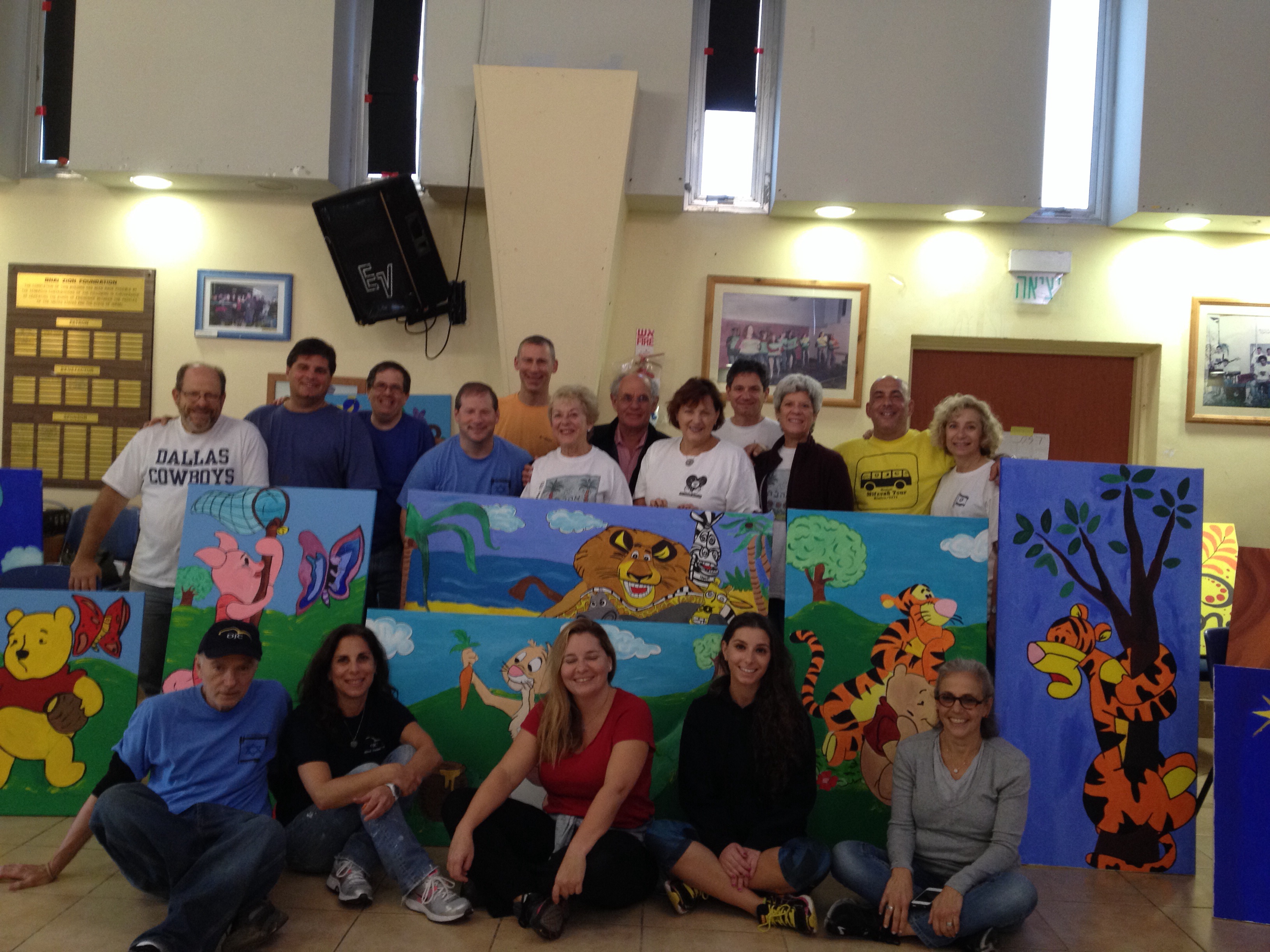
 Like everyone else, we threw ourselves into our work. As we painted, we sang Al kol eileh (“For the bitter and the sweet”), so appropriate for the mixed emotions we were experiencing. Surrounded by children scarred by their abusive homes and a society scarred by the abuse of her neighbors, we recommitted ourselves to creating something remarkable through which our impact would be felt. (Okay, some of us worked, and others of us directed!)

We wrapped up our work and admired the gallery of work that will adorn the walls of the children we served.
After an emotional goodbye with Yoav, Ahava’s executive director, we visited the Technion (Israel’s Institute of Technology), Israel’s first institute of higher learning founded in 1912. Danny Shapiro, Director of Public Affairs and a longtime friend of our own Aram Schwartz, presented us with a history of the institute. The Technion, in its first century, has responded to each of Israel’s needs, ranging from the development of its infrastructure to the development of the Iron Dome. It represents the bright, optimistic, hopeful side of Israel as a producer and exporter of creativity, self-reliance, medical and technological advancement.
Tonight, as I write this blog, the sounds of a public singalong could be heard in the hotel lobby, reminding us all that this is Israel. We sing, we celebrate life, and we awaken to each day with a sense of purpose. Tonight, we all feel safe.
Laila tov,
Rabbi Craig Scheff
Pictures are worth…
We knew from the start that Day Two of the Orangetown Jewish Center’s 2014 Mitzvah Mission was going to be a day of powerful impressions. Linda Varon started the morning with reading Torah for us from the Sephardic Torah, always a special treat!

The sun came up over the bay of Akko, the rain fell for a while, and a rainbow shot across the sky as we were preparing to load the bus for Kfar Ahava.

If anyone told you that you would be spending the majority of your day painting pictures of Winnie the Pooh or Alladin, you might think, “This is what we travelled thousands of miles to do for Israel?”


Understanding the plight of these young at-risk children and the unusual circumstances under which they are raised, however, quickly changes our understanding of what a picture can add to a child’s self-esteem. The murals we are creating will add color, smiles and love to the lives of the children who will open their eyes each morning to the vibrant characters.
We shared lunch with the kids and their foster families. I even had a surprise visit from my sister!

After a day of exercising our fine motor skills, we drove to Zichron Yaakov, where we were welcomed with generous hospitality by OJC’s Yoel Ledany and his new wife Batya in their beautiful home. Over dinner, Josh Drill, who is performing a preparatory year of leadership training before entering the army, shared with us his experiences and reflected on his new social and spiritual environment.
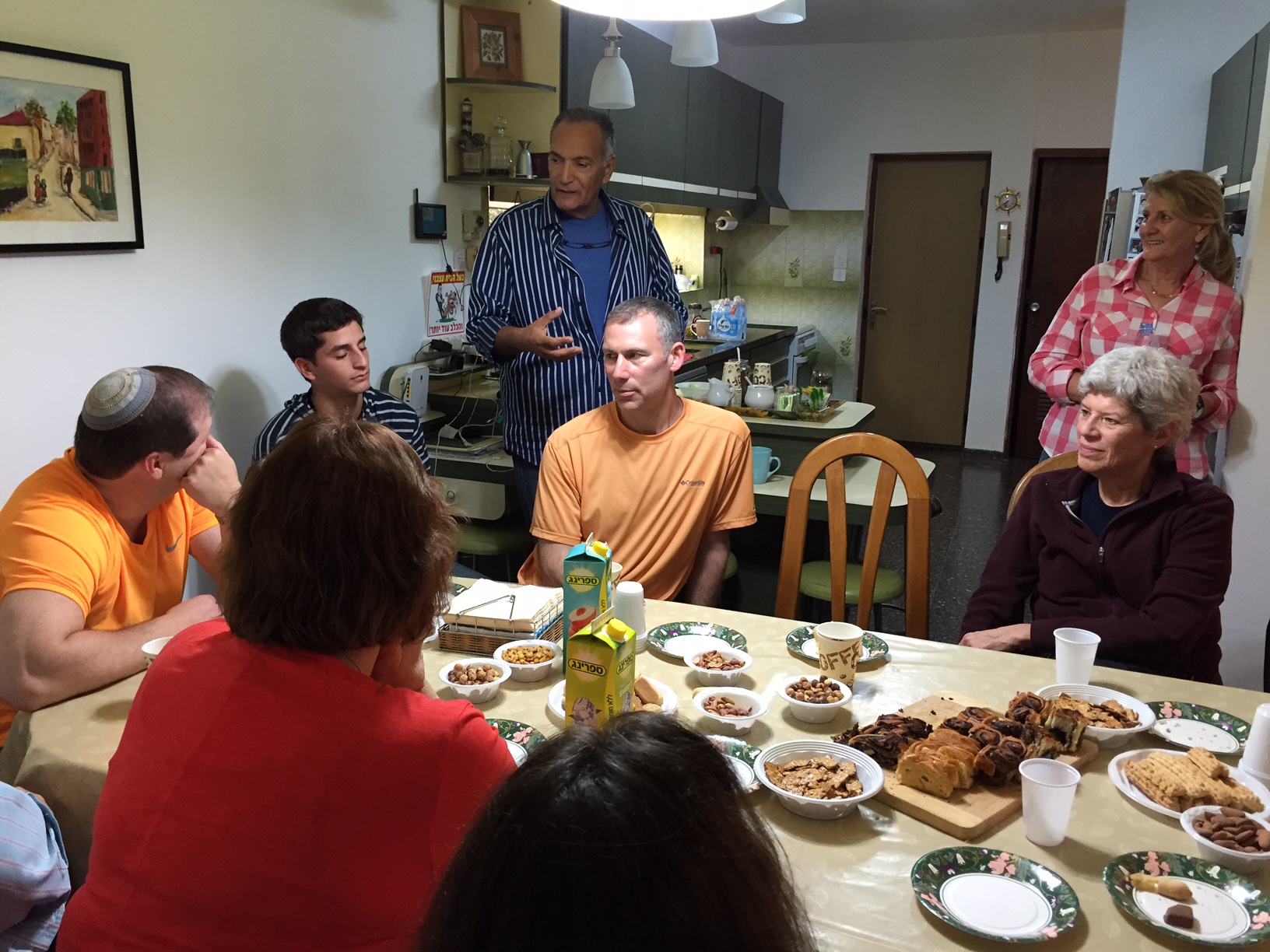

After a full day, you’d think the gang was ready for some sleep before we tackle Day Three. But no one seems to have lost their bounce yet!

 Three Rabbis Walk Into A Shul
Recent Comments