Simple Abundance in a Time of Lack
In a time lacking in truth and certainty and filled with anguish and despair, no one should be shamefaced in attempting to give back to this world, through her work, a portion of its lost heart. — Louise Bogan
As the crisis in Israel continues to unfold, I am feeling acutely aware of how much I currently lack. I lack peace of mind. I lack my typical sense of expansiveness and contentment. I lack a sense of wellbeing regarding those I love in Israel. I lack confidence about the place of the Jewish people in the world. I lack optimism about the United Nations and international leaders. I lack hope for secure borders and true peace for Israel in my lifetime.

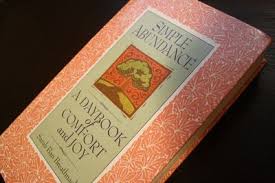
Perhaps it is Divine Providence or maybe just luck, but exactly now, when I feel the emptiness of that glass half filled, I am teaching a summer course at the Orangetown Jewish Center called Simple Abundance. In a class based on the book by Sarah Ban Breathnach, twenty-five students share Monday mornings as a time to focus on all of our blessings. Anchoring Breathnach’s work in Jewish values and texts, we talk about the principles of gratitude, simplicity, order, harmony, beauty and joy as a way to realize that we possess all that we need to be genuinely happy.
In Breathnach’s words: “When I surrendered my desire for security and sought serenity instead, I looked at my life with open eyes. I saw that I had much for which to be grateful. I felt humbled by my riches and regretted that I took for granted the abundance that already existed in my life.”
Just before teaching the first class, I thought that I could not possibly facilitate a learning experience about finding personal joy when Israel was in crisis. As soon as I began teaching, however, the connections being made and the kindnesses being shown shifted my understanding of what was actually taking place. In our corner of the world, we were bringing God into our midst and sharing ways in which we could be our best possible selves.
I cannot change the make-up of the United Nations Human Rights Council. I don’t know how to solve the complicated issues of Israel in her dangerous neighborhood. I cannot protect all of my children and friends in Israel from harm.
But I can do something. I can maintain my best self in the midst of the fear, anxiety and loss in Israel. It is so much easier to fall into despair. I realized through the path toward simple abundance that the courageous response to world events is to be optimistic and positive. Rabbi Scheff declared at our Kiddush time discussion about Israel this past Shabbat, “I am an idealist and I make no apology for that. When I give up hope, I might as well stop this work that I do.”
Be courageous! Reclaim optimism. Empower yourself by taking one small action for Israel and for yourself. Join us for the next Simple Abundance class on August 4th at 11:00 am.
Praying for the peace of Israel, Rabbi Paula Mack Drill
Pray for the Peace of Israel

History has been outpacing my ability to write a blog that can address how we are feeling. We had just finished watching the funerals of our three boys for whom we had prayed for eighteen hopeful days. We had not yet begun to grieve fully for Naftali Fraenkel, Gilad Shaar and Eyal Yifrach, when we were hit in the stomach by the news that a sixteen year old Palestinian boy, Mohammad Abu-Khdeir had been murdered violently by Jews. Before we could adjust our minds to that news, eighty rockets fell on the south of Israel, in just a few hours of one night. Then before we could even sit down, last night, Operation Protective Edge, Tzuk Eitan, began as Israel sought to protect her civilians from the ceaseless missiles that have been raining from Gaza for three weeks.
If you are like me, it has been a hard week to focus on life in the present moment. I found it difficult to do anything as mundane as make a phone call to the dentist or order a book. Instead, I follow the updates of my Israel news apps, read every email that arrives in my inbox, call my cousins in Tel Aviv to learn that they are in their safe room for the night, and text with my daughter Sarah and her boyfriend to ensure that she is okay on her base and to wonder when Sagi, a reservist infantry officer, will be called up.
If you are like me, you are here and you are also there. Experiencing this strange kind of time travel, you want to know what you can do. The following is a list of suggestions.
1. Write letters of condolence to the Fraenkel, Shaar and Yifrach families. As I explained on Shabbat, they will be comforted to know that we are thinking of them in their mourning. State your name, mention the OJC and your town and state. Send your letters to
mail@masortiolami.org or mail your letters to: Masorti Olami;32 General Pierre Koenig Street, 4th Floor; Jerusalem, Israel 93469. Our letters will be delivered after shloshim.
2. Plant trees in Israel in memory of the three young men who were kidnapped and killed on their way home from school for Shabbat. Check out http://www.israeltrees.org or http:www.jnf.org.
3. As I suggested on Shabbat, commit to perform four acts of loving kindness in memory of three Jewish boys and one Palestinian boy. Torah asks us to turn away from darkness as a response to violence and turn instead toward light. If you would like to share with Rabbi Scheff and me what chesed you choose to do, we would love to collect your anecdotes.
4. Pray. Pray for the peace of Israel. Pray for security of her borders and a return to normal life for all civilians in the area. Pray for the wisdom of Israel’s leaders and the courage of the soldiers of the IDF. Pray for a speedy cessation of this war so that the toll of human life is as low as possible. Pray for seeds of understanding to be planted even as we are at war. Pray in your own words or with the words of psalms or the Prayer for the State of Israel. Pray by yourself or come and be with us at the OJC to pray with your community.
5. Stay updated about what is going on in Israel. Sign on to an Israeli news service like ynet.co.il or jta.org. Download Jerusalem Post and Ha’aretz apps to your smart phones. Find out what is happening and share the information with your Jewish and non-Jewish friends. Do not assume that they understand all that is going on.
6. Use social media to promote Israel’s story. Write with moderation and intelligence, and with all your heart. It is not possible to learn from someone who writes with hostility and anger. Write to teach. Share essays and pictures that are meaningful to you. If a picture is worth a thousand words, then this short video must be worth a million. Cut and paste into your browser: https://www.youtube.com/watch?v=zQmpiEotWME&feature=youtu.be.
Rabbi Scheff, as you know from the most recent blog entry, is in Israel with Nancy to celebrate their niece’s wedding. Scheduled for tomorrow night, it is unclear what will take place for Kellie and Gonen since gatherings of more than forty are prohibited for safety and guests at Israeli weddings typically number in the hundreds.
From his sister Randi and Avi’s bomb shelter on the moshav, Rabbi Scheff wrote a letter home. In part, he wrote: “Today, more than 150 rockets left the Gaza strip, aimed at civilian population centers, including Tel Aviv. They continue to fly… Watching Fox and CNN, I have learned that only rockets that kill people will make headlines around the world. No news of the trauma to our children, the interruption to life, the prohibition against public gathering, the fact that tens of thousands are sleeping in bomb shelters because no defense system is fool-proof. What you will see on the news is Israel’s response, the destruction surrounding missile sites (sometimes footage from Russian aggression passed off as damage in Gaza), the number injured and killed by Israel’s attempts to put an end to the days and nights of terror.
Rabbi Scheff asks us to contact our elected officials regarding the need to understand and appreciate the reality of this situation, and thank them for their financial support of the Iron Dome project. He reminds us to call family and friends in Israel and tell them that they are not alone.
Rabbi Scheff and Nancy will return early Friday morning. We hope that you will be at the OJC on Shabbat to hear all that he learned with his head and heart from being in Israel at this turbulent time.
Have mercy, dear God. Draw Your peace into the world and let it spread among all Your people. End conflict for You know how much evil and sorrow it creates. Show us Your compassion. Send Israel love, life, and peace. (Rebbe Nachman of Bratslov)
Pray for the peace of Israel. Shalom, Rabbi Paula Mack Drill
Parashat Hukkat: Why Me?…Why NOT Me?
 Readers of Torah know that the reason Moshe cannot enter the Promised Land is that he disobeyed God’s directions, hitting a rock twice instead of speaking to it to gain water for the thirsty, complaining Israelites. We probably also know that the punishment does not seem to fit the crime. This servant of God has been intimate with God. He has been a conduit for supernatural miracles, led the people selflessly, argued on their behalf and brought down to them God’s word. After forty years of service to God, he is denied entry to the long promised reward of the Land because of one error in direction following? The story of Moshe’s hitting the rock and being denied entry to the Promised Land stands at the center of this week’s Torah portion, Hukkat.
Although Moshe himself never asks Why me, our commentators through the generations have offered answers to just that question. They say that Moshe diminished God’s greatness by hitting the rock twice instead of once. He claimed power for himself instead of for God; he lost his temper; he humiliated the Israelites by calling them rebels. All of the commentaries that offer answers to why Moshe received such a harsh consequence are responding to the story with the question, Why me.
Why me is a question we ask ourselves when we get bad news, are experiencing a hard time, or have lost someone dear to us. We tell ourselves, “But I am a good person. Why me?”.
There is, however, another way to consider Moshe’s story here in Hukkat, and therefore another way to consider our own difficult times. Instead of asking Why me regarding Moshe’s harsh consequence, we can look at the narrative and ask Why NOT me.
When we ask Why NOT me in the context of Hukkat, we remember that Moshe is not the only one being denied entry to the land. His own brother Aaron and sister Miriam die in this parasha, never to enter the land despite their service to God and to the people in the desert. An entire generation of former slaves will die in the desert, denied access to the land that was promised to them on the Exodus from Egypt. Instead of asking only why Moshe cannot enter the land, we ask why all of these people are denied entry to the land.
Asking Why me puts us into a place of being a victim. We get stuck in Why me. There is no answer to the question except that life is terribly unfair and we don’t deserve our situation. Asking Why NOT me opens us to a recognition of the precious nature of life. Why NOT me reminds us to be grateful for the good that is ours even in the most difficult times. Why NOT me teaches us that we are one of God’s creations together with all of the people around us. When we ask Why NOT me we remember to have faith that God knows us and remembers us. When we ask Why NOT me our hope is restored.

 Shabbat Shalom,
Rabbi Paula Mack Drill
Who Is Truly Honored?
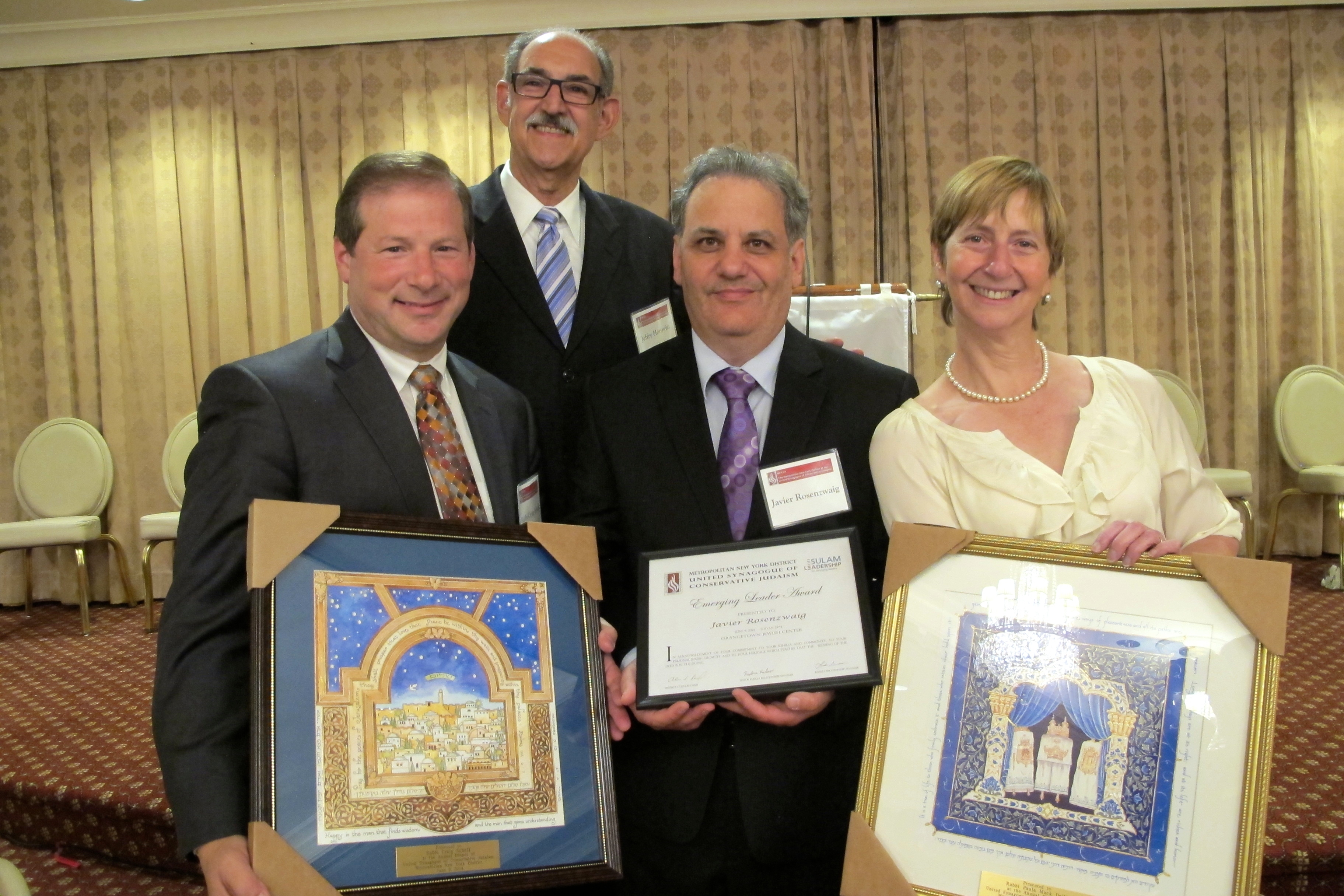
Pirke Avot, Ethics of the Fathers, answers the question of who is truly honored in Chapter 4: “Who is honored? One who honors his fellows.” Rabbi Scheff and I were honored this past Monday night at the annual dinner of the METNY District of United Synagogue of Conservative Judaism. We both felt pride in being singled out and the joy of being celebrated. We were prouder still of Javier Rosenzwaig, one of five laypeople from the entire district honored as an emerging leader. We all know how much heart and soul Javier gives to the OJC and to our mission.
Yes, Rabbi Scheff and I felt honored. What we felt even more powerfully, however, was that in accepting the accolades of METNY, we were acknowledging our extraordinary OJC community.
We were honored because we honor all of you. And you are honored because of the way our synagogue continually strives to honor our neighbors, our fellow Jews in Rockland, in Israel, and the world, and all people created in the image of God.
Rabbi Scheff spoke about the partnership of Joshua and Caleb in this week’s parasha, Sh’lach L’cha. If there had been just one spy alone against the majority, would he have had the strength to stand up and say, “Let us by all means go up”? Relationships are the key to a synagogue that operates with optimism and courage. Lay leadership and clergy work together to meet the needs of the community. At the OJC, we are saying, “Let us by all means go up” every day!
I spoke about God’s command to Moses to send men to spy out the land. In that word L’cha (for yourself) lies the difference between the fear of ten spies and the vision of Joshua and Caleb. Ten men went only for themselves, with their own personal worries and concerns. They forgot that they were part of an endeavor larger than their own worldview. Joshua and Caleb might have been just as concerned as the other ten, but they remembered that their mission was God directed and the outcome was promised in advance by God. They remembered that “for yourself” is complete only when “yourself” and “others” are linked into a common commitment. At the OJC, we strive in every ritual, minyan, program and interaction to remember that we are part of something bigger than ourselves. No less than the spies, we are on a mission directed by God.
Todah rabbah, METNY District, for this great honor.
Rabbi Paula Mack Drill
A City, A Palace, A Parade
This past week we observed Memorial Day. In synagogue we read the names of Jewish soldiers who have been killed defending America since 2001 and took a moment of silence to reflect on those sacrifices. On Tuesday night and Wednesday, we celebrated Yom Yerushalayim, a joyful day to remember the miracle of the reunification of Jerusalem in 1967.

On Sunday, June 1st, Orangetown Jewish Center congregants and our Rockland County friends will join with thousands from the tri-state area to walk down Fifth Avenue in the Israel Day Parade. (For information about the parade, go to the Rockland Jewish Federation website: http://www.jewishrockland.org.) Rabbi Scheff and I hope that you’ll join us there. So often, our Jewish selves and our American selves weave together and separate and weave together again.


This past Shabbat, I asked our congregation to stand if Israel is their home. A vast majority of people in the sanctuary was standing. For some like our Israeli congregants whose families are all there, Israel is the place to which they return when they go home. For some like Rabbi Scheff’s sister and her husband and my daughter Sarah, Israel actually is their home. For others like my son Josh who recently announced his plans for aliya, Israel will be their home.
What about the rest of us? We identify Israel as home. We are Zionists who understand the need to support and advocate for a home for the Jewish people in the land of Israel. We travel there as often as we can. Shouldn’t we be living there? What are we doing here?
I suggested this past Shabbat that there are two important ways to be Zionists: to be there and to be here. In the first century of the common era, Rabbi Shimon bar Yochai said that Judaism is a palace floating atop two ships at sea: one is Eretz Yisrael (the land of Israel) and the other is Galut (Jews outside of Israel). Without both ships staying afloat, said this rabbi of the Mishnah, Judaism would topple. This palace atop two ships imagery is important to this day.
Two of my children will live out their Zionism in Israel, protecting the state by serving in the IDF and then studying, working and establishing themselves as adults in Israel. Two of my children will live out their Zionism in America, protecting the state of Israel by their support and advocacy as they establish their lives here in the U.S. If the metaphor of the palace holds true, then Judaism will remain safe, with both ships staying afloat. As long as the palace of Judaism is carried by Israel and the Diaspora, it will remain Or L’Goyim, a light to the nations, spreading our understanding of living with a moral compass — to the entire world.
With dreams of peace, Rabbi Paula Mack Drill
The Incredible Power of Acknowledgment
Shy, I’m not! On a stage in front of a room of people, on the bima before a congregation, or in front of a video camera — it’s all just fine with me! When Judith Umlas and I first spoke about the idea of an interview format for her Rockland Jewish Family Service Author Series presentation (in partnership with the OJC), I knew that it would be a lot of fun. What I didn’t realize was how profound an experience it would be for me. 
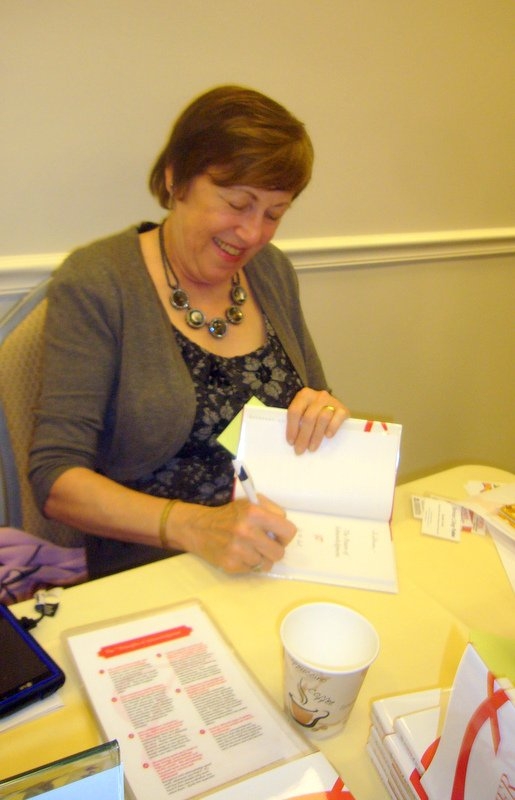
On Tuesday evening, our own Judy Umlas, author of three books (The Power of Acknowledgment, You’re Totally Awesome: The Power of Acknowledgment for Kids and Grateful Leadership) spoke about her calling to teach the simple yet life changing lessons of acknowledgment. Judy considers her writing and speaking about acknowledgment to be a fulfillment of the Jewish call to Tikkun Olam, repair of the world.
One of Judy’s favorite sayings is: “Gratitude – it’s not just a platitude.” In her teaching, Judy is clear that acknowledgment must be authentic and heartfelt. Surface thank-yous and thoughtless praise are not what true acknowledgment is all about. In answer to my questions on Tuesday night at the Rockland Jewish Community Campus, Judy shared real stories about people who changed lives by generously telling others that their actions and words matter. Thanking a barista for always remembering her coffee order made that young worker feel noticed and appreciated. She burst into tears. Telling a phone operator that she appreciated his going the extra mile shocked him. “No one ever says thank you,” he explained. “I only hear complaints.”
We practice acknowledgment with people who are not in our intimate circles so that we become adept enough to share our thanks and appreciation with those closest to us: co-workers, friends, partners, spouses and our children. For so many of us, acknowledgment does not come easily. We take our spouses for granted; we feel competitive with co-workers; we feel awkward showing gratitude to our friends. Judy convinced us all that the results are well worth the effort. Judy posts testimonies from people who experience heart-opening joy through giving and receiving acknowledgment each week on her blog, http://www.thepowerofacknowledgment.com.
Judy challenged the audience to complete a writing assignment she calls “Knock Your Socks Off.” At the end of the presentation, we sat quietly and wrote to any person we wanted to acknowledge. One woman thanked her postman for his consistency, dedication, and willingness to ensure that her slightly broken mail box was always closed tight. Another woman thanked her teachers for creating safe space and for always acknowledging their students. The evening could not have ended in a more precious way than the final audience member who shared her letter of acknowledgment. Judy and Bob’s daughter Stefany acknowledged her brother with a wonderful list of things that she appreciates about him.
We should all practice acknowledgment! I’ll start right now by sharing that Judy Umlas is a treasured congregant and friend in the OJC community. She shares her wisdom with generosity and humility, and I do believe that her work can repair the world.
With acknowledgment to all of you for reading our blog each week,
Rabbi Paula Mack Drill
Open the Gates of Justice (in Albany)
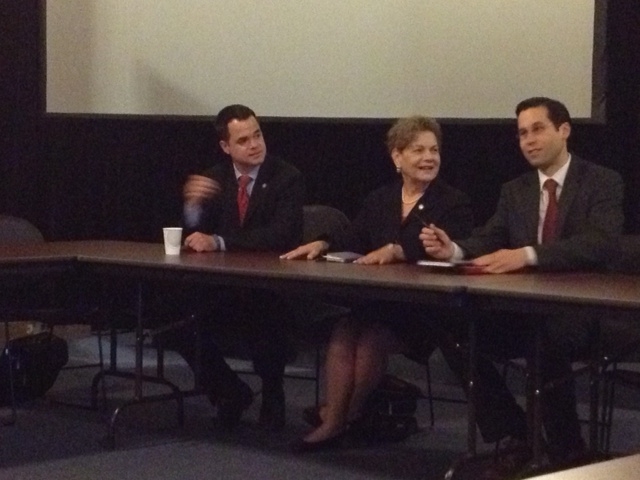
At 6:00 am this morning, Ariella Rosen, our Rabbinic Intern, and I boarded a bus together with thirty interfaith clergy bound for Albany. The Rockland Clergy for Social Justice fulfilled our pledge to call on Governor Cuomo and legislative leaders to initiate immediate fiscal and administrative oversight in the East Ramapo Central School District and to revise the structure, governance and financing of that school district. On the two hour ride up the Thruway we were briefed about our mission and the many advocacy meetings that we would have. Just after a stop for coffee, I davenned the prayers of Rosh Hodesh, the New Month. When I reached Hallel, I sang softly to myself: Pitchu li sha’arei tzedek – Open for me the Gates of Justice. “How perfect,” I thought to myself, “the Jewish calendar can be so in sync with the world.
The day was a big success. I will be sharing information with everyone about the ways in which each one of us can become involved in this issue that is of concern to so many of our congregants in the days ahead. Today we met with Larry Schwartz, Secretary to Governor Cuomo, Speaker Sheldon Silver, Senate leaders Dean Skelos, Jeffrey Klein and John Flanagan, and Senator Andrea Stewart-Cousins. Throughout the day we were accompanied by Senator David Carlucci, Assemblywoman Ellen Jaffe and Assemblyman Kenneth Zebrowski; all three are champions of our cause and deserve our thanks.

For tonight, I would like to share with you the words that I spoke at the Prayer Vigil/Press Conference, to give you a sense of the impact felt in Albany when a unified band of rabbis, ministers, pastors and imams raised our voices together for justice.
I am proud to stand before you this afternoon representing the Orangetown Jewish Center, a congregation of more than 500 families who are concerned about the issue of fair and meaningful access to education for all young people in our county.
On the Jewish calendar, today is Rosh Hodesh, the first day of a new month. It is appropriate to be here today because Rosh Hodesh is a day of introspection and renewal. It is a day of optimism. Interestingly, it is also a day set apart for women and today as the sole woman clergy in attendance, I raise my voice for all of the mothers who send their children to school in the East Ramapo Central School District and for the teachers in that school district, the vast majority of whom are women.
Rosh Hodesh is a day of witnessing. In history, a new month was not declared until witnesses saw a new moon in the sky. Now this witnessing was by necessity subtle because what was being seen in the sky was actually the absence of the moon. Today, we stand before you as witnesses to important things that are absent from the lives of the families in the East Ramapo Central School District. Absent is protection for the children. Absent is fair governance of their schools. Absent is the education that is the Constitutional right of every child in the State of New York.
I stand today as a witness.
Consider the student in Spring Valley High School who has no Child Psychology and Day Care class to take because it was eliminated from the budget. Her dream to begin a career in Day Care will not be fulfilled. I am a witness to her dream.
Consider the student in Ramapo High School whose dream of a college scholarship in swimming or wrestling or tennis is crushed because those teams were eliminated from the budget. I am a witness to his dream.
Consider the mother sending her children to school each day who has sidelined her dreams of their succeeding in a competitive world thanks to education. Now she is more concerned that they return from school safely each day. Security guards were eliminated form the budget. I am a witness to her dreams for her children.
Consider the father who is a mathematician or a musician or … fill in the blank. Like any father, he had dreams of his children’s following in his footsteps. But there are no math electives, not even Advanced Algebra. There are no music programs at all in the Elementary Schools and the award winning marching band no longer exists. All were cut from the budget. I am a witness to his dreams.
Consider the guidance counselor in the high school or the sports coaches in the middle schools or the kindergarten teaching assistant. They were committed to careers in education but their jobs were eliminated. I am a witness to their dreams.
All that I witness leads me to the only possible response: a cry for justice. Here in Albany, I pray that you hear the same call. We clergy of every faith have gathered together as witnesses. We represent our congregations who stand as witnesses. We cannot and will not look away. You are our elected officials. We pray that you join us as witnesses so that we can take action together.
Bashana haba-ah B’Yerushalayim
 If we say, “Next year in Jerusalem” at a seder in New York, what do we say when we make a seder in Jerusalem? The answer is that we still say, “Next year in Jerusalem” because we pray to be in Yerusalayim L’Malah, Jerusalem on High, the future Utopian time when all will be peace. Singing about being in Jerusalem is a moment of hope and open-heartedness every year at the end of the seder, but this year, actually sitting at a seder in Jerusalem, I felt even more optimistic.
We made our seder with my brother Eric and lots of my cousins at a hotel in Jerusalem. As I looked around the large ballroom, I saw tables of thirty and tables of three. There were Jews in white shirts and black pants, Jews dressed in high fashion, and Jews in jeans. As each table began to sing “Dayenu,” we heard more different tunes than I thought possible. There were tables that were being served dinner before our table asked even the second of the four questions. While we sat at the table singing for a long time, we still were not the last table in the room. Every kind of Jew in Israel celebrates Pesach. Walking back through the streets of French Hill to our apartment at close to 1:00 a.m. I felt that anything is possible. Next year in Jerusalem.
We have been spending Chol HaMoed (the middle days of Passover) with Sarah’s boyfriend Sagi’s family on Kibbutz Mefalsim (next to Sederot, in the south), mountain biking and hiking. Everywhere we go, we see Israeli families enjoying the Passover vacation. It is the gift of Israel to be on the same calendar with everyone else! If I am hoping for next year in Jerusalem, so are all the other Jews I see.
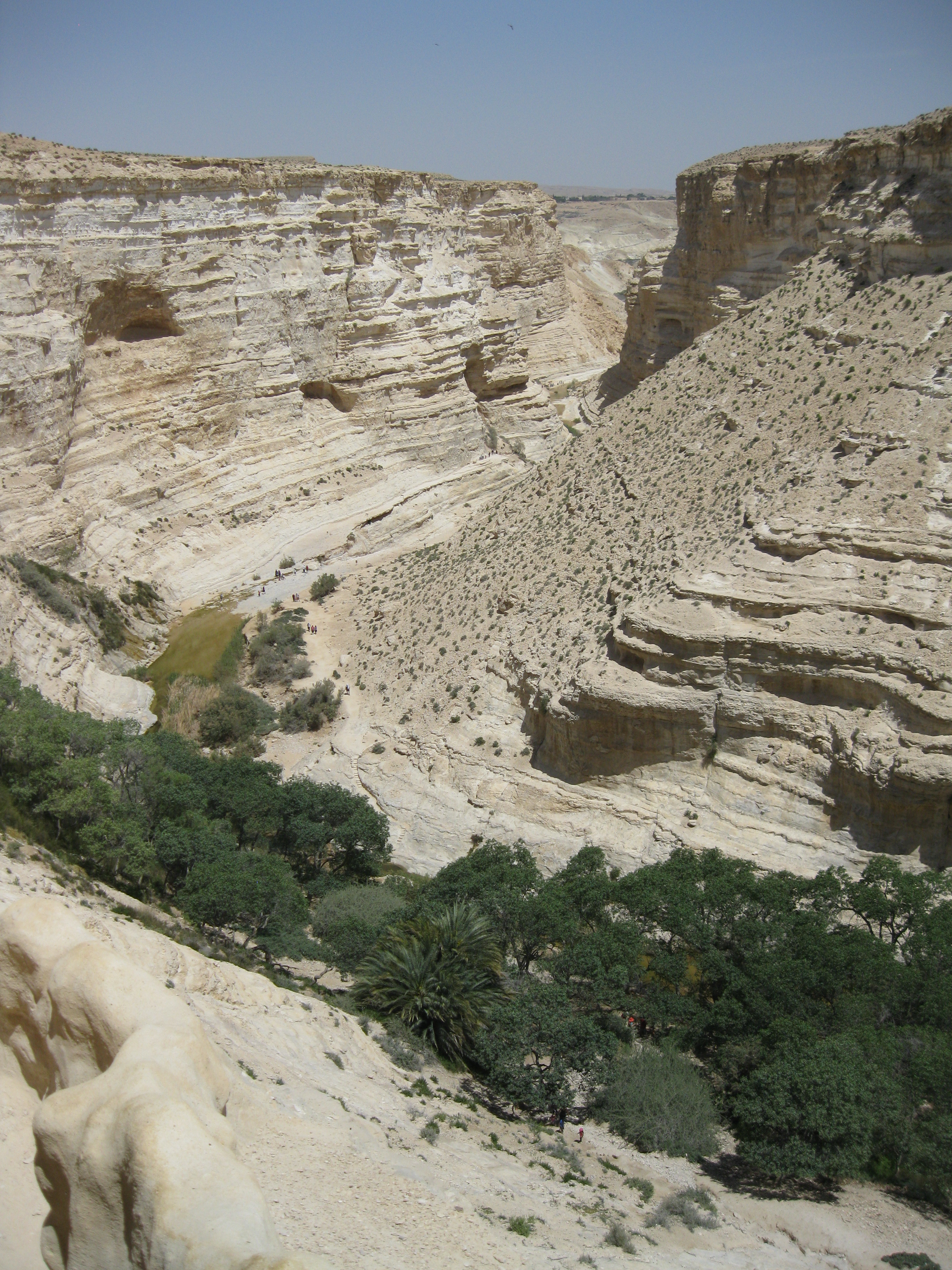 Our youngest, Joshua, announced his intention to make aliya and follow his sister’s footsteps into the IDF. We couldn’t be more proud. With the great possibility of two out of four of the Drill children making lives in Israel, it will really be true for many years to come that we’ll be saying, in a real way, “Next year in Jerusalem.” As a Jew with faith, optimism and a belief in Jewish destiny, I will always say, “Next year in Jerusalem.” I’ll say it when I am here for Pesach, here among people living according to the Jewish calendar, here as a mother of Israeli offspring. I’ll say it when I am with all of you at the OJC for Pesach, among the people in the congregation that I love. My task never sways from working to bring about a better day for all humanity. Bashana haba-ah B’Yerushalayim.
L’hitraot, See you all soon! B’yedidut, with friendship,
Rabbi Paula Mack Drill
Community as a Salve to Loss
If you read the Orangetown Jewish Center emails, you have seen that we have experienced an inordinate amount of loss in our community in these weeks leading up to Pesach. Answering the needs of every loss in a community includes support for the immediate family, answering the questions of loving friends and acquaintances, advising regarding traditional practices and personal decisions, preparing for a funeral, coordinating shiva houses and minyanim, being present for the mourners in the days and weeks and months following the death. “This must be the hardest part of your job,” say loving, concerned congregants. They ask Rabbi Scheff and me how we cope.
There are two answers to the question. The first answer is that responding to the needs of a family at the time of loss is one of the holiest things that rabbis do. Families open the doors to their hearts and share their stories with us. They depend on us to answer some of the most important questions that humans can ask. And when we can be helpful, it is indeed sad but also uplifting.
The second answer is unique to our community. And the answer is: This community. Without the OJC community, we would not be able to help our families in the loving, respectful way that we do. Sometimes our president or Krista in the office are the first to know of a death. They respond as part of a team and find one of the rabbis immediately. The Ritual Committee delivers chairs and books, finds davenners, alerts Minyan Captains of the alternate sites for minyanim. In these past three weeks, we cannot thank Steve Richter and Jonathan Cohen enough for their responsible and caring attention to every detail. Sisterhood delivers some food for the condolence meal, Chesed finds out if there are any special needs for each family. And then all of you come out to the homes of fellow congregants. Some of you turn plans upside down in order to be there for another. I cannot remember making very many shiva calls without an OJC congregant coming to pay condolences at the same time. Tomorrow night, we will have four shiva homes in addition to the minyan here at the OJC. Some people are understandably hesitant about going to the home of a mourner they do not know. Not every mitzvah is easy. But the hard thing is almost always the right thing to do.You can be a part of the compassionate outreach of our synagogue by attending one of those minyanim. You might just be the tenth.
If you would like to know of a shiva house that would benefit from your attendance Sunday evening, please email one of your rabbis at Rabbi.Scheff@theojc.org or Rabbi.Drill@theojc.org.
B’yedidut, With friendship, Rabbi Paula Mack Drill
A Circle of Chesed
 At a recent meeting with the volunteers of our Chesed Committee, I suggested that one goal of the committee was to need such a committee no longer. Won’t it be great when we are a Chesed Community, and everyone’s needs are taken care of by each one of us doing our part. Until that day arrives, however, we still have a lot of work to do.
One fact that makes me proud and yet also stymies me is why we have fifty volunteers on the Chesed Committee. Fifty is a great number of committed people who make meals anonymously, drive people to appointments, call on the phone and visit shut-ins. Those fifty, however, are not available for every need that arises. In a community of more than 500 families, how do we ensure that the number grows?
Another fact that has surprised me over time is how many people hesitate to ask for help. Many congregants have a broad and steady support network of family and friends and so do not need the support offered by the OJC Chesed Committee. But I have found that many people simply do not want to ask for help. A willingness to ask for help completes the circle of Chesed (loving kindness): today I need your help but tomorrow I’ll be able to offer mine. The work of loving kindness completed by the Chesed Committee is done so discreetly and compassionately. Performing a mitzvah quietly gives a unique feeling of pride. This kindness that I do — I do simply to bring an uplift to someone else.
Perhaps you say that you’d love to help but cannot because you have a full time job and a long commute. Perhaps you say that in a few years you’ll help when the kids are older. Maybe you think that you have too many hard issues of your own. To each of you, I say: your life will be enriched by the good that you will do. There are volunteer positions that range from ten minute phone calls once a week to preparing a meal for one or two – once every six weeks or so. Some families complete their friendly visiting with kids in tow; the children learning from their parents’ modeling how to be a true mentsch. And if you yourself are struggling, helping another is a  powerful prescription for healing.
Please consider finding out how you could become a part of the dream of the OJC as a Community of Chesed … by becoming a part of the Chesed Committee. Get in touch with our Chesed chairs, Adele Garber (Ahg19@optonline.net) or Maddy Roimisher (845-359-4846), before you close this blog! You’ll be part of a circle of loving kindness, and who couldn’t use that in our lives?
Kol tuv, All the best, Rabbi Paula Mack Drill
 Three Rabbis Walk Into A Shul
Recent Comments