Reflections on “Walking as Witnesses”
The following is not the typical blog post from the OJC rabbis. It is a daily recap of the OJC-Poland 2024 experience that ended yesterday. It is meant for those who wanted to follow our experiences without resorting to Facebook. It is a bit long, but hopefully you will find it worthwhile reading! Please note, however, that to truly appreciate the emotional arc of our experiences, you really should read to the end….
OJC-Poland 2024: “Walking as Wintesses”
Day One
On the eve of arrival in Poland, leading a group of 32 (mostly from our synagogue community) to Krakow, Majdanek, Lublin and Warsaw, I wrestle with these thoughts:
How do we bear witness and process the inhumanity that was visited upon us? And how do we avoid permitting this victimization to be the primary motivator of our Jewish identification?
How can we make room for empathy towards those who were bystanders (sometimes innocent and sometimes willing), while also holding accountable those who actively participated in our suffering? What can we learn from those who stood up righteously in our defense or in defense of their own humanity?
How do we appreciate Jewish physical and spiritual resistance in spite of Jewish suffering?
How can Poland remain both home and graveyard?
How do we understand Jewish life in Poland today? What is its meaning and mission?
And how does all our wrestling translate into a productive and empowering way to confront our current circumstances as American Jews?
Though this is my third time leading this trip, I anticipate an emotional, challenging and hopefully meaningful week ahead with what seems to be a very special group of people.
Day Two
Our group convened this afternoon to begin our tour of Krakow. After I offered an intention for the days ahead, we set off for the Jewish quarter in Kazimierz.
Our tour guide walked us through the bustling city and into the heart of Jewish life here, home to the world’s largest annual Jewish festival. We visited the Altshul, the Rema Synagogue and Cemetery, and the Temple Synagogue, tracing the history of a Jewish presence dating back to the 15th century.
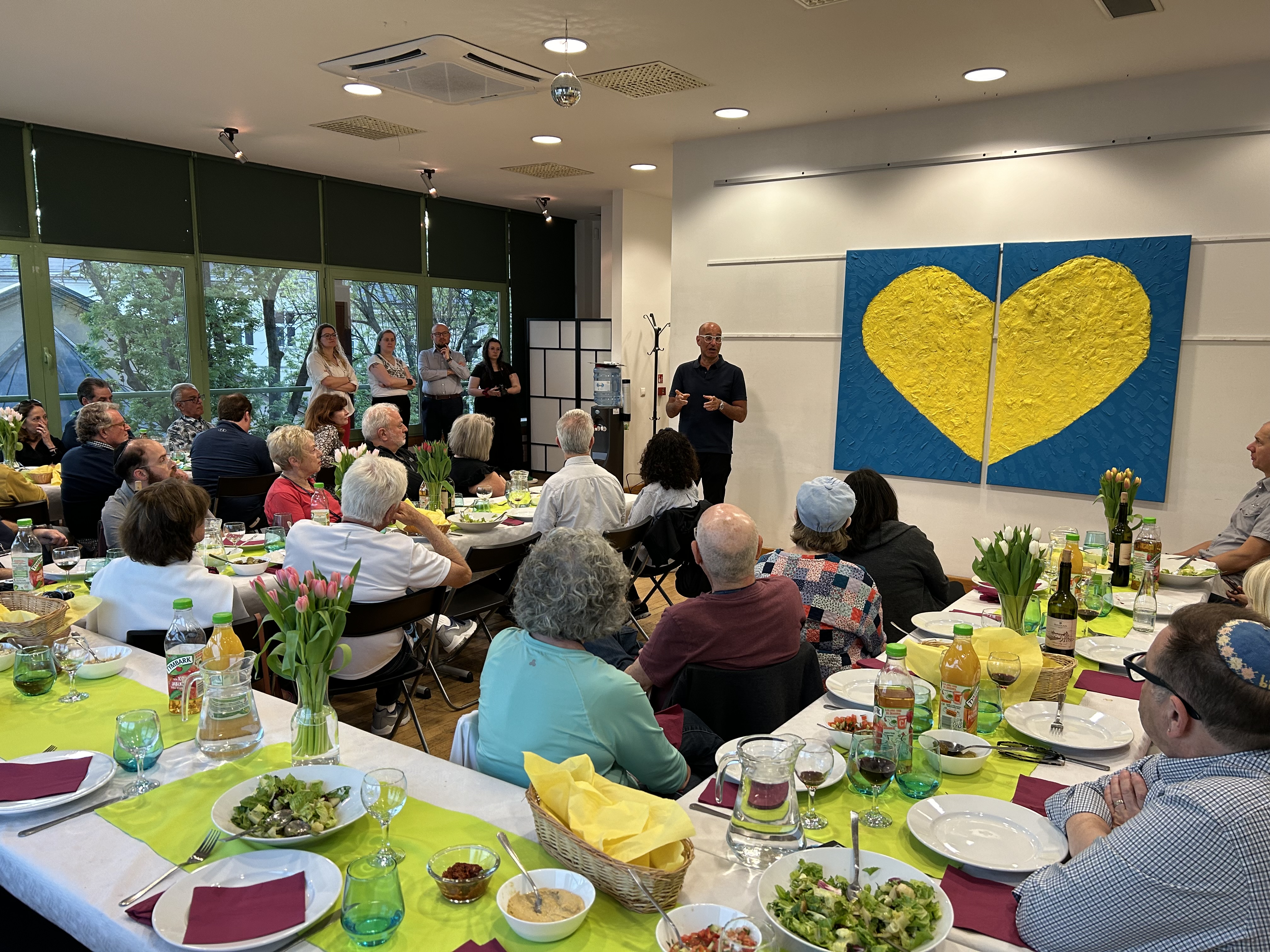
Our tour ended at JCC Krakow, where we dined and met with CEO Jonathan Ornstein, who shared with us his perspective on the phenomenon of a growing Jewish presence in what many considered a Jewish graveyard. The work that is being done for those discovering Jewish roots is remarkable, and the JCC has become a safe haven and support center for Ukrainian refugees.
We asked ourselves the question earlier today, “why are we here”? After our first experiences in Krakow, we can answer that we are here to witness the resilience of the Jewish people.
Day Three
An early start on a warm and sunny day took us through the lush Polish countryside, out of Krakow and to Auschwitz and Birkenau. As we approached the site of the slaughter of 1.1 million Jews, I could sense the ghosts of the dead walking through the shadows of the dense woods, beckoning us to come bear witness.
Touring the exhibition halls gave us the history of the site’s construction and the story of how Jewish lives were routed to this final destination for so many. More impactful, however, was seeing the belongings of individuals who were given hope that they were heading from a ghetto to somewhere else — a suitcase, a pot. The piles of eyeglasses, prosthetic limbs and hair told us the unimaginable end that was met instead.

We left Birkenau and stopped at the remaining synagogue of the city of Oswiecim (Oswiecim Synagogue), where we had the opportunity to reflect on our personal reactions to the experience. We felt speechless, overwhelmed, sad, angry, scared, determined, resilient, strong, hopeful, all of the above and more. We felt the cognitive dissonance of walking in the sun on a beautiful day along the path that led to death for so many; of the magnificent weather for a space we associate with the color grey; of the bustling life going on all around, and even within, a torture chamber.
We will continue to let the images settle in our brains and the feelings come to rest in our hearts. It’s time to literally and figuratively wash off the dust as we prepare for Shabbat. This evening we will welcome the Sabbath queen as royalty ourselves. We are here, and we are alive. This Shabbat we make our presence known to God, to one another, and to all the ghosts relying on us to continue their legacies.
Day Four
Krakow is a magnificent city. It avoided destruction during multiple wars, in part because the Poles were quick to retreat in an effort to spare their crown jewel, in part because aggressors made it their center of operations. From castles to churches, we were impressed by the scale, opulence and history reflected by its layers of architectural beauty. Crowded and vibrant public squares and outdoor cafes showed us a free and happy society.
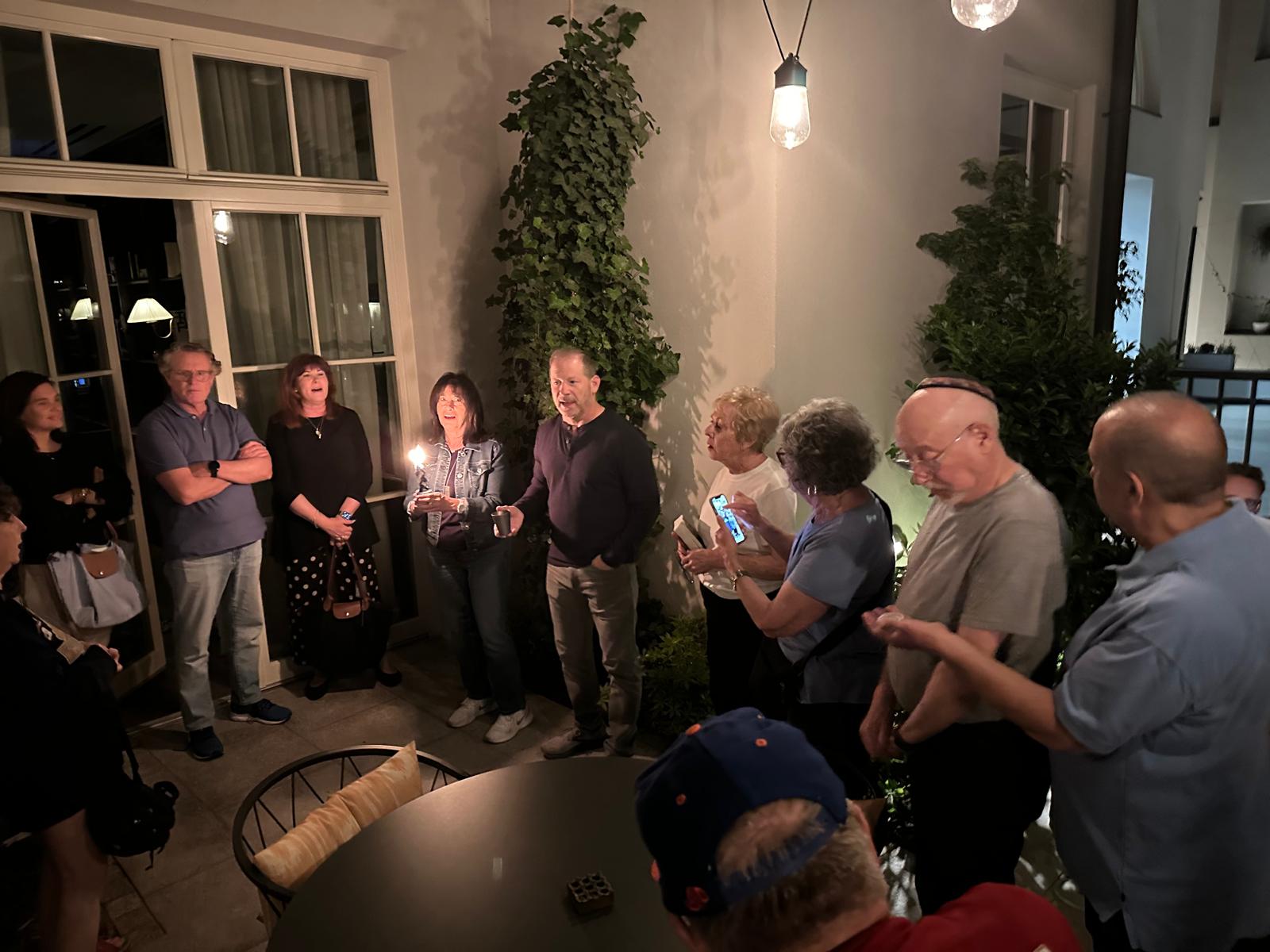
So what does it say about Jewish life in Poland if I tell you we had a perfect Shabbat in Krakow, from sundown to Saturday night? A space of our own in our gracious and inviting boutique hotel, a warm and uplifting Kabbalat Shabbat, and a sumptuous kosher dinner prepared by Chef Alon; morning Shabbat tefillah at the Rema Synagogue with locals and visitors, accompanied by melodies both familiar and new (giving me a couple of ideas to bring home!), where I received an aliyah (thanks David Simkins!) and couldn’t help but tear up thinking about what my grandfather z”l would say; a late morning walking tour to the Old Town; an afternoon walk to the site of the Jewish Ghetto and Schindler’s factory; and, of course, Havdalah.
Out of the depths of Friday’s experience at Auschwitz we rose up to feel our souls soar (in stark contrast to our sore soles!), and this morning we once again descend into the pit that was Majdanek.
May we rise once again, Am Yisrael chai.
Day Five
An early departure from Krakow for the long ride to Majdanek was not a given. Despite the inconvenience and the apprehension about committing to experiencing a camp that could be operational in minutes, we knew we had made the right decision immediately upon our arrival.
Simply put, every Jew must see what we saw. It was a comfort to see multiple “March of the Living” groups of teens walking by us, sitting in reflection. On this eve of Yom Hashoah, they are learning the lesson we must all learn: Our Jewish identities and way of life are what has given us the resilience to survive, live and build lives. Our enduring the worst atrocities humans could inflict upon others only proved that we the Jewish People are the source of hope for all humanity.

Sitting in the Yeshiva of Chochmei Lublin, we felt the power that centuries of learning and prioritization of teaching and living Jewishly has brought to our ancestors and continues to provide for our children.
And despite terrible traffic that delayed our arrival in Warsaw by 2 hours, we still managed to hold our own Yom Hashoah commemoration, reflecting on what it means to us in the wake of this experience to be “keepers of the flame”.
Tonight, through the miracle of technology, I was able to share my reflections from this trip on the heroism of my own grandparents, Israel and Sonia Neiman z”l, to see generations representing the survivors of their own families, and to hear Amy Edelstein share her own story. I hope the next 24 hours will provide each of us the opportunity to reflect on what “never forget” means to us in light of where we find ourselves today.
Day Six
Too many people are unaware that the full name of Holocaust Remembrance Day is actually Yom Hashoah v’Hagevurah, meaning the day of remembering the destruction and the heroism.
On this Yom Hashoah, we find ourselves in Warsaw, the place that inspired the full name of the commemoration. The Warsaw Ghetto was obviously a place of terrible suffering as a result of inhumane treatment and living conditions. But while the Nazis tried to strip the Jews of their humanity and ultimately set about liquidating the ghetto, its residents fought until the end. After unexpectedly costing the Nazis soldiers’ lives, resources and time, the persistent and heroic Jews ultimately took their own lives in the face of an overwhelming Nazi military response.
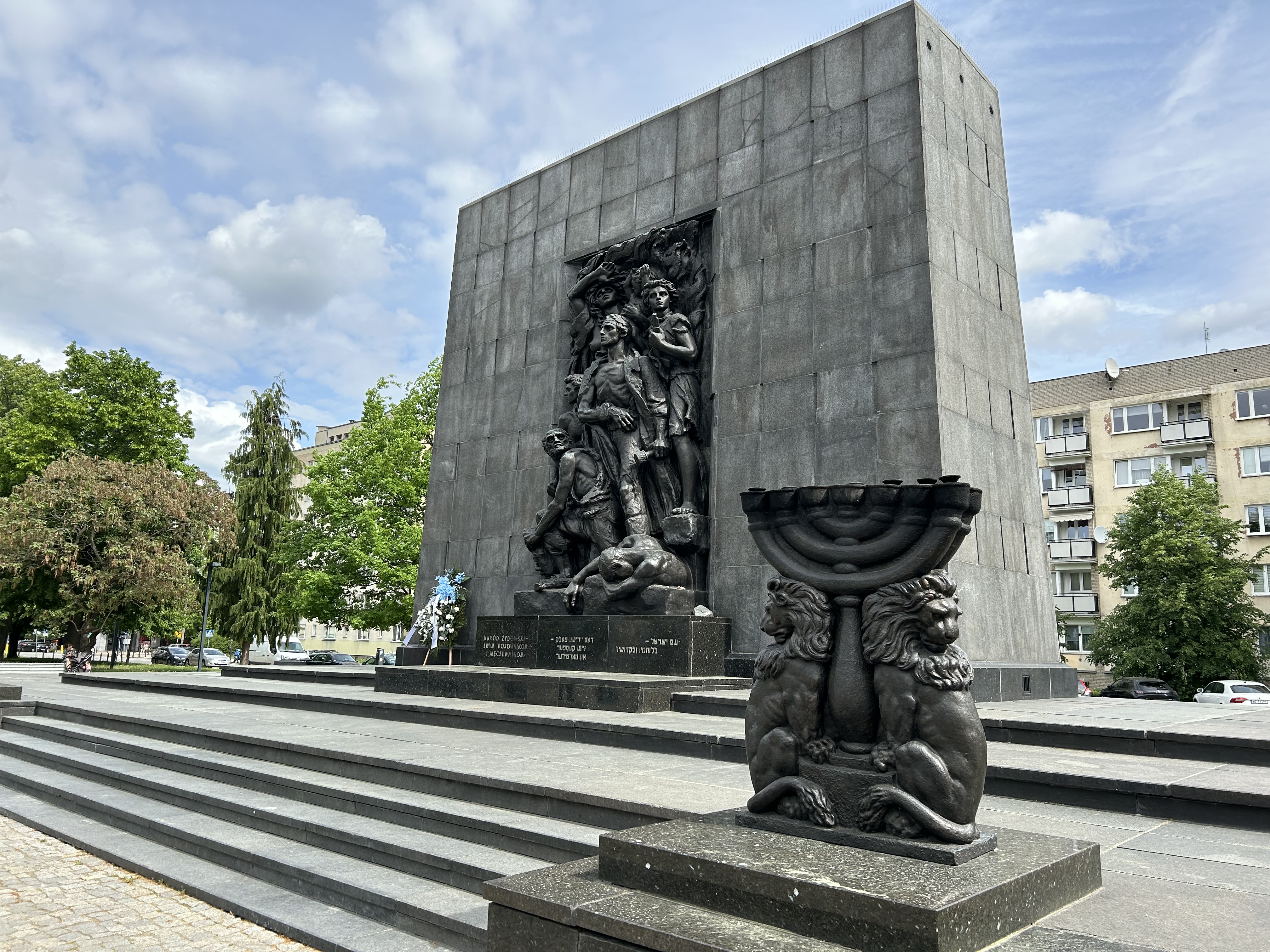
There are few remains of the actual physical ghetto or of the WWII city, given that 85 percent of Warsaw was reduced to rubble. But there are reminders everywhere of Jewish presence, persistence and rebirth, and of the Jewish history that is being rediscovered and examined by so many Polish citizens. From public memorials (plaques, monuments, structures like the deportation platform) to the new Polin Museum, it’s hard to be in Warsaw and not be reminded of the city’s Jewish heritage.
Standing in the Nozyk Synagogue, the only synagogue that remains in Warsaw today, we reflected on the connection between the heroism shown in Warsaw by the likes of Mordechai Anielewicz and the image of the “new Jews” who fought for the establishment of the State of Israel. Our voices echoed in the sanctuary as we sang a prayer for the hostages on this Day 213 of their Gazan captivity, the prayer for the State of Israel, and Am Yisrael Chai.
The Warsaw Jewish cemetery is history told in stone. Parts of the cemetery have been restored with monuments erected symbolically to pay homage to the many greats of Warsaw’s Jewish past. But as Nancy and I went in search of the burial place of our daughter-in-law’s relative who was buried here in 1934, we found ourselves in the deep, dark recesses of an abandoned graveyard with toppled and broken stones, one plot indistinguishable from the next. I felt the shadows closing in on us, and I was reminded of the brutality Jews experienced in a place they once called home.
A day to remember the heroism. A day to remember the destruction. Never again. Never again.
Day Seven
It’s honestly hard to appreciate how we got here without experiencing it for oneself. Considering this emotional roller coaster of a ride we’ve been on and where it started, most of us (if not all) could not have imagined finishing this journey where we did.
Today we took in a presentation from the Polin Museum about the “righteous gentiles” who risked and even gave their own lives protecting Jews. We heard an honest assessment of non-Jewish attitudes towards the Jewish past, and of the ways in which “cultural” antisemitism manifests itself in Polish society.
Today we visited the Jewish Historical Institute, where we saw the written testimonies preserved by “Oyneg Shabbos”, the underground archivists of the Warsaw Ghetto. Their heroic efforts of spiritual resistance have preserved legacies and eyewitness testimonies for Polish and Jewish students of the past.
Today we visited the beautiful Warsaw Zoo, where Jan and Antonina Zabinski hid Jews whom they helped escape from the Warsaw Ghetto, some for days and some for years. We were treated to a piano concert of Chopin and Offenbach, the music Antonina played to signal to the Jews in her basement whether they could emerge from hiding, fall into silence, or head for tunnel that led to the cages beneath the zoo.

We finished our day at the JCC Warszawa, where we dined and learned from CEO Patrycja Dolowy and JDC Entwine fellow Sam Kapner about the continuing revival of Jewish life in Warsaw.
Despite the horrors of the past to which we bore witness, despite the reality that our feet walked above the ruins of Jewish homes, and despite our desire to claim and brandish our victimization against the world, there is a fragrant flowering of Jewish life in Poland. It is youthful, energetic, embracing, and proud. It is unencumbered by the past. It is recognized, appreciated, and even celebrated by non-Jewish Poles.
With great curiosity and a desire for answers, Jewish life is being rediscovered by those with Jewish roots; revealed by those who hid their Jewish identities; explored by those who have recognized that Judaism comprised a substantial piece of Polish history and culture; and remembered by those who don’t want to be condemned to repeat the past. In a Poland that continues to redefine and rebuild itself since its independence from Soviet rule, Warsaw is a safe place to openly identify and practice as a Jew.
Did I just say that?
We heard it from young, proud voices. We heard it from the people who are living it. Who are we to diminish their Jewish enthusiasm, spirit or determination in any way?
As we concluded our night and our Poland experience singing our anthem “Vehi sh’amdah,” the words came out feeling quite different than when we first sang them. May that which has sustained us, despite the enemies in every generation who have sought our destruction, continue enabling us to flourish along with God’s help.

Preparation in Elul: I lift my eyes to the mountains…
My horse, Naapi, stepped gently through the trees, stopping now and then to munch on the grasses and wildflowers along the trail. I was supposed to pull his head up and give him a heel to the ribs. Of course, I did not have much heart to do that! He knew in an instant that he had a softie in his saddle. Naapi was named for the Old Man in the Blackfeet Indian origin story; he is the one who designs and shapes the world into being. He is also a trickster. (Maybe it was not only my compassion that kept me from steering him away from his mid-ride snacks – I took his name seriously!)


I asked our guide, Shane, what he thought about a Creator who is also a trickster. Shane laughed, and then turned our light banter immediately to a theological discussion. It turns out that not only is Shane a prize winning rodeo competitor, a high school teacher, and an entrepreneur, but he is also pastor of his church.
He told me about his sense of wonder at the birth of his first child just three days earlier, a funeral at which he had officiated the day before, and community healing he hopes to effect in his church. I told him about my synagogue, the social action and prayer in which we engage, and the serious work of preparation for the High Holy Days that begins (tonight!) with Rosh Hodesh Elul.
Shane was especially moved to learn about the Jewish idea of repentance. I explained that the Hebrew word teshuva does not mean punishment or forgiveness; but rather, return. When I told him about returning to our best selves and to God as the true work of repentance, he thought this would be a good lesson for the people in his church.
I joked that I would be teaching about his church on Saturday and he would be preaching about our synagogue on Sunday!
As our scheduled one hour horseback ride lengthened into two hours, we spoke about obligations to family, privileges of community and our connection to God through nature. Shane told me that he believes that there are more atheists in urban areas than in back country. I understood exactly what he meant. In our normal suburban/urban lives, we are surrounded by the accomplishments of humans: bridges and buildings, roadways and highways. We spend our days connected to electronics and social media. It makes sense that there is not much room for God in our busy, human-centered lives. How different it is in the back country where I was privileged to spend ten days of vacation. I spent my days on a bicycle or in hiking shoes. I rarely used my phone. The tallest things in every direction were the glorious mountains of Glacier National Park. When I considered the Rocky Mountains decorated on top by ever-changing cloud formations, glacial lakes, fast-running rivers, endless plains and deep forests, I felt deeply God‘s presence. Who else could have “invented all of this stuff”?!


It is time to prepare for Rosh Hashanah. We will be hearing the blast of the shofar for the first time on Sunday morning. How will we wake up? OJC is offering several opportunities to do the work of Heshbon haNefesh, taking an accounting of our souls.
Women of OJC are invited to a Saturday evening program on September 7 to Envision a New Year . #OJCSupportsU is hosting a workshop, Hope into the new year, at two different times: Monday, September 16 at 4 o’clock in the afternoon or Wednesday, September 18 at 7:30 pm. Hope into the New Year.
After my amazing experience at Glacier National Park, I have one more suggestion for Elul preparation. Consider preparing your soul by connecting to God in nature. Rockland County, New York and Bergen County, New Jersey have some of the most beautiful outdoor areas in our country. Unplug, disconnect, and find the green spaces to quiet your mind and listen to your soul. Bring with you a prayer book, a poetry collection, a journal or a book of Psalms. Close your eyes and breathe in as the trees breathe out. Listen to the sounds of the woods or the ocean. Be present to yourself in the majesty of God’s creation. On my vacation, every morning when I prayed, I could never figure out if I should read a Psalm about God’s creation or simply look up from the page at God’s creation. Ultimately, I chose to do both. I hope that you will do the same.
Whether on footpath or sandy beach, I wish you luck on your journey toward the High Holy Days. Perhaps you will be rewarded, as I was, with a rainbow. God keeps God’s promises. Do we keep ours?

Mas’ei: These are the voyages
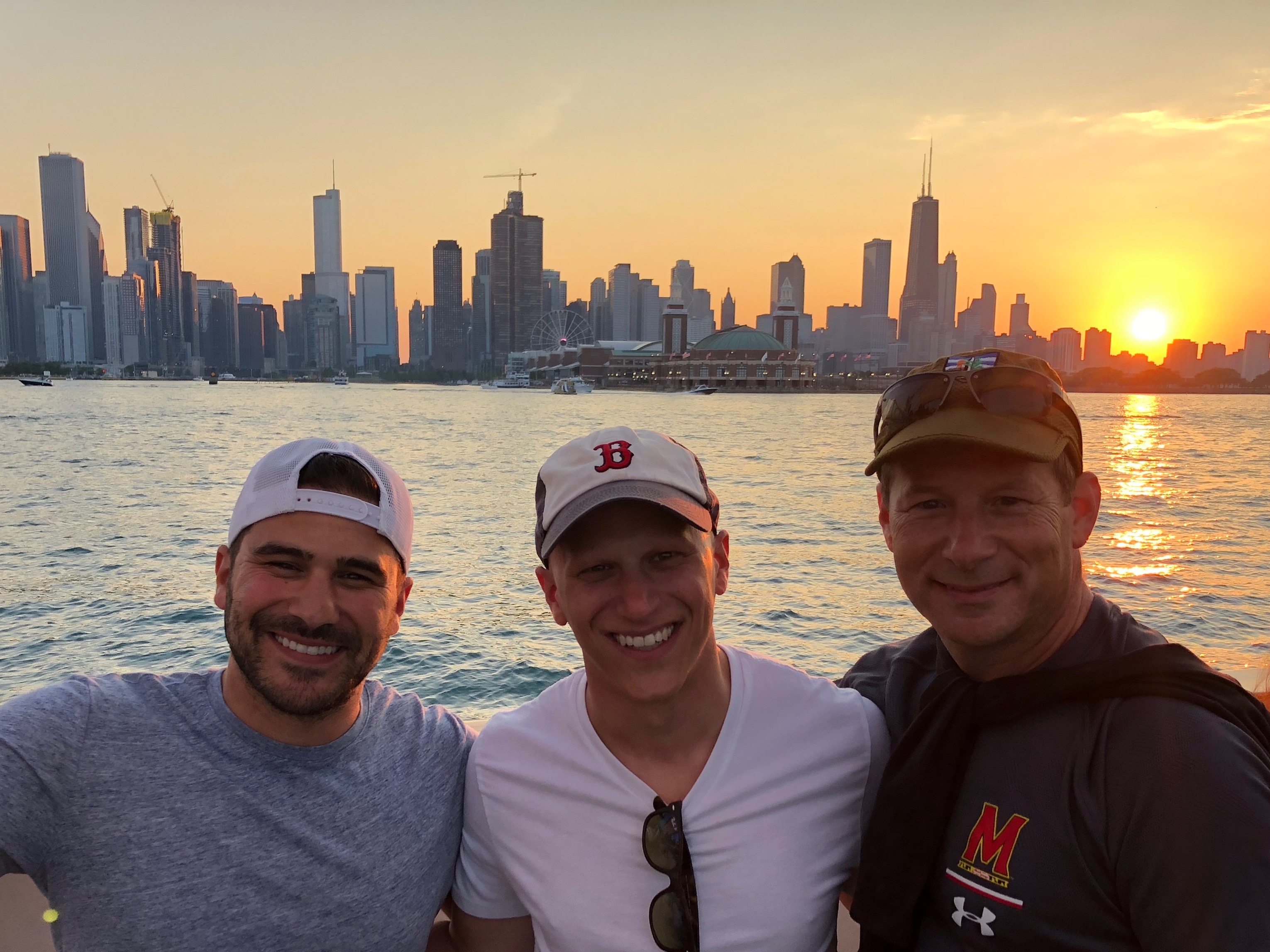
Over the past week, I had an opportunity to share some vacation travel with my two older sons. Aside from being a time to rest, relax and rejuvenate, it was also an opportunity to experience a new city, reconnect with my adult children, and revisit relationships with extended family and friends.
Sharing space and time with others for an extended period, especially in close proximity, was an excellent exercise in self-awareness. The experience brought on a heightened consciousness of personal habits and a test of comfort with making conversation or with the lack thereof. Even our pace of movement as a group was something to be considered and negotiated.
Our destination was more familiar to some and brand new to others. This imbalance dictated that some would step up to lead while others would be relegated to follow. Some accepted their roles with complete comfort; others were forced to confront the insecurities that can accompany such powerlessness. While some of us sought to take in the experience from an intellectual perspective, diving deep into each historical site and building, others of us preferred the bird’s eye view, preferring the forest to the trees of the landscape.
Now, imagine that we were two million travelers instead of just three! These challenges (relatively insignificant, especially given that the context was a vacation!) must have been multiplied exponentially for the Israelite families journeying from Egypt to the Promised Land. The Torah, however, goes to great lengths to recount the places that served as mileposts of the trek and the people who led the migration. Let’s not lose sight of the many emotions and dynamics that had to be addressed by individuals, families and communities along the way.
And the next time we venture to a new place or choose to share an experience with others in a new configuration, perhaps we can examine our own responses more closely, especially relative to others. Perhaps we’ll come to appreciate the journey as much as, if not more than, the destination.
Shabbat shalom,
Rabbi Craig Scheff
 Three Rabbis Walk Into A Shul


Recent Comments