So how was your sabbatical?
I have been back at the OJC for two weeks and cannot count the number of times I have been lovingly asked, “So how was your sabbatical?!” I found myself answering the question with some version of: it was meaningful and valuable and I will tell you all about it soon.
Putting off the description for the future started feeling more and more troublesome until this past Friday. I experienced one of those sacred rabbinical days that make me feel grateful for my profession and also put into perspective the gift of the past three months.
I will start with a narrative of Friday and work backwards to the delayed description of my sabbatical. Early in the morning on Friday, Rabbi Scheff and I met our colleague Rabbi Mark Cooper and a wonderful young man with his family at the Temple Israel Center mikvah in White Plains. Jason* studied for two years in preparation for conversion and then found the conclusion of his journey delayed by Covid. He spoke with intelligence and thoughtfulness about becoming the Jew whom he has always felt himself to be. The privilege of sitting on his Beit Din (rabbinic tribunal) and granting a Hebrew name to a person of deep integrity lifted my soul.
Back in Rockland County, I visited the hospital room of Janice*, a congregant who had survived a life-threatening illness. When I walked into her hospital room, she wept tears that had been stored up for the past three weeks. She was surprised to find herself weeping, but I understood. I represented her community, her Jewish faith, and perhaps even God. We sat together, speaking quietly. Her heartfelt response to being granted a second chance opened my soul.
I drove to the home of Susan*, a congregant who has been isolated for the past two years due to Covid precautions. As we sat and talked about matters serious and not, I felt the importance of connection face-to-face. Her friendship and her optimism despite difficulty filled my soul.
Just before Shabbat, I welcomed into my office Harry*, a man who has been investigating Judaism. He described the study, prayer and experiences he has been seeking. Perhaps wanting to show how much he had learned so far, he offered to chant Shema for me. When I heard his beautiful voice, I closed my eyes and felt tears well. My soul was connected through his words of prayer to God.

As I led the Ma’ariv prayers for our in-person and virtual minyan, I reflected on the very full soul with which I was entering Shabbat. Throughout the day, my soul had been lifted, opened, filled and connected. Such intense interactions with people is a privilege and a gift. I am granted a window into their souls. Their thoughts, hopes and prayers pour in to me; and at the same time, my energy must pour out to them.
As I began to pray the Amida, I suddenly understood how to answer the question, “So how was your sabbatical?” My sabbatical lifted, opened, filled and connected my soul for three months without requiring me to give back anything. I was filled to the top so that I have plenty to give back now.
I studied virtually and privately. I traveled, hiked and practiced yoga. I did a great deal of writing, reading, and spending time with family, most preciously my grandboys. I was filled up.


Those of us who work have demanding jobs. Many of us who are retired have time-consuming volunteer positions and caregiving responsibilities to family members. Sabbatical is a great idea for all of us.
For clergy, three months without waiting for phone calls with someone else’s emergency is a respite that is more valuable than can be described. It is a complete rest of the soul.
I do not want the precious gift of sabbatical to be lost amidst the rush and intensity of work. I have dedicated myself to taking full advantage of the weekly opportunity for sabbatical that we Jewish people call Shabbat.
I encourage you to take the time to enter into Shabbat in the way that feels most reasonable for you. However you do it, practice self-compassion and care. Feel yourself lifted, opened, filled and connected. If you are not sure how to do this, ask Rabbi Scheff or me. We have lots of entry ways into Shabbat to suggest. I guarantee you will have more to give to others if you begin by taking care of your soul.
With a full soul, Rabbi Paula Mack Drill
*All names and circumstances have been changed for this blog post.
Answering the call
I so clearly remember the day I decided to pursue the rabbinate as a profession. It wasn’t a moment of revelation as much as it was an invitation to recognition. There was no event that suddenly awakened some personal transformation. Instead, there was a suggestion (from my big sister to be exact) that I had been denying my true nature, distracting myself with the pursuit of others’ dreams for me. In that moment, I had a choice: I could ignore the suggestion and continue on my path; or I could take a closer look, be present to the moment, diverge from my course long enough to envision an alternate direction.

You might think that the miracle of the burnish bush, as the event is described in this week’s Torah portion, is found in the fact that God spoke to Moses from the bush, or that the bush itself was not consumed. Experience has taught me, however, that a miracle can be found in Moses’ decision to divert from his path long enough to consider a change in course. “Let me divert from my course and examine this magnificent sight,” he says. Certainly, a revelation to Moses of God’s existence takes place; but even more impressive is Moses’ presence in the moment to recognize the invitation to consider his life’s course. The events of his life might have led Moses to a happy life as a shepherd in Midian; but his true calling was to a different path. His acceptance of the invitation to consider that path was not a given.
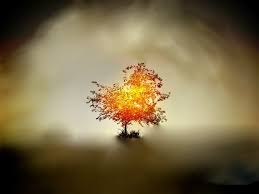
The burning bush has always been a symbol present in my life, though I was not always conscious to its relevance. It was the emblem of the summer camp I attended (thank you, Camp Ramah in New England); it was at the heart of a blessing I was given upon becoming a bar mitzvah; it lies at the center of the atarah (collar of my tallit) my mother made for me when I was in college; it is the logo of the Jewish Theological Seminary. Some might go so far as to say it was even a sign, pointing the way to my ultimate destination.

My decision to become a rabbi certainly did not come as a surprise to those who knew me well or who watched me grow up. The signposts were everywhere to be seen. But the combination of experiences that shaped my life did not necessitate one particular path. The invitation to recognize my life’s “true calling” would have passed had I not chosen to give it my attention.
I do not believe that we have only one calling in our lives. We may find contentment down multiple life paths. But each interaction in our lives offers us a choice of paths to travel. Our aversion to change and uncertainty may sometimes limit the options we perceive, getting in the way of our ability to entertain even a minor detour from our current path. But life presents us with multiple burning bushes just calling out to be examined. And we are invited to stop, look and consider the alternate directions our lives’ circumstances have presented us.
Dare we heed the call?
Rabbi Craig Scheff
 Three Rabbis Walk Into A Shul
Recent Comments