Counting the Days of Omer and Covid-19
More than a month ago, a friend asked if I am journaling every day. She thought it would “really be something” to capture this unprecedented time and then look back at my words a year from now. She is certainly right. But it seems I cannot write; after five and a half weeks of stay-at-home, I have two entries, each no more than a paragraph, sentences drifting off in the middle.
I have planned to write this post for weeks now. Every day I write little pieces of it in my mind, but then, before I even begin, I decide that it has all been said already: The times are hard; look for the silver lining. We have great sorrow; still we try to be grateful. What else is there to say?
I realized today that what has actually kept me from writing is that I cannot comprehend the texture of this time. I simply cannot wrap my head around this time of languishment. (I remember feeling this way in college, reading Thomas Mann’s Magic Mountain. If you also read it, you understand.)
We Jews are so good at understanding time as a container, a useful vessel for emotion, striving, and cataloguing: Shabbat, 10 Days of Awe, Three Weeks, 49 days of Omer.
Yet it is hard to understand what is happening in this particular time. If there is indeed a time for everything under heaven, I do not think it includes this pandemic. Do we think there is nothing new under the sun? We must think again. We have never before known COVID-19.
The days slip by. I think Sunday is Monday. I go to bed early or very late. I wake in the middle of the night worrying about small details, my sleepy brain unable to go to my real concerns. I breathe deeply and smile and model optimism. Just under the surface of each day, however, is an existentialist anxiety. Beyond questions of when will it end and how will we cope lies the theological impossibility: What does it mean? Here we are, full stride in the midst of it, and we have absolutely no idea what it all means. Hence, anxiety.
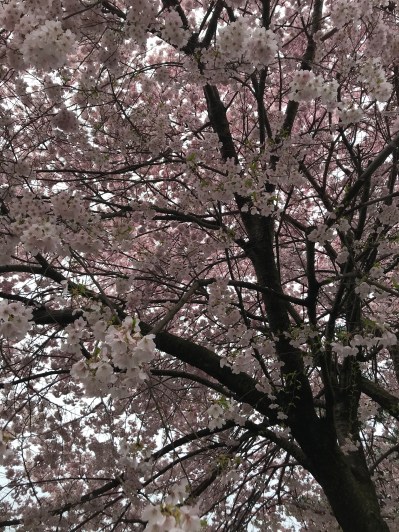
We are taught to face anxiety with a good dose of gratitude. Gratitude, I can do. I am grateful for many gifts: walking in my neighborhood in the spring time,
practicing yoga virtually (I have finally been able to follow my own mantra: ‘Stay on my own mat’ – no one else to look at!), rediscovering the pleasures of my kitchen – inventing new recipes like carmelized pearl onions and cauliflower soup with red peppers. I made Sharon Rappaport‘s mother’s Passover popovers for the first time in years. (Thank you, Estelle, they are delicious!)
But I know that these months are not just an extended retreat from the world. No matter how content I might be during hours at home, no matter how I seek out reasons to be thankful, the entire world around me fills my heart and mind with sadness and concern.
I have completely good health. My kids are all safely at their homes, jobs intact, healthy and in good spirits. My in-laws are in their own homes, tucked away and safe.
But across my driveway, our beloved Millie is recovering from a fierce bout with the virus. She is a certified nurse aide at a geriatric center and had no choice but to go to work even when she didn’t feel completely well. No fever? Come to work. The Center is – like so many caregiving facilities – desperately short-staffed. Millie is an hourly worker who needs each paycheck. And she is a dedicated compassionate worker who now worries about the residents who are missing her special care and attention.
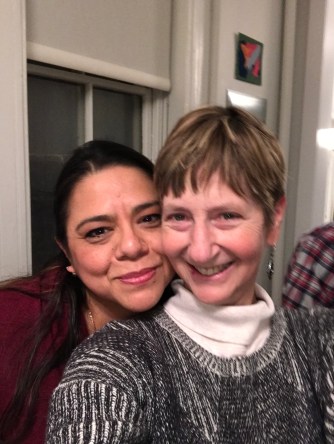
Across the airwaves, I speak with our congregants who are ill, worried about their family members, or grieving losses. I receive notices from the three synagogues to which I belong as well as from the Rabbinical Assembly. I wring my hands thinking about Rabbi Scheff officiating at four funerals within a 24 hour span of time (and today in this monsoon). I speak to our congregants who describe literally and metaphorically standing on the other side of a pane of glass, trying to connect to their loved ones… trying to connect to their own grief. In the mourners, we sense a shock that goes well beyond the usual experience of bereavement. This precious OJC community will have work to do when this is over. The work of healing and rebuilding will require as much courage as this work of sustaining community in the crisis.
Covid-19 has stolen so much from us. Children have lost the ability to play with friends, teens have lost their clubs and sports, young adults have lost graduations, wedding dates, promises of summer jobs. Adults have lost health, jobs, the ability to care for our vulnerable family members, holiday gatherings, structure, and a sense of security. We simply do not know how to understand this passage of time.
And so we will count the Omer and remember the lessons of counting up: That every day is a gift. That we count up to appreciate and remember. That Judaism and community offer us structure when the world is chaotic.
This year, it looks like we’ll be counting toward Shavuot and just keep on counting. When will it end and how will we cope? I do not know, but I know that it will end and we will cope.
What does it mean? We will not ever know. But we can learn something about what it means each day as we count the Omer. We can say thank you to God for the goodness in our life. We can reach out each day to someone who is suffering emotionally, spiritually or physically from this plague. When there is no meaning, Judaism teaches us to make meaning.
Stay safe and healthy in mind, body and soul, Rabbi Paula Mack Drill
Counting the Omer of Illness, Loss, Gratitude and Redemption
You shall count from the eve of the second day of Pesach, when an omer of grain is to be brought as an offering, seven complete weeks. The day after the seventh week of your accounting will make fifty days. — Vayikra 23: 15 – 16
When it was time to count the first day of the Omer, I was not at a second night seder. I was not standing with family and friends, turning to the final pages of the Haggadah and reciting the blessing and counting for the first time this year. I did count the first day of the Omer, but I was prone on an emergency room bed, felled by an intense case of what turned out to be pancreatitis.
Ever the optimist, I expected the nurse to tell me I was being discharged. Instead, she told me that something had been detected on my pancreas and I was being admitted into the hospital. Day One of the Omer. A new reality began.


I have not missed counting each day of the Omer since. No carelessness, no jumping up out of bed half asleep because I had forgotten, no catching up the morning after to save the pattern in the nick of time. Blessing and counting became serious business for me this year because the days of the Omer have entirely encompassed this strange odyssey in my life. From Day One through Day Forty-Nine (which will be counted tonight) I have experienced unexpected illness, a shocking diagnosis, major surgery, the unexpected death of my brother, a limited ability to fulfill the mitzvah of shiva, learning protocols for chemotherapy, and rising up from shiva and shloshim with the onset of Shavuot.
Certainly, the coincidence of time cannot be ignored. Certainly, there was much for me to learn along the way as I counted diligently each night and wondered what the new day would bring.
The Omer beat out a consistent rhythm for me. Do not despair. Count each day. There are blessings present in every single moment.

I know that life is not easy. Faith is a challenging, ephemeral thing to hold. But despite my training in the world of yogic philosophy, I have never accepted that life is about suffering. Despite the many sorrowful experiences I have shared with cherished congregants, I believe that life is in the joy despite the sadness. And though we struggle with faith, God is always right there for us, just one request for help away.
To me, life is not a battle. Life is a precious gift and sometimes we are challenged by illness and loss to hold on to that primary Jewish belief. The Omer helped me remember each day that life is a gift.
Throughout this Omer period, God has felt entirely present to me. My son-in-law, Sagi, asked me a profound question. He wanted to know if I was acting strong and whole or if I was feeling strong and whole. I explained that the way I am behaving is because of how I feel – held by family, friends and community, and most of all, held by God. I am strong and whole.
I have found that God is present at all times. I broke down completely one of the first nights in the hospital. Rather than receive any positive results at all, I was instead receiving worse and worse news. I gave in to my fears and grief, lay in my bed weeping for all that I was going to miss. I railed against God, asking why I had to have cancer when I have so much to do, so many ways to serve God, and so many family obligations to fulfill. I asked God, “How can I do this without You?”
Just as I was drying my tears and collecting myself, my kind nurse Nadine came in to check on me. “Oh, my dear,” she comforted. “What is the matter and why are you so sad?” I told her about the diagnosis I had received that afternoon. She huffed a bit at my news, looked me straight in the eye and began to preach. “You are one of the Children of Abraham, you are God’s chosen child and God will not let you falter. Remember that God loves you and is with you. I know you have great faith. God has great faith in you.” I wish that I could remember all that Nadine told me that evening. She was speaking to me from another faith tradition but it was clear to me as I looked into her compassionate, beautiful face that she was my angel, delivering to me the answer from God for which I had just been praying.
As it turned out, the pancreatitis that was so painful (and inconvenient, happening on the first day of Pesach) was also my personal miracle. If I had not had such an acute case of the inflammation that sent “stubborn me” to the Emergency Room after a day of “waiting for it to pass,” the small, encapsulated tumor at the head of my pancreas would not have been found.
I will stand by my certainty that I was blessed by God with a miracle. I will not try to defend this belief theologically because it is indefensible. Why should I receive a miracle and not the patient in the next hospital bed? Why would a murderer potentially receive the same miracle as me if this were all part of God’s special gift to me? God is neither cancer nor oncology. I know. It is indefensible. Yet it is true for me. God granted me a miracle for which I am grateful.
I have learned also that the power of prayer and positive energy is a curative. I have read research, studied Jewish texts and taught about the power of prayer. Now, I have experienced it for myself. My healing has not been easy, but it has progressed faster than one might expect. The Circle of Psalms of congregants and friends has had a profound impact on me, reminding me that I am surrounded by love. Each evening at 7:30 when I read Psalm 121, I wonder who else is reciting a psalm. I am always buoyed by the thought of just how many have joined with me in that moment. When I told my surgeon, Dr. Langan that many people were praying for his wisdom and steady hands, he responded, “That means so much to me. I have been praying for you too.”
And then, in a startling confluence of time, on my first day home after surgery, we received the shocking news that my brother Dr. Eric Mack z”l had died in his home in California. I was unable to fully ingest the reality, manage any of the decisions that needed to be made, travel to Maine for the funeral or sit in a complete shiva. In case I had any final reservations about the need to protect myself and care for myself first through this period of time, losing Eric was a complete and final lesson in this regard. I had no choice. I had to choose life – my own life.

Eric’s greatest joy in his later years was sharing insights into the weekly Torah portion with his fellow congregants at his shul, Etz Hadar in Redlands, something that he and I would discuss almost every week. How appropriate that the shiva for my brother and my days of mourning as his sister come to a completion just as we rise up tomorrow evening, for the holiday of Shavuot, to receive the Torah at Sinai. This year, Revelation will feel especially sweet with one more student of Torah studying at God’s Table for the holiday.
I will never again take for granted the mitzvah of counting the days of the Omer. We count up to remind us to cherish every day. Despite the great trials of these seven weeks, I have indeed felt every day heightened by gratitude and blessing. The world has felt more beautiful, people have seemed kinder, and love has seemed to be present in every moment. I have felt truly held by God.

As we all step forward toward Revelation at Sinai, may we be ready to enter into relationship with God. May we be willing to serve God with our gifts and blessings. May our hearts be open to miracles and prayer and Torah. May we always be kind.
Chag sameach, Happy holiday,
Rabbi Paula Mack Drill
 Three Rabbis Walk Into A Shul
Recent Comments