A mother’s prayer
Perhaps it was the timing of coming together in these post-October 7 days.
Perhaps it was an escape from all the protests that seem to want to besmirch or obliterate our Jewish identities.
Perhaps it was the complicated vibe of Yom Hazikaron (Israel’s memorial day) and Yom Ha’atzmaut (Israel’s independence day) juxtapositioned back to back, and our desire to connect to that vibe from afar.
Perhaps it was that so many of us were without our mothers, either because of distance or loss, or without children.
Perhaps it was because a young Jewish mother was sitting in front of us on this Mother’s Day morning, having left three of her children overseas, singing to her husband who sat across from her and to us, needing to open her heart and share her music about parents and children and wanting to feel safe in a place she calls home and loving the land and all its problems and wanting no war and wanting her husband to return safely from reserves and believing in peace and needing to spread word about the power of love.

Whatever the reason, what started out in concept as an opportunity to acknowledge Israel’s two days of remembrance and gratitude during this uniquely complicated time was instantaneously transformed into a holy moment. We could not have anticipated the flood of emotion, the sense of hearts opening in our midst, the tear-streaked and smiling faces from the moment Yoni and Nina (“Yonina”) began to sing Al Kol Eleh (“For all these things, watch over me my good Lord, for the honey and the thorn, for the bitter and the sweet”). What might have been a forty-five minute singalong of Israel songs became a timeless ritual of holding our collective breath, inhaling deeply with a sense of wonder, awe and reverence for it all, and then exhaling the exhaustion, anxiety and sadness, only to repeat the exercise with each song.
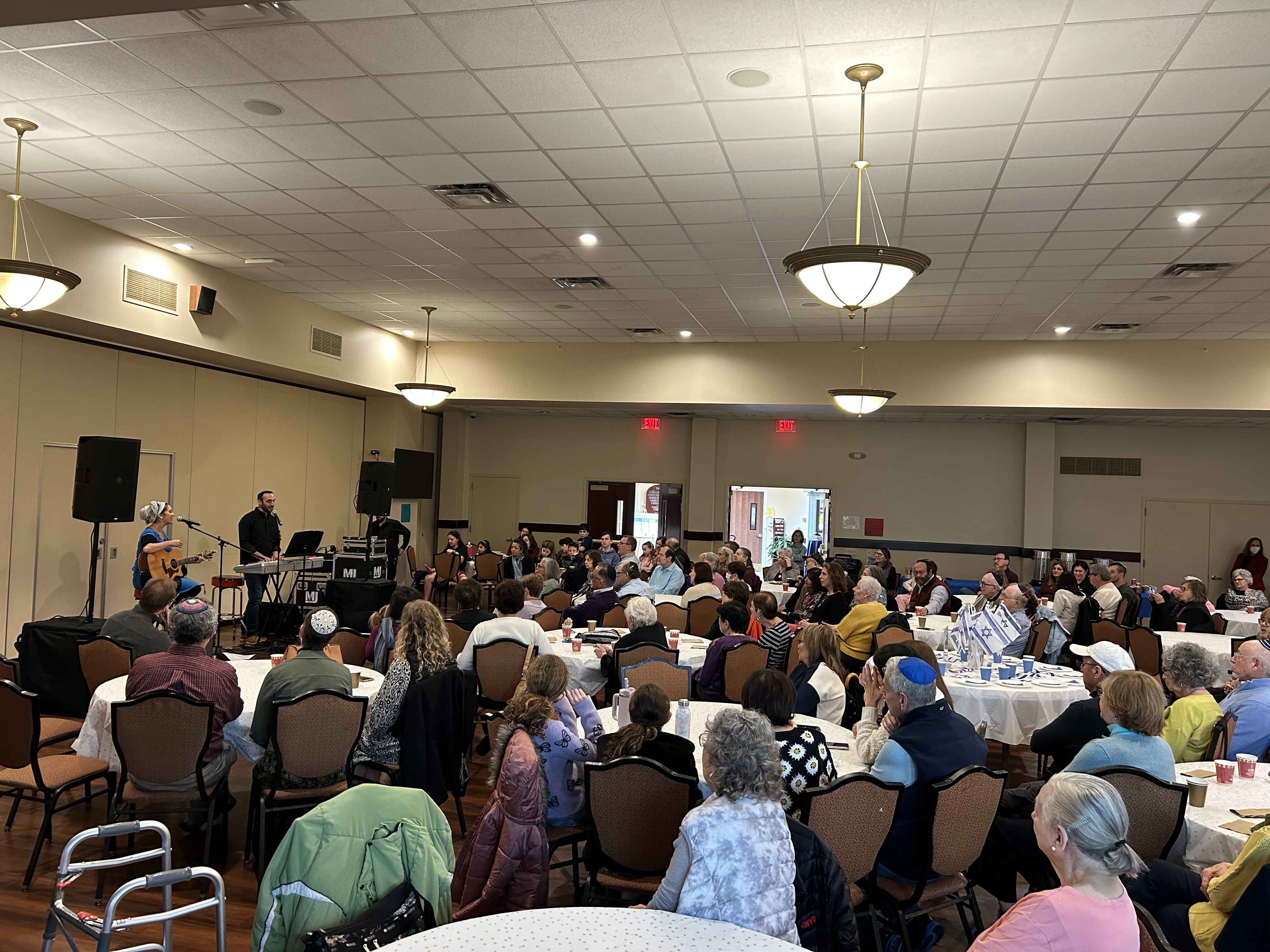
Yoni and Nina came to us with Rabbi Hersh’s urging early in the spring of 2020. They performed via Zoom monthly on Friday morning to help us connect heading into Shabbat in a time when we could not yet gather physically. Their music, for many of us, has continued to feed us, uplift us, connect us. While we felt this personal appearance was a homecoming for them of sorts, I know they felt the conflict of being away from their one home, their parents, and their children.
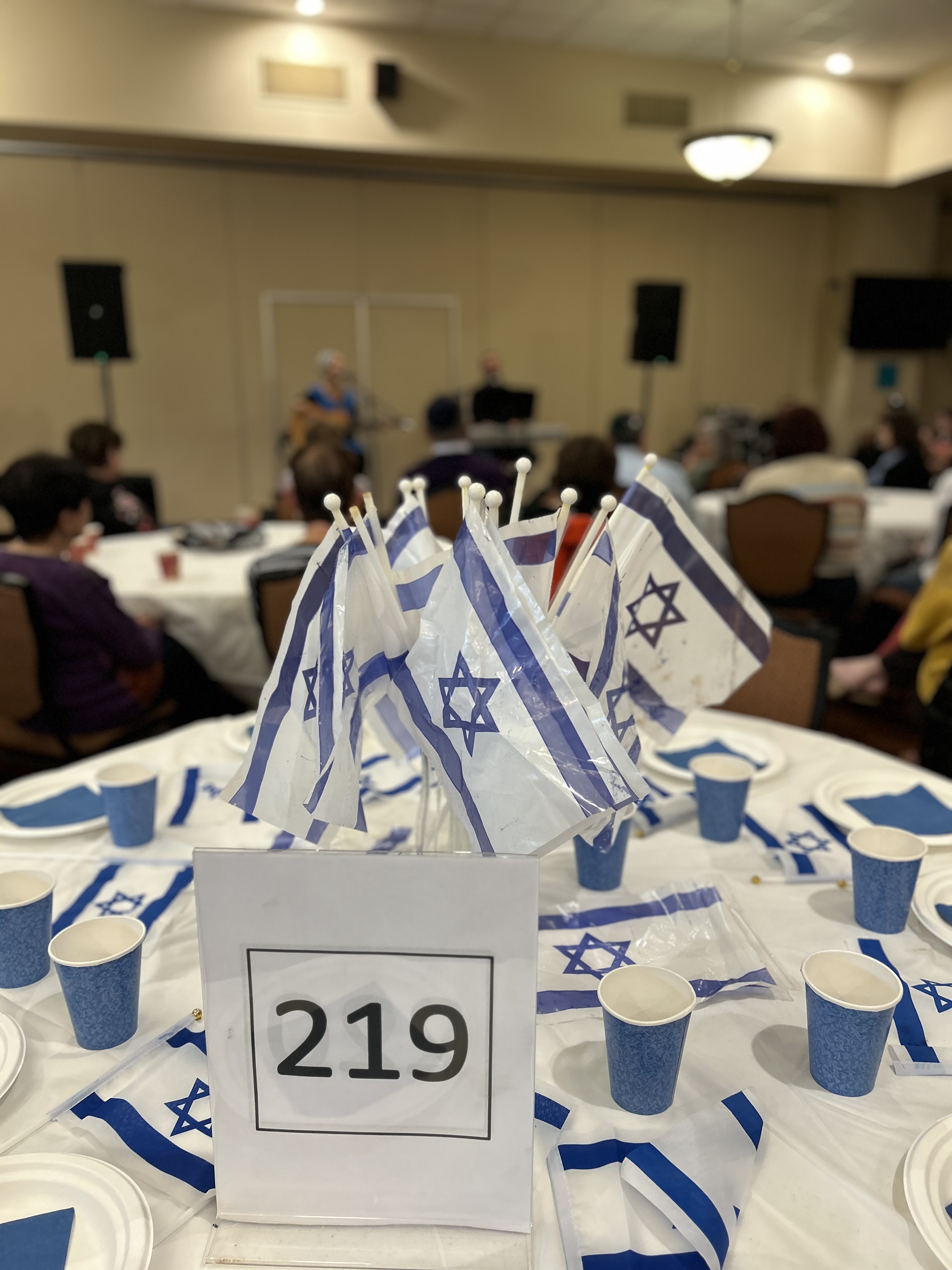
For ninety perfect minutes, with the help of their music, lyrics and heartfelt stories, we ascended together out of the time and space that restricts us. We were all home with one another, all connected to our mothers and fathers, all feeling the love we give away coming back to us, all absorbing the resilience and hope shared by these two loving artists.
In their song Melaketet kochavim (“collecting stars”), Nina and Yoni sing to each other from afar, a mother caring for children and home, a father fighting a war, both hoping to reunite safely and soon, holding onto hope that their dreams will soon be realized:
So now I am gathering all of my strength
of kindness, and of faith
that good days are yet to come
that the songs of joy will return to us
and I hug the children tightly
to protect from the storms outside
and in all the craziness
under black skies
I gather stars
Inhale. Read the words and hear the song. Exhale. Repeat.

Happy 76th birthday, Israel. May this year be better than the last, one in which your children’s dreams come true, one in which your hope is realized.
Rabbi Craig Scheff
Reflections on “Walking as Witnesses”
The following is not the typical blog post from the OJC rabbis. It is a daily recap of the OJC-Poland 2024 experience that ended yesterday. It is meant for those who wanted to follow our experiences without resorting to Facebook. It is a bit long, but hopefully you will find it worthwhile reading! Please note, however, that to truly appreciate the emotional arc of our experiences, you really should read to the end….
OJC-Poland 2024: “Walking as Wintesses”
Day One
On the eve of arrival in Poland, leading a group of 32 (mostly from our synagogue community) to Krakow, Majdanek, Lublin and Warsaw, I wrestle with these thoughts:
How do we bear witness and process the inhumanity that was visited upon us? And how do we avoid permitting this victimization to be the primary motivator of our Jewish identification?
How can we make room for empathy towards those who were bystanders (sometimes innocent and sometimes willing), while also holding accountable those who actively participated in our suffering? What can we learn from those who stood up righteously in our defense or in defense of their own humanity?
How do we appreciate Jewish physical and spiritual resistance in spite of Jewish suffering?
How can Poland remain both home and graveyard?
How do we understand Jewish life in Poland today? What is its meaning and mission?
And how does all our wrestling translate into a productive and empowering way to confront our current circumstances as American Jews?
Though this is my third time leading this trip, I anticipate an emotional, challenging and hopefully meaningful week ahead with what seems to be a very special group of people.
Day Two
Our group convened this afternoon to begin our tour of Krakow. After I offered an intention for the days ahead, we set off for the Jewish quarter in Kazimierz.
Our tour guide walked us through the bustling city and into the heart of Jewish life here, home to the world’s largest annual Jewish festival. We visited the Altshul, the Rema Synagogue and Cemetery, and the Temple Synagogue, tracing the history of a Jewish presence dating back to the 15th century.
Our tour ended at JCC Krakow, where we dined and met with CEO Jonathan Ornstein, who shared with us his perspective on the phenomenon of a growing Jewish presence in what many considered a Jewish graveyard. The work that is being done for those discovering Jewish roots is remarkable, and the JCC has become a safe haven and support center for Ukrainian refugees.
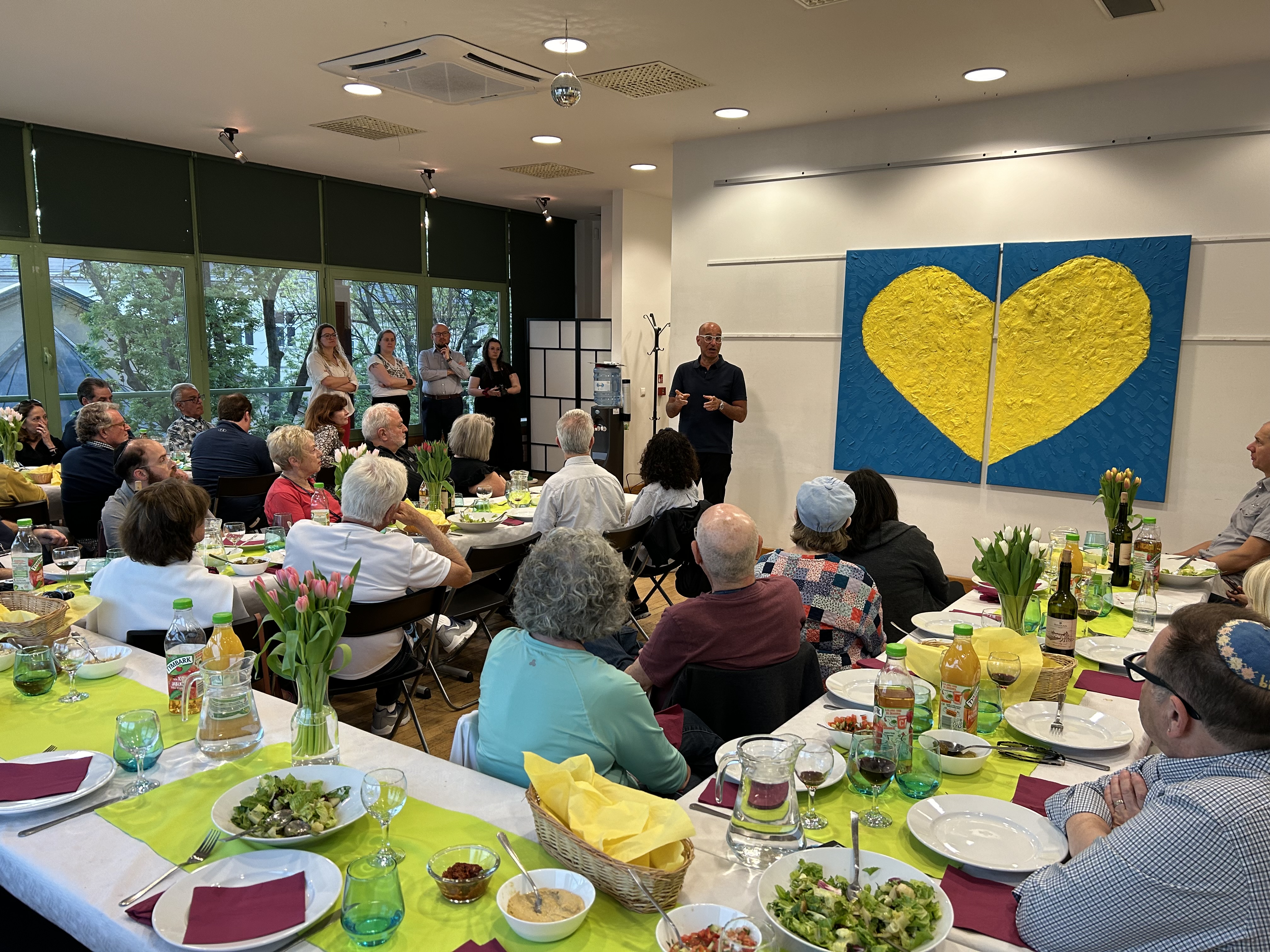
We asked ourselves the question earlier today, “why are we here”? After our first experiences in Krakow, we can answer that we are here to witness the resilience of the Jewish people.
Day Three
An early start on a warm and sunny day took us through the lush Polish countryside, out of Krakow and to Auschwitz and Birkenau. As we approached the site of the slaughter of 1.1 million Jews, I could sense the ghosts of the dead walking through the shadows of the dense woods, beckoning us to come bear witness.
Touring the exhibition halls gave us the history of the site’s construction and the story of how Jewish lives were routed to this final destination for so many. More impactful, however, was seeing the belongings of individuals who were given hope that they were heading from a ghetto to somewhere else — a suitcase, a pot. The piles of eyeglasses, prosthetic limbs and hair told us the unimaginable end that was met instead.

We left Birkenau and stopped at the remaining synagogue of the city of Oswiecim (Oswiecim Synagogue), where we had the opportunity to reflect on our personal reactions to the experience. We felt speechless, overwhelmed, sad, angry, scared, determined, resilient, strong, hopeful, all of the above and more. We felt the cognitive dissonance of walking in the sun on a beautiful day along the path that led to death for so many; of the magnificent weather for a space we associate with the color grey; of the bustling life going on all around, and even within, a torture chamber.
We will continue to let the images settle in our brains and the feelings come to rest in our hearts. It’s time to literally and figuratively wash off the dust as we prepare for Shabbat. This evening we will welcome the Sabbath queen as royalty ourselves. We are here, and we are alive. This Shabbat we make our presence known to God, to one another, and to all the ghosts relying on us to continue their legacies.
Day Four
Krakow is a magnificent city. It avoided destruction during multiple wars, in part because the Poles were quick to retreat in an effort to spare their crown jewel, in part because aggressors made it their center of operations. From castles to churches, we were impressed by the scale, opulence and history reflected by its layers of architectural beauty. Crowded and vibrant public squares and outdoor cafes showed us a free and happy society.
So what does it say about Jewish life in Poland if I tell you we had a perfect Shabbat in Krakow, from sundown to Saturday night? A space of our own in our gracious and inviting boutique hotel, a warm and uplifting Kabbalat Shabbat, and a sumptuous kosher dinner prepared by Chef Alon; morning Shabbat tefillah at the Rema Synagogue with locals and visitors, accompanied by melodies both familiar and new (giving me a couple of ideas to bring home!), where I received an aliyah (thanks David Simkins!) and couldn’t help but tear up thinking about what my grandfather z”l would say; a late morning walking tour to the Old Town; an afternoon walk to the site of the Jewish Ghetto and Schindler’s factory; and, of course, Havdalah.
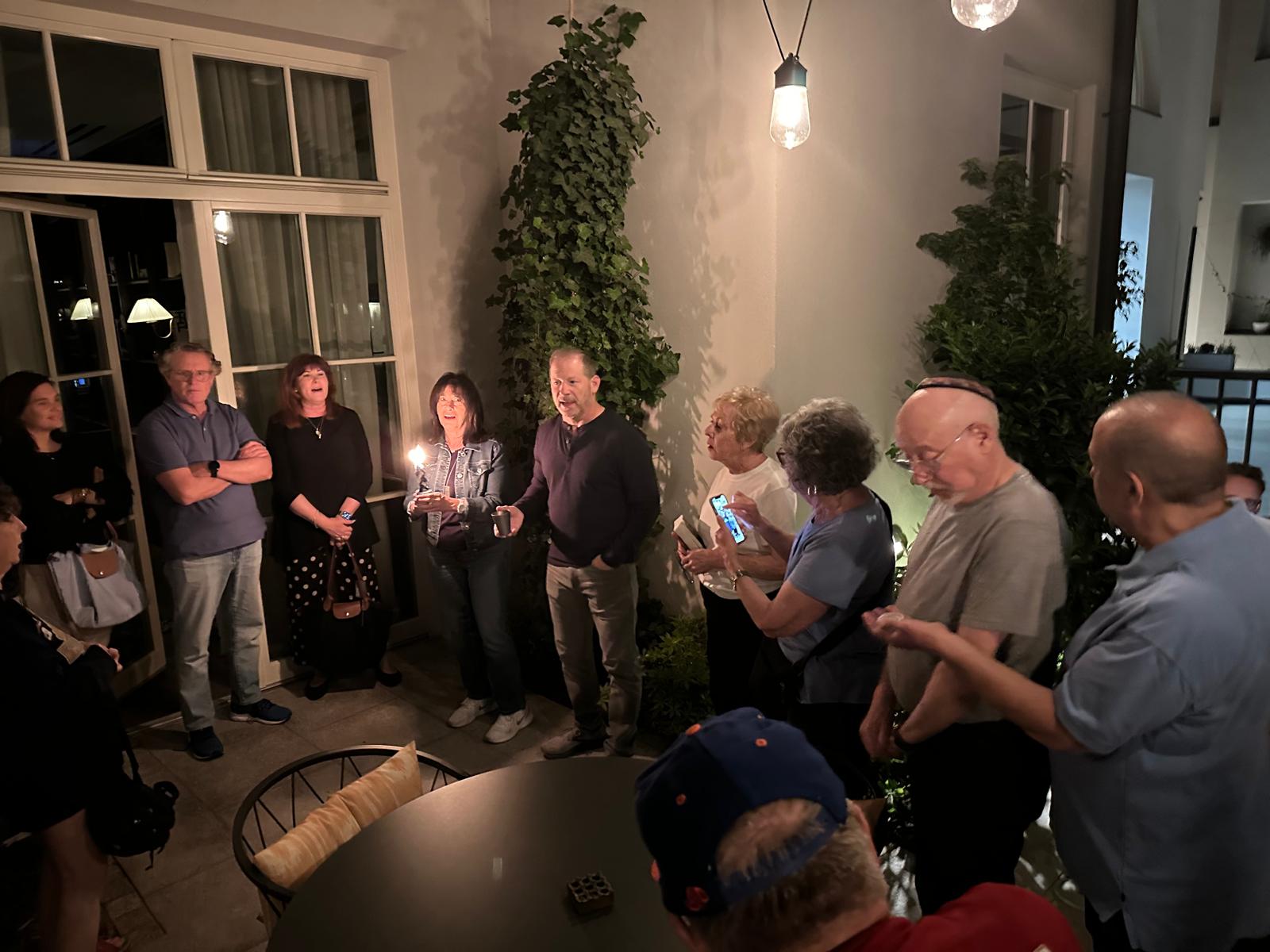
Out of the depths of Friday’s experience at Auschwitz we rose up to feel our souls soar (in stark contrast to our sore soles!), and this morning we once again descend into the pit that was Majdanek.
May we rise once again, Am Yisrael chai.
Day Five
An early departure from Krakow for the long ride to Majdanek was not a given. Despite the inconvenience and the apprehension about committing to experiencing a camp that could be operational in minutes, we knew we had made the right decision immediately upon our arrival.
Simply put, every Jew must see what we saw. It was a comfort to see multiple “March of the Living” groups of teens walking by us, sitting in reflection. On this eve of Yom Hashoah, they are learning the lesson we must all learn: Our Jewish identities and way of life are what has given us the resilience to survive, live and build lives. Our enduring the worst atrocities humans could inflict upon others only proved that we the Jewish People are the source of hope for all humanity.

Sitting in the Yeshiva of Chochmei Lublin, we felt the power that centuries of learning and prioritization of teaching and living Jewishly has brought to our ancestors and continues to provide for our children.
And despite terrible traffic that delayed our arrival in Warsaw by 2 hours, we still managed to hold our own Yom Hashoah commemoration, reflecting on what it means to us in the wake of this experience to be “keepers of the flame”.
Tonight, through the miracle of technology, I was able to share my reflections from this trip on the heroism of my own grandparents, Israel and Sonia Neiman z”l, to see generations representing the survivors of their own families, and to hear Amy Edelstein share her own story. I hope the next 24 hours will provide each of us the opportunity to reflect on what “never forget” means to us in light of where we find ourselves today.
Day Six
Too many people are unaware that the full name of Holocaust Remembrance Day is actually Yom Hashoah v’Hagevurah, meaning the day of remembering the destruction and the heroism.
On this Yom Hashoah, we find ourselves in Warsaw, the place that inspired the full name of the commemoration. The Warsaw Ghetto was obviously a place of terrible suffering as a result of inhumane treatment and living conditions. But while the Nazis tried to strip the Jews of their humanity and ultimately set about liquidating the ghetto, its residents fought until the end. After unexpectedly costing the Nazis soldiers’ lives, resources and time, the persistent and heroic Jews ultimately took their own lives in the face of an overwhelming Nazi military response.
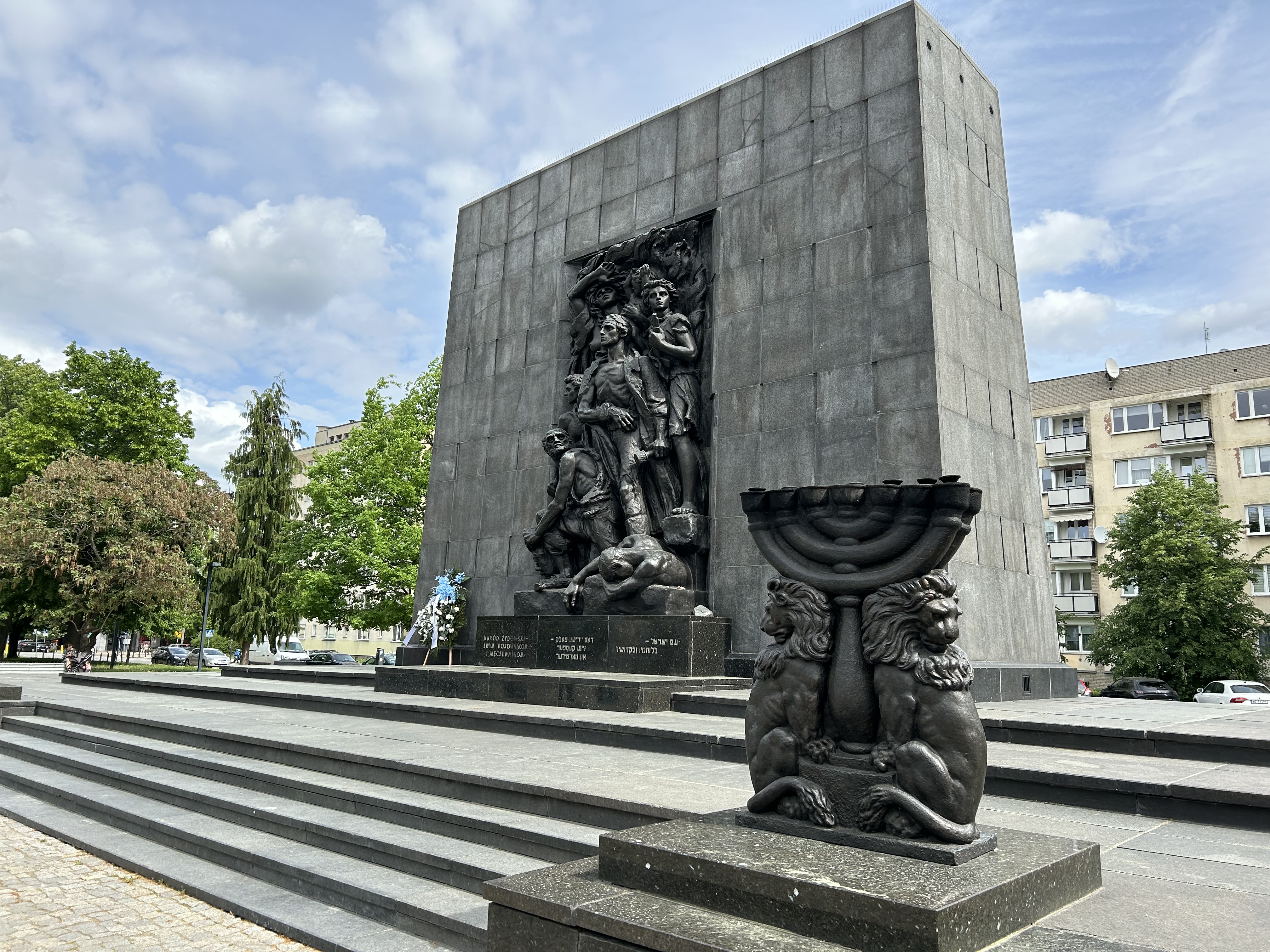
There are few remains of the actual physical ghetto or of the WWII city, given that 85 percent of Warsaw was reduced to rubble. But there are reminders everywhere of Jewish presence, persistence and rebirth, and of the Jewish history that is being rediscovered and examined by so many Polish citizens. From public memorials (plaques, monuments, structures like the deportation platform) to the new Polin Museum, it’s hard to be in Warsaw and not be reminded of the city’s Jewish heritage.
Standing in the Nozyk Synagogue, the only synagogue that remains in Warsaw today, we reflected on the connection between the heroism shown in Warsaw by the likes of Mordechai Anielewicz and the image of the “new Jews” who fought for the establishment of the State of Israel. Our voices echoed in the sanctuary as we sang a prayer for the hostages on this Day 213 of their Gazan captivity, the prayer for the State of Israel, and Am Yisrael Chai.
The Warsaw Jewish cemetery is history told in stone. Parts of the cemetery have been restored with monuments erected symbolically to pay homage to the many greats of Warsaw’s Jewish past. But as Nancy and I went in search of the burial place of our daughter-in-law’s relative who was buried here in 1934, we found ourselves in the deep, dark recesses of an abandoned graveyard with toppled and broken stones, one plot indistinguishable from the next. I felt the shadows closing in on us, and I was reminded of the brutality Jews experienced in a place they once called home.
A day to remember the heroism. A day to remember the destruction. Never again. Never again.
Day Seven
It’s honestly hard to appreciate how we got here without experiencing it for oneself. Considering this emotional roller coaster of a ride we’ve been on and where it started, most of us (if not all) could not have imagined finishing this journey where we did.
Today we took in a presentation from the Polin Museum about the “righteous gentiles” who risked and even gave their own lives protecting Jews. We heard an honest assessment of non-Jewish attitudes towards the Jewish past, and of the ways in which “cultural” antisemitism manifests itself in Polish society.
Today we visited the Jewish Historical Institute, where we saw the written testimonies preserved by “Oyneg Shabbos”, the underground archivists of the Warsaw Ghetto. Their heroic efforts of spiritual resistance have preserved legacies and eyewitness testimonies for Polish and Jewish students of the past.
Today we visited the beautiful Warsaw Zoo, where Jan and Antonina Zabinski hid Jews whom they helped escape from the Warsaw Ghetto, some for days and some for years. We were treated to a piano concert of Chopin and Offenbach, the music Antonina played to signal to the Jews in her basement whether they could emerge from hiding, fall into silence, or head for tunnel that led to the cages beneath the zoo.

We finished our day at the JCC Warszawa, where we dined and learned from CEO Patrycja Dolowy and JDC Entwine fellow Sam Kapner about the continuing revival of Jewish life in Warsaw.
Despite the horrors of the past to which we bore witness, despite the reality that our feet walked above the ruins of Jewish homes, and despite our desire to claim and brandish our victimization against the world, there is a fragrant flowering of Jewish life in Poland. It is youthful, energetic, embracing, and proud. It is unencumbered by the past. It is recognized, appreciated, and even celebrated by non-Jewish Poles.
With great curiosity and a desire for answers, Jewish life is being rediscovered by those with Jewish roots; revealed by those who hid their Jewish identities; explored by those who have recognized that Judaism comprised a substantial piece of Polish history and culture; and remembered by those who don’t want to be condemned to repeat the past. In a Poland that continues to redefine and rebuild itself since its independence from Soviet rule, Warsaw is a safe place to openly identify and practice as a Jew.
Did I just say that?
We heard it from young, proud voices. We heard it from the people who are living it. Who are we to diminish their Jewish enthusiasm, spirit or determination in any way?
As we concluded our night and our Poland experience singing our anthem “Vehi sh’amdah,” the words came out feeling quite different than when we first sang them. May that which has sustained us, despite the enemies in every generation who have sought our destruction, continue enabling us to flourish along with God’s help.

When Asked How I Am, What Do I Say?
“What am I supposed to say when people ask how I am?” I complained to my Israeli friend, “I have no idea how to answer that question these days. Am I supposed to say I’m fine? Am I supposed to say I am not fine?”
“In Israel,” he said, “we are answering, ‘K’mo kulam’,” like everyone.
How are you? Like everyone.
I tried it on for size for a day. I wondered if it was fair for me to say that my feelings were like everyone’s feelings. Here in America, I am on the mezzanine, not even in the orchestra, and certainly not on the main stage.

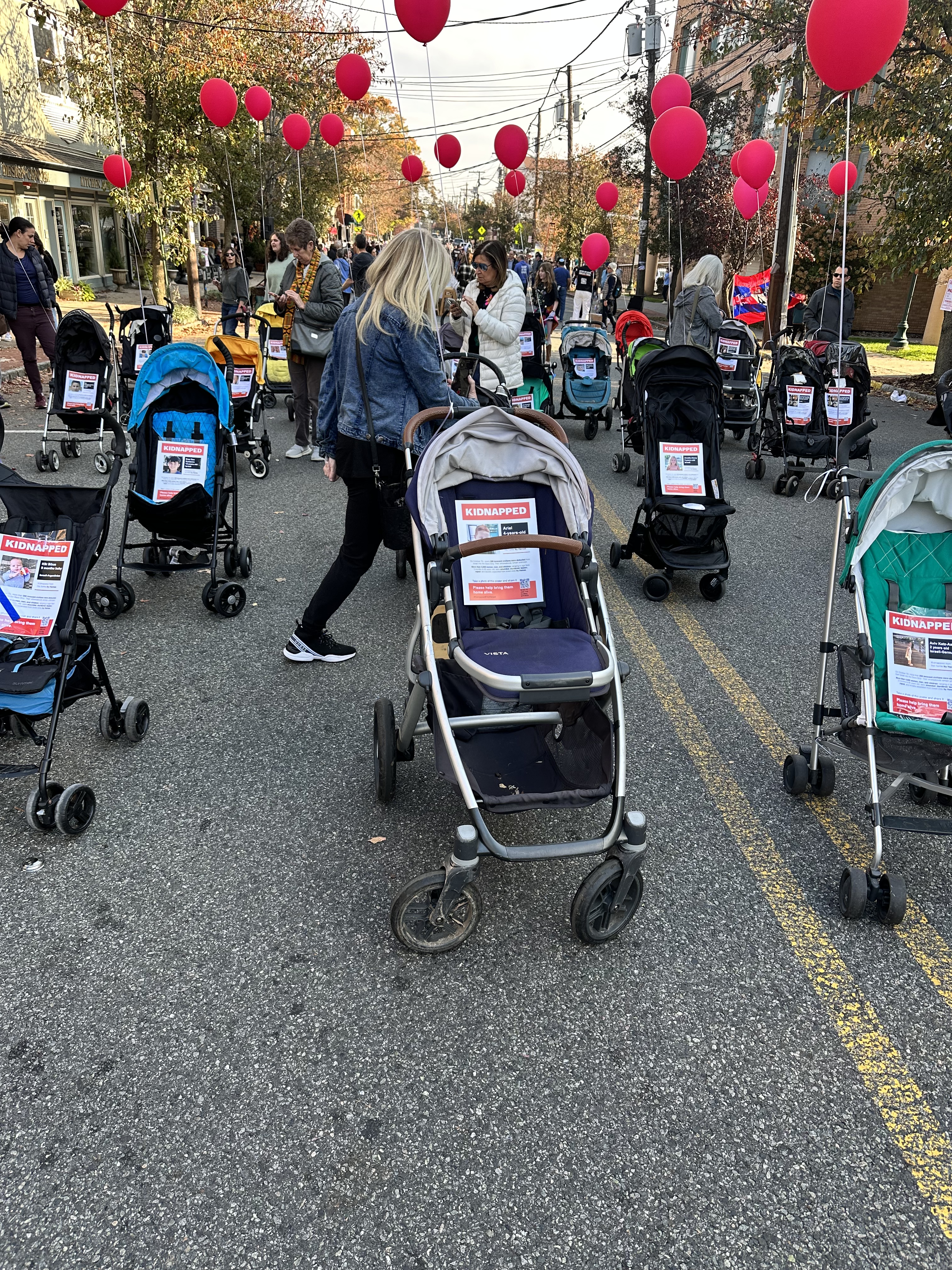
My heart is broken regarding the massacres and kidnappings of October 7. I worry about the IDF soldiers in Gaza. I feel hopeless about the mounting number of casualties and deaths of Palestinians in Gaza. My anxiety is high regarding the unleashing of virulent antisemitism here in America and around the world.
I don’t sleep well at night. I wake up from the middle of horrible dreams.
But my situation is not the same as my cousins’ whose four adult children are all serving on the front lines. I cannot compare myself to my son-in-law‘s mother whose entire community, her entire personal and professional world, was devastated on October 7. I am not my dear friend who had to move to safety from her home and whose son and son-in-law are both serving in the IDF at the same time.
And although I teach that there is no hierarchy of suffering, I know that my suffering is not the same, and can never be weighted as heavily, as those families whose loved ones have been murdered and abducted.
So I faltered for a couple of days when people asked me how I was.
Now, it is true that a rabbi in a community carries the weight of a congregation’s fear and concern. We are looked to for optimism and hope when we might feel quite lacking in those categories ourselves. We are asked questions for which there are no answers.
But still, I did not feel that I deserved to say, “K’mo kulam.”

And then one Friday evening at minyan, I led the community in the traditional words we say to a mourner. L’cha Dodi ended and we turned toward the man in shivah for his mother. We said, “HaMakom yinachem etchem b’toch sha’ar avalei Tzion v’Yerushalayim.” May God comfort you among all of the mourners of Zion and Jerusalem.
We say these words so often, counting on them to offer comfort to those who are bereft. On this particular night, I paused and considered their intention. I did not say these words to tell this particular man that his sorrow was exactly like all other Jews who were mourning. I meant that he is not alone in his grief. As a Jew, he was one of a great number of people at any given time who are held by God in our grief. We are all connected. That very fact offers comfort.
And the next day I went back to answering the question, how are you with the answer “k’mo kulam”.
I am not alone in my grief. And neither are you.
Rabbi Paula Mack Drill

Replenishing the well
This past Shabbat, Day 8 of the “October 7” War, our synagogue rabbis presided over a ritual marking the transition of a girl to adulthood in the eyes of the community. On Sunday morning, Day 9, we were present for twin girls experiencing the same rite of passage. On Sunday afternoon, I officiated at the naming of a baby girl, linking her to the legacy of her paternal grandfather (a close personal friend who died at a young age) and her maternal great-grandfather.
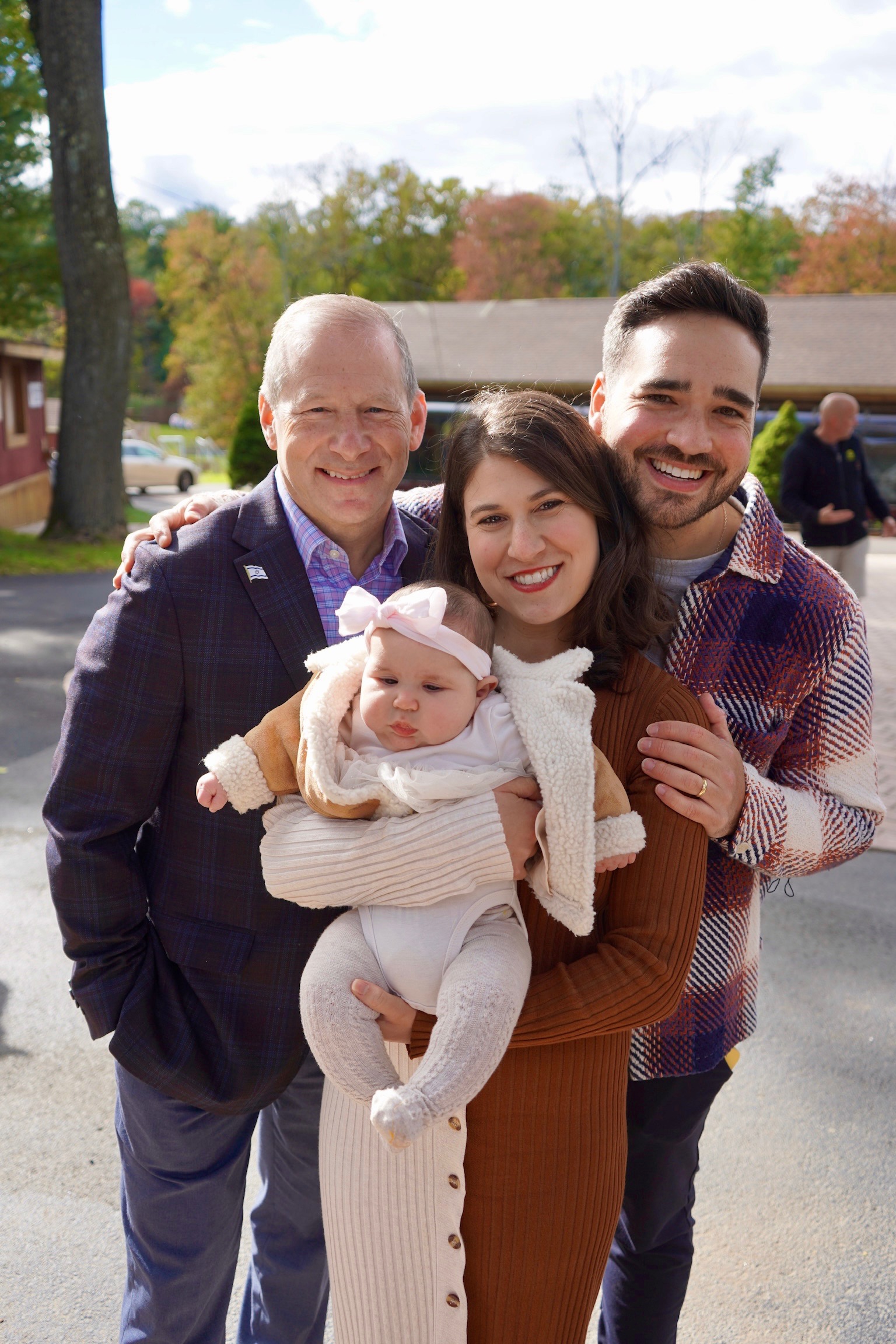
Each of these moments was filled with love and infused with meaning. Each of these rites was held in the embrace of family, friends and community. Each of these children gave honor to their past and held out promise for our shared future. Each of these families prayed and planned for the day to arrive when their respective occasions could be shared.
And each of these events was touched and somewhat shaped by events happening on the other side of the ocean. Parents reached out to their rabbis to inquire on a personal level about the rabbis’ wellbeing and emotional preparedness. They asked whether a postponement might be warranted. They wanted to know that, if the simcha were to take place, it would be framed appropriately in light of tragedy hanging like a cloud over our heads.
The Talmud (Ketubot 17a) teaches that a funeral procession gives way to a wedding procession. In other words, we prioritize the celebration of life over death. The teaching may feel harsh or insensitive to some, especially considering the emphasis we place on caring for mourners. (As an aside, caring for mourners is in fact caring for the needs of the living, as distinguished from the funeral procession itself, which is about the caring for the dead.) But the lesson is one that we need right now.
Caught inside the looping 24-hour newsfeed, glued to images and reports of the dead and the missing, worrying about our family and friends, our well of resilience is being depleted further from hour to hour. We need to exercise the kind of self-care that will replenish that well, so that we can confront and navigate the challenges yet to come. The gift of joy, of celebrating life, is the best form of self-care we can give ourselves.

Like a bridal procession, the celebration of life’s moments of transition fills us with optimism, with a reason to look to the future with hope. The times to be treasured are moments that we are not promised or guaranteed; they are not to be postponed, lest intervening events preclude their being rescheduled. And there’s no guarantee we will be there to enjoy them the next time around.
Seize the moment to celebrate when it presents itself. Join us on November 29 (the date of our rescheduled fall gala, exactly 60 years since the day our building was dedicated!) to celebrate the synagogue and to help us replenish our own communal well of resilience.
Am Yisrael chai, so let’s be sure to celebrate life when we can.
Rabbi Craig Scheff
Don’t Do This Alone (Coping with these Dark Days)
On Friday, October 6, just three things were on my mind.
First, my son Josh and his beloved Shay had just gotten engaged, but they had not yet made it public. I wondered how I could make it through Shabbat and two days of holiday without sharing the good news.

Next, I was feeling quite pleased with my decision to forego shoes and just wear sneakers with my synagogue dresses on Saturday night and Sunday for Simchat Torah dancing.
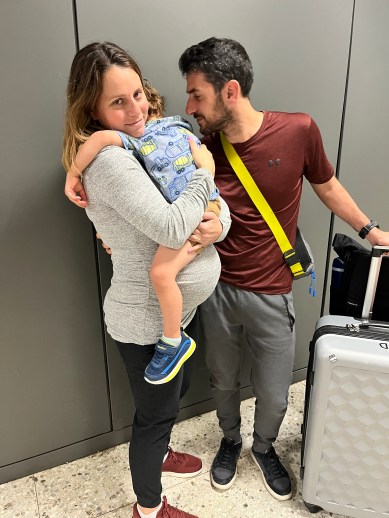
And third, I was a bit worried about having time to pack after two days of holiday before the car service arrived to drive me to Newark Airport for my flight to Israel. I was making a trip for four days to attend the wedding of my son-in-law‘s brother Omer to his cherished Tal. Jonathan, Sagi and Carmel had already been in Israel for a week and I was looking forward to a fun few days in Tel Aviv and a wonderful Fainshtain celebration.

I didn’t need to have worried about my Sunday night flight to Israel. It was cancelled.
On Saturday, October 7, the world as we knew it ended. We will never be the same.
Jonathan was awakened by sirens on Shabbat morning and travelled out of Tel Aviv to Shay’s family home. That morning, Sagi and Carmel were with Racheli, (Sagi’s mom and Carmel’s savta). Many of you have read Sarah’s account of Sagi’s harrowing escape with his mother, her partner and our grandson Carmel from their home in Mefalsim. In case you didn’t have the chance to read it, here is a link:
https://docs.google.com/document/d/1lng-H_PCVwpDlZrUwvmWFxBjgg2trn-_voJWUMnYGWQ/edit

What do Jewish people do when tragedy strikes but the calendar says it is time to celebrate? We celebrate. With breaking hearts, with tears, and with complete dissonance, we take the Torahs out of the ark and we dance. It’s the hardest thing to do and it’s the only thing to do.
So many congregants of all ages came to OJC for the holidays, drawn in to community like homing pigeons. We knew where to be for comfort and solidarity.
We prayed, we broke bread (and chocolate), and yes, we danced. Our eyes met and we read the grief and bewilderment there. We danced with our children in long “Tayish” lines and circles of “The Tushie Dance” (Od Lo Ahavti Dai). We grinned and laughed with a stubborn refusal to give in to terror. We sang Acheinu softly and walked in slow circles for all those in Israel unable to celebrate Simchat Torah, and the children of our shul saw their rabbis cry. We honored teenagers as Chatanei Torah and a centenarian as Chatan Bereshit and we felt uplifted by them and their proud families.
All of it was necessary. It’s what we Jews have been forced to learn throughout all the centuries of our history. If we stopped celebrating every time we endured suffering, we would never be able to fulfill our calendar year.
At the OJC, we did not celebrate despite our sorrow. We celebrated together with our sorrow.
I was never more proud of our congregation.
Since the holidays have ended, we have truly been prepared for Mar Cheshvan which begins on Saturday night. It will be a bitter month indeed.
After the holidays concluded, the news from Israel continues to be intolerable. As the numbers of injured, kidnapped, and murdered in Israel climb and the inhuman stories emerge, as soldiers are mobilized and in harm’s way, as we speak to precious friends and family in Israel and find that we have no useful words, we find that the reality is more than any one soul can comprehend.
And so, we cannot do it alone. We must find each other in our grief and come together to pray, find comfort, and take action.
Hundreds came to the rally on Tuesday at the courthouse in New City.
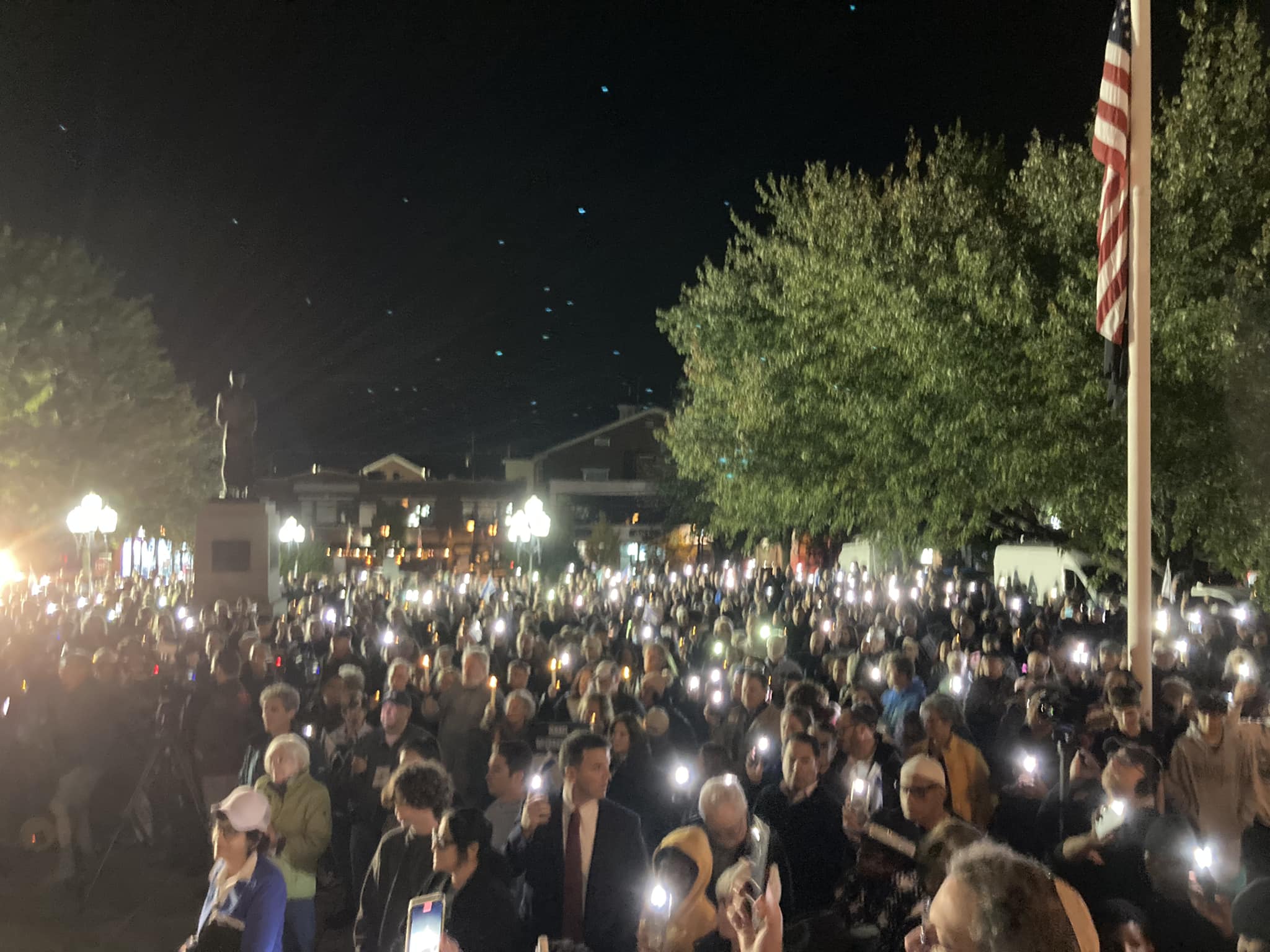
Many of you will be with us on Shabbat to feel the power of community.
I expect that hundreds more will come together on Saturday night at 8 o’clock at Congregation Sons of Israel in Nyack for the Rockland Board of Rabbis Prayer Vigil and Memorial Service.
More opportunities for prayer, healing, and action will be announced soon.
Please don’t try to do this alone. We are a community that knows how to be together in the most joyous times and in the hardest times.
Am Yisrael Chai.
The People of Israel lives!
Rabbi Paula Mack Drill
Crossing a Red Line
What is your red line? Mine has just been crossed.
I have been filled with sorrow, outrage and concern over the past two months, regarding the intentions and actions of the new coalition government in the Israeli Knesset under the leadership of Bibi Netanyahu.
Your rabbis have attempted to educate according to values of Judaism and democracy through a sermon, a webinar with Yizhar Hess (CEO of WZO) and my son Josh, and an extensive letter filled with analysis and resources for you.
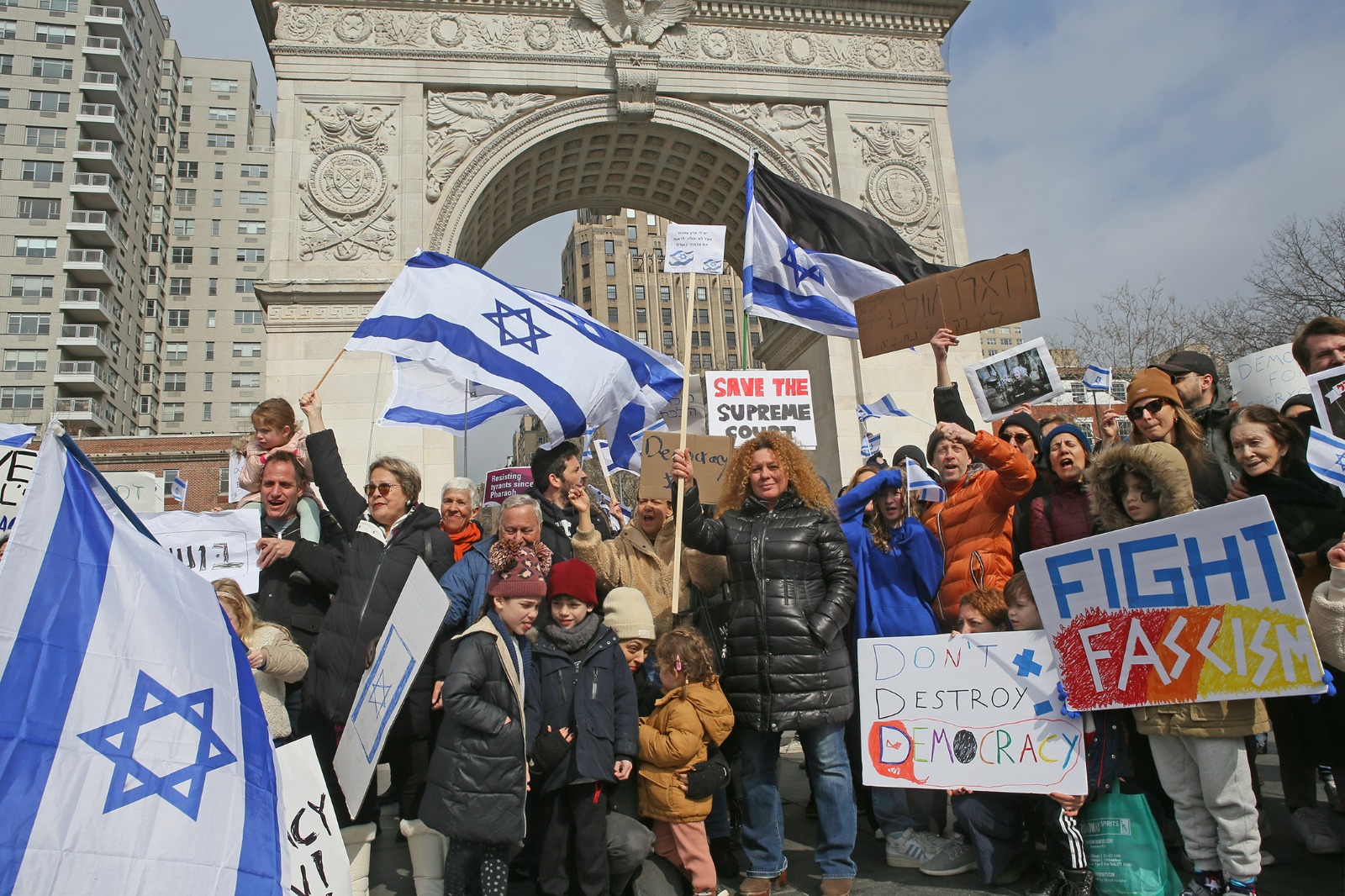

I have thought time and again over these past weeks of writing to you in this blog. Each time, I wondered what I could possibly say that would be either new or useful.
This morning, I woke to the news that last night, 400 Jewish settlers poured down a hill from Jewish West Bank settlements into the small Palestinian town of Huwara and neighboring villages, where they rampaged, setting fire to 40 buildings and hundreds of cars, causing injury to one hundred people, killing one Palestinian man, and destroying extensive amounts of property.
What is the context of these riots?
Yesterday, two young Jewish brothers in their twenties, Hillel and Yagev Yaniv, were tragically murdered in a terrorist attack. Even as security forces pursued the terrorist responsible for this heinous act, hundreds of Jews rioted in Huwara with the support of senior political figures. Answering violence with more violence, taking the law into their own hands, only six of these 400 settlers have been arrested.
While both Prime Minister Benyamin Netanyahu and President Isaac Herzog have officially condemned the Jewish violence, some elected officials in Israel justified the violence and burning of villages.
As your rabbi, a Zionist, a Jew, and a fellow human, I feel compelled to take action today. What can I do but use my words which Judaism has taught are more powerful than the sword? Yet what can I possibly do through these words that will be helpful?
Is it possible to convince you who love Israel to keep your faith in the Israeli people and in humanity?
I have a file in my hard drive that is called “Israel in Crisis.” Over the years, I have saved a tragic number of articles and emails regarding terrorist attacks against Israeli citizens, missile strikes against Israeli civilians in towns and cities, and all-out war. When this new government was elected in Israel, I did not create a new file. I simply started storing information in this same file called “Israel in Crisis.” This time, the crisis is from within.
In a powerful open letter to Israel’s friends in North America, published on February 2, 2023, Times of Israel article, Matti Friedman, Yossi Klein-Halevi, and Daniel Gordis warned us: “ the changes a foot will have dire consequences for the solidarity of Israel’s society, and for its economic miracle, as our leading economists are warning. It will also threaten Israeli-American relations, and it will do grave damage to our relations with you, our sisters and brothers in the Diaspora.”
It’s not just these famous columnists from across the political spectrum who are asking us to step up and let Israeli politicians know where we stand. Israeli family and friends are pleading with us to take action.
We lovers of Zion from outside of Israel have been given mixed messages through the years. Some of us internalized the message that we have no right to speak up regarding internal Israeli matters if we do not serve in the IDF or vote in the elections of the State.
This directive no longer feels tenable to me on this morning, after unspeakable violence against innocent Palestinians committed by Jewish hands in response to a terrorist act that took the lives of two innocent Jews.
I encourage you to continue studying and asking questions about the situation in Israel. To me, it seems clear that Israeli leaders need to hear where Zionists from outside of Israel stand. While Israel belongs first and foremost to the citizens of Israel, Israel matters to the entire peoplehood of Judaism. This government has gone far beyond my understanding of what a Jewish state and a democratic nation should be. I will continue writing and calling my representatives, asking them to make clear to the current government of Israel that the path they are currently on will lead to dire consequences. I invite you to consider doing the same.
May the memory of the murdered Yaniv brothers be for a blessing. May we all join together to work for peace between all of the citizens of Israel, and between Israelis and Palestinians in the occupied territories.
Rabbi Paula Mack Drill
Leaving on a Jet Plane

Oh my bags were packed, I was ready to go…
As you read this post, I should be landing at Ben-Gurion Airport with 18 Hazak congregants to begin ten days of adventure in Israel. Highlights included staying at the gracious Inbal Hotel in Jerusalem, a painting party with street graffiti artist Rami Meiri in Tel Aviv, and home hospitality with my son-in-law‘s mother on Kibbutz Mefalsim in the south.


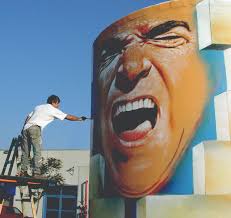

It was going to be a truly wonderful trip, and I had been saying for weeks that the third time was the charm. This trip was originally scheduled for March 2020 when forty of us were scheduled to travel together. When COVID-19 grounded us, we rescheduled to December 2020. When that date still proved impossible, we rescheduled to a trip that was to have begun last night, December 7, 2021.
Many of us had started packing already and had scheduled our Covid tests. As soon as I heard the news about the Omicron variant a week and a half ago, I knew our trip would be canceled once again. Israel closed her borders to all but citizens for two weeks, and in a snap, our trip was canceled.
(We have already rescheduled for December 6 – 16, 2022. Perhaps the fourth time is the real charm?!)
It is disappointing to be at home instead of traveling. It is worrisome to think that the world is undependable and unpredictable. It is true that many who planned to go with us back in March 2020 are no longer able to travel with us at this point for a variety of reasons.
What do we do with disappointment? I have learned from all of my congregants and their life experiences to reframe, to be grateful, and to maintain hope in a positive outcome.
REFRAME: I feel so sad not to be in Israel, a place that I love to share with congregants, a place where I feel at home, a place that lifts people up in transformative ways. And also – I know that we are among the most fortunate people who can even dream of international travel. As one wise congregant told me, “Commit to no complaining and then watch for miracles.” We will get to Israel yet. Perhaps some of you who wanted to join our group but were not able to go this year will be able to go with us next year. Perhaps it is a blessing that I get an extra week and a half with my sixth graders in Kulanu. I know that it is a blessing to be at OJC for one more Shabbat before sabbatical, celebrating Carl Roth’s birthday!
GRATITUDE: Congregants who have been planning to travel with me have been inspiring in their graciousness since the cancellation. One told me, “Whenever you go, I am ready to go with you.” Another wrote to me: “I didn’t realize just how much I wanted to go until the trip was canceled.” I am grateful for a congregation filled with people who love Israel. I am grateful for courageous older people still willing to accept the risks of international travel. I am grateful for Ayelet, an amazing Israel tour company that knows how to pivot and bend over backwards when necessary. I am grateful for the good health of the OJC travelers, and pray for the continuation of good health so that we can travel together next year. Our blessings outweigh everything else.
HOPE: Our world is not an easy place. We can no longer depend upon things we used to take for granted. I do not, however, subscribe to the idea that humans plan and God laughs. The God I believe in does not trivialize our hopes and dreams.
I hope that we will travel to Israel in December 2022. I hope that the world will be a safer and more open place by that time. I even hope that you will consider traveling with us!
And in the meanwhile, I will miss writing to you for the next three months while I am on sabbatical. But know that I will be collecting experiences and replenishing my heart so that I return to you from sabbatical refreshed and energized to continue being your rabbi, a position that I feel with gratitude and hope.
Rabbi Paula Mack Drill
A tale of two sirens
I welcome my younger sister, Randi Galron, as a contributor to this post. Her words will appear italicized in the text.
The first siren introduced herself into my life with no warning. On a quiet and sunny Tel Aviv afternoon in October 1973, as the nine year-old version of me was busy playing a board game with my older sisters, she came through our living room windows, bounced off the walls and took up residence in our floors. The siren grew stronger as she grabbed hold of my feet, causing me to lose my balance. The room had tilted, or so it seemed, as panicked neighbors stopped at our door just long enough to tell us to move down the apartment house stairs to the bomb shelter in the building’s bowels. We sat silently in the dark, dank space for hours until the siren returned to inform us we could emerge, but only to prepare ourselves more adequately for the many times she would return over the next few weeks to send us scurrying back underground.
Every April I steel myself for the visit of the second siren. She comes to visit me in a different way, never catching me off guard. I can anticipate her arrival down to the minute; nevertheless, I am left feeling shaken when she passes. Over the years of my rabbinate, I have busied myself in the month of April with programs, speakers, and songs of Israel. Once the Passover dishes are put back into storage, Yom Hazikaron, Yom Ha’atzmaut, and even Lag B’Omer powerfully reconnect me to Israel and to my Israeli family, friends and places that have become such a foundational piece of my Jewish and spiritual identity. Nothing, however, brings me back to Israel more powerfully than the siren sounded on the morning of Yom Hashoah (Holocaust Remembrance Day). A small piece of me wants to avoid the moment, but the larger piece of me that is insistent upon standing inside it wins out every time.

April 8, 9:09 am, Tel Aviv, Israel
It’s 9:09 am and Craig just texted me. What’s he doing awake at this hour? It’s only 2 am in the States. Riiiiight, he’s the “Keeper of the flame,” a 24 hour vigil that his synagogue observes every Yom Hashoah. I join his “watch” on Zoom and we continue to text. As he writes to me about his reflections, I share my own feelings about what it’s like to have my two sons in the Israeli army at the same time. That both my boys are fighting for and protecting our Jewish homeland is a tremendous legacy to all those who perished. I share with him a picture or two to capture the meaning of this powerful day for me.

April 8, 2:46 am EST, Orangeburg, New York
In a few minutes, the siren will sound in Israel. Most of the country will come to a standstill. Drivers on the highways will pull over to step out of their cars. Merchants will cease their business dealings. The elderly will stand by the young, quietly paying their respects to the fallen.
9:53 am, Tel Aviv
Only 7 minutes to go before the siren. Just a few minutes to quickly finish up what I’m doing to prepare for a moment of reflection and to pay respect to our families and all those who perished in the Holocaust. The time is 9:59 am and from my office on the 48th floor of the midtown office building in Tel Aviv I can already see civilians and soldiers lining the bridge that leads from the Azrieli mall to the Kiryah.
10:00 am, Tel Aviv
The sharp shrill of the siren that pierces the air. The steady siren that symbolizes our mourning and calls us to remember. It’s different from the rise and fall of the air raid “red alert” sirens we hear and heard only a couple of days ago to alert us that our small country is under attack. This siren pierces your heart and stops your breath for an instant. This siren causes the tiny hairs on the back of your neck to stand. This siren calls our entire nation to a halt. An entire nation stopping in its tracks – people, cars, radios, phone calls, the construction site I see down below – all of it. I stand with my head lowered, hands at my sides. I close my eyes. In the background I can hear the faint beating of my heart and I remind myself to take a breath. I try to settle the thoughts and emotions swirling through my mind. I picture the faces of my loved ones, the face of my grandfather who is no longer with us, faces of friends, faces of those whom I don’t even know. But, I remember them. From my office window, I look out at the Ayalon highway. Cars are pulled off to the side, their doors opened, their passengers standing at attention like monuments. I feel a tear on my cheek.

3:00 am, Orangeburg
I stand in our sanctuary before the candles, and I listen to the siren from my sister Randi’s phone. As the alarm pierces the still surroundings, her reverberation connects her listeners one to another, across space and time. Though I stand here seven hours behind, I am transported to that time outside of time, that place outside of space, where the souls of the living and the dead come face-to-face. And even as they are bound up with each other in that moment, the one gazes expectantly, while the other averts its eyes. “Have you learned?” asks the one. The other holds its breath, releases and answers, “I thought I had, but perhaps not.”
While Yom Hashoah and Yom Haatzmaut are inextricably linked on the Jewish calendar, separated only by a week, and while it is so often said that the State of Israel arose from the ashes of the Holocaust like a phoenix, I do not like to perpetuate the idea that Israel exists today due to the Holocaust. There can be no denying that the Holocaust accelerated the realization of a dream that was centuries old, but that dream had already gained major traction in the years leading up to World War II. Even so, the siren of the 1973 Yom Kippur War that lives in my memory and the siren of our annual Yom Hashoah commemoration remind me that Israel’s security and legitimacy–her rootedness in our Jewish past and her aspirations for a Jewish future–are what ultimately give me the luxury of feeling secure as a Jew in the world today.

Randi, kiss your boys for me, and thank them for standing guard on my behalf.
Shalom al Yisrael,
Rabbi Craig Scheff
I pledge allegiance to three flags
I pledge allegiance to three flags:
Of the United States of America
And to the republic for which it stands
One nation
Under God
Indivisible
With liberty and justice for all;
Of the State of Israel
And to the hope for which it stands
One People
Sharing a prophetic vision of God’s sovereignty
United in diversity
With equal rights and religious freedom for all;
Of the Rainbow of Pride
And to the sexuality and gender identities for which it stands
One emanation of God refracted in a multitude of ways
Indistinguishable as humans in the Divine image
With love for and inclusion of all.
My allegiance to any one of these three flags does not preclude my allegiance to any other. I can raise them side by side and pledge myself to each, for they are in consonance with one another. In fact, each demands my allegiance to the others. To believe in that which the American flag symbolizes is to believe in that which the others symbolize.
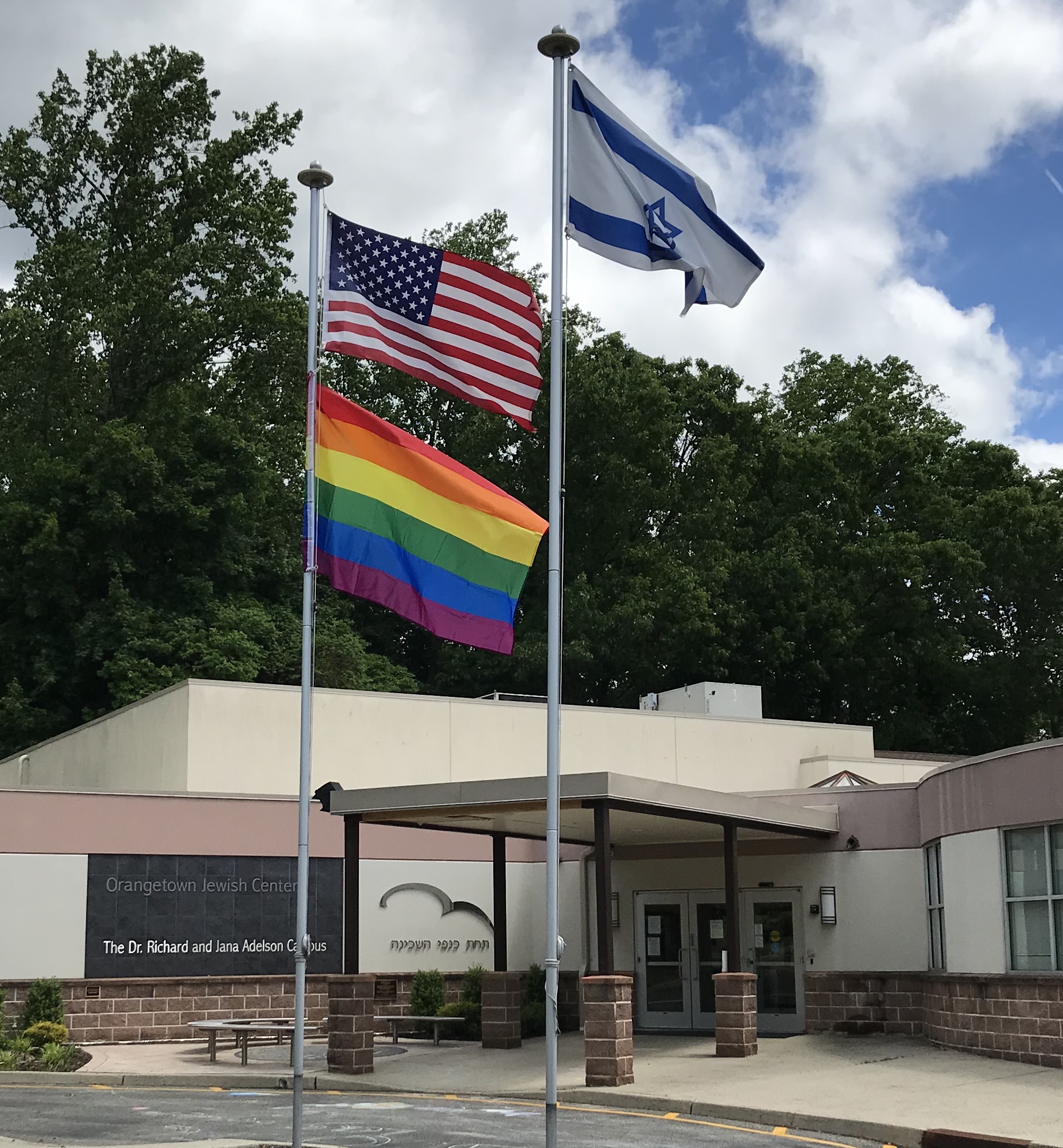
And though we sometimes fall short—as communities and as individuals—of the ideals to which we profess to aspire when we wrap ourselves in those flags, in pledging our allegiance we nonetheless commit ourselves to working towards the realization of the aspirations each represents. We pledge to respect the rule of law; we pledge to exercise our right to advocate, educate and vote; we pledge to demand that every person be treated equally regardless of race, religion, gender or romantic orientation.
In the short span of seven days, I will have paid honor in memorium to those who sacrificed their lives so that we could breathe freely as Americans, even as I lament the treatment of families at our borders; I will have marched up 5th Avenue to celebrate the State of Israel and its remarkable achievements, even as I let it be known that I am a concerned stakeholder in the ongoing Zionist project; and I will have celebrated “Pride Shabbat” at our synagogue as an introduction to a month of events in and around our community, even as I know we have so much education to do before “inclusion” no longer needs a committee of its own.
So the next time someone asks how it is that one can pledge allegiance to three different flags, tell them that it is your God-given right and responsibility to do so. And then ask them how it is that they don’t.
Rabbi Craig Scheff
Finding solace after Passover
On a 30-mile sunrise trek out of and back into Mitzpe Ramon, my colleague and fellow rider Rabbi Ed Gelb introduced me to the idea of the “solace of silence.” Or was it the “solace of solitude?”

Reflecting on my recent participation in the Ramah Israel Bike and Hike in the Negev (which included 250 miles of biking over 5 days the week before Passover), I sat with my memories of the silence, the solitude and the solace I experienced in the open spaces of the desert. Given the timing of the trip, I was particularly excited to travel along the Jordanian-Israeli border and the Egyptian-Israeli border at the same time of year the Israelites of the Torah would have exited Egypt. Due to this year’s very wet winter in Israel, the Negev was green along the “river” beds that would carry the rains. I was reminded of the words of Psalm 104, which we read just this morning in celebration of the new month: “You make springs gush forth in torrents to flow between the hills.” I imagined the flock that accompanied the Israelites feeding on the greenery, the children picking the purple and yellow flowers. I wondered whether the winter that preceded the exodus was an unusually wet one in God’s anticipation of the challenging journey.
As I rode with my group (we “Bogrim” were the intermediate riders, encompassing a wide range of biking abilities), we’d often get spread out along our route. Sometimes we’d be divided into small packs, where we could push, encourage, joke with, and occasionally sing to one another. Sometimes we’d feel entirely alone on the road, though there was always someone just a minute ahead or a minute behind us.


The moments of community and the moments of solitude in the open and quiet space of the wilderness gave me a new perspective on the Israelites’ journey from slavery to freedom. I’d always understood the desert as a necessary transformational experience for our people, but never fully appreciated the effects of the surroundings on the fledgling community. Barren, silent and expansive, yet beautiful, peaceful and awe-inspiring, the Negev invited me to clear my head, to shed my burdens, to breathe deeply into my faith and to connect at a soul-level with the land, the journey and the people sharing both with me.
Wanting to pursue the topic further, I searched for the book that Rabbi Gelb had mentioned. As it turns out, I had the title entirely wrong. The book he referenced that morning was The Solace of Open Spaces by Gretel Ehrlich, a collection of essays about the author’s life and encounters in Wyoming! My mistake, however, led me to two wonderful blogs. One was about the benefits of practicing silence, entitled “Finding Solace in Silence” by Kerine W. on wittedroots.com. She writes: “There’s always been more to silence than we think. It hasn’t been obvious because we’ve villainized it. We’ve given it negative connotations of loneliness, isolation, and the illusion that we’ll be missing out on all the things around us. I think we too often associate silence with loneliness, but a void filled with noise is still empty. I believe silence is recuperation.”
In the second, entitled “Finding Solace in Solitude,” Zat Rana comments on upliftconnect.com: “When you surround yourself with moments of solitude and stillness, you become intimately familiar with your environment in a way that forced stimulation doesn’t allow.”

Sadly, the events transpiring in the world around us on this new moon challenge our faith and our hopes. We don’t have the luxury of such time in the wilderness when rockets give only seconds to find shelter. And ceasefires rarely yield the silences that bring about the reflection and reassessment required for true transformation.
Then again, maybe a few days off will give everyone a chance to take a long bike ride in the desert. It certainly worked for me.
Rabbi Craig Scheff
 Three Rabbis Walk Into A Shul
Recent Comments