The Blessing of Hope
Last night at the OJC, I offered the following words about the great blessing of hope to my community at our annual congregational meeting. I print them here for anyone who was not there or would like to think about the words once again. Whether or not you are an OJC congregant, I hope that my words shed a small light into this dark time in which we find ourselves. B’yedidut, with friendship, Rabbi Paula Mack Drill

Erev tov. I am aware of the profundity of this moment as I offer Torah for the last time at a congregational meeting as your rabbi. I am rejoicing as I stand here with you, knowing you all and caring so deeply about each one of you. And I am sad because soon I’ll be stepping away from the role as your rabbi to begin Act 3. Blessings and curses. Every moment of life includes both: berakha v’toch’ha, plentiful harvest vs. famine, freedom vs. enslavement – in the concrete understanding as well as spiritual. As our Torah portion this week, Parashat Behukotai, says over and over: im v’im. If, but if.
If we have built something beautiful here together for decades, then God will establish God’s abode in our midst, but if we do not observe and live according to our mission and purpose, then God will… Well, I don’t want to be melodramatic. We are not the Israelites in the desert facing God’s furious curses to “break our proud glory.” Still the point remains: Blessings and curses are made of choices that are squarely in our hands.
As we consider Behukotai, we are taught about the power of faith, the blessings that come from walking in God’s ways, and the profound potential each one of us holds to shape our future with positivity and purpose. In our context tonight, it is even more. We are reminded of the power of faith that radiates from a healthy, aspiring, optimistic synagogue. We know that as a congregation, we learn every day to walk in God’s ways – to connect, create relationship, care for our vulnerable, rejoice in our moments of triumph. And most importantly, to embrace our potential, the potential of each one of us, to shape the future of OJC with positivity and purpose.
Parasha Behukotai begins with a simple yet powerful promise: “If you walk in My ways and keep My commandments and perform them, then I will give you rain in its season, the land will yield its produce, and the trees of the field shall yield their fruit.” This is not just a promise of physical sustenance but by extension, a promise of the spiritual and communal abundance that flows from living lives aligned with our highest values and teachings.
In a world that often feels uncertain and tumultuous, these words offer us a beacon of hope. They remind us that by staying true to our principles, by nurturing our relationships, and by supporting one another, we can continue to create a community that thrives against all odds, that will be a beacon to others, that will stand the test of time. The rains will come, the land will produce, and the trees will bear fruit—not just in the agricultural sense, but in the flourishing of our families and our community.
Im v’im. If, but if. If we take a moment to appreciate the blessings we already have, we can be filled with gratitude and pride. If our community will be strong and vibrant, the individuals who are its heartbeat must contribute their talents, kindness, and energy. If we are surrounded by friends who support us, by leaders who guide us, and by opportunities to make a difference in the world, we will be the best OJC we can be. But if, if we become disengaged, if we stay away, if we show cynicism, if we give up hope, our OJC will not be the place we dream it to be.
So tonight, I encourage all of us to look forward with optimism. Just as the Torah promises rewards for our dedication and hard work, we too can anticipate the fruits of our collective efforts. Step up. Do the work quietly. Give generously. And most of all, remember to acknowledge each other with heartfelt gratitude. Every act of kindness, every lesson taught, every moment of shared joy, every welcome to the kiddush table, every voice lifted to sing Eitz Chaim strengthens the fabric of our community. Together, we can overcome challenges, celebrate our successes, and build a future filled with hope and promise.
May we always see the blessings in our lives, may we cultivate gratitude and joy, and may we walk forward with faith, knowing that together, we can create a world that reflects the beauty, kindness, and divine promise of Torah.
May our work here tonight mark a new beginning with a unique path forward. May OJC be blessed with the knowledge that we are a sacred community that serves not only our congregants but also those in the greater community. We serve not only today but the Jewish future. May we know prosperity and may the anthem of our people also be our anthem: HaTikvah.
A mother’s prayer
Perhaps it was the timing of coming together in these post-October 7 days.
Perhaps it was an escape from all the protests that seem to want to besmirch or obliterate our Jewish identities.
Perhaps it was the complicated vibe of Yom Hazikaron (Israel’s memorial day) and Yom Ha’atzmaut (Israel’s independence day) juxtapositioned back to back, and our desire to connect to that vibe from afar.
Perhaps it was that so many of us were without our mothers, either because of distance or loss, or without children.
Perhaps it was because a young Jewish mother was sitting in front of us on this Mother’s Day morning, having left three of her children overseas, singing to her husband who sat across from her and to us, needing to open her heart and share her music about parents and children and wanting to feel safe in a place she calls home and loving the land and all its problems and wanting no war and wanting her husband to return safely from reserves and believing in peace and needing to spread word about the power of love.

Whatever the reason, what started out in concept as an opportunity to acknowledge Israel’s two days of remembrance and gratitude during this uniquely complicated time was instantaneously transformed into a holy moment. We could not have anticipated the flood of emotion, the sense of hearts opening in our midst, the tear-streaked and smiling faces from the moment Yoni and Nina (“Yonina”) began to sing Al Kol Eleh (“For all these things, watch over me my good Lord, for the honey and the thorn, for the bitter and the sweet”). What might have been a forty-five minute singalong of Israel songs became a timeless ritual of holding our collective breath, inhaling deeply with a sense of wonder, awe and reverence for it all, and then exhaling the exhaustion, anxiety and sadness, only to repeat the exercise with each song.
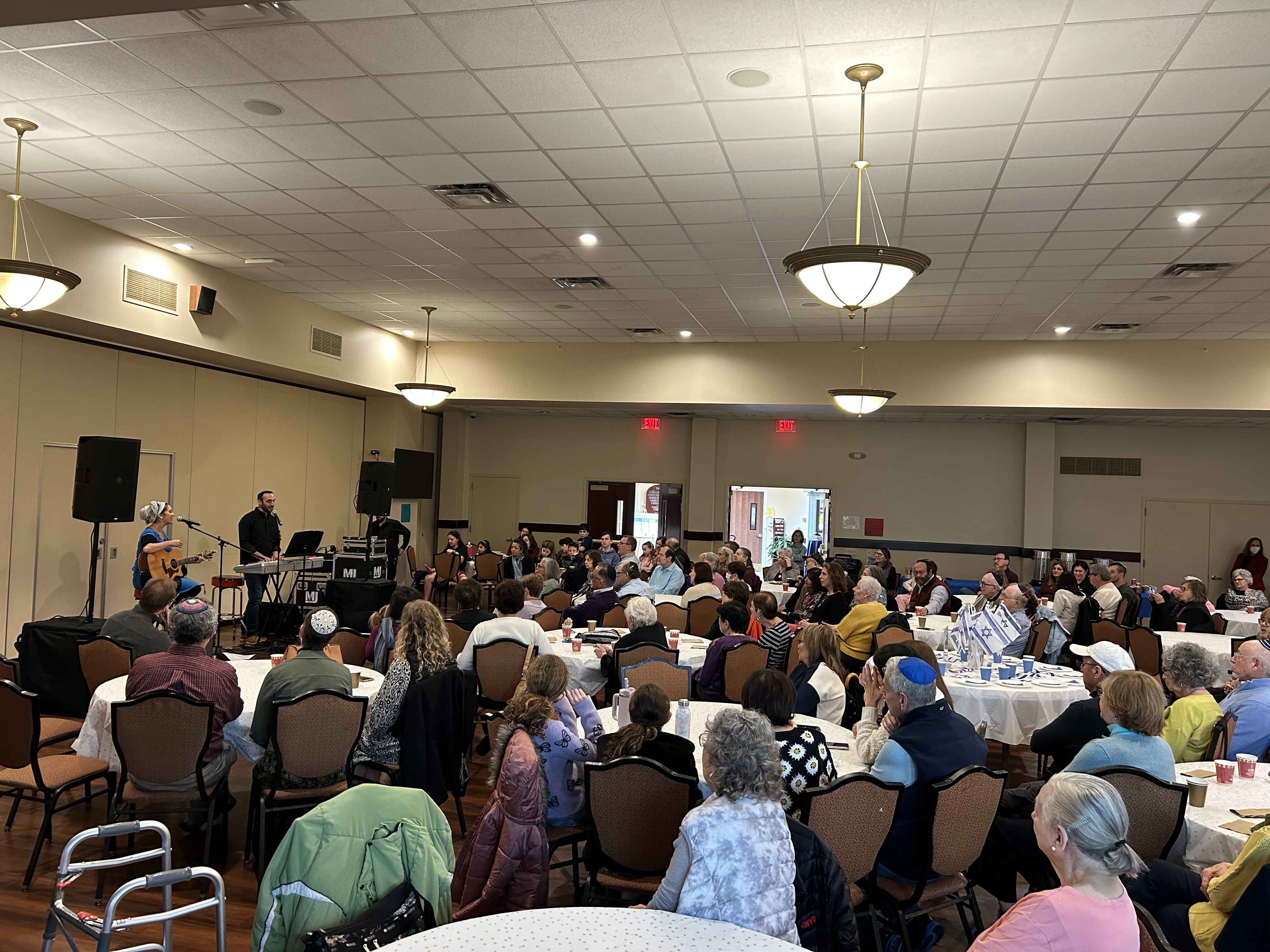
Yoni and Nina came to us with Rabbi Hersh’s urging early in the spring of 2020. They performed via Zoom monthly on Friday morning to help us connect heading into Shabbat in a time when we could not yet gather physically. Their music, for many of us, has continued to feed us, uplift us, connect us. While we felt this personal appearance was a homecoming for them of sorts, I know they felt the conflict of being away from their one home, their parents, and their children.
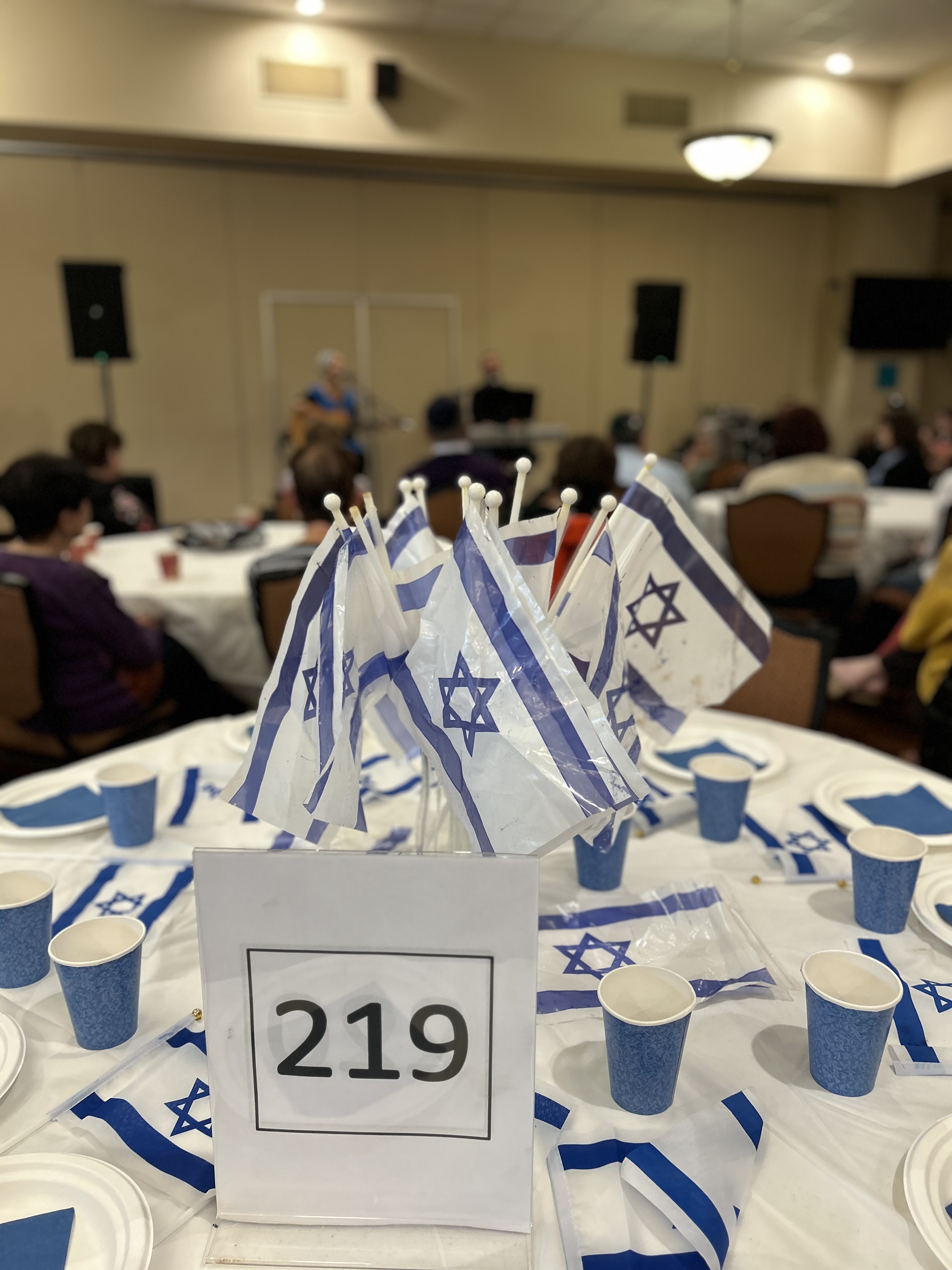
For ninety perfect minutes, with the help of their music, lyrics and heartfelt stories, we ascended together out of the time and space that restricts us. We were all home with one another, all connected to our mothers and fathers, all feeling the love we give away coming back to us, all absorbing the resilience and hope shared by these two loving artists.
In their song Melaketet kochavim (“collecting stars”), Nina and Yoni sing to each other from afar, a mother caring for children and home, a father fighting a war, both hoping to reunite safely and soon, holding onto hope that their dreams will soon be realized:
So now I am gathering all of my strength
of kindness, and of faith
that good days are yet to come
that the songs of joy will return to us
and I hug the children tightly
to protect from the storms outside
and in all the craziness
under black skies
I gather stars
Inhale. Read the words and hear the song. Exhale. Repeat.

Happy 76th birthday, Israel. May this year be better than the last, one in which your children’s dreams come true, one in which your hope is realized.
Rabbi Craig Scheff
Riding the rush to the future
This Friday I begin a three month sabbatical. For those unaware, my professional partner Rabbi Paula Drill and I each have this opportunity for renewal every four years, and we are grateful to our congregation’s leadership and community for recognizing the mutual benefits of the sabbatical to us and to the synagogue. My last sabbatical began in December 2019 and ended in March 2020. I “re-entered” our synagogue’s life just as the COVID-19 pandemic made its presence felt in the community.

Since then, the challenges we have faced as a congregation have been unlike anything we had ever experienced, and unlike anything I ever imagined I would encounter in my rabbinate. The unpredictable and unprecedented challenges often left our congregation and our rabbinates in a reactive mode. The triage approach to pastoring to the community had us on our heels and running on adrenaline, often feeling spent after the rush. Despite the many challenges, our congregation has survived and thrived, revealing untapped strengths and unveiling creative modes of connection. In many ways, we are a stronger community than we were four years ago.

In the early 2000’s, mental health experts identified phases of individual and collective emotional response to disaster, and our individual responses to the pandemic fit the framework well. They labeled and described several of these phases as follows:
- The “Heroics” phase, characterized by adrenaline-induced rescue behavior; high activity; low productivity; a greater sense of altruism.
- The “Disillusionment” phase, where stress and fatigue take their toll; optimism turns into discouragement, resentment, frustration and anger; the larger community returns to business as usual.
- The “Reconstruction” phase, a time of individuals and communities beginning to assume responsibility for rebuilding their lives and adjusting to new circumstances; the recognition of growth and opportunity.

As I think back over the last four years, I believe we defied the suggested model in one very significant way. We largely avoided the “Disillusionment” phase by initiating a strategic planning process while still in our “Heroic” phase and the “Honeymoon” phase of good will that followed. We had enough vision and faith to look beyond our reactive mode and to look to the future proactively. Our “Inventory” phase was a time of taking stock and already planning for the reinvention of our congregation. Seeing the very best of our community and its individuals in action, and in ways that were so aligned with our mission and values, we knew that our core strengths would carry us beyond the pandemic and into the future.

This year, the busy holiday season ended with the tragic and traumatic events of October 7, the hostage ordeal and the days of war that would follow. Our typically quiet month of Cheshvan was suddenly a period that demanded heroics – mobilization, giving, energy, programming. We have responded as I knew we would, with passion, love and generosity. And once again, we are capitalizing on our core strengths and our best resources (you!) to look past this moment, to plan for the future, beyond my sabbatical and even beyond Rabbi Drill’s retirement.
I have no crystal ball. I can’t say what lies ahead for Israel and the Palestinians, and I can’t tell you what our synagogue will look like four years from now (when I’ll be preparing for my next sabbatical!). I can say with certainty, however, that we will still be here, doing what we do best, learning, growing, responding and looking to the future with vision, confidence and hope.
Believe it or not, I miss you already.
Rabbi Craig Scheff
When Asked How I Am, What Do I Say?
“What am I supposed to say when people ask how I am?” I complained to my Israeli friend, “I have no idea how to answer that question these days. Am I supposed to say I’m fine? Am I supposed to say I am not fine?”
“In Israel,” he said, “we are answering, ‘K’mo kulam’,” like everyone.
How are you? Like everyone.
I tried it on for size for a day. I wondered if it was fair for me to say that my feelings were like everyone’s feelings. Here in America, I am on the mezzanine, not even in the orchestra, and certainly not on the main stage.


My heart is broken regarding the massacres and kidnappings of October 7. I worry about the IDF soldiers in Gaza. I feel hopeless about the mounting number of casualties and deaths of Palestinians in Gaza. My anxiety is high regarding the unleashing of virulent antisemitism here in America and around the world.
I don’t sleep well at night. I wake up from the middle of horrible dreams.
But my situation is not the same as my cousins’ whose four adult children are all serving on the front lines. I cannot compare myself to my son-in-law‘s mother whose entire community, her entire personal and professional world, was devastated on October 7. I am not my dear friend who had to move to safety from her home and whose son and son-in-law are both serving in the IDF at the same time.
And although I teach that there is no hierarchy of suffering, I know that my suffering is not the same, and can never be weighted as heavily, as those families whose loved ones have been murdered and abducted.
So I faltered for a couple of days when people asked me how I was.
Now, it is true that a rabbi in a community carries the weight of a congregation’s fear and concern. We are looked to for optimism and hope when we might feel quite lacking in those categories ourselves. We are asked questions for which there are no answers.
But still, I did not feel that I deserved to say, “K’mo kulam.”

And then one Friday evening at minyan, I led the community in the traditional words we say to a mourner. L’cha Dodi ended and we turned toward the man in shivah for his mother. We said, “HaMakom yinachem etchem b’toch sha’ar avalei Tzion v’Yerushalayim.” May God comfort you among all of the mourners of Zion and Jerusalem.
We say these words so often, counting on them to offer comfort to those who are bereft. On this particular night, I paused and considered their intention. I did not say these words to tell this particular man that his sorrow was exactly like all other Jews who were mourning. I meant that he is not alone in his grief. As a Jew, he was one of a great number of people at any given time who are held by God in our grief. We are all connected. That very fact offers comfort.
And the next day I went back to answering the question, how are you with the answer “k’mo kulam”.
I am not alone in my grief. And neither are you.
Rabbi Paula Mack Drill

Leaving on a Jet Plane

Oh my bags were packed, I was ready to go…
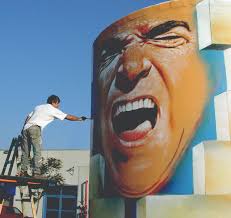
As you read this post, I should be landing at Ben-Gurion Airport with 18 Hazak congregants to begin ten days of adventure in Israel. Highlights included staying at the gracious Inbal Hotel in Jerusalem, a painting party with street graffiti artist Rami Meiri in Tel Aviv, and home hospitality with my son-in-law‘s mother on Kibbutz Mefalsim in the south.



It was going to be a truly wonderful trip, and I had been saying for weeks that the third time was the charm. This trip was originally scheduled for March 2020 when forty of us were scheduled to travel together. When COVID-19 grounded us, we rescheduled to December 2020. When that date still proved impossible, we rescheduled to a trip that was to have begun last night, December 7, 2021.
Many of us had started packing already and had scheduled our Covid tests. As soon as I heard the news about the Omicron variant a week and a half ago, I knew our trip would be canceled once again. Israel closed her borders to all but citizens for two weeks, and in a snap, our trip was canceled.
(We have already rescheduled for December 6 – 16, 2022. Perhaps the fourth time is the real charm?!)
It is disappointing to be at home instead of traveling. It is worrisome to think that the world is undependable and unpredictable. It is true that many who planned to go with us back in March 2020 are no longer able to travel with us at this point for a variety of reasons.
What do we do with disappointment? I have learned from all of my congregants and their life experiences to reframe, to be grateful, and to maintain hope in a positive outcome.
REFRAME: I feel so sad not to be in Israel, a place that I love to share with congregants, a place where I feel at home, a place that lifts people up in transformative ways. And also – I know that we are among the most fortunate people who can even dream of international travel. As one wise congregant told me, “Commit to no complaining and then watch for miracles.” We will get to Israel yet. Perhaps some of you who wanted to join our group but were not able to go this year will be able to go with us next year. Perhaps it is a blessing that I get an extra week and a half with my sixth graders in Kulanu. I know that it is a blessing to be at OJC for one more Shabbat before sabbatical, celebrating Carl Roth’s birthday!
GRATITUDE: Congregants who have been planning to travel with me have been inspiring in their graciousness since the cancellation. One told me, “Whenever you go, I am ready to go with you.” Another wrote to me: “I didn’t realize just how much I wanted to go until the trip was canceled.” I am grateful for a congregation filled with people who love Israel. I am grateful for courageous older people still willing to accept the risks of international travel. I am grateful for Ayelet, an amazing Israel tour company that knows how to pivot and bend over backwards when necessary. I am grateful for the good health of the OJC travelers, and pray for the continuation of good health so that we can travel together next year. Our blessings outweigh everything else.
HOPE: Our world is not an easy place. We can no longer depend upon things we used to take for granted. I do not, however, subscribe to the idea that humans plan and God laughs. The God I believe in does not trivialize our hopes and dreams.
I hope that we will travel to Israel in December 2022. I hope that the world will be a safer and more open place by that time. I even hope that you will consider traveling with us!
And in the meanwhile, I will miss writing to you for the next three months while I am on sabbatical. But know that I will be collecting experiences and replenishing my heart so that I return to you from sabbatical refreshed and energized to continue being your rabbi, a position that I feel with gratitude and hope.
Rabbi Paula Mack Drill
Can this be God’s will?
The video message arrived as an attachment from a trusted source. I opened it and began watching. The scenes of smogless skies, clear waters, and lush fauna served as a reminder that a world was being reborn around us, and that our stay-at-home quarantine was having the side benefit of giving Mother Earth a sabbatical, the chance to catch her breath. The beauty of the world around us could serve as a silver lining of this challenging time.
The second video message arrived within a couple of hours. It came from a name I knew, though someone I hadn’t connected with in quite some time. I opened it and began watching. It depicted similar scenes of smogless skies, clear waters and lush fauna, with facts about how much cleaner our world is today than at any other time in recent history. The video, however, was not a PSA for climate change. Its final scene was a man with the title of “Rabbi” trying to reassure me that the current pandemic was God’s will, part of the divine plan to renew the earth.

I was surprised, to say the least. Did the sender of the second video actually think that I would find comfort in its message? Have I ever given off the sense that I embrace and am comforted by a God who would will the death of hundreds of thousands of innocent people to advance a plan? What then could I say about God’s role in the Holocaust? About an innocent pedestrian hit by a drunk driver? About a cancer victim? About a parent losing a child? About a natural disaster that claims dozens or hundreds?
I don’t need to rely on theologians for my answer about the nature of God, instructive though their perspectives may be. Buber, Heschel, Wiesel and Kushner (with all due respect) don’t know anything more than you or I do when it comes to God. The rabbis across the centuries have offered many paths to faith, some that even stand in conflict with one another. God is, after all, infinitely unknowable. What theologians have going for them is that they think about the question of God long enough to develop consistency. Want to be a theologian? Work at it, test your opinion against theological questions, and be consistent!
Somewhere along the line of time, well before The Wizard of Oz, we started referring to God as perfect, all-knowing and all-powerful. While God does credit God’s self in the Torah as the Creator, God never uses these other descriptors for God’s self. God changes God’s mind, God admits to making mistakes, God learns and grows. At best, God says God is compassionate and loving, truthful and holy, and more powerful than other gods; at worst, jealous and judgmental, begrudging and impatient. The notion that God is all-powerful and all-good can’t withstand the test of consistency by my standards of goodness and justice. The notion that God is all-powerful but not all-good is untenable personally.
These weeks on the Jewish calendar would be a challenge to Jewish theology without a pandemic raging around us. From the death of Aaron’s sons for their “foreign” sacrifice to the command to be “holy” because “I the Lord your God am holy”, from Yom Hashoah and Yom Hazikaron (Memorial Day) to Yom Ha’atzmaut (Independence Day), it can be so tempting to conclude that all is connected in some divine plan that necessitates God‘s intervention at certain times but doesn’t warrant God‘s intervention at others. I cannot and will not place my hope in an omnipotent god who requires the sacrifice of innocents or matyrs for the sake of learning lessons, realizing dreams, or cleaning the air. God promised us: No more floods at God’s direction to destroy the earth.
But that doesn’t mean there won’t be floods.

Personally, I’ve come to the conclusion that God is perfectly imperfect, as are we. God purposefully gave us free will and God intentionally introduced an element of chance into our existence. Without this measure of unpredictability, we’d be as naive as Adam and Eve in the Garden of Eden, without the ability to make choices that reflect God’s glory (and goodness) in the world. As our sages taught, “Everything is in God’s hands except for the fear of God.” God controls everything except the choices we make. Those choices have long-ranging consequences that God will not control, and those same choices can reflect well or poorly on God. But in God’s love and goodness, God has given us the infinite potential to learn, grow and change course. It’s God’s hope that we see the God-given strength within to persevere, to live, to celebrate and to spread our hope.
We have been divinely inspired to create a way of living that reveals God’s goodness in an imperfect world. It’s that very imperfection that presents us with the opportunity to rise to the level of the divine. I will appreciate that which I perceive as miraculous without understanding what merits such grace. I will bemoan that which I perceive as tragic without attempting to explain, justify or defend. I will hold onto my faith that the goodness of God, as reflected in the actions of others and in my own choices, will raise us all towards a higher plane of meaning and love.

God is hope, faith, and goodness, along with the strength to live our lives accordingly in a perfectly imperfect world.
Rabbi Craig Scheff
Days 3 and 4: Planting for the future
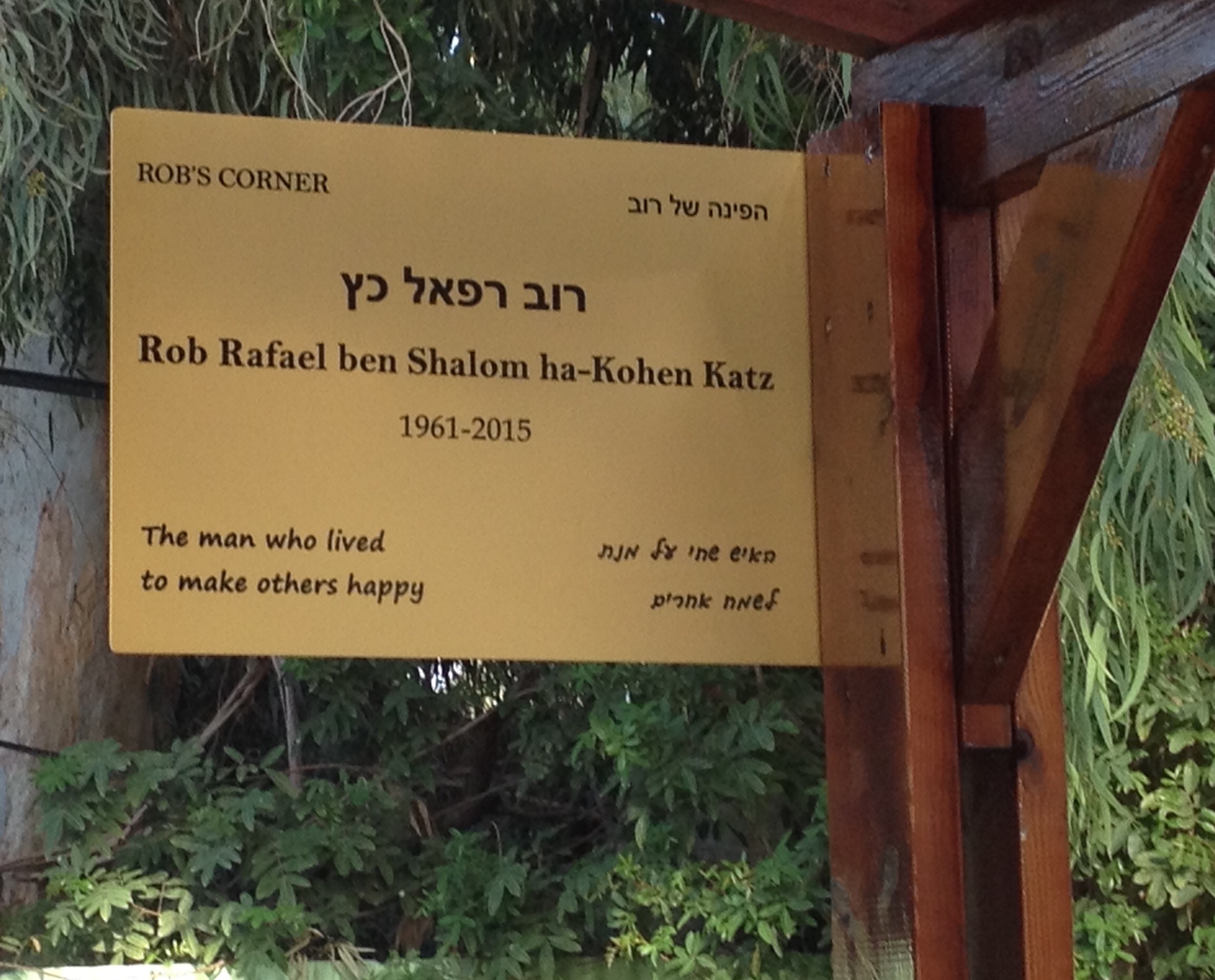
Day Three of our 10th annual mitzvah mission proved to be an emotional roller coaster. We returned to Ahava, anxious to finish our projects, determined to dedicate a final product at the end of the day. We worked hard and fast, skipping lunch. As we waited for the cement stools to dry and the tile mosaics to set, a young girl by the name of Efrat entertained us with her exuberant dancing, magnetic personality and charming smile. We danced and laughed as the final touches were completed. Finally, the work of our hearts and our hands was permanently memorialized. Efrat and her friends quietly stood with us as David Klein spoke of his son and Rob, and of the significance of our community shoveling soil together once again, this time for the purpose of planting. Two ficus trees now stand side by side, one in memory of Rob Katz and one in memory of Danny Klein. They will grow together and ultimately become intertwined. They will spring large leaves that will offer shade to those who seek shelter sit in “Rob’s Corner.” We charged the children to care for this corner of their lives, always remembering how they witnessed a group of adults sharing raw emotion, love, respect, comfort and care. We had come to Ahava to offer comfort, but in the end, amidst our tears, these children comforted us.


Driving into Jerusalem, we stopped atop Mount Scopus to see the city from afar. We stood next to Christian pilgrims who sang songs of praise. The Muslim call to prayer rang out atop their song, and we stood quietly in a tight circle for a moment to take in the significance of these three faiths in momentary peaceful coexistence. We then offered our own pilgrim’s prayer, thanking God for the ability to give of ourselves and appreciating the opportunity share the moment together.
Day Four began with a morning service at the Masorti Kotel. We were completely alone in the archaeological park. We celebrated several “firsts” as Miriam led Shacharit, Linda and robin read Torah, and Lesley received her first aliyah. Once again, the ability to pray together and stand side by side at the wall was not lost on any of us. We drew together in a circle of prayers for peace, comfort, healing and gratitude. The sentiments pulled us closer to one another, and the prayer became one.

The final stop before our closing lunch was Hand in Hand, a school in Jerusalem where 600 Israeli Arab and Jewish children learn together. As the children grow through their high school years, they engage one another openly in confronting the difficult challenges that their conflicting national narratives present. They come to recognize that hearing each other’s personal family narratives, and appreciating each other’s suffering, is the most important lesson if they are to be able to move forward constructively. They recognize that there are many extremists (and not-so-extremists) from their respective communities who don’t support their decision to coexist in this fashion. A year ago, the students saw their school set afire by Jewish arsonists. Graffiti on the walls of their school is not uncommon. Their response: We may disagree about the past, but we have a shared future whether we like it or not. The teens with whom we met were not idealists; they recognize the many challenges they face. But they are determined–even in a time of fear and anxiety–to continue living their shared lives. We thanked them for their courage and determination, and we prayed that their glimmer of hopefulness would carry them bravely into the future. Perhaps their voices will one day proclaim peace in the land.
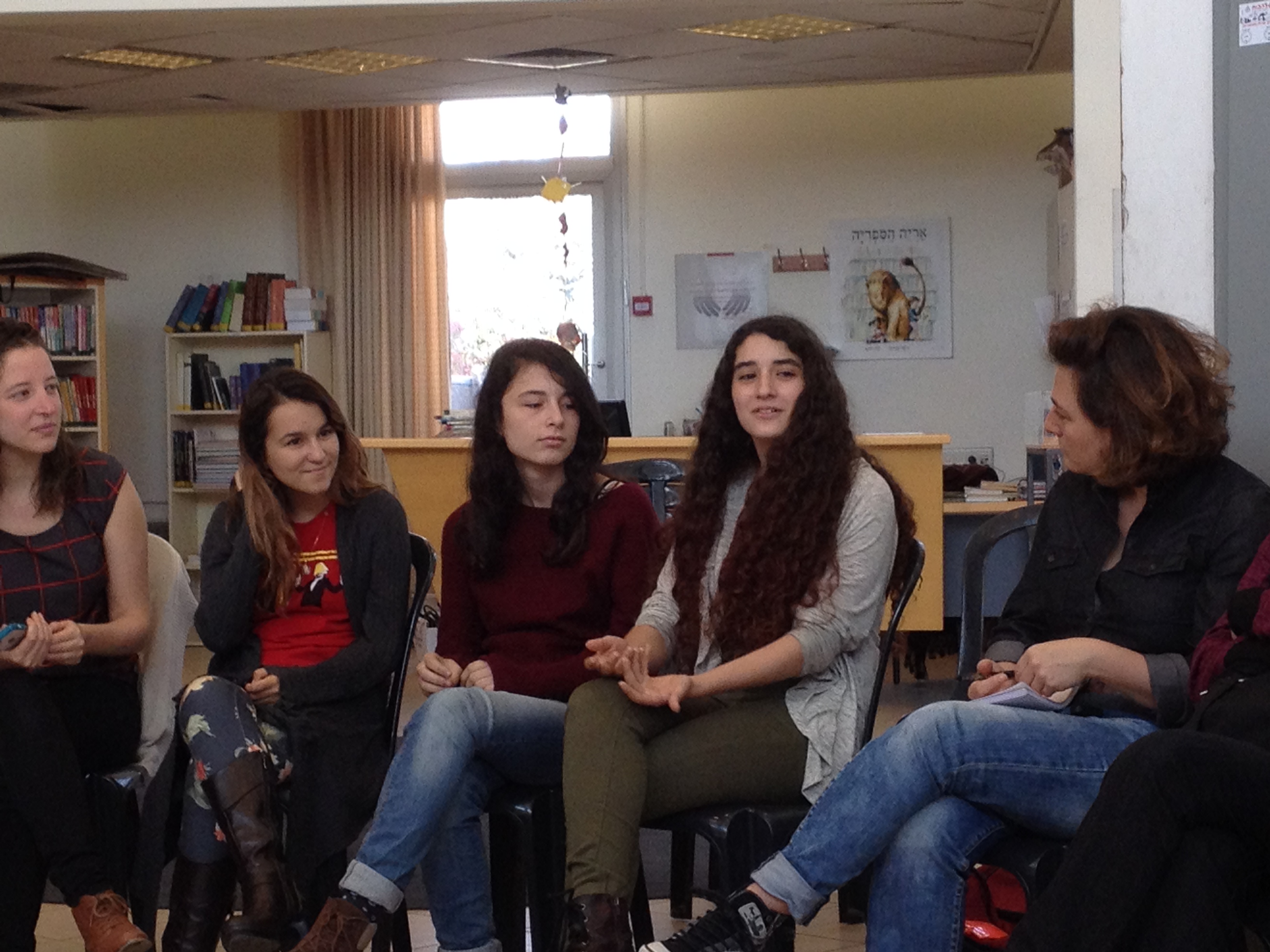
A final lunch gave each of us the ability to reflect on what we had accomplished and on the gifts we received from one another and from being the community that we are. Due to the intentions we bring to this experience, our circle is one that is able to expand easily, and to welcome those who are similarly committed. We invite you to join us, next year in Israel.

As I finish writing this entry, I am watching news about 2 more attacks today, one in Tel Aviv this morning and one in Gush Etzion this evening. The second hits closer to home than any of the attacks thus far. It is suddenly harder to leave than it was before. I want to remain in a place of hope, and I want to do my part to bring hope to others. And I don’t want to have to wait until next year to do it.
Perhaps Mitzvah Dy this Sunday back at the OJC will restore a measure of the hope we have felt all week long.
L’shalom,
Rabbi Craig Scheff
 Three Rabbis Walk Into A Shul
Recent Comments