Israel Bonds Rabbinic Cabinet Mission, Day Two
When it comes to a “mixed” group of rabbis (Reform, Conservative and Orthodox, male and female) traveling together on a mission like ours, I can always tell how successful the trip will be based on who shows up for the first morning’s minyan. And this morning’s minyan surpassed my expectations. Nearly every rabbi arrived within the first 10 minutes of our 7am start time! Yes, a couple slept in and a couple got there a bit later, but the tone for the group was set.
After breakfast, we were addressed by Gidi Grinstein, president and founder of the Reut Institute, a non-profit think tank focused on effecting political and social change within Israeli society. (See http://www.Reut-Institute.org for more.) He was engaging and challenging, as he highlighted many issues that Israel confronts in defining what it means to be a Jewish nation-state in todays Jewish world. He shared that the success of the Jewish project for 26 centuries has been based upon a societal structure of a broad network of smaller units, all struggling to be adaptable to changing social, economic and political conditions while trying to hold onto our traditions and values. He coined the term “flexigidity” to characterize our behavior. Interestingly, he surprised us all by asserting that, with more than half the world’s Jews living in Israel and most of the rest living in the United States, the resulting model has hurt the relationships that Jews have shared with each other inside of Israel, and the relationship that Jewish communities of the Diaspora share with Israel. The solution he suggests? Relationships, of course! One to one, and community to community.
We took our comments and debriefing onto the bus and headed to our next stop. CheckPoint is an Israeli start up software company that invented the first firewall, and now claims all 500 of the Fortune 500 as its clients. As an internet security technology company, CheckPoint represents the best of Israeli ingenuity, innovation and competitive strategy on a global scale, and addresses threats that range in scale from script kiddie hackers to cyber-terrorists. Cool!
After lunch, we visited another cutting edge company changing the world for the better. Would you believe I am talking about a sewage treatment facility? And can you believe I am not making any potty jokes??? In all seriousness, water shortage is a major issue in Israel and in many other areas of the world that find themselves on the edge of the desert. The Shafdan Wastewater Reclamation Facility recycles an astounding 85 percent of its waste water as potable. (Compare that with the second leading country in the world, India, at 15 percent!) We had a Disneyworld-like tour through the facility and an actual city pipeline (it was dry, carpeted, and lit!), and learned how Israel’s ingenuity is solving issues of water shortage, and contamination for the Negev and the world.
Back on dry land, we concluded our day with an emotional visit to the Western Wall. The egalitarian rabbis among us prayed together in the new area of the Kotel, the Azarat Yisrael, where men and women are given access to the Wall together. For the first time in the history of the Cabinet’s missions, a woman led the rabbis in prayer. The significance of the moment was not lost on any of us.
The snow should be coming to you once again just as we start our new day. Be safe. More tomorrow.
Rabbi Craig Scheff
Israel Bonds Rabbinic Cabinet Mission, Day One
There are many reasons to be grateful for the gift of being in Israel: First, it is always a privilege to be here – something I never take for granted. Second, it isn’t snowing here in Tel Aviv (sorry, everyone!). Third, I get to see my daughter who is being released from her base for two days to join me on Wednesday and Thursday of this week. Those reasons are all valid and meaningful. Tonight, however, I am grateful for a different reason.
I am filled with gratitude because I am traveling with thirty-two rabbis of all Jewish streams with the specific purpose of gaining an insider’s view of the work that is accomplished in this country with the income of Israel Bonds. Rabbi Marty Pasternak, Executive Director of the Synagogue Division of Bonds, jokingly introduced us to the itinerary, pointing out that rabbis are going to love putting on hard hats and gaining entrance to construction sites. While I am sure that hard hats, flashlights and tunnels would float Jonathan Drill’s boat, it is the opportunity to learn and to make connections with rabbis that really make me excited about this mission.
Our trip began with an opportunity for hands on chesed, an annual addition made to the itinerary by Rabbi Scheff. We visited one of the food distribution sites of Chasdei Naomi where we sorted produce and packed boxes of food staples for pick up by families in need. The work was satisfying but it felt like a mitzvah lifted higher by the introduction we received in a breathtaking talk given by founder Rabbi Yosef Cohen. Rabbi Cohen told us about growing up in the kind of poverty that one cannot understand unless one has known it. With tears of pure emotion, he shared stories of his youth that influenced him to found this agency that today distributes 300 tons of food to 10,000 hungry families, supporting Israelis in need with various kinds of assistance. For more information, see http://www.chasdei-naomi.org. Rabbi Cohen described bringing home a fresh loaf of bread and his mother’s putting it on a top shelf so that they would finish the older stale loaf before it went bad and precious food was wasted. He never had fresh bread as a child. Today he ensures that children do not go hungry. I was proud to be part of his mission, even for a few hours today.
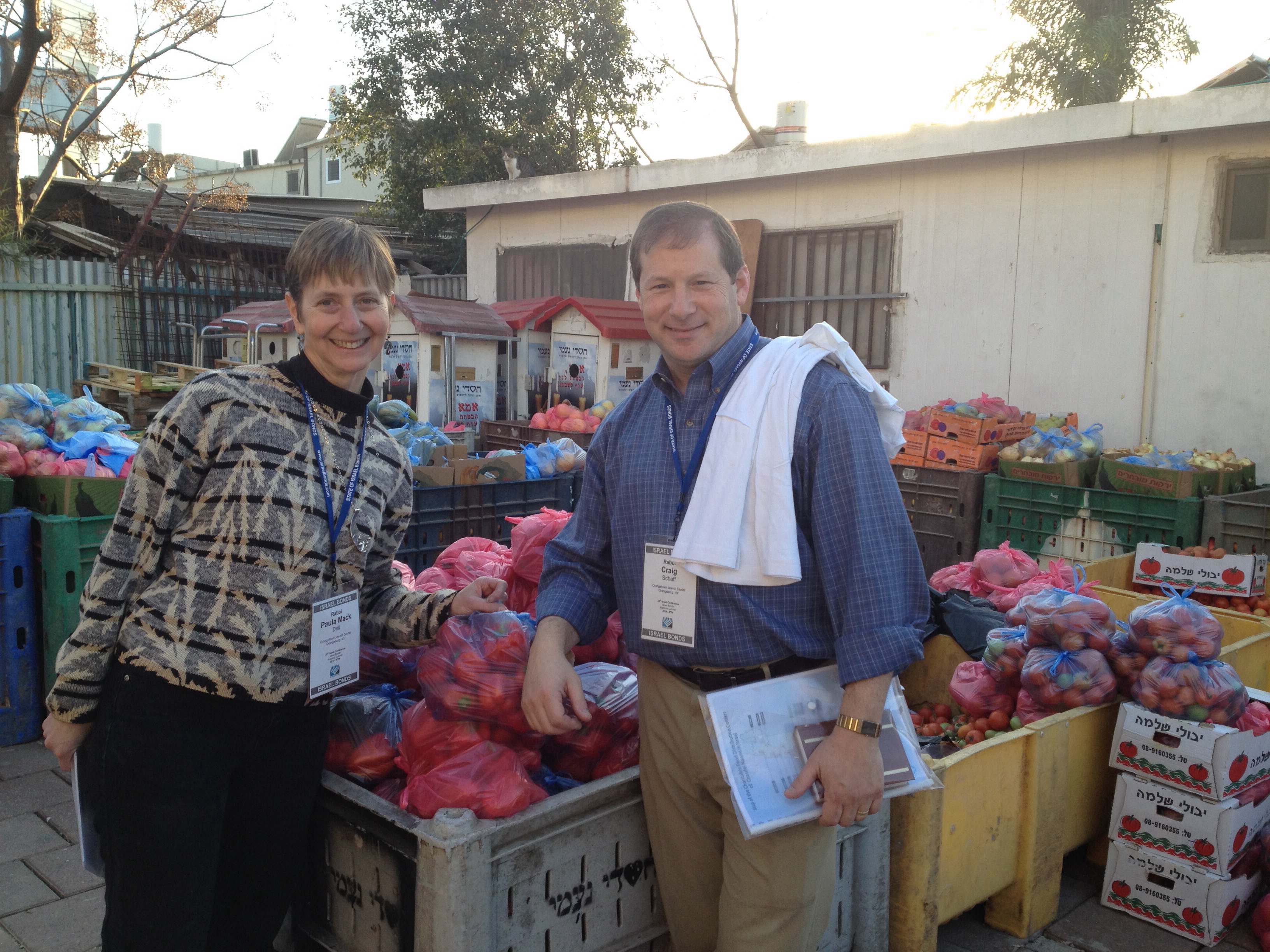
There was, of course, much more learning, but you will all have an opportunity to hear many stories from Rabbi Scheff and me. For now, it is after eleven here with a 6:00 am wake-up call for morning minyan.
Laila tov from here and tzahariyim tovim there. Good night and good afternoon,
Rabbi Paula Mack Drill
Renewing the bond
Yes, I am off to Israel again. Saturday night. And I will be back Friday morning. It is one of those quick visits. Yes, I will see my family on Sunday evening upon my arrival, but from Monday through Thursday night I will be busy fulfilling my responsibilities as chairman of Israel Bonds’ Rabbinic Cabinet. I will have the honor of representing a group of 32 Reform, Conservative and Orthodox rabbis from North America (4 from Rockland County!) for the last time as chairman, after serving the organization for three years. On Wednesday night, Rabbi Drill will preside over relieving me of my obligations and appointing a new chairperson.

It is a joy to know that you share these trips with me through my daily summaries from Israel. On this trip, Rabbi Drill and I will alternate sharing daily reports Monday through Thursday via the OJC Rabbis’ blog. PLEASE NOTE THAT WHILE THIS BLOG POSTING IS BEING SHARED VIA OUR “CONSTANT CONTACT” NOTIFICATION SYSTEM, NEXT WEEK’S UPDATES WILL ONLY BE ACCESSIBLE VIA THE OJC BLOG! SO PLEASE CLICK HERE TO SUBSCRIBE TO OUR BLOG (IF YOU ARE RECEIVING THIS VIA E-MAIL) AND TO RECEIVE OUR DAILY REPORTS!
These last three years have afforded me a wonderful opportunity to get to know Rabbinic colleagues and laypeople who are passionate about Israel. I have gained new insights into, and appreciation for, the many advancements made within Israeli society in the areas of science, technology, and medicine. I have met so many people who have played major roles in Israel’s economic successes and who serve as Israel’s exporters of hope. I have come to appreciate why so many countries, institutions, businesses and individuals today are choosing to invest in Israel. It is one of the safest, and most rewarding, investments that can be made. It is certainly satisfying to know that your money is earning money; it is even more satisfying to know that you are owning–or giving someone else the gift of owning–a piece of the dream-come-true we call Israel.
I want to thank you for supporting and sharing this passion. I look forward to sharing more opportunities to renew these bonds. Perhaps you’ll join Rabbi Drill and me on Sunday morning, February 9 (you’ll pardon me if I am a bit jet-lagged!) as Rockland County Women’s Division of Israel Bonds celebrates its annual Premiere Brunch. Tamar Weinger will be our honoree, and our own Janice Wertheim is being celebrated as JCC Rockland’s honoree. Contact our Israel Bonds office at 800-724-0748 if you want to attend, to invest, or to give the gift of a bond! Congratulations to them, their families, and to us all for what we have been able to build together.
Stop that Horse!
I love the story of the rebbe who sees one of his young students galloping through their town on the back of a fast horse. “Where are you going with so much speed?” calls the rebbe.
“I have no idea,” shouts back the young student. “Ask the horse!”

So often, this is exactly what life feels like for me! I have no idea where my life is flying to; I just hold on to my routines and schedules and To Do lists for dear life and they take me at full speed from day to day.
I was thinking about this story today because yet another snow storm called a halt to my full-tilt gallop. At home this morning with a sun-filled winter wonderland outside my window, I sat quietly and asked myself if I know the direction in which I am running. Note that I am not asking for a destination. I would just like to know that I am guiding the horse and not the other way around.
What is important and valuable enough in our lives to convince us to grab the reins and take charge? Can we change our routines just a little bit to bring something new into our days, something rewarding and meaningful? Can we find the way for Jewish living and connection to God to be at the center of our journey rather than another activity on the To Do List of our lives?
A congregant recently shared with me that she had been living life full tilt, but had forgotten to nourish her soul. She loves and cares for her family, does meaningful work, and takes the time to keep her body healthy. Her life is full and rich. She shared that she started to feel that something was missing and realized that she had not been in synagogue since Yom Kippur. She returned one Shabbat morning for a simcha and has been in services every Saturday since. “The quiet and the peace of the service gives me something I cannot otherwise find. I love my life, and take good care of myself physically, intellectually and emotionally. But I came to know that I must take care of my soul as well,” she explained to me.
This congregant reined in the horse. She asked, “Where exactly am I headed?” She reminded me to do the same, and I in turn pass on her wisdom to you.
B’yedidut, With friendship, Rabbi Paula Mack Drill
Ten things
We hear of “The 10 Commandments” and we think Charlton Heston, fire and brimstone, an awe-inspiring and perhaps frightening and coercive encounter. And perhaps at some level we are intended to quake in our boots when we consider how the Israelite experience at Mount Sinai (no matter how you understand it)–and the resulting written words–have shaped the course of humanity.

That being said, I believe we get a bit too hung up on the “Thou shalt” and “Thou shalt not” language, and in so doing we often miss the gift of the beautiful and simple wisdom inherent in these utterances. (Note: the Torah never refers to the big 10 as mitzvot, or commandments. They are called dibrot, from the root meaning “speak”). So I offer you below my personal restatement of the 10 expressions:
I am.
And as such you need rely on no other.
Don’t overstate or minimize my presence.
One day each week, appreciate the ability to just BE, and treat it as a gift from me.
Don’t forget who brought you into this world.
No one life is more precious than another.
Control your physical appetites.
Control your material appetites.
Be honest in pursuit of your personal sense of justice.
Work for what you want, and live with the reality that you won’t always get it.
Live these statements, and perhaps we too will experience the Divine.
Shabbat shalom,
Rabbi Craig Scheff
Lessons Learned from Loss
I dedicate my writing this week to the memory of Abraham Mordecai Akselrad, z”l
It is fair to say that I attend more funerals than the average person. I am usually in the room with the family tearing the black ribbon, standing behind the lectern, driving the first car behind the hearse in the processional. The honor of performing the mitzvah of kavod la-met (honor to the dead) or of nichum avelim (comfort to the mourners) is very great but it is also very difficult. As rabbi, I gain strength knowing that I can truly help in many ways: standing steady for a family when the world is tilting, explaining a ritual with compassion, educating a community about how to pay a shiva call, or calling a grieving daughter a month after shiva has ended.
This past week, I remembered with full force what it means to perform these mitzvot, but without the designation of “Rabbi” as I did so. I realized with humility how performing kavod la-met or nichum avelim as a rabbi provides a layer of protection to me as a person in such sad times.
Just before Shabbat last week, Jonathan and I lost a dear friend of thirty years after a heroic battle with cancer. Abe Akselrad loved life completely and fought for every day and every hour he could spend with his wife Claire, his four children, son-in-law, and two grandchildren. The entire community of our synagogue in Caldwell attended Abe’s funeral this past Sunday, and he was buried in a downpour.
As friend in the pews rather than rabbi at the podium, I learned many lessons that I want to share with you. I believe that in the OJC community, we are supportive, appropriate and understanding of the laws of mourning and comfort. But we can also improve and grow. In that spirit, I share my learning of this past week.
One of my friends called me on Friday midday and asked how she could help the family who were overwhelmed by people stopping by with their sorrow, their condolences and their fruit platters. I suggested that they hang a sign on the door: “According to Jewish custom, it is not traditional to visit a family until after the funeral has taken place.” When Jon and I entered the funeral chapel, we saw long lines waiting to enter the room where the family sat before the service. We chose to enter the chapel directly instead and sit quietly. After the service, I saw friends clinging to Claire, crying with her, when I thought that she probably wanted to just get into the limousine and prepare herself for the cemetery. I thought about the way all of us have a need to ensure that the bereaved know we are there for them. Sometimes our need to be known outweighs common sense about what true comfort means. Claire and her family would never complain. I know that they have felt the love of family and friends. My first lesson is that all of us need to check our motivation in comforting very carefully: are we acting out of our own need or what we believe to be the needs of the bereaved?
As Jonathan and I sat in a row waiting for the service to begin, we were joined by friends from the Caldwell synagogue. At the end of my row was our friend Rabbi Michael Jay. Both of us have been well-schooled by Rabbi Scheff to sit silently in the presence of the dead. As rows all around us filled with chatting people, our row, anchored by Michael’s and my respectful silence, remained relatively quiet. The second lesson is that we can carry our learning wherever we go and model behavior that shows compassionate understanding of mourning ritual.
Presiding at the funeral was Rabbi Alan Silverstein of Congregation Agudath Israel, the Drill family’s rabbi for more than thirty years. He spoke about Abe as a congregant and as a cherished friend; he presided at the baby namings and bris and b’nai mitzvah of all four Akselrads, and at the oldest, Aviva’s wedding. His words brought comfort and an uplift of the heart not just because they were beautiful, heartfelt words, but because Rabbi Silverstein was speaking from a true relationship with the family. The third lesson I share today is that I came away from the funeral affirmed in the rabbinate that Rabbi Scheff and I have created at the Orangetown Jewish Center. We know you. We know your passions and your sorrows, your celebrations and your questions. “Relationship” is the mantra of our rabbinates. . . and for good reason. Truly knowing you allows us to be there with our full selves, as rabbi and as person, in your greatest joys and times of need. If we don’t yet “truly know” you, call one of us for a cup of coffee or a meeting at the shul. We do not want to wait for a time of loss to establish our relationship with you. Visit with us to make a meaningful relationship so that we can continue to build our community together.
Shabbat shalom, Rabbi Paula Mack Drill
Celebrating a new year
2014! We ushered in a new year this week, perhaps with a bottle of bubbly, an evening with friends, watching a ball drop with Miley Cyrus (oy!), or a morning to lazily lounge around the house. Perhaps we even resolved to change something about our personal habits or exercise routines.
What distinguishes the calendar’s new year from the Jewish new year, however, is the amount of preparation that goes into the celebration. The Times Square event may take months to prepare and rehearse, but most of us don’t put much effort into preparing for our personal celebrations. Perhaps we make a phone call to establish whom our company will be for the evening; perhaps we prepare a dish or buy a new outfit. Perhaps we make a resolution to lose 10 pounds as the ball drops.

Contrast with this our celebration of the Jewish new year. Traditionally, we spend a month preparing for Rosh Hashanah. We reflect, examine, resolve and repair in order to bring about real change in our relationships. And while the potential lies within us all year, it is in the month leading up to Rosh Hashanah that we harness the energy to do the necessary work that will bring about change.
Today is the first day of the month of Shevat. According to Beit Shammai, it is also the new year of the trees. You may be more familiar with Beit Hillel’s ruling that we celebrate the new year of the trees on the 15th of this Hebrew month (Tu Bi-Shevat). But two thousand years ago, the date of the trees’ new year was a matter of debate. And this year, Beit Shammai’s new year of the trees fell one day after we celebrated the arrival of 2014. The proximity is significant because the new year of the trees can inform the way we mark and celebrate the passage of time. We plant for the future; we explore that which has been dormant within us; we gather the energy to bring forth new fruits; we express gratitude for those things we enjoy.
Oh yeah, then there are those 4 cups of wine, symbolizing the 4 seasons: white, pink, rose and red. So go ahead, drink a toast (or four) to the new year! Just don’t forget to add boreh p’ri ha-gafen!
Celebrating December 25
The answer to your question is: “Yes, of course we had Chinese food!” The Kosher Chinese take-out was bustling and I heard a call from the back that they had run out of vegetable lo mein and General Tzo’s chicken. Luckily, I had called my order in two days earlier. And yes, we saw a movie too.
Before these traditional Jewish ways of celebrating Christmas, however, my family participated in a newer tradition. It is one that I hope catches on. We volunteered our time. At lunchtime, we visited a nearby nursing home where we transported residents to physical therapy and to a music program. I fed lunch to residents in a dining room where they were short-staffed. As I fed them lunch, I sang to the residents and responded to their questions and reminiscences. Even if they were confused, I found a way to honor their communication. One of our friends and her seven year old daughter played many games of Checkers and Gin Rummy. I am certain that our acts of kindness made a difference in the days of these elderly nursing home residents.
It occurs to me, however, that the most important recipients of our chesed might have been the staff. Everywhere we went in the building, we asked the staff, “Do you celebrate Christmas? Thank you for your work today.” We were asked why we had come to the nursing home, and our answer of coming to help on a day that was someone else’s holiday was met with delight.
I was thinking about my experience at the end of the day (yes, pleasantly full of vegetable lo mein!) and found an article in The Forward written by our good friend Rabbi Jesse Olitzky, one of the rabbis at the Jacksonville Jewish Center in Florida. Most of us remember Rabbi Olitzky as one of our treasured rabbinic interns here at the OJC. Rabbi Olitzky wrote: “Instead of taking the day off because others are celebrating their holiday, make it a day of meaning, a day of doing good, and a day committed to repairing the world. . . Before you take advantage of a day off, make it a day on by helping others.”
I add just one more thought to Rabbi Olitzky’s wisdom: Don’t wait for next December 25 before you find a way to repair just a small corner of the world. Many of our congregants volunteer in beautiful, quiet ways: reading to a person who is blind, visiting with a congregant in a rehabilitation center, clowning around in hospitals, sorting clothing and home goods at People to People. If you need ideas on how to participate in acts of Chesed, contact me at Rabbi.Drill@theojc.org. I’ll be proud to put you in contact with our Chesed Committee, Helping Hands or one of the many worthwhile organizations and institutions here in Rockland County. Make it a secular New Year’s Resolution to volunteer your time and skills! You won’t believe how good it feels!
Saturday night the rabbi slept early
Our sages tell us that we are meant to live as if there is an eye that sees, an ear that hears, and a book that keeps track of all we do. You might think this is enough to drive us to paranoia! In fact, living one’s life as if someone is always watching even our most secretive acts can lead to a more conscious, more intentional existence.
Case in point: a few weeks ago I attended a Saturday night community jazz concert. Shabbat had been a busy one, including a Friday night program, a Shabbat morning bar mitzvah, a lecture after lunch, and a Shabbat afternoon bat mitzvah. Needless to say, I had no Shabbat nap. I settled into the comfortable auditorium seat, the lights were dimmed, and the mellow saxophone began to sing. You can guess what happened next.
That’s right, I fell asleep.
A week later, I had a meeting at our community campus. A colleague said to me, “I heard you are not much of a jazz fan.” “What do you mean?” “I heard you fell asleep!” Ouch. A few days later, while shopping at Fairway, I saw someone from the community I hadn’t seen in a while. “When was the last time we saw each other?” “Actually,” he answered, “I saw you at the jazz concert. You must have been pretty tired.” Double ouch! I actually enjoy jazz; if I ever need some help falling asleep, it’s the Carpenters, John Denver or jazz that does the trick. But one short shloof, induced by exhaustion, mood lighting and music, and I am the talk of the town!
Okay, so I exaggerate a bit to make my point. I understand that I live in a fishbowl, as do many public figures and leaders. The point our sages make, however, is that we should all feel that we are living in a fishbowl, and guard our words and deeds accordingly. Every action, reaction or inaction can be understood as intentional, so we must live intentionally. Every action, reaction or inaction can be understood as a conscious choice, so we must live consciously. In doing so, perhaps we save ourselves a bit of shame, a bit of guilt, a bit of regret, and a bit of being a topic of other people’s conversations!
Rabbi Craig Scheff
Women Rabbis Lean In at JTS
I was one of sixty women, all members of the Rabbinical Assembly of Conservative Judaism, who gathered at the Jewish Theological Seminary on Monday and Tuesday, December 9 and 10 to connect, learn and replenish our minds and souls. The title of the conference was “Leaning In, Leaning Out, Learning from Each Other.” The learning, prayer, and opportunity to connect were all valuable.

But that is not what is on my mind as I think about the conference in the days since it ended. I am thinking about what it means to be present, completely and wholly present. In her opening talk, Rabbi Amy Eilberg, the first ordained woman of the Conservative Movement of Judaism, explained to us that her work has been about cultivating compassion. That work, she asserted, can only happen through true listening, through being present to another and thereby to God. She reminded us that careers in the rabbinate are guided by what we believe God wants of us more than by ambition.
I spent the rest of the day asking myself how I could ever know what God wants of me. As I listened to fellow rabbis, talked in small groups, and took notes, I asked myself the question about what God wants. And then the answer came to me as I pictured myself in our sanctuary at the OJC. Above the ark, the words are carved: “Shiviti Adonai l’negdi tamid.” I place God before me always.
I can know what God wants of me by being quiet enough, in the sanctuary of my soul, to listen. And to do that? I must be present. I must be in the moment with each of you, with the children of the Religious School, with the youngest children and their grown-ups at Early Kabbalat Shabbat. I must be fully present in your loved one’s hospital room, at your kitchen table or across the table from you at Starbucks. I must be present in the moments we share on the telephone.
And then, at the end of our moment, I must listen to my soul deeply enough to reassure myself that I am doing what God wants of me. Did I listen to you? Was I fully present to you?
It is not easy to be fully present in the year 2013. As we rabbis sat in a room, sharing our dreams, our insecurities, our prayers, many of us focused on the faces of whoever was speaking. If I place God before me always, then I must look for God in the faces of my fellows.
But a great number of us were typing away on i-pads, laptops, phones. Several in the room were tweeting. A difficult conversation erupted about this fact when confidentiality was breached with tweets that quoted what specific women were saying. Those who were tweeting defended their actions by stating the importance of sharing what was happening in the room with the public. I wonder how we can be in this moment, however, when we are already shaping it to share it with a nameless public. I understand that tweeting is meant to connect us, but doesn’t it distance us instead?
One rabbi said that she is more focused when she is tweeting than when she is just listening. There is a difference, however, between being focused and being present. Rabbi Eilberg had just told us that we must remember to be present to others. The result of the conversation was to shut down the tweeters. Sometimes it is valuable and important to get the word out. I understand the value of social media; after all, here I am blogging to you all! But sometimes it is much more important to get the word in. Lean in, lean out. Utimately, we chose to lean in, to lean within, to be present to each other and to ourselves — with the hope and prayer of being present to God.
 Three Rabbis Walk Into A Shul
Recent Comments