Friendly competition
Nine- and ten-year old athletes crowded into the gymnasium, each JCC delegation sporting a different color. They nervously fiddled with their gloves and rackets, either trying not to look at their opponents around the court, or staring down the competition they would soon be facing. (Or perhaps they were just checking out each other’s $130 shoes?!)
As the mini-athletes took the field for the opening ceremony this past Sunday, they smiled large for the cameras, proudly displaying their hometown banners, clearly excited about kicking off the first (hopefully annual!) JCC Mini-Maccabi Games. Welcoming the 200-plus athletes and their families (from as far away as Baltimore) to JCC Rockland, I asked them if they knew the Hebrew word chaver. “Friend,” many of them exuberantly called back to me. Actually, they were 9 and 10, so it sounded more like “frieeeeeeend!” Yes, friend.

But to the teachers of our tradition, I explained, the word chaver meant much more than someone with whom we play and socialize. The chaver is also our competition, the one who challenges us to be our best, the one who forces us to refine our strengths and inspires us to give our best effort. In the Jewish tradition, we learn with a chaver who will not always agree with us or accept our argument. Our study partner is expected to push back, to challenge our assumptions, to introduce us to new ways of thought.
On the fields of play, our teammates may indeed be our friends and playmates. They may also, however, force us to grow, challenge us to be better, and sometimes require us to face our shortcomings. And the same may be true of our opponents. If they care about us and our development (and that is an important Jewish assumption in this equation), they too may be our chaverim. They may teach us how to win and lose graciously, help us develop resilience, remind us how much harder we must work if we expect to succeed.

Not everyone can be a winner all the time. And we need not–and should not–protect our children from the experience of losing in life. Certainly we want them to experience success in areas that bring them satisfaction. As parents, teachers and mentors it is our job to help our children find situations where they will experience success, or at a minimum help them learn confidence, recognize growth and feel satisfaction in their efforts. It is also our responsibility, however, to to teach them how to own and use failure.

Whether you win or lose, it is NOT how you play the game. It’s about what the experience of playing teaches you about yourself. That’s what a worthy and true chaver–even one on the opposing team–can help you learn.
Rabbi Craig Scheff
The Only Woman at the Table
His seat was directly across the table from me. He called me Rabbi Drill, but he did not look directly at me. I know that calling me “Rabbi” was a concession he made for me and he knew that my understanding of his lack of eye contact was a compromise I accepted from him. Rabbi Mayer Schiller represented the Skver community in the Village of New Square and I represented a very different religious world. We were two of twelve religious leaders from Rockland County and New York City who gathered at the invitation of Rockland County Executive, Ed Day. Everyone around the table accommodated each other so that we could meet in the middle, in a place where we could listen to each other and truly feel heard.
When I was invited to the two hour summit that took place at Rockland Community College President’s Office yesterday, the meeting was described as an opportunity to sit down to open lines of communication between various religious groups of Rockland County. I accepted with the hope that a process of healing and reconciliation could begin.

But I arrived with low expectations. I knew that leaders of Rockland Clergy for Social Justice, of NAACP and of parent groups in East Ramapo have tried to meet with members of the Ultra-Orthodox community for open dialogue. I knew that these attempts had not been successful. I wondered what could possibly be different.
And here is what was different: Mr. Day invited religious leaders from Spring Valley and Suffern churches, the Islamic Center of Rockland, the Board of Rabbis (Conservative and Reform colleagues) and the Orthodox Jewish and Chassidic communities. Mr. Day told us that he is working to make Rockland County a place where we can live next to each other with respect and cooperation, with fair treatment for all and special privilege for none. He asked us to speak our truth and established an atmosphere of safety. Rabbi Joseph Potasnik, Executive Vice President of the New York Board of Rabbis, was invited as our facilitator. He established the tenor of the meeting when he said that it is better to discuss without resolution rather than resolve without discussion.
Two powerful pictures of broken community emerged from our conversation that struck powerful chords with me. First, Rockland County was compared to a ride on a New York City subway. We get on and get off at different stations, and while we share the space, no one makes eye contact or greets the other. We are as close as can be, but we pretend that the others are not there at all, sharing a bench or even hanging onto the same subway strap. Such travel through our days may be adaptive for New York City’s underground (though I would disagree) but it is not the way to be a cohesive county where all citizens have a profound sense of belonging.
The second description was shared by Reverend Raymond C. Caliman of the Fairmont Baptist Church in Haverstraw. He described a visit to Walmart in Suffern. People pass each other as they shop, but no one looks at the other. Instead, they look away. He said that the turning away speaks volumes about distrust and a refusal to know the “other”.
We spoke honestly and with open hearts from the anchor of our various religious traditions. Reverend Dr. Weldon McWilliams Jr. of the First Baptist Church of Spring Valley reminded us that we are all God’s children. Rabbi Schiller acknowledged that members of the Chassidic community must be taught that all people are created in God’s image. We talked about the need for a balance of power and empathy.
We explored next steps which include Rabbi Greenwald and Rabbi Schiller bringing members of their communities to the table, a statement of principles to which religious leaders can sign on, and a confederation of religious leaders who can stand together to condemn actions of bias against any group in the county as well as to celebrate positive steps forward.
It was only a beginning. But I feel optimistic. I felt heard. And Rabbi Schiller called me Rabbi.
http://www.fios1news.com/lowerhudsonvalley/first-interfaith-summit%20#.VVTTq7FsJTY
http://www.fios1news.com/lowerhudsonvalley/andrew-whitman-weighs-in%20#.VVSkO9m9K0c
With optimism and friendship, Rabbi Paula Mack Drill
Teacher Appreciation Life
From the second night of Passover, some of us have been “counting the Omer,” a period of seven weeks that culminates on the fiftieth day with the holiday of Shavuot. The omer was actually a measure of barley that was presented from the new barley crop to the High Priest in the time of the Temple, in fulfillment of the commandment in Leviticus 23:15 (from this week’s Torah portion, Emor). It has come to be known, however, as the period of forty-nine days we are commanded to count. Some people simply refer to this time as the sefirah (the counting). On a spiritual level, our mystics have imbued this practice over the centuries with multiple layers of meaning, focused especially on inner growth and ethical improvement. While it is not an easy ritual to incorporate into one’s life, even with the assistance of electronic reminders, I find it very satisfying to arrive at the holiday of Shavuot, when we celebrate receiving the Ten Commandments, knowing that I have been so conscious of the passage of time and so connected to the calendar.

The sefirah is also observed as a time of semi-mourning, during which Jewish law forbids haircuts, shaving, listening to instrumental music, weddings, parties, and dinners with dancing. According to the Talmud, a plague killed 24,000 of Rabbi Akiva’s students in the early part of the second century during this time on the calendar. Tradition tells us they were punished for their inability to disagree with each other with respect. The thirty-third day of the sefirah is said to be the day in which the plague was lifted. Today (actually tonight into tomorrow!) we celebrate this thirty-third day–lamed (thirty) and gimmel (three), thus “Lag Ba’Omer”–by breaking from our mourning to cut our hair, shave (if our spouses force us to), dance to live music, and maybe even get married!

While I can’t speak to whether Rabbi Akiva’s students were the victims of Divine anger or of Roman swords during what was an historical period of rebellion, upheaval and suffering, I can appreciate the seriousness of the lesson our tradition conveys. Yesterday, our schools celebrated the national holiday known as “Teacher Appreciation Day.” As we find ourselves celebrating Lag Ba’Omer in the midst of Teacher Appreciation Week, I know what Rabbi Akiva’s students would offer us from the Jewish tradition:
Who is wise? Those who learn from every person. Who is honored? Those who honor all people. Do not disdain any person, for every person has his hour. Any person from whom we learn even a letter is considered to be our teacher; and anyone who is our teacher is considered to have given us life. Search out life teachers; in the process, you may discover new friends, while rendering yourself a more accepting, giving and forgiving person.

Appreciate your teachers—and every person’s potential to be your teacher—every day. Maybe that is the ultimate lesson we can as we strive each day to merit receiving Torah. Thank you, Mrs. Tuttle.
Rabbi Craig Scheff
Ben Shloshim, l’Koach
By a surprising coincidence of timing, this week I celebrated two thirtieth anniversaries. In Columbus Ohio, I celebrated the thirtieth year of the Wexner Foundation together with 1200 Jews who were graduates of the Israel Fellowship Program, the Heritage Program or, like me, were alumni of the Graduate Fellowship. I flew home on Monday night to drive into New York City for a two day Rabbinical Assembly celebration of the thirtieth anniversary of the ordination of women.
Why such a big deal about thirty? (Believe me, I ask myself that question as I consider that Jonathan and I will celebrate thirty years of marriage this May.) In Ethics of the Fathers, one chapter lists developmentally significant ages and identifies each with a unique characteristic: “At five, the study of Torah. At ten, Mishnah. At thirteen, responsibility for mitzvot. At fifteen, Talmud.” The list continues until it declares: “Ben shloshim, l’koach.” At thirty years, the age of strength.
A midrash asks why thirty is the age of strength. The answer begins with a list of those who rose to greatness upon reaching thirty: Joseph began to serve Pharaoh at thirty. Priests began service in the Beit Mikdash at thirty. David became King of Israel at thirty. Then the midrash asks: why at thirty did they rise to greatness? The answer is stunning: Because at thirty, they were humbled and heartbroken.
This teaching played like a leitmotif in my mind throughout four days of intense learning, listening and rejoicing. True leadership requires humility and vulnerability. At the Wexner conference, much of the message was about leading through change – change in our lives, organizations and the world. Yes, leadership requires optimism, grit, resilience, and creativity. But in order to respond to the fierce urgency of now, we must first and foremost cultivate empathy to the other.
I felt challenged by questions of how to move people from caring about an issue to acting on it. I understood that in order for Jews to sit in a room together, we must acknowledge that all of us think about our Judaism from our own prisms. Partners in leadership must be asked to fine tune skills and generously use their gifts.
Shimon Perez was the great anniversary surprise. He told us that Israel is not just a country. Israel, he asserted, is an idea. He promised us that there are two things in the world that we can experience only if we close our eyes a little bit: love and peace. The common thread throughout the Wexner learning was that the leader who can lead through change must be humble and vulnerable enough to recognize the potential greatness in others.
At the conference of the Rabbinical Assembly, we learned sweet Torah, discussed models of successful change, and heard from inspiring thinkers and teachers, including one of my heroes, Letty Cotin Pogrebin, in conversation with her daughter Abigail Pogrebin. We celebrated with great joy the change that affected the whole Jewish world thirty years ago when Rabbi Amy Eilberg (another hero of mine) became the first woman ordained in the Conservative Movement after years of halakhic and sociological study and debate.
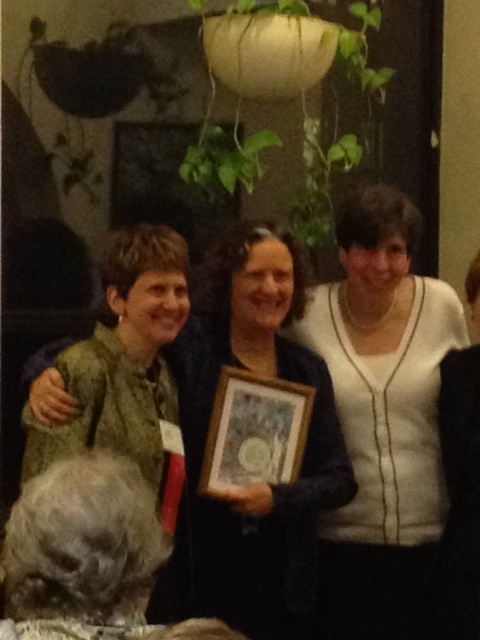

At the same time, we acknowledged that there is much work still to do in the arena of an equal place for men and women, boys and girls, in our congregations, schools, camps and communities. Rabbi Pamela Barbash taught that egalitarianism is not about women’s participation; rather, it is about increasing the adherence and participation of all Jews through obligation, study and mitzvot. I was reminded that women’s rise to a place beside men in Judaism would have never begun without the humility and vulnerability of men who became empathic allies to the cause as they studied and interpreted the Torah through the eyes of modern Jews.
Rabbi Scheff and I delighted in seeing OJC rabbinic interns, now our colleagues over these two days. We reconnected with friends and classmates, ate and prayed together, and recharged our leadership batteries. We’ll be teaching about the halakha, the sociology and the moral questions of the 30th anniversary of Women’s Ordination during Sisterhood Shabbat, June 19–20. We might even give you a version of the session that we taught about men and women as equal partners in pulpit life! Both rabbis look forward to sharing with our community the learning that filled us at the RA.
Kol tuv, All the best, Rabbi Paula Mack Drill
Not my God
The Torah’s narrator tells me that two sons of Aaron the High Priest brought a strange fire as an offering to God, an offering not commanded. A fire goes forth before God and devours Nadav and Avihu. Moses, in a moment of poor pastoral care, blames Nadav and Avihu for their failure to sanctify God when they had the opportunity to do so. Our rabbinic commentators, relying upon the juxtapositioning of the verses that follow, accuse the boys of being drunk or arrogant. All these readings justify one troubling presupposition: God willed the death of the boys.
Sorry, not my God. Even if the boys did something wrong, “God does not desire the death of the sinner.” And if the Torah’s narrator and commentators are just grasping at straws, trying to assign to God something beyond our limited comprehension, what kind of just God takes innocent life? How can I possibly believe in a God who would claim–or even permit the slaughter of–a million children’s lives? And if I pass off all that I don’t control as “bashert” (predetermined or meant to be), then what happens to my free will and ability to grow, learn, change and make a difference?
My God is a God that dwells within me. Perhaps there was a time in the early history of humanity, when God had to intercede in the course of history, make a big splash, split a sea, or bring food from the heavens to earn our faith. But that was before God made a covenant with the Jewish people that expressed God’s will for this world and the directions to fulfill it, making room for us to show our potential as humans created in the image of the Divine.
My God is the God that has blessed me with strength, resilience, perseverance and humanity. My God is the God that has made room for me in the world, empowering me to act, to influence, to show humanity its greatest potential.
The wonder of it all is that I still believe in the possibility of miracles. I can’t rely only them to ward off the consequences of our actions or to change the natural course of nature, or even to control the measure of randomness that exists in this world. I trust in those miracles, nevertheless, to keep me humbled and in awe, hopeful and striving. Israel’s establishment was such a miracle in my eyes; but it came about with sacrifice of thousands of lives whose agency enabled the miracle to happen.
I can’t blame my God for that which I don’t understand; I can’t accept everything as God’s will. My God mourns with me; hurts with me; cheers me on to get it right; rejoices with the display of my empathy, compassion and humanity. My God believes and anticipates with full faith the coming of my redemption. And even though I may tarry, my God believes in me, and waits.
Shabbat shalom,
Rabbi Craig Scheff
Keepers of the Flame
Consider the candle and how it can both define and defy the darkness. — Anne Frank
The sanctuary is silent and dark except for pages turning softly and six candles burning on the bima. Hour after hour, congregants come to serve as Keepers of the Flame, praying, reading, writing, honoring. It is Yom HaShoah, Holocaust Memorial Day.
After last night’s evening minyan, the Holocaust Committee facilitated a poignant, meaningful program. Congregants spoke about the OJC Kaddish Project, explaining how they had committed to knowing the story of a child killed in the Holocaust. They chose a yahrzeit date for that child and promise to light a candle and say kaddish for him or her every year. [For more information on the Kaddish Project, contact Sandy Borowsky ojcschool@gmail.com.] Sixth graders presented their stories, reports and posters about the Righteous Gentiles they studied. Rabbi Scheff chanted El Maleh and six candles were lit to mark the beginning of the twenty five hour vigil.

And now it is my turn.
It is uncomfortable to be in the sanctuary at 6:00 am when I yearn for sleep, but who am I to complain when I am here by choice, when the hours of a day are all left to my discretion?
It is a bit cold in the sanctuary, but who am I to complain when I can pull on a sweater, when the time of feeling chilled will soon end?
It is lonely here in the sanctuary, but who am I to complain when the ones I love are safe and healthy and right where they are supposed to be?
And then it is 6:45, time for morning minyan. Our prayers are an act of defiance.
I lay tefillin
with a silent minyan.
The sanctuary seems empty except for the ten of us.
Six candles are our witnesses.
We lay tefillin and daven shacharit
and fill our beautiful sanctuary
with six million souls who join us
as true witnesses.
We lay tefillin and daven shacharit and leyn Torah.
God enters the sanctuary with The Words,
quietly pleased, relieved that we remember.
God is the True Witness. Baruch Dayan HaEmet.
In ways mundane and transcendent, it is impossible to wrap my mind or my soul around the reality of the Shoah. The best path seems to stop seeking answers and focus instead on action: loving, whole-hearted actions anchored in the hope of a better world.
May their memories be for a blessing.
Rabbi Paula Mack Drill
Holy days
When I was much younger, in my junior high and high school years, the last days of the Passover holiday were a time I truly cherished. Even if school was in session, my father would allow me the days off from school to be with him in synagogue for holiday services. It was school policy that no new material or exams could be assigned on the holy days, and my parents were willing to make sure that policy was observed. After all, as I was the only student in my class of 550 students to utilize the excused absence, there wasn’t much incentive for teachers to abide by the policy.
There are 13 “holy days” on the Jewish calendar: the first and last 2 days of Passover; the 2 days of Shavuot; the first and last 2 days of Sukkot; the 2 days of Rosh Hashanah; and Yom Kippur. Schools are closed on the 3 days of the “high holy days” in most New York and New Jersey districts, and some of these holy days occasionally fall on weekends (especially this year). Given that our calendar and dietary rules are two of the things which serve to best distinguish Jewish people from others, one would think that the Passover holiday would be an ideal time to avoid school and find our way to synagogue (where we are serving the very tastiest of Passover cakes this Friday and Saturday). When Jon Stewart of The Daily Show claims that Easter crushes Passover as holidays go, he skips the fact that Easter always takes up a Sunday, whereas 4 of the days of Passover are excused absences from school!

So maybe you scheduled a family vacation on some kosher-for-Passover island to avoid all the extra work that accompanies this holiday. But if you can’t join us this Friday and/or Saturday to celebrate our freedom, you have another opportunity that is 45 days away! As we count up to the holiday of Shavuot to celebrate the giving of the Torah, please consider that our next festival’s 2 holy days fall on Sunday and Monday of Memorial Day weekend! That means that you (and your children!) can pull an all-nighter with us at our Tikkun Leyl Shavuot (our all-night learning session from Saturday night through Sunday morning), catch up on your sleep through the day, and then join us on Monday for services and a Shavuot/Memorial Day barbecue picnic! Okay, so dairy is the prescribed holiday food, but we can make an exception for one meal if it means that we can bring true meaning to our religious and secular holidays. Besides, the opportunity to celebrate receiving the Torah, to recite Yizkor in remembrance of our own loved ones, to give honor to our fallen troops and to be together as a community–all in one day? Who could ask for anything more?!

And maybe, just maybe, the experience will inspire you to give your kids a holy day off from school when we celebrate Simchat Torah on Tuesday, October 6.
Rabbi Craig Scheff
Your Best is Good Enough
Many of us have powerful memories of our childhood Passover seders. Here is mine: Nana Edith bustles about the kitchen, finishing off the matzah balls, putting the hand-grated horseradish on the seder plate and arranging the vegetables around the gefilte fish. After a chorus of, “Sit down, Mom. Come and sit down,” Nana finally sits across the large dining room table from Poppy. We open our Maxwell House haggadahs and Poppy chants the Pesach Kiddush. I peek down toward the end of the table at my beloved Nana. She is snoring lightly, her cheek resting on her palm. We are ready to be redeemed from slavery. She is at last redeemed from the weeks of cleaning and preparation. But she is too tired to celebrate Passover.
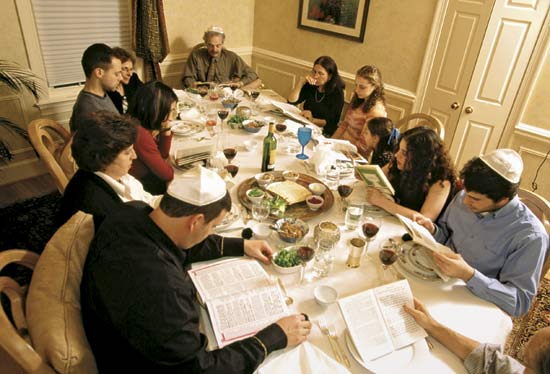
For generations, the great tradition of Passover has been all about missing the point. Too many of us get trapped into thinking that the main endeavor of the Passover holiday entails sweeping attics, vacuuming bedrooms, packing up half-filled bottles of catsup and shlepping boxes of dishes from the basement to cupboards emptied and scoured clean. And if we don’t turn our houses over according to strict Jewish law, we still manage to get caught up in the pressure of preparation. Our friends finish their Passover shopping the day after Purim and brag about three dozen matzah balls in the freezer. We worry about keeping the brisket from drying out and whether our sponge cake will rise as high as our mother’s used to do.
None of this is the main point.
The main point of Passover is that we were slaves in Egypt for four hundred years and God took us out with a strong hand and an outstretched arm. We are commanded to remember this narrative and teach it to the next generation, ensuring that the Jewish people will never forget our origins. We tell the story over and over about how we began as slaves to ensure that others do not suffer as we did. We marvel at all of the miracles God performed, plagues and parted seas, and we understand that we are surrounded by daily miracles. We are thankful to God for delivering us from Egypt and remember to be grateful for all the good that is ours.

Rabbi Yitz Greenberg writes about Passover in The Jewish Way: “By the magic of shared values and shared story, the Exodus is not some ancient event, however influential. It is the ever-recurring redemption; it is the once and future redemption of humanity.”
So, yes, I have been sweeping and vacuuming, packing and shlepping. I have resisted panicking over the masterful shopping of boastful friends but I am actually quite worried about the height of my sponge cake. How do I stay focused on the main point? First, I remember my own best advice regarding Passover cleaning and cooking mantra: “My best is good enough.”
Then, I remind myself that the physical preparation for Pesach is just a metaphor for the spiritual preparation with which I am meant to engage. At Passover, my soul is redeemed from the slavery of the everyday (think: calendars, iPhones, To Do lists, and unreasonable expectations). Once a year, in the month of Nisan, I remember that I am blessed with the greatest gift of all. I am free. I remember this truth every time I tell the story of the Exodus. And that is the point of Passover.
Wishing everyone a beautiful, freeing and meaningful Passover, Rabbi Paula Mack Drill
Restoration
“What is certain is that you love bringing things back to life. It is a wonderful feeling to identify the undermining factors, eradicate them, and restore something to its true glory.” Tom Rath, StrengthsFinder 2.0 (Gallup Press, 2007, p. 153)

Strengthsfinder 2.0 is a popular assessment tool for identifying and applying an individual’s strengths. The book is based on the premise that we should spend more time in our professional lives building upon our strengths than trying to overcome our weaknesses. Everyone loves the story of an underdog overcoming overwhelming odds to achieve, but that model of success is not usually the best application of our resources! The quote above refers to the person who possesses a “restorative” talent, the ability to resuscitate and rekindle the vitality of relationships. Indeed, institutions can be revitalized; relationships can be resuscitated. This can only happen, however, when the right “match” is achieved—when a restorer is brought into a relationship where restoration is needed.

As an adjunct lecturer at the Jewish Theological Seminary, I work with students who are preparing to transition into new professional settings. Among my goals is to help budding cantors and rabbis recognize their own strengths, and identify the professional opportunities where they will experience fulfillment and success, and feel valued for what they bring to the task. Not every available opportunity is the right opportunity for every candidate. In the moments of rejection, we learn about the nature of relationships, the needs of our potential partner, and our own strengths and talents.
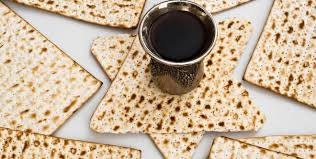
This week’s haftarah for Shabbat Hagadol, from the prophet Malachi, tells us that a day of restoration is approaching. The children of Israel seemingly stand back to back with God, too ashamed in their imperfection to face the Divine, perhaps anxious about the prospect of confronting their strained relationships. The prophet announces that God will provide a restorer in Elijah, one who will reconcile the open and eager hearts of parents and children to each other.
Passover, the season of restoration is once again upon us. Many of us are headed home at this time of year—children to parents, families to one another, even institutions to their missions–perhaps anxious about the prospect of confronting those with whom we have strained relationships. Not everyone is cut out for every task. Perhaps there is someone among us who is particularly “restorative” by nature, who will restore our hearts to each other?

Who among us is prepared to play the role of Elijah?
Chag sameach,
Rabbi Craig Scheff
Travels with Aunt Sheila
Would a visit to Europe be possible for me without mixed feelings and conflicted responses to being a tourist?

To celebrate a significant birthday and to visit my daughter Sarah, Aunt Sheila and I traveled this past week to Budapest and Munich. I stayed in touch with the family on What’s App, sending descriptions of the sights and the people (and the food!) and pictures of the Opera House, the Chain Bridge lions and Sarah and her boyfriend Sagi.
After Budapest, when Aunt Sheila and I arrived in Munich, I sent pictures of our adventure at the Hofbräuhaus and a description of drinking a beer and eating pretzels with young Australian backpackers, Meghan and Stephen. My son Josh responded to that day’s post, “How do you feel about enjoying yourself in Germany?”
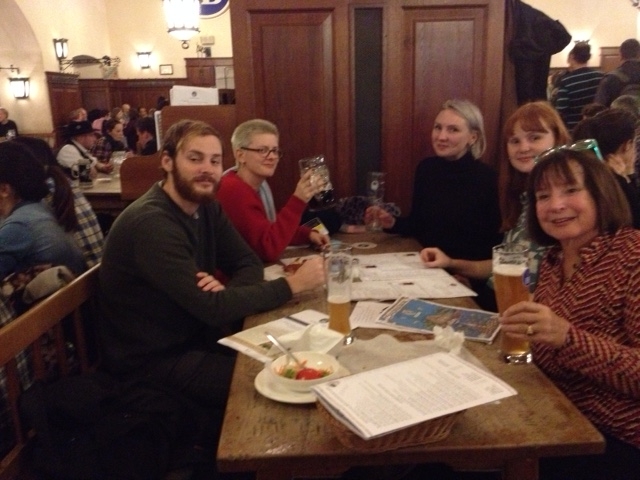
Josh’s question resonated because it had been sitting in me, just under the surface since the trip began. It did indeed feel strange to me, very strange. Since the upsurge in threatening and deadly anti-Semitic events in many European capitals, it is clear to me that too many are ready to forget and even negate the lessons of the Holocaust. But even without these foreboding times in Europe, walking the streets of cities culpable during the Shoah has always seemed fraught with anxiety to me.
“Your brother’s blood cries out from the ground to Me!” How could I eat a rugelach and drink a latte in the very spot where Nazis tormented and desecrated the lives of my people? But should I not allow new generations to be absolved of the guilt of their parents? Do I desire all of Europe to be a silent, sacred burial ground? Where in this whole world could I possibly go where the ground below my feet would not have a bloody story of suffering to tell?
And so I accepted the fact of dissonance.
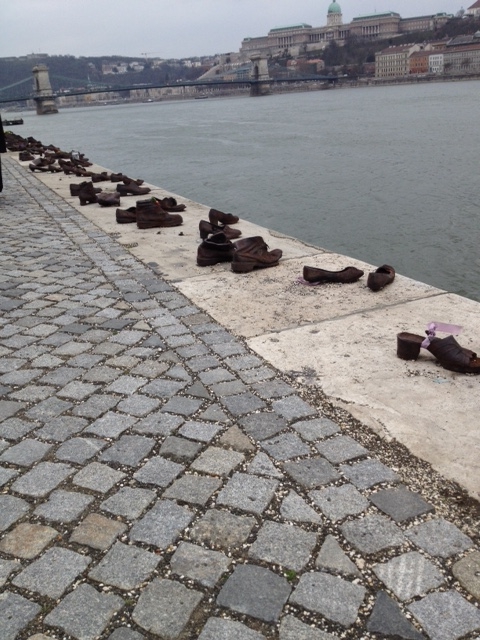
In Budapest, we enjoyed the view from St. Stephen’s Basilica and the thermal baths at Gellert. But we also read every plaque on every wall, judging its historical honesty. We toured the Great Synagogue and the Raoul Wallenberg Memorial, asking pointedly Jewish questions. We walked to the sculpture of shoes along the Danube where 8000 Jews were shot dead into the river by the Hungarian BRIGADE just before liberation. We stood in silence.

In Munich, we were charmed by the chimes of the Glockenspiel in Marienplatz and enjoyed the Museum of Modern Art. But we also traveled for the day to Dachau. Listening intently to the descriptions and voices of survivors on the audio tour, we walked every path, counting the empty outlines of barracks intended to hold 6,000 Jews and some political opponents and resisters. When the American Army liberated Dachau, 41,500 had been murdered and 32,000 living dead were housed there. Aunt Sheila wept during the documentary and I chanted El Maleh inside the Jewish Memorial.
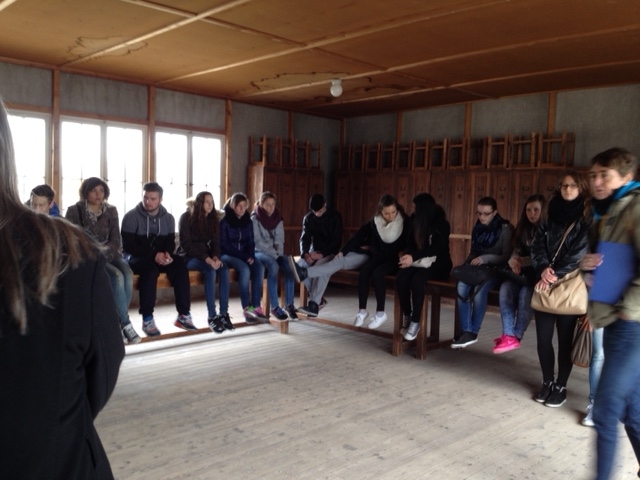

German student groups were with teachers and guides in great numbers. And inside the Maintenance Building that houses the museum, we turned a corner and suddenly met up with our “dear chums” Meghan and Stephen, the travelers from Australia. Aunt Sheila and I had to go to Dachau, we understood it as our obligation. But Meghan and Stephen chose to go to Dachau. When Aunt Sheila embraced them as long lost friends, I saw the way that their visit to Dachau redeemed the day.
People are capable of evil. Places like Dachau preserve the reality of that evil. And those who choose to understand the history of Jewish suffering in the Shoah will be our partners in fighting for the good.
When we got in the taxi to return to our hotel, the affable driver asked, “Did you enjoy your day?” Aunt Sheila answered, “It was not an enjoyable day, but it was an important day. It was a necessary day.”
Life is filled with conflicting ideas and emotions. To live a complete life, perhaps our job is not to avoid conflict but to learn how to live with it.
Thank you, Aunt Sheila, for a trip that taught me this lesson and so much more.

 Three Rabbis Walk Into A Shul
Recent Comments