Joseph and Anakin, children of grace
Long ago, in a galaxy far away…. The glue has once again been provided to connect the generations with one another. The themes are as eternal as they were before; the myths are as powerful as ever. The child within the oldest of us is awakened, and the wisdom of the ages enters the heart of our youngest.
These moving narratives are treasured by us, in part, because they imaginatively capture the metaphors that give expression to our truths. The battle between forces of light and dark, the struggle between our innate inclinations (the yetzer ha-tov and the yetzer ha-ra), the propensities we carry towards hope and despair—these most basic conflicts play out in the scroll and on the screen before our eyes in living color.
I admit that I am slow to admit that anything is coincidence. It is a gift that the newest installation of the Star Wars saga hits the silver screen as we are immersed in studying the portions of the Torah retelling the story of Joseph and his family. I can’t help but see the parallels between the narratives of Anakin Skywalker and Joseph.
Both boys discover at a young age that they have abilities that distinguish them from others. Both sense that they are destined for something greater than their stations in life. Both are sold into servitude. Both will ultimately rise up to be second in command of their respective empires. Both live with the loss of a mother and with separation from family.
Their paths, however, diverge due to the ways in which they confront their respective circumstances. Driven by the anger generated by his sense of loss and by the fear of losing those he holds dear, Anakin is drawn to the Dark Side. Joseph, on the other hand, recognizes that his gifts are but an instrument of God, to be used for the furthering of the Divine Will (also known as the Force?). He is moved beyond his selfishness and ego by his faith in the goodness of God and his trust in the desire of others to redeem themselves through righteousness.
Ultimately, Anakin redeems himself. It is a sign for all future generations that they, too, can overcome the Dark Side to choose a path of grace. Is it coincidence that the name “Anakin” can be translated to “child of grace”? (Okay, I made that up, using the Hebrew root for “Ana,” or Hannah, meaning “grace,” and the Germanic origin of “kin,” meaning “give birth to.” Thus, child of grace!) Joseph redeems himself as well, and teaches his brothers and all future generations that they can redeem themselves through acts of faith. The seemingly endless battle between good and evil is perpetuated by those who give in to anger, fear and loss. While I won’t see the new movie until next week, I am fairly certain that the narrative will remind us, during these troubling times, that our actions cannot be dictated by fear, and that our actions of faith and trust may sometimes give way to betrayal, but ultimately are the only way to forge a path towards redemption.
May the Force be with us,
Rabbi Craig Scheff
A Light in the Window in East Ramapo
“I don’t just wish there were solutions, I believe that there are solutions to the problems in this district,” Dr. Deborah Wortham, Interim Superintendent of the East Ramapo Central School District insists. She explains how she is building a team and finding solutions despite the enormity of the issues and roadblocks in her path.

She is greeting children in their schools every day and working on recognizing the strengths in the administrators and teachers. Every day she sends out a message of empowerment to every classroom in every school in the district. Building collaboration between the community, the schools and the families and their children is her goal. She says that a community is as strong as the education of its children, and she is working to ensure that the children receive the constitutionally guaranteed education they deserve. Dr. Wortham told us that she cannot start with one task and then move on to the next. The needs of the district require a full court press. And indeed she seems to be doing so during very, very long days. Even a hint of what she does in a day makes me feel dizzy.
Dr. Deborah Wortham sees her task as the Interim Superintendent as healing a broken district so that the East Ramapo Central School District can become a creative school system that leaves a legacy of greatness.
How does she do it? I watched her teach, acknowledge and cheer at a School Board Meeting that Rabbi Scheff, Deb Roth and I attended in November. I was amazed by her unflagging energy, but I did not understand the source of her drive.
The source of her strength, however, became clear to me after sitting next to her for a two and a half hour meeting with the Rockland Clergy for Social Justice.

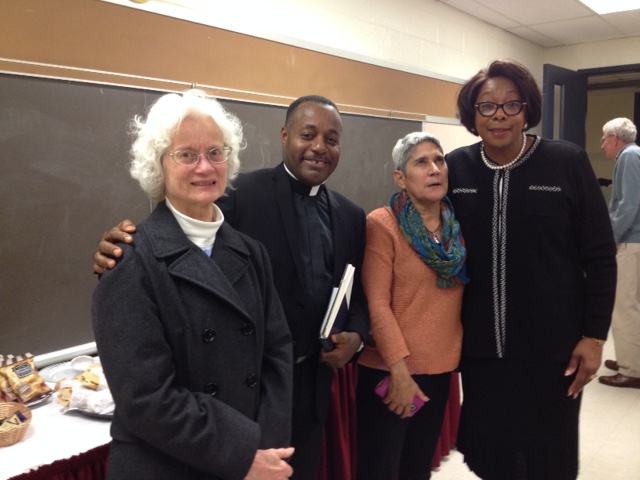
Dr. Wortham did not take a difficult position as Interim Superintendent because she wanted to leave her old job or was ready for a big challenge. She came to East Ramapo because she feels called by God to do this work, this daunting and seemingly impossible work. She told us that she makes no apology for her deep faith and close relationship with God. Her mission is to be what she calls an Educational Evangelist. I wanted to stand up and cheer when she described herself in that way. Dr. Wortham is fearless because she is using her blessings and gifts for the benefit of those who need them. For the four weeks during which she has been in her position, she told us, she has been filled with the grace of doing the work that God expects of her.
She listened to our concerns and responded to our questions, dedicating precious time to clergy leaders because she believes that the community must work together to heal and to repair.
On Sunday night, we will light the first candle of Chanukah, placing our menorahs in our windows to publicize the miracle.
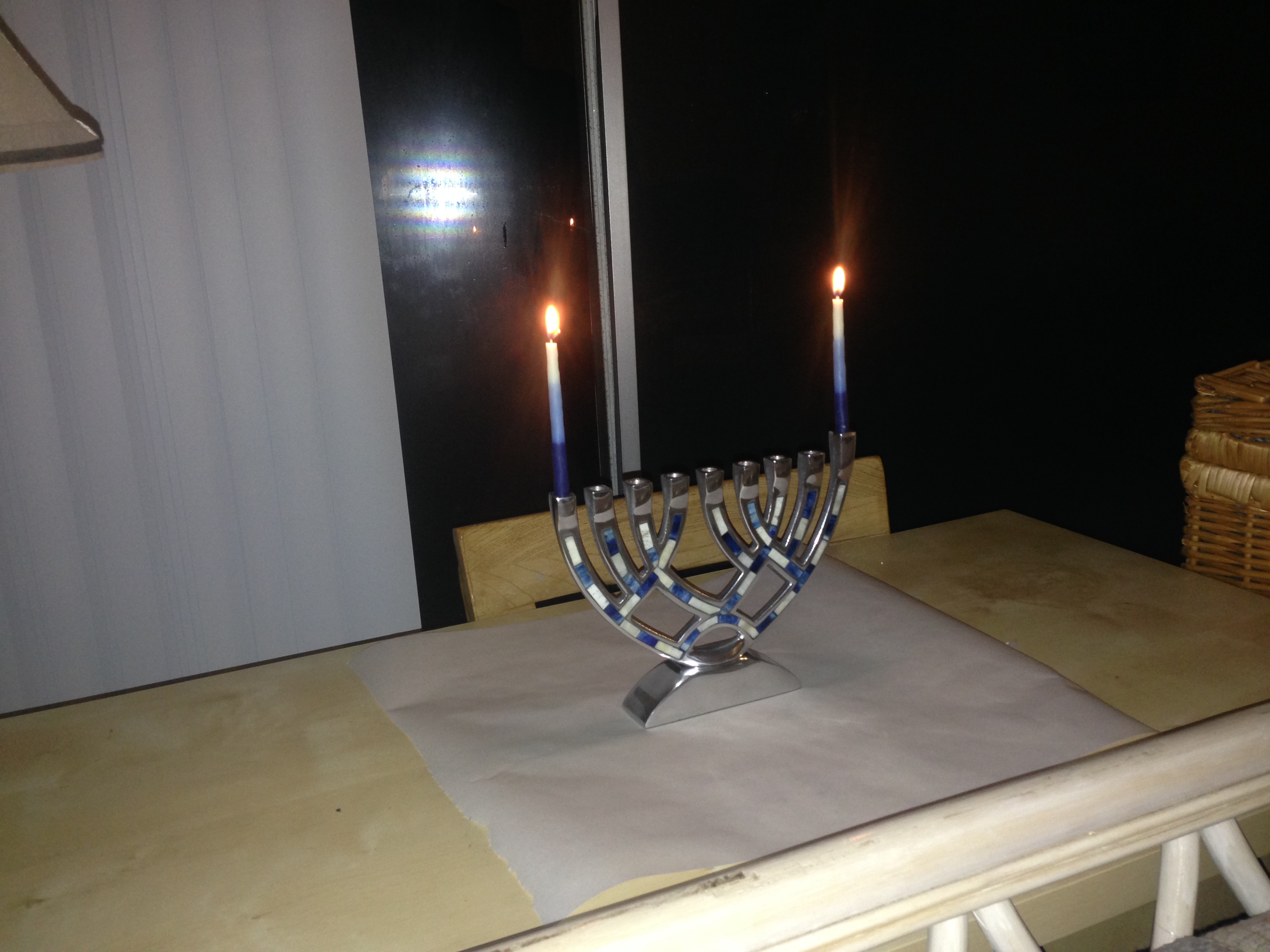
During the darkest time of the year when the days are short and the night feels endless, we cast our light outward to cheer and enlighten others. Dr. Deborah Wortham, it seems to me, is like one of those lights in the window. I pray that her energy and optimism stay with her as she continues on her mission of healing and education.

What can we do? We can continue the work of supporting and advocating for the children of ERCSD. We still need a full time monitor with veto power in the District. We still need a long range plan to overhaul governance in the District. And we can all roll up our sleeves and give time to the children of the schools.
To become a DOVE, a volunteer from OJC who helps teachers in the Early Childhood Center at Kakiat Elementary School, contact sallykagan@gmail.com. If you are able to organize congregants and friends who would serve as mentors to high school seniors in the District, contact me.
Happy Chanukah! Let your light shine!
Rabbi Paula Mack Drill
Days 3 and 4: Planting for the future
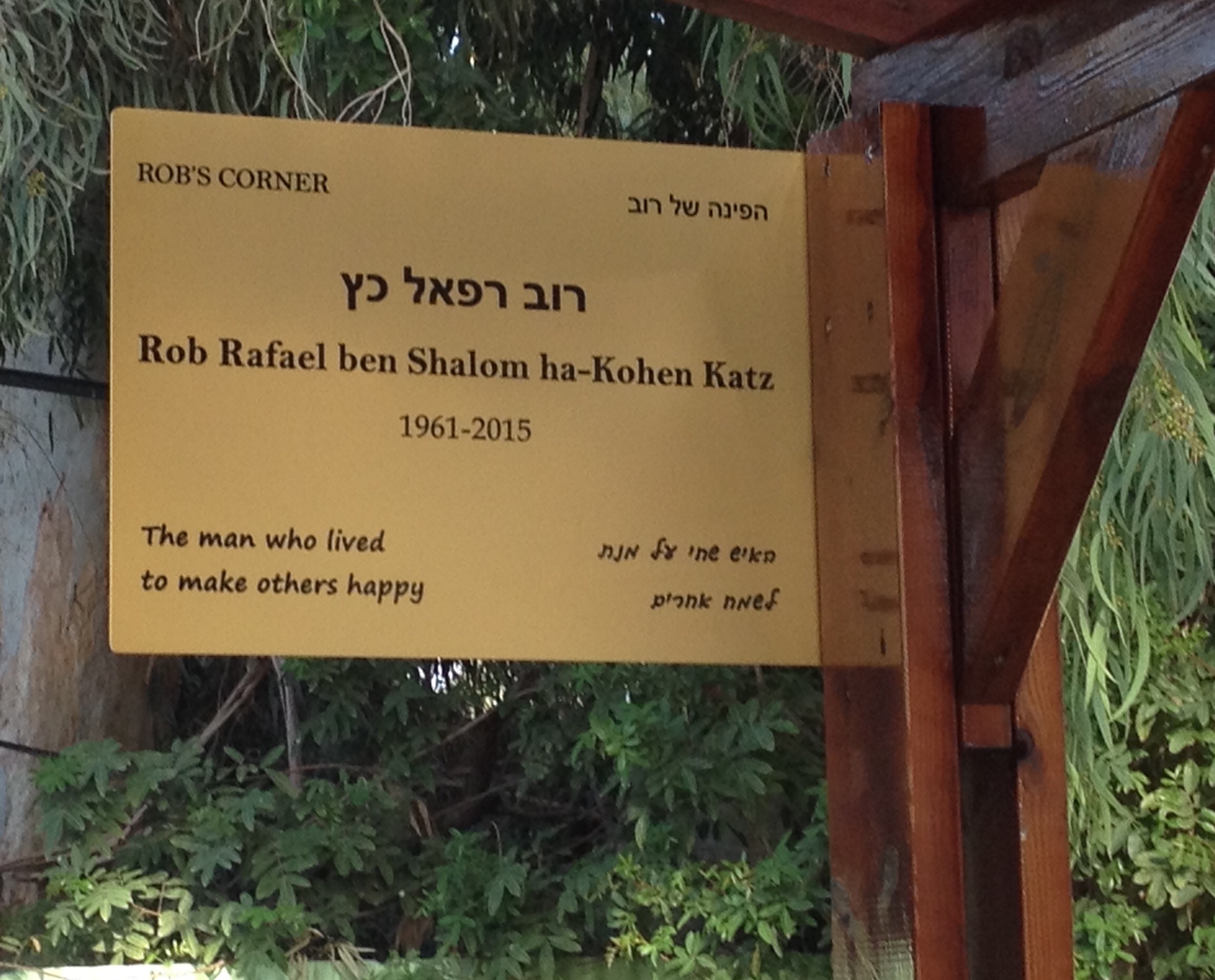
Day Three of our 10th annual mitzvah mission proved to be an emotional roller coaster. We returned to Ahava, anxious to finish our projects, determined to dedicate a final product at the end of the day. We worked hard and fast, skipping lunch. As we waited for the cement stools to dry and the tile mosaics to set, a young girl by the name of Efrat entertained us with her exuberant dancing, magnetic personality and charming smile. We danced and laughed as the final touches were completed. Finally, the work of our hearts and our hands was permanently memorialized. Efrat and her friends quietly stood with us as David Klein spoke of his son and Rob, and of the significance of our community shoveling soil together once again, this time for the purpose of planting. Two ficus trees now stand side by side, one in memory of Rob Katz and one in memory of Danny Klein. They will grow together and ultimately become intertwined. They will spring large leaves that will offer shade to those who seek shelter sit in “Rob’s Corner.” We charged the children to care for this corner of their lives, always remembering how they witnessed a group of adults sharing raw emotion, love, respect, comfort and care. We had come to Ahava to offer comfort, but in the end, amidst our tears, these children comforted us.


Driving into Jerusalem, we stopped atop Mount Scopus to see the city from afar. We stood next to Christian pilgrims who sang songs of praise. The Muslim call to prayer rang out atop their song, and we stood quietly in a tight circle for a moment to take in the significance of these three faiths in momentary peaceful coexistence. We then offered our own pilgrim’s prayer, thanking God for the ability to give of ourselves and appreciating the opportunity share the moment together.
Day Four began with a morning service at the Masorti Kotel. We were completely alone in the archaeological park. We celebrated several “firsts” as Miriam led Shacharit, Linda and robin read Torah, and Lesley received her first aliyah. Once again, the ability to pray together and stand side by side at the wall was not lost on any of us. We drew together in a circle of prayers for peace, comfort, healing and gratitude. The sentiments pulled us closer to one another, and the prayer became one.

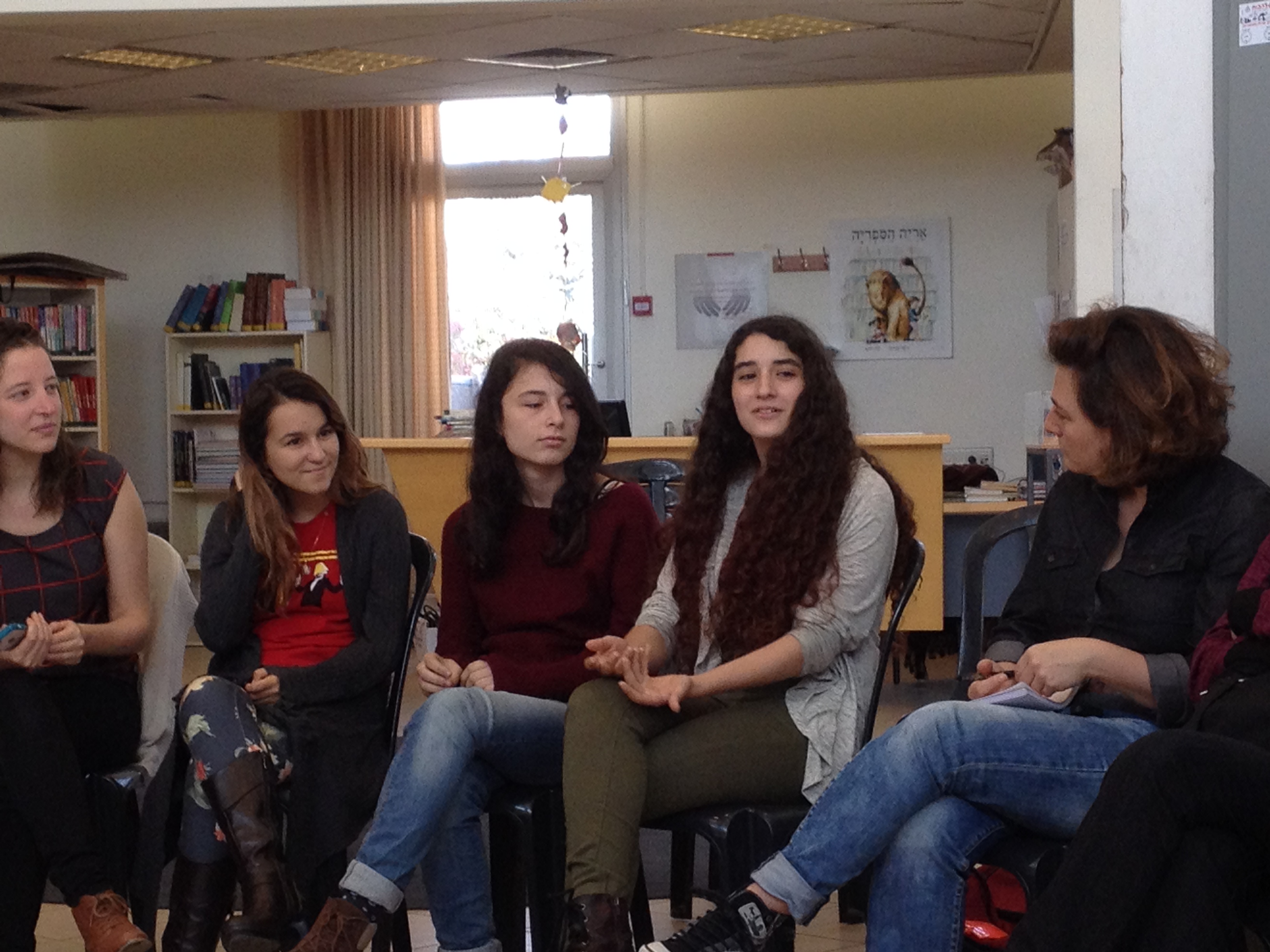
The final stop before our closing lunch was Hand in Hand, a school in Jerusalem where 600 Israeli Arab and Jewish children learn together. As the children grow through their high school years, they engage one another openly in confronting the difficult challenges that their conflicting national narratives present. They come to recognize that hearing each other’s personal family narratives, and appreciating each other’s suffering, is the most important lesson if they are to be able to move forward constructively. They recognize that there are many extremists (and not-so-extremists) from their respective communities who don’t support their decision to coexist in this fashion. A year ago, the students saw their school set afire by Jewish arsonists. Graffiti on the walls of their school is not uncommon. Their response: We may disagree about the past, but we have a shared future whether we like it or not. The teens with whom we met were not idealists; they recognize the many challenges they face. But they are determined–even in a time of fear and anxiety–to continue living their shared lives. We thanked them for their courage and determination, and we prayed that their glimmer of hopefulness would carry them bravely into the future. Perhaps their voices will one day proclaim peace in the land.
A final lunch gave each of us the ability to reflect on what we had accomplished and on the gifts we received from one another and from being the community that we are. Due to the intentions we bring to this experience, our circle is one that is able to expand easily, and to welcome those who are similarly committed. We invite you to join us, next year in Israel.

As I finish writing this entry, I am watching news about 2 more attacks today, one in Tel Aviv this morning and one in Gush Etzion this evening. The second hits closer to home than any of the attacks thus far. It is suddenly harder to leave than it was before. I want to remain in a place of hope, and I want to do my part to bring hope to others. And I don’t want to have to wait until next year to do it.
Perhaps Mitzvah Dy this Sunday back at the OJC will restore a measure of the hope we have felt all week long.
L’shalom,
Rabbi Craig Scheff
Day Two is a day for love
We introduced nine newcomers to Ahava this morning, including 4 Israelis. Yoav, our good friend and executive director, proudly led the group around the grounds of this residence for at-risk children. The group met one of the foster families that cares for thirteen children between the ages of 6 and 17, and was warmly welcomed by a group of Israeli lone soldiers who have come to live at Ahava for life-skill counselling. They somberly walked through the rooms of the emergency shelter, where fifteen children are given intensive therapy to address their traumas. They met one girl who only weeks ago witnessed her mother’s murder at the hands of her father. These are the harsh realities, they learned, that serve as the motivation for the loving and supportive framework that Ahava attempts to provide. Finally, they saw the many projects of OJC’s past mission participants and financial supporters.
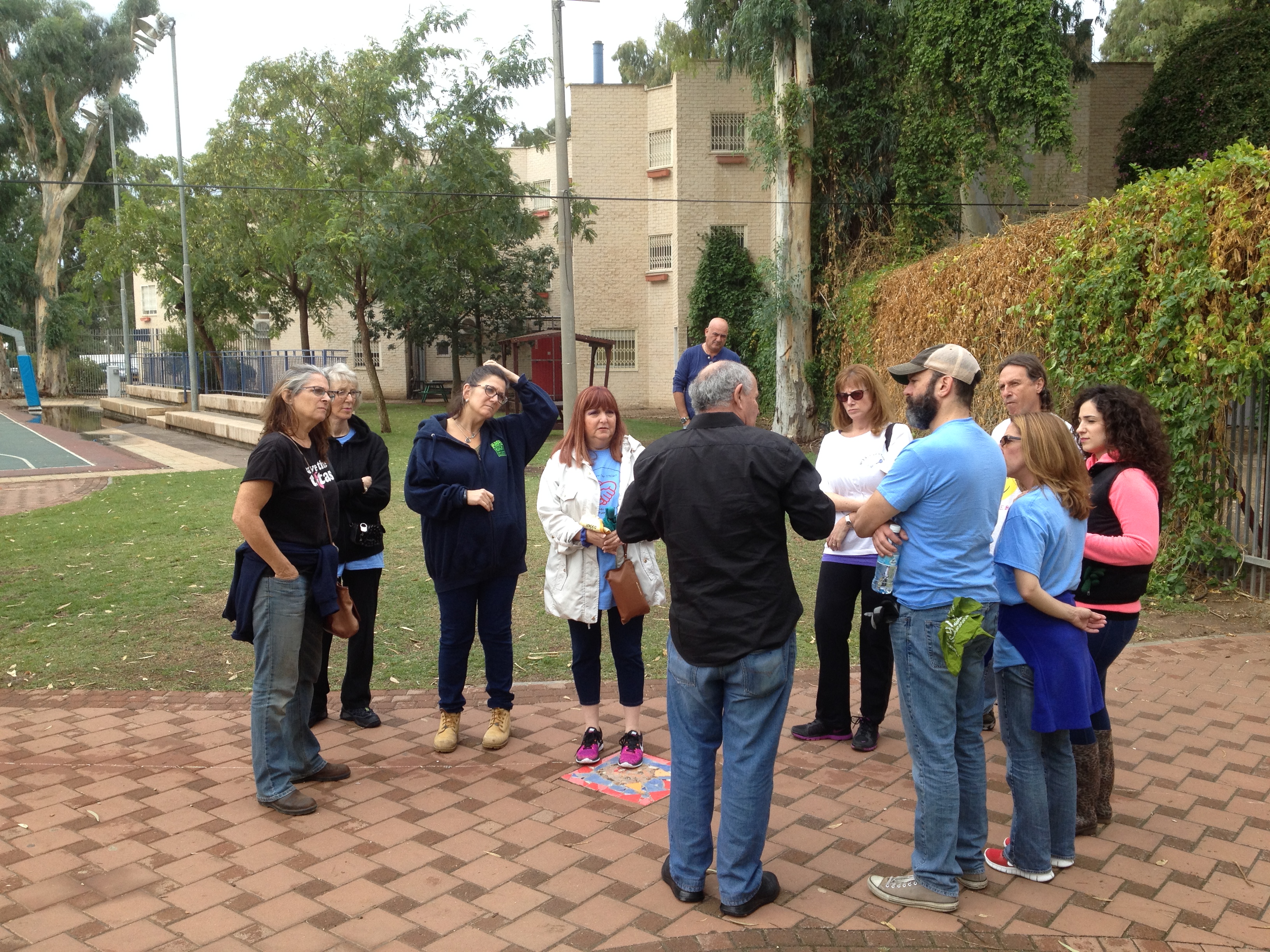
Meanwhile, the rest of our group was getting started on the projects that would occupy us today and tomorrow. In addition to painting the playroom and stairwells of the emergency shelter, we created “Rob’s Corner,” an outdoor meeting and relaxation area to be dedicated in memory of Rob Katz, z”l. Using large tires covered in a metal netting, we poured and plastered cement around the tires to create a seating area. We fashioned tile mosaics that will be set into the cement structures tomorrow.


In the evening, the children’s band and choir entertained us in song and dance, and board members and staff expressed their appreciation for our ten years of service. In truth, we owe them so much more for the opportunity to give a bit of ourselves to their herculean–make that Godly–effort. It is so humbling to be in the presence of these teachers, counselors and civil servants who are saving lives and repairing damaged psyches.

Tomorrow, we finish our tasks, and we are off to Jerusalem. May we leave a little more peace in our wake, and may we arrive in peace to our destination.
B’Ahava,
Rabbi Craig Scheff
It was evening and it was morning
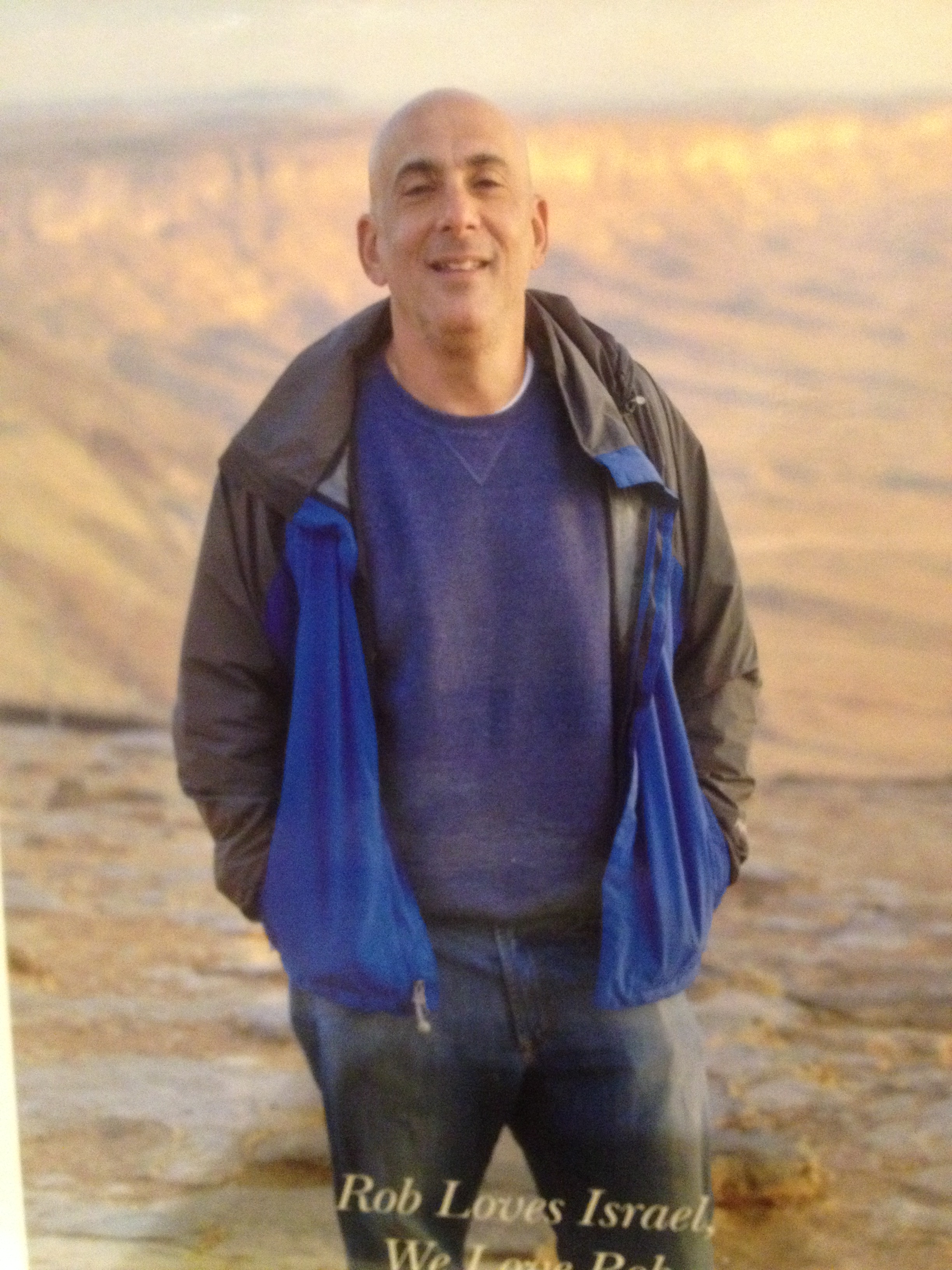
Day One of our 10th mitzvah mission to Israel began officially with a dinner. But this dinner was unlike any other I have shared on our mission before. We drank a toast and sang happy birthday to a man in Rob Katz who inspired us, modeled generosity, and dared each of us to move beyond our comfort zones. This would have been his 54th, and he would have loved to share it, as he did each year for the past eight, in Israel. We shared our favorite memories and we dedicated ourselves to continuing his legacy.
After far too late a night for some of us who caught the Giants-Patriots game at a local bar, we were up early to daven on the beach and head for South Tel Aviv. There we met Felicia, a woman who came to Israel from Ghana twenty years ago. Today, she and one other person were caring for 45 preschoolers and babies, children of Sudanese refugees. They greeted us with easily offered hugs and the excitement of anticipating a treat that comes along with visitors. We carried some,and led others by the hand (and even chased after a few!) as we accompanied them several blocks and down busy streets to small park under a porous tent. The children burned energy playing, and suddenly the heavens opened. First we were drenched in the rain, and then came the hail! Small marbles of ice bounced all around us. Some of the kids held us tightly to stay warm; others ran from under the leaky tent to dance in the icy shower. Our bus finally came to the rescue, and we loaded the children onto their coach to return them to their over crowded playroom. Leaving them was the low point of the day for many of us. Several of us committed ourselves to a return visit next year.

As we rode to our next stop, we wrestled with the conflicting realities Israel faces in remembering its roots as a safe haven for those escaping persecution and in wanting to preserve a healthy economy, a strong defense, and the Jewish character of the state.
This conflict was further complicated by our visit to the Rabin Center, an exhibit dedicated to the life and death of Prime Minister Yitzhak Rabin. Once again, we were bombarded by images of an Israeli society struggling to pursue peace while negotiating among its own citizens and with its neighbors for secure and defensible borders for all.

Dinner brought us to Zichron Yakov and the rabbi and leadership of Kehillat Ve’Ahavta, our new sister Masorti community. The warmth and comfort with one another followed quickly, and we began brainstorming ways by which our communities can build a lasting, supportive and mutually beneficial bond.
Until tomorrow, shalom to us all,
Rabbi Craig Scheff
Taking Action to Remember
“I know I’m not the best person socially. I know I’m not. Asperger’s has this tendency to make people who have it not the best people socially. I can only be one person – me.” Danny Klein wrote these words in one of the many journals he kept in high school and college. In April 2015, Danny committed suicide.
At our Na’aseh program last night, Danny’s courageous parents shared these and other words with fifty OJC teens. As part of a learning unit entitled “I am Enough,” we were learning about the inclusion of people with Asperger’s, what is today referred to as people on the spectrum.

Five years ago, Danny attended every Tuesday evening at Na’aseh. Often wearing a cool hat with earflaps that he himself had crocheted, Danny was an active participant. Kind, generous, and social, Danny wanted to be in the midst of whatever was happening. But unless his older brother Jared was at Na’aseh that night, Danny was never actually at the center of things. Danny was never excluded or teased or bullied. He was always tolerated. Last night, Rabbi Craig Scheff told the teens that tolerance is not good enough. We taught the teens of the OJC the value of inclusion.
Danny’s mom Judy explained all about Asperger’s, how it shaped Danny’s life and affected the entire family. Asperger’s is primarily a communication disorder that manifests as having difficulty with the back-and-forth flow of conversation, reading non-verbal cues, and understanding sarcasm. Judy told the teens, “What I saw was a kid who desperately wanted a circle of friends, who had so much love inside to give, who was prepared to be the best friend you would ever want… I saw a kid who held it together all day at school and then came home and asked me to help him figure out what was going on in social situations that he didn’t understand because people didn’t always say what they really meant.”
Judy concluded her remarks, “When I started typing this on my iPad and autocorrect didn’t recognize “Asperger’s” yet, it corrected to ‘as perfect’. Actually, my iPad was right. Danny was just as perfect and as imperfect as every one of us, just another good kid, and every good kid deserves friendship.”
How do caring adults teach teens the necessity of going beyond their safety zones to include others when every teen himself or herself is struggling with finding a place? We offered them the opportunity to listen, ask questions and participate in a variety of learning experiences. The Klein family’s participation was at the core of their ability to feel safe asking and processing the evening.
After Rabbi Scheff and I framed the evening and Judy introduced Danny’s story, I had the privilege of interviewing my friend Zahava Finkel in front of the group. Zahava is a 29-year old woman with Asperger’s who told her story with honesty and humor.

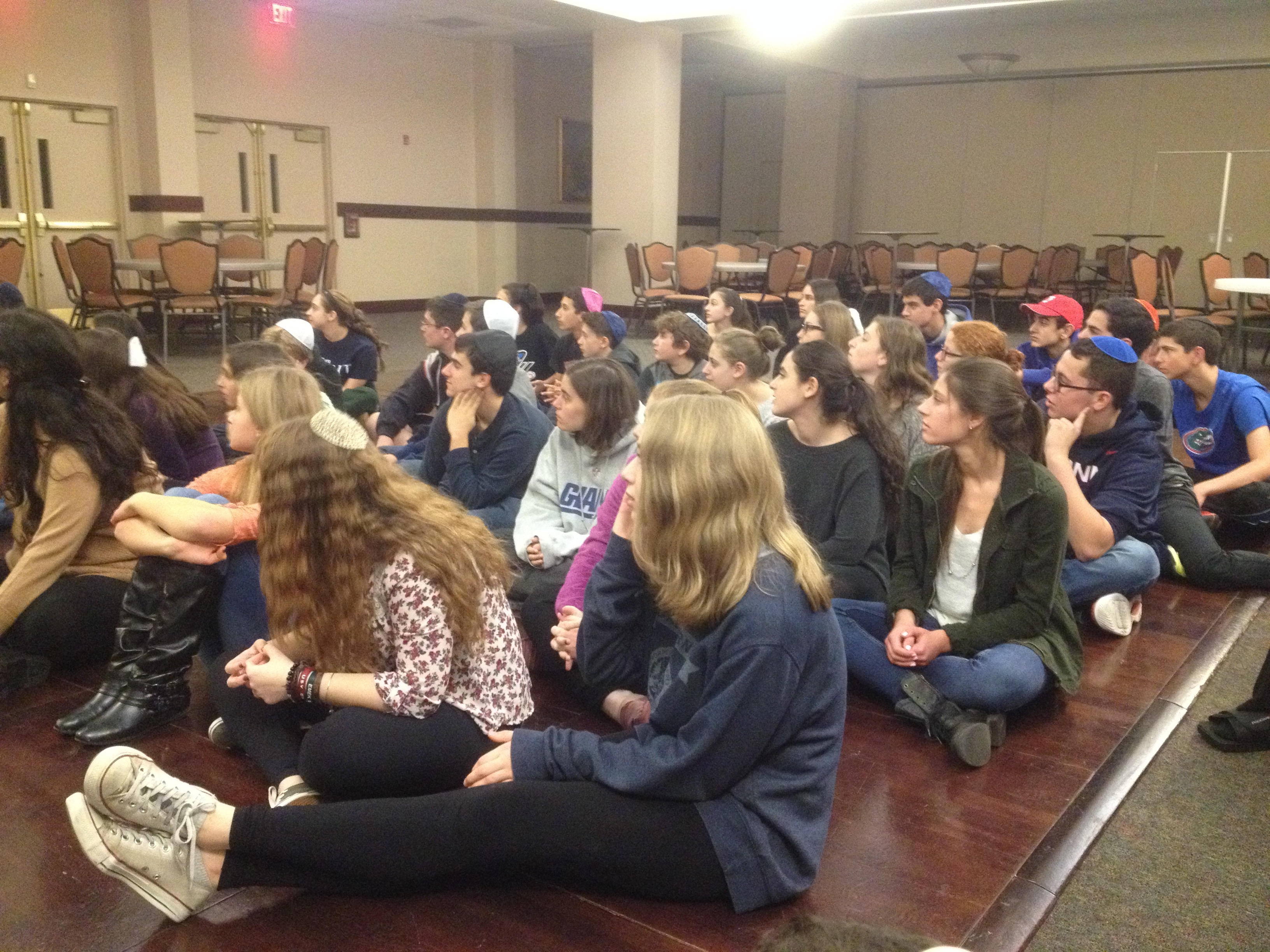
She and I facilitated an activity that she brought to our program. Everyone wrote their name on a piece of masking tape and put it on their shirts. Zahava then read statements that began with “I have been made fun of for…” and finished with “the way I look” or “my athletic ability” or “asking lots of questions when I don’t understand.” If a sentence rang true, a piece of tape was torn off. One teen said, “Every put-down diminishes our sense of who we are.”
In small groups, we considered Danny’s own words, allowing each teen to process the difficulties and triumphs that were Danny’s too short life.
When showed an interview of Danny with his psychologist, Youth Director Sharon Rappaport fielded questions from the teens that were answered by Danny’s parents and brothers. I was reminded of what the evening was really about when one teen asked, “What did you love about Danny?”
For me, the most important take away of the powerful evening is the generous spirits of the Klein family. They are experiencing an unimaginable loss and their grief is palpable. But all of us who love them watch in awe as they channel that sorrow into activism. In Danny’s name, they are determined to make a change in our world so that people who struggle as Danny did will have champions among their peers.
At the close of the night, Judy told our teens, “I know that you are learning about what it means to say ‘I am enough’ but I want you all to know that you aren’t just enough. You are all way more than just enough.”
May Danny’s name always be for a blessing.
Rabbi Paula Mack Drill
Hello and free will; goodbye and fate
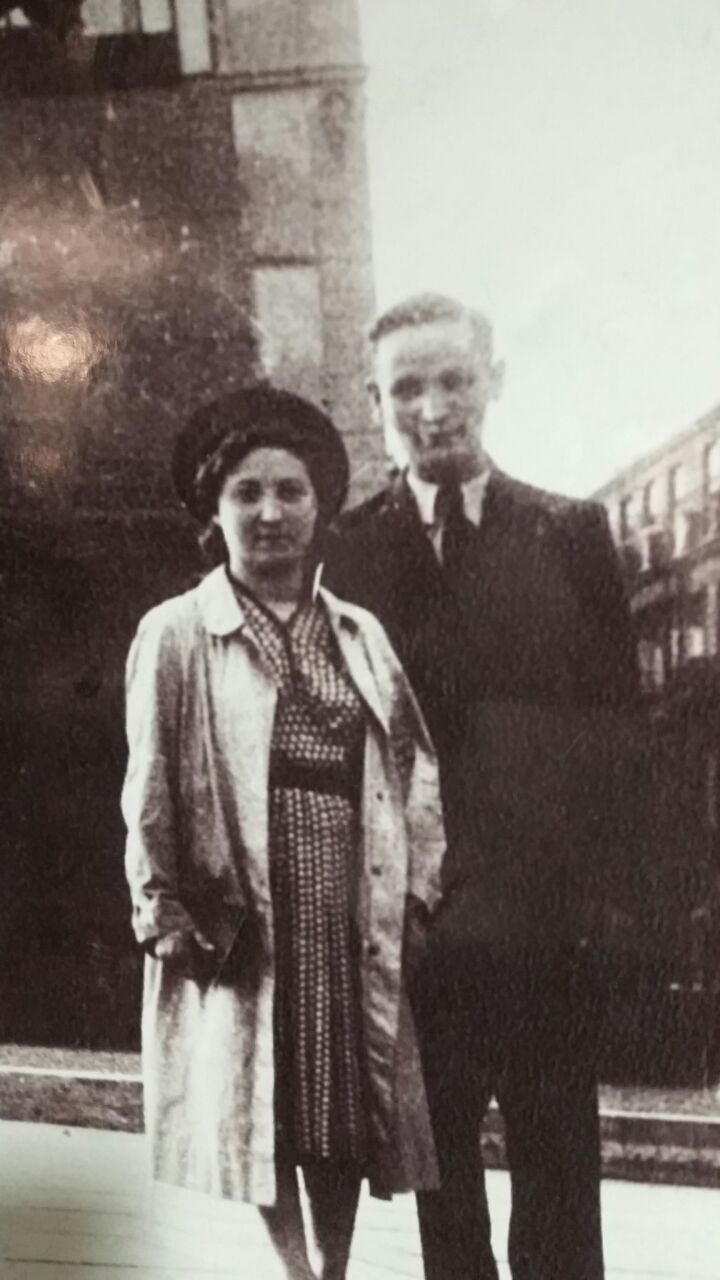
Despite hearing the call, not everyone up and left home. My grandparents were among the lucky ones. They heeded the call, though they did not know where their journey would take them. That decision would ultimately save family members and the generations that would follow. If Israel and Sonia had been told in that moment that they would one day number like the stars, they might not have believed you. Today, as my grandfather once again shared tidbits of his story with me, he recounted the many times he cried thinking that his world was coming to an end: a father losing his job; a young boy sent off to a distant city to attend yeshiva; a journey with wife and brother in tow out of Poland; life in the displaced persons camp; an arrival in the United States. There were no guarantees of a happy ending, no assurances of survival. Yet, in retrospect, my Zeidy believes that none of the blessings he now enjoys would have been possible without those moments over which he cried.
Faith is not synonymous with the belief in miracles. Just ask Abraham and Sarah! Their faith was not blind and without question. They did not rely on Divine Providence alone to make the future promised them come to fruition. So much of their fate was dictated by the choices they made and the actions they undertook, sometimes at great peril to themselves and their progeny.
My grandparents don’t assert that God chose to grace them above anyone else. They don’t believe that God interceded to save their family from the harm that befell so many others. But faith in the power of working hard, loving well, doing good and taking responsibility for one’s decisions–and consequences thereof–can certainly bring one closer to the belief in a Divine plan. At least it has for them.

The tension between our beliefs in Divine Providence and our own free will is constantly played out in the text of the Torah and in the narrative of our lives. Is God testing Abraham and us, leaving matters in human hands? Or is God the all-knowing One who is manipulating us as part of a grander scheme? I don’t have an answer to this question, but this much I know: If my grandparents’ lives were a matter of God’s intervention for some greater purpose, I have thanked God many times over. And if their journey has been one of their own making, with God kvelling all the while, I hope their legacy will be instructive for many generations to come.
As for my grandparents and me, every “hello” is more precious than the last, and every “goodbye” is more difficult. So I have chosen to resolve the tension between fate and free will, between Divine plan and human agency, as only a grandson of Yisrael ben Avraham v’Sarah can: May we extend every “hello” as an offer of peace, a moment of appreciation, and an opportunity to change someone’s world for the better; and may we express every “goodbye” as a prayer for peace, a moment of reflection, and an invocation of God’s greater plan in our lives.
Hello, goodbye and shalom,
Rabbi Craig Scheff
The Soul Remembers
During eight years of social work in a Jewish geriatric center, I gravitated to Barnhard Pavilion for residents who lived with dementia. I sat with elderly men and women, talking quietly, feeding them breakfast or singing show tunes from the 1950s. Most often, they remained locked in their own diminished world. But if I sang “Shalom Aleichem” or brought a lulav and etrog to shake or lit Chanukah candles, the frail resident would come alive in that moment, often joining in the words of the song or the blessing. Those words would emerge from a deep, hidden place. I call that place the soul.
Zachor! We are commanded as Jews time and again to remember. Jewish ritual, study and celebration are anchored in national and personal memory.
Can Jews who live with Alzheimer’s or some other form of senility still participate in Jewish life? What happens to the souls of Jews whose memory has been robbed by dementia of some kind? And more importantly, how can the family and friends of a person who has lost some or all memory find their loved one within the person before them?
We are commanded “You shall rise before the aged and show deference [v’hadarta] to the old.” (Vayikra 19:32) Poet Danny Siegel plays on the Hebrew word v’hadarta and translates this verse: “You shall rise before the aged and allow the beauty, glory and majesty of their faces to emerge.”
The answer at a theological level seems to be that the soul of a person is still within. Soul is somehow separate from intellect, emotion or memory. The pure piece of God implanted within every person remains as long as breath remains in the body. In rare and gentle moments, the soul shows itself.
The answer to the question about coping at a personal level, however, is very different. Theology does not help when long, painful days of coping with a loved one’s losses are our reality. A fleeting moment in a heartbreaking flow of hours, days and weeks is not enough to sustain most of us. The mourning process is excruciating for those who have lost a person even as that person sits before them. And yet, I still encourage families to seek those moments when the beauty and majesty of the face emerges, the moment of soul.
My Nana could not remember which grandchild I was during the last three years of her life, but she would snap to attention when I asked her for the chicken soup recipe that delighted her family every Friday evening at her Shabbat table. The Cantor who lived on Barnhard Pavilion for four years could not tell me where he had lived before the nursing home, but he could lean back in his chair and sing Kol Nidre as if he were in his sanctuary once again. I felt privileged to recognize their souls in those moments.
My friend Charlotte Abramson’s daughter Adena wrote a a prayer-poem for Yizkor this year. Adena wrote about her father, Rabbi Robert Abramson, my friend and teacher. I share it here with Adena’s permission, in the hope that it will bring recognition and succor to those of us coping with dementia in a loved one and that it will encourage all of us to reach out today to someone who is living the long grieving process of a family member of someone with senile dementia.
You are still here, but I remember.
I remember when your mind was connected to your voice.
I remember when your mind and body acted as one.
When with two words you could cut through all the noise or cause the room to burst in laughter
When your eyes sparkled green and were clear with focus.
Is it too early for me to start remembering?
You are still here. Your heart still beats. You are kind.
Do you experience joy?sadness? fear?
Is it still there?
So, I remember because you cannot, and by doing so, I feel all.
Adena Abramson


With blessings, Rabbi Paula Mack Drill
Here comes the rain again
The Talmud teaches that those who don’t mourn ancient Jerusalem’s destruction will not merit rejoicing with her at her redemption. I have always understood this statement to mean that we can only truly appreciate the greatest joys in our lives if we have truly engaged with the sorrows in our lives. As the two extremes seemingly travel together within us, our saddest moments are buoyed by the knowledge that we have known—and will know again—pure joy. Similarly, our happiest moments are tinged with the knowledge that such joy can’t last forever, and that we will no doubt come to know sadness again.
One of the ancient rituals of the holiday of Sukkot is the celebration of water drawing and libations that took place in the time of the Holy Temple. The Talmud describes this ceremony as the epitome of joy, as water would be drawn from a well and poured over the sacrificial altar. As the rains fall today, on this third day of the holiday, we have the luxury of moving indoors; but our prayers for rain at this time despite wanting to be outside in the sukkah underline this sense of anxiety with which we live. We don’t control the weather—no matter what Rabbi Drill tells you about her powers—and we are dependent on a force beyond our control to bring just enough rain to be a blessing, a source of sustenance and joy. The same source of that joy, however, can also be a source of destruction and sadness. When it is time to draw from the well, there is no guarantee the well will be filled. We want to find the well filled when we need it, but not at the expense of the joy that is meant to accompany this holiday.

I liken this well to a well that exists within each of us. That well holds all our love. It is filled by how much love we give, and by how much we allow ourselves to be loved. In our times of greatest celebration, that love is easily drawn and poured out atop our offerings of joy. And in times of our greatest sadness, that love is similarly drawn up from the well, to be poured atop our altar of tears. Only those of us who have drawn from the well in sadness can truly understand what it means to draw from the well in joy. And only those of us who have known such complete joy as to cry in happiness can fully appreciate the profound nature of our loss.
To paraphrase a line from the movie Parenthood (the original with Steve Martin, not the TV series), we must choose whether we want our lives to run like a rollercoaster, with all its exhilarating highs and frightening lows, or like a merry-go-round, never really getting anywhere. Jewish living invites us to ride the rollercoaster–to be exhilarated and frightened, joyful and sorrowful, in the same breath.
May we be comforted in knowing that the feeling in the pit of our stomach is simply a wellspring of love.
In gratitude for your friendship,
Rabbi Craig Scheff
Being Mortal
Thank you to so many congregants, family members and friends who have responded in phone calls and writing to my Rosh Hashana sermon, anchored by Dr.Atul Gawande’s deeply affecting book, Being Mortal.
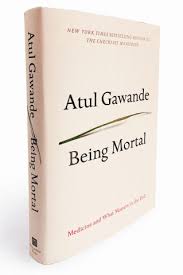
In the days since Rosh Hashana, many of you have shared your stories, struggles and experiences of deep understanding. And many more of you have asked for assistance with beginning the difficult conversations about what our lives mean to us. On Rosh Hashana I asked us to consider how we want to face the end of our lives if we are blessed with the opportunity to have choices. I asked us whether we know the true choices of those we love.
I share here a synopsis of my teaching and the links to the resources that I mentioned in the sermon.
In the experience of family members dealing with the inevitable dying of an elderly or seriously ill loved one, there comes a time when they recognize at some level that they are up against the unfixable. If they are blessed or wise or very well versed in matters of life and death, however, the unfixable does not have to be the unmanageable.
Gawande’s transformative book is filled with studies and anecdotal evidence about the astounding intersection of medicine and dying in modern society. He writes that scientific advances have turned the processes of aging and dying into medical experiences, matters to be managed by health care professionals. Gawande believes that the medical world has proved alarmingly unprepared for helping people understand death. His book is filled with stories of heartbreak and loss and dying. But each story is most of all about triumph – triumph due to the recognition that we are all mortal. Being mortal means that we are not immortal. It means that all of us will one day die.
As I prepared my sermon, believe me, I understood that mortality can be a treacherous subject. Listeners might be alarmed at my talking about the inevitability of decline and death. No matter how carefully I framed my words; for some, the topic would raise the specter of a society ready to sacrifice its sick and aged. But here are Gawande’s words that encouraged me to take up this topic despite the risks of discomfort or fear. He wrote: What if the sick and aged are already being sacrificed – victims of our refusal to accept the inexorability of our life cycle? And what if there are better approaches, right in front of our eyes, waiting to be recognized?
Gawande’s book, to me, is a very Jewish conversation. Rebbe Nachman of Bratzlav wrote: Kol haolam kulo gesher tzar m’od, v’ha-ikar lo l’fached klal. “All of this world is just a very narrow bridge and the main thing, the essence, is not to be afraid at all.” Perhaps that narrow bridge is meant to teach that between birth and death, there is just a narrow passage, like grass that springs up in the morning but is gone by night and no one can tell where it grew. That bridge is the human condition. We move from birth toward death every moment. So – do not be afraid. Rather, walk confidently and solidly and powerfully on that bridge. Without fear, we can enjoy the view.
Do not be afraid at all.
What is required is courage. We require courage to acknowledge what we all know to be true, and then, most daunting of all, the courage to act on the truth we find. The wisest course is so frequently unclear. In conversations about mortality, it is important to decide whether our fears or our hopes are what should matter most.
There is no right or wrong way for everyone. The only correct way of facing aging, illness and dying is the way required by each individual in his or her unique situation.
The difference between a good death and a hard death hinges on whether someone’s wishes were expressed and respected, whether they’d had a conversation about how they wanted to live toward the end. While 90% of Americans think it’s important to have such conversations, only 30% of us have actually had these conversations. We can change that by bringing the people we love to the kitchen table to have the conversation. And we can do this before there is a crisis rather than in the I.C.U. So what stops us? We don’t talk with our loved ones, we don’t talk about our own desires because “it’s too soon.” But it’s always too soon … until it’s too late.

Throughout the liturgy of this High Holy Day season, we Jews practice thinking about our mortality. Who shall live and who shall die? On Yom Kippur, we will abstain from food and drink, playacting a mini-death in order to understand the necessity of teshuva, repentance. Our rabbis knew what they were doing, insisting that the theology of each new year must address the meaning of our lives which can only be done with an acknowledgment of the finitude of these lives of ours.
The question remains: How do we have these conversations?
If you choose to begin the conversation with your doctor, consider the Dear Doctor letter devised by a team led by Dr. VJ Periyakoil, Director of Palliative Care Education at Stanford University School of Medicine. Here is Dr. Periyakoil’s letter that can help in this conversation.
I advocate that the conversation also take place in your families and in your circles of intimate friendships. Conversation Starter Kit created by The Conversation Project avoids being a technical medical checklist for the dying in favor of a careful discussion guide for the living. The kit asks what matters to you, NOT what’s the matter with you. http://theconversationproject.org/starter-kit/get-ready/.
Rabbi Scheff and I are available to you to help begin the conversations. Contact us at Rabbi.Drill@theojc.org or Rabbi.Scheff@theojc.org. Be in touch if you would like to see the full text of my Rosh Hashana sermon.
If Rabbi Nachman was correct, and all the world is just a narrow bridge, I pray that all of us are able to make meaning of our short walk across it. It begins with acknowledging the bridge, not to diminish life, but rather to value it.
Shana tova tikatevu v’techateimu, May you be written and sealed for a good new year,
Rabbi Paula Mack Drill
 Three Rabbis Walk Into A Shul
Recent Comments