When Asked How I Am, What Do I Say?
“What am I supposed to say when people ask how I am?” I complained to my Israeli friend, “I have no idea how to answer that question these days. Am I supposed to say I’m fine? Am I supposed to say I am not fine?”
“In Israel,” he said, “we are answering, ‘K’mo kulam’,” like everyone.
How are you? Like everyone.
I tried it on for size for a day. I wondered if it was fair for me to say that my feelings were like everyone’s feelings. Here in America, I am on the mezzanine, not even in the orchestra, and certainly not on the main stage.


My heart is broken regarding the massacres and kidnappings of October 7. I worry about the IDF soldiers in Gaza. I feel hopeless about the mounting number of casualties and deaths of Palestinians in Gaza. My anxiety is high regarding the unleashing of virulent antisemitism here in America and around the world.
I don’t sleep well at night. I wake up from the middle of horrible dreams.
But my situation is not the same as my cousins’ whose four adult children are all serving on the front lines. I cannot compare myself to my son-in-law‘s mother whose entire community, her entire personal and professional world, was devastated on October 7. I am not my dear friend who had to move to safety from her home and whose son and son-in-law are both serving in the IDF at the same time.
And although I teach that there is no hierarchy of suffering, I know that my suffering is not the same, and can never be weighted as heavily, as those families whose loved ones have been murdered and abducted.
So I faltered for a couple of days when people asked me how I was.
Now, it is true that a rabbi in a community carries the weight of a congregation’s fear and concern. We are looked to for optimism and hope when we might feel quite lacking in those categories ourselves. We are asked questions for which there are no answers.
But still, I did not feel that I deserved to say, “K’mo kulam.”

And then one Friday evening at minyan, I led the community in the traditional words we say to a mourner. L’cha Dodi ended and we turned toward the man in shivah for his mother. We said, “HaMakom yinachem etchem b’toch sha’ar avalei Tzion v’Yerushalayim.” May God comfort you among all of the mourners of Zion and Jerusalem.
We say these words so often, counting on them to offer comfort to those who are bereft. On this particular night, I paused and considered their intention. I did not say these words to tell this particular man that his sorrow was exactly like all other Jews who were mourning. I meant that he is not alone in his grief. As a Jew, he was one of a great number of people at any given time who are held by God in our grief. We are all connected. That very fact offers comfort.
And the next day I went back to answering the question, how are you with the answer “k’mo kulam”.
I am not alone in my grief. And neither are you.
Rabbi Paula Mack Drill

The Palace is Either Lit Up or On Fire
We welcome our colleague and congregant, Rabbi Ted Lichtenfeld, as a guest blogger this week. He offered these powerful words on Parashat Lech L’cha this past Shabbat to honor the brit mitzvah of his child.
The Torah tells us nothing about Abraham’s personality or motivation. It
just begins his story by telling us of his family background and then that
God instructs him to move from the city of Ur in Mesopotamia to “a land
that I will show you.” We learn more about his character as the Torah goes
on, but pre-rabbinic legends and the Rabbinic midrash spend a good deal
of time explaining why God chose Abram. Abraham was the person who
discovered the one true God, setting the stage for Judaism, Christianity,
and Islam. The Midrash Rabbah on Genesis tells the following parable:
This is analogous to one who was passing from place to place, and
saw a palace all lit up. [Noting that such a beautiful illuminated palace
must have been built by somebody,] he said: ‘Is it possible that this
palace has no one in charge of it?’ The master of the palace looked
out at him and said: ‘I am the master of this palace.’ So, because
Abraham our patriarch was saying: ‘Is it possible that this world is
without someone in charge?’ The Holy One blessed be He looked at
him and said to him: ‘I am the master of the world.’
In this way, Abraham through intellectual investigation comes to believe in
what we call the teleological argument for the existence of God. A world of
such seeming order and wonder – like a many-roomed palace – could only
have come about through a Creator, and it must have a Master watching
over it.
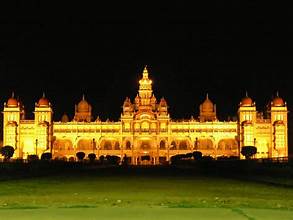
But there is another way of translating this midrash. In this version the
Hebrew birah doleket means not “a palace all illuminated,” but rather, a
“palace completely on fire.” In this version, the traveler sees a building
completely on fire, thinks, “Well, someone must have built this thing.
Where the heck is he?!” By and by, the owner of the palace sticks his head
out and says, “I am the master of this palace.” The midrash now means
that Abraham sees the world as a dumpster fire. He thinks, “Where the
heck is the Creator of the world?! Has he completely stopped paying
attention?! And then Adonai reveals Himself as “the Master of the world.”
Without belaboring the point, the world as dumpster fire probably feels to
many of us like a not unreasonable analogy to the present moment.
The original meaning of the “palace on fire” story was probably more
comforting to the Rabbis than it is to us. In fact, the original idea was that
the world only looks like an out-of-control conflagration. In fact, all the
recent disasters that Abram knows about, like Noah’s flood, were a result of
a God who is completely in charge, and were a means of just punishment
of the wicked.
But our teacher Rabbi Abraham Joshua Heschel, z”l sees much more
complexity in all the bad that happens in the world. Heschel, ud mutzal
me-esh, a brand plucked from the fire, lost his whole family in the
Holocaust and was not one to sugarcoat the cruel reality of the world. In
fact, in God in Search of Man, he tells our midrash twice. Early on he tells
the “a palace filled with light” version and speaks of how our wonder at the
world can inspire faith in God. Chapters later, he tells the “palace on fire”
version, as an introduction to the section entitled, “The Problem of Evil.”
His summary of our midrash poignantly declares, “The world is in flames,
consumed by evil. Is it possible there is no one who cares?”
The idea that God cares, and even more important, that we as human
beings must, pervades Heschel’s discussion of evil. Writing ten years after
Auschwitz was liberated and the Germans surrendered, he worries that we
have become “callous to catastrophes” and that “our sense of horror is on
the wane.” (I think of Lewiston, where my reaction was both horror and the
thought, “Oh, another one.”) But even more worrisome to him, rather
prophetically, is the confusion of good and evil.
In this world it seems, the holy and the unholy do not exist apart, but
are mixed, interrelated, and confounded. It is a world where idols
may be rich in beauty, and where the worship of God may be tinged
with evil.
This seems truer than ever in a world where students rightly concerned
with fair treatment of the Palestinians descend into frightening
anti-Semitism. A world where an Israel which in the wake of horror must
rightly neutralize Hamas maintains a Jewish terrorist as national security
minister.
So how do we face a world burning out of control? As much as the God of
Abraham may be the Guide, the sovereign of the world, what we do is much more important than what we believe about God’s justice. Torah is
the antidote. The mitzvah is the response. Heschel expands on this idea:
Neither the recognition of the peril nor faith in the redemptive power
of God is sufficient to solve the tragic predicament of the world. We
cannot stem the tide of evil by taking refuge in temples, by fervently
imploring the restrained omnipotence of God. The mitzvah, the
humble single act of serving God, of helping man, of cleansing the
self, is our way of dealing with the problem.
In this moment of disaster upon disaster, I wish I had a more expansive
answer. But I find hope in the fact that Judaism has endured through the
ages with a healthy understanding that the world is a palace that is
sometimes miraculous and beautifully illuminated and sometimes burning
down. May we respond by doing mitzvot, by shoring up the spirit of our
fellow Jews, by contributing to the welfare of all people. May our faith in the
one God of Abraham lead, however slowly and gradually, to a universal
belief in the oneness of all humanity.
Replenishing the well
This past Shabbat, Day 8 of the “October 7” War, our synagogue rabbis presided over a ritual marking the transition of a girl to adulthood in the eyes of the community. On Sunday morning, Day 9, we were present for twin girls experiencing the same rite of passage. On Sunday afternoon, I officiated at the naming of a baby girl, linking her to the legacy of her paternal grandfather (a close personal friend who died at a young age) and her maternal great-grandfather.
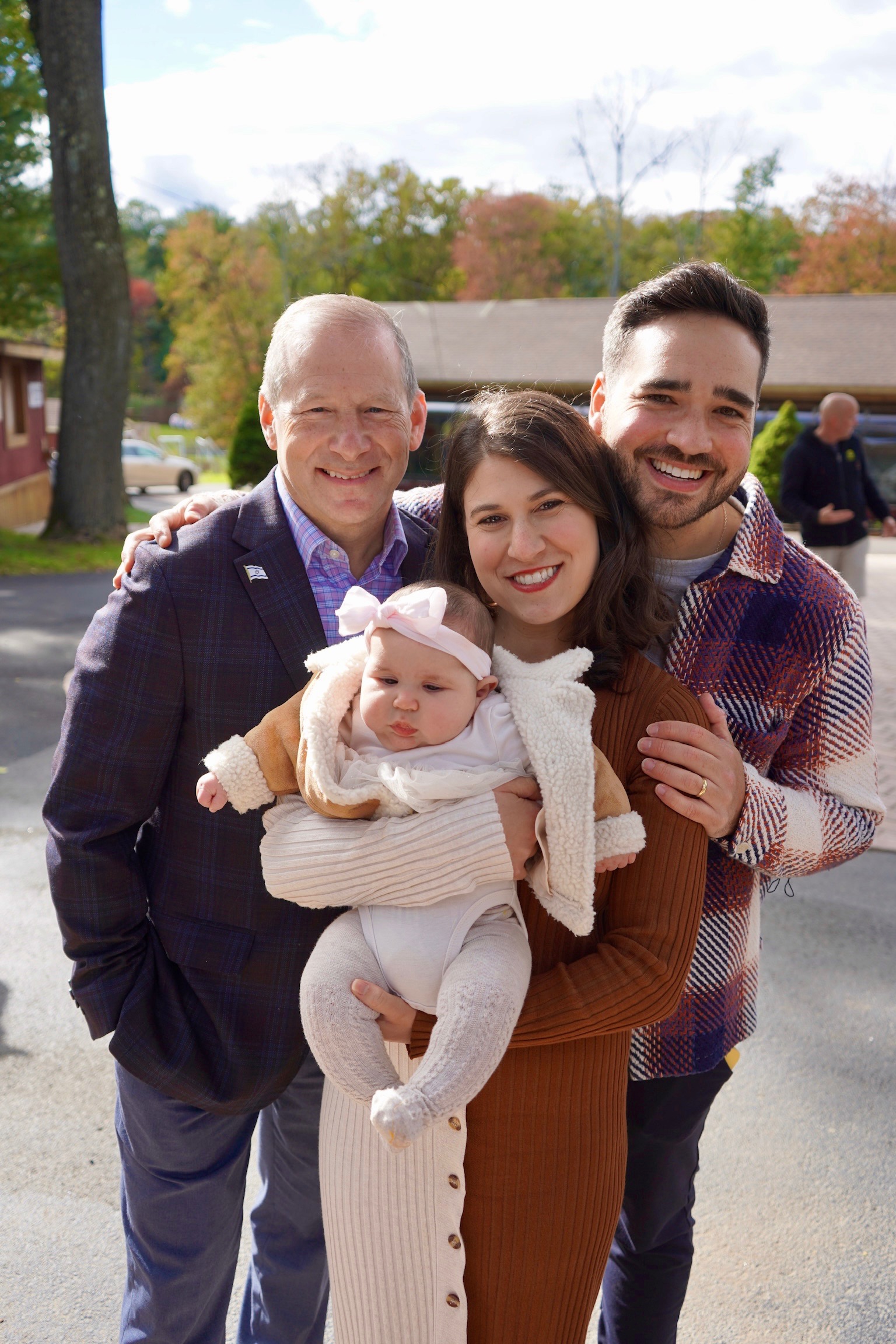
Each of these moments was filled with love and infused with meaning. Each of these rites was held in the embrace of family, friends and community. Each of these children gave honor to their past and held out promise for our shared future. Each of these families prayed and planned for the day to arrive when their respective occasions could be shared.
And each of these events was touched and somewhat shaped by events happening on the other side of the ocean. Parents reached out to their rabbis to inquire on a personal level about the rabbis’ wellbeing and emotional preparedness. They asked whether a postponement might be warranted. They wanted to know that, if the simcha were to take place, it would be framed appropriately in light of tragedy hanging like a cloud over our heads.
The Talmud (Ketubot 17a) teaches that a funeral procession gives way to a wedding procession. In other words, we prioritize the celebration of life over death. The teaching may feel harsh or insensitive to some, especially considering the emphasis we place on caring for mourners. (As an aside, caring for mourners is in fact caring for the needs of the living, as distinguished from the funeral procession itself, which is about the caring for the dead.) But the lesson is one that we need right now.
Caught inside the looping 24-hour newsfeed, glued to images and reports of the dead and the missing, worrying about our family and friends, our well of resilience is being depleted further from hour to hour. We need to exercise the kind of self-care that will replenish that well, so that we can confront and navigate the challenges yet to come. The gift of joy, of celebrating life, is the best form of self-care we can give ourselves.

Like a bridal procession, the celebration of life’s moments of transition fills us with optimism, with a reason to look to the future with hope. The times to be treasured are moments that we are not promised or guaranteed; they are not to be postponed, lest intervening events preclude their being rescheduled. And there’s no guarantee we will be there to enjoy them the next time around.
Seize the moment to celebrate when it presents itself. Join us on November 29 (the date of our rescheduled fall gala, exactly 60 years since the day our building was dedicated!) to celebrate the synagogue and to help us replenish our own communal well of resilience.
Am Yisrael chai, so let’s be sure to celebrate life when we can.
Rabbi Craig Scheff
Don’t Do This Alone (Coping with these Dark Days)
On Friday, October 6, just three things were on my mind.
First, my son Josh and his beloved Shay had just gotten engaged, but they had not yet made it public. I wondered how I could make it through Shabbat and two days of holiday without sharing the good news.

Next, I was feeling quite pleased with my decision to forego shoes and just wear sneakers with my synagogue dresses on Saturday night and Sunday for Simchat Torah dancing.
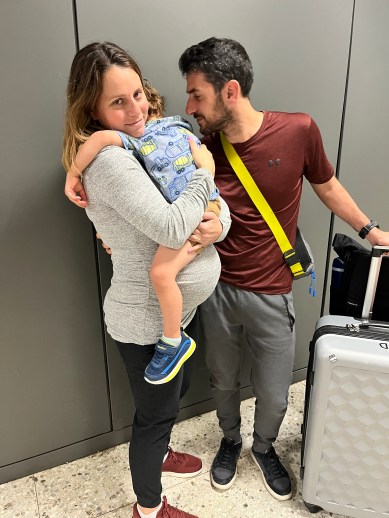
And third, I was a bit worried about having time to pack after two days of holiday before the car service arrived to drive me to Newark Airport for my flight to Israel. I was making a trip for four days to attend the wedding of my son-in-law‘s brother Omer to his cherished Tal. Jonathan, Sagi and Carmel had already been in Israel for a week and I was looking forward to a fun few days in Tel Aviv and a wonderful Fainshtain celebration.

I didn’t need to have worried about my Sunday night flight to Israel. It was cancelled.
On Saturday, October 7, the world as we knew it ended. We will never be the same.
Jonathan was awakened by sirens on Shabbat morning and travelled out of Tel Aviv to Shay’s family home. That morning, Sagi and Carmel were with Racheli, (Sagi’s mom and Carmel’s savta). Many of you have read Sarah’s account of Sagi’s harrowing escape with his mother, her partner and our grandson Carmel from their home in Mefalsim. In case you didn’t have the chance to read it, here is a link:
https://docs.google.com/document/d/1lng-H_PCVwpDlZrUwvmWFxBjgg2trn-_voJWUMnYGWQ/edit

What do Jewish people do when tragedy strikes but the calendar says it is time to celebrate? We celebrate. With breaking hearts, with tears, and with complete dissonance, we take the Torahs out of the ark and we dance. It’s the hardest thing to do and it’s the only thing to do.
So many congregants of all ages came to OJC for the holidays, drawn in to community like homing pigeons. We knew where to be for comfort and solidarity.
We prayed, we broke bread (and chocolate), and yes, we danced. Our eyes met and we read the grief and bewilderment there. We danced with our children in long “Tayish” lines and circles of “The Tushie Dance” (Od Lo Ahavti Dai). We grinned and laughed with a stubborn refusal to give in to terror. We sang Acheinu softly and walked in slow circles for all those in Israel unable to celebrate Simchat Torah, and the children of our shul saw their rabbis cry. We honored teenagers as Chatanei Torah and a centenarian as Chatan Bereshit and we felt uplifted by them and their proud families.
All of it was necessary. It’s what we Jews have been forced to learn throughout all the centuries of our history. If we stopped celebrating every time we endured suffering, we would never be able to fulfill our calendar year.
At the OJC, we did not celebrate despite our sorrow. We celebrated together with our sorrow.
I was never more proud of our congregation.
Since the holidays have ended, we have truly been prepared for Mar Cheshvan which begins on Saturday night. It will be a bitter month indeed.
After the holidays concluded, the news from Israel continues to be intolerable. As the numbers of injured, kidnapped, and murdered in Israel climb and the inhuman stories emerge, as soldiers are mobilized and in harm’s way, as we speak to precious friends and family in Israel and find that we have no useful words, we find that the reality is more than any one soul can comprehend.
And so, we cannot do it alone. We must find each other in our grief and come together to pray, find comfort, and take action.
Hundreds came to the rally on Tuesday at the courthouse in New City.
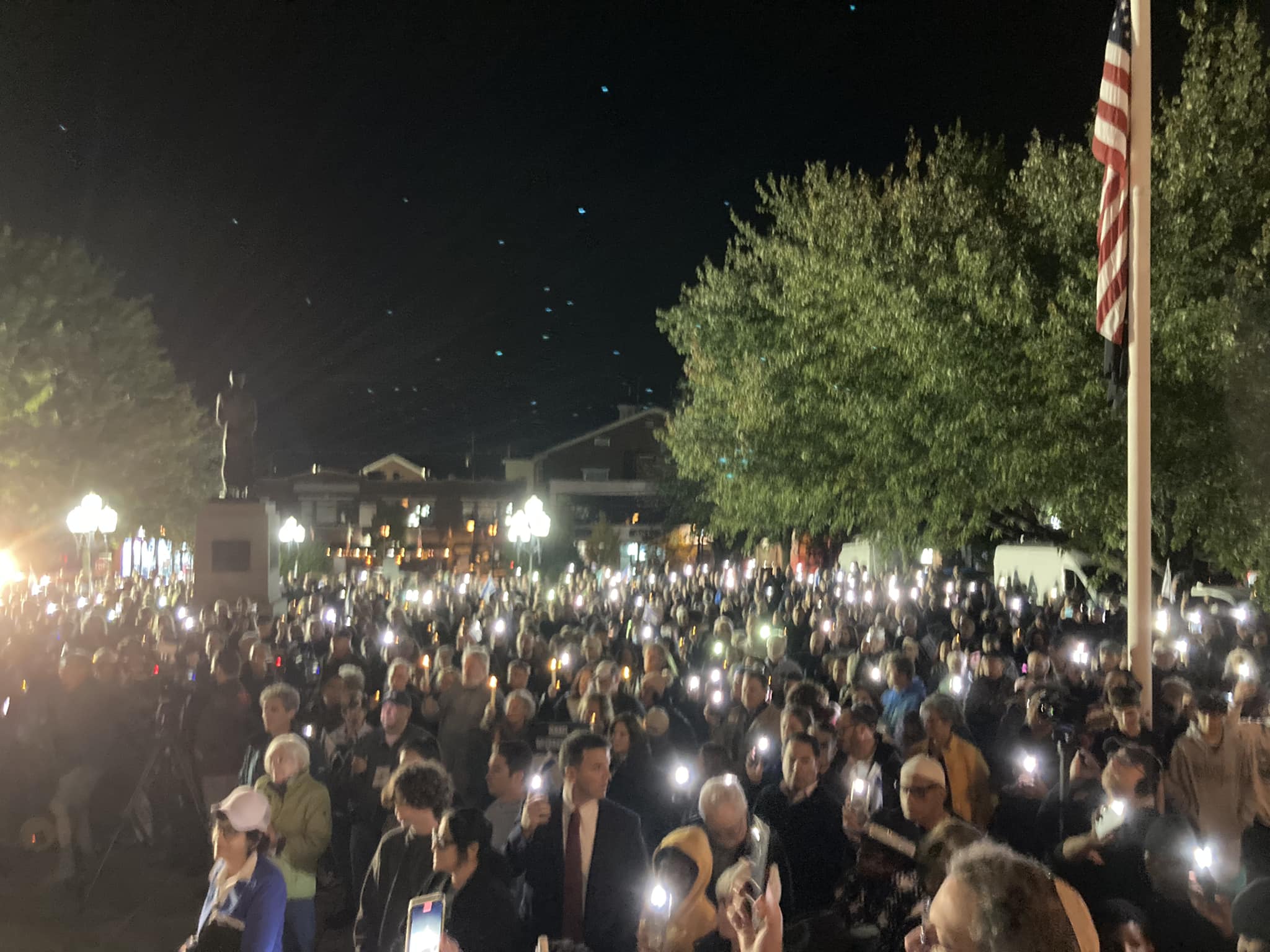
Many of you will be with us on Shabbat to feel the power of community.
I expect that hundreds more will come together on Saturday night at 8 o’clock at Congregation Sons of Israel in Nyack for the Rockland Board of Rabbis Prayer Vigil and Memorial Service.
More opportunities for prayer, healing, and action will be announced soon.
Please don’t try to do this alone. We are a community that knows how to be together in the most joyous times and in the hardest times.
Am Yisrael Chai.
The People of Israel lives!
Rabbi Paula Mack Drill
Traveling with Two Hearts
Perhaps it is always the case that when a Jew travels in Europe, one travels simultaneously with two minds. Or more correctly, with two hearts.
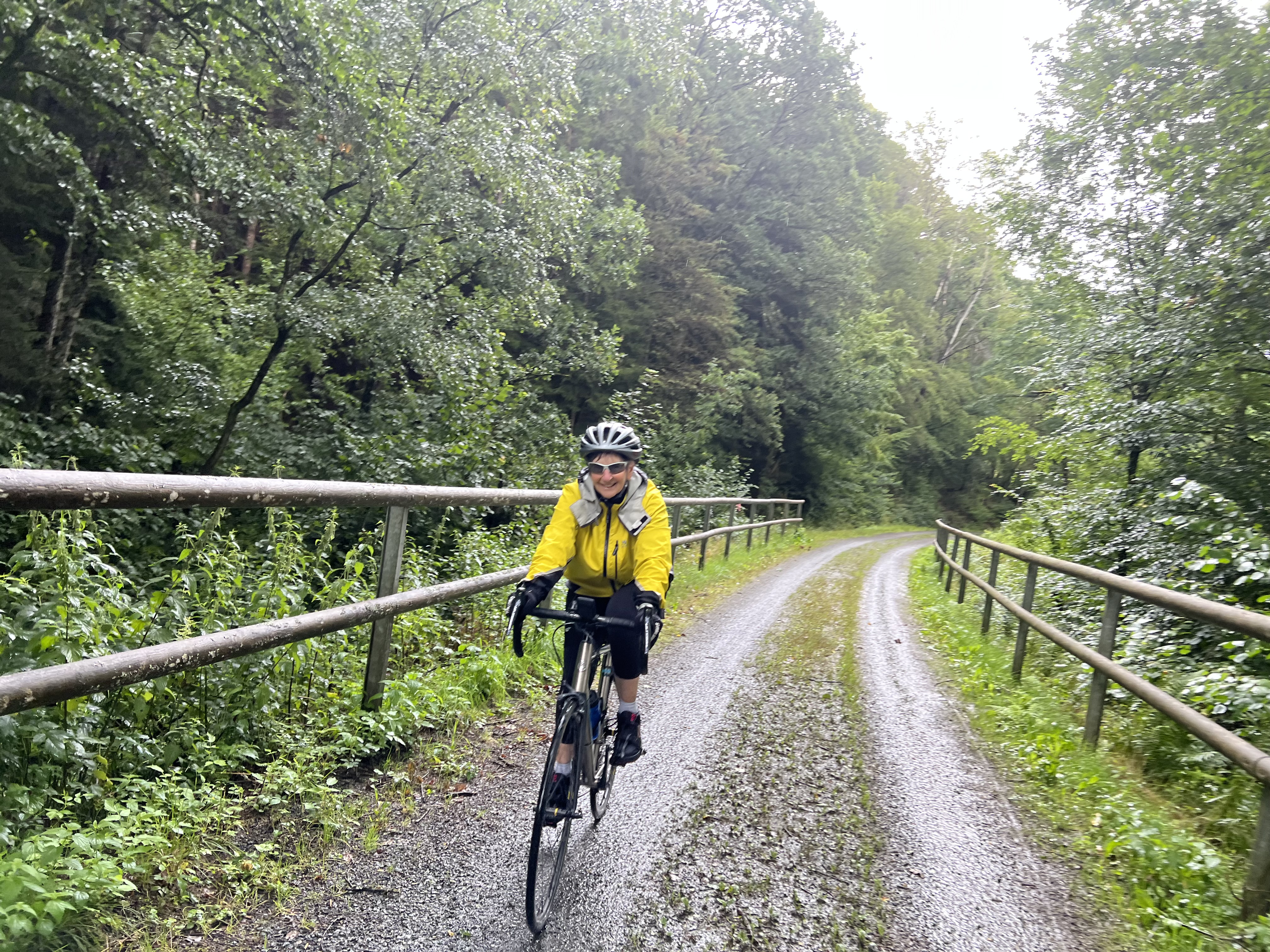
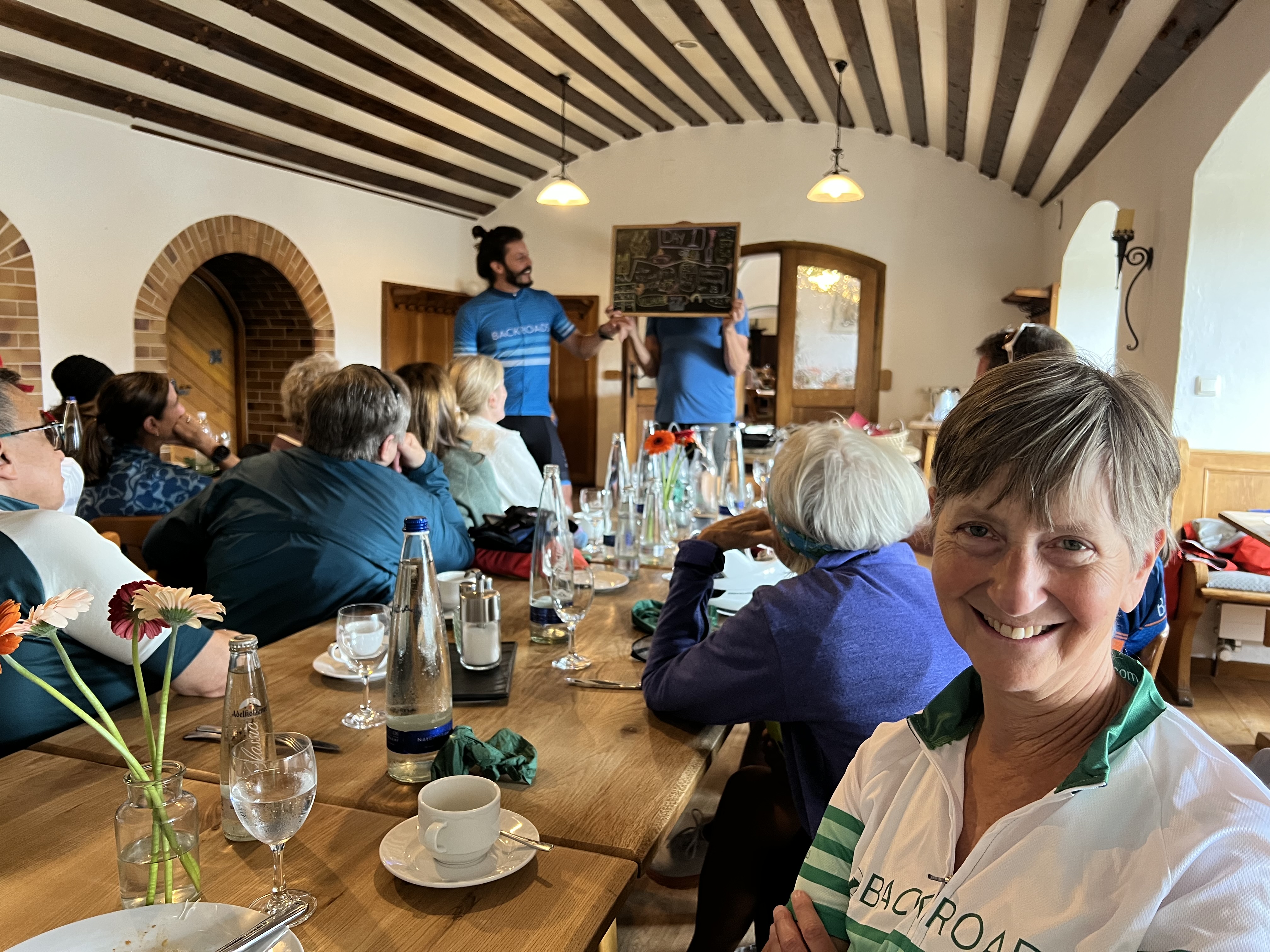
Of the first mind, here is an amazing vacation filled with everything one could desire, and for which I am grateful. We cycled and cruised the Danube from Prague to Budapest, enjoying river paths and forests, orchards and vineyards, castles and medieval forts, small villages and impressive cities. Jonathan and I enjoyed the fellowship of other cyclists, great food, and a Mozart concert.
And in the other chamber of my heart, there are the unstoppable thoughts. What is the Jewish history of this place?
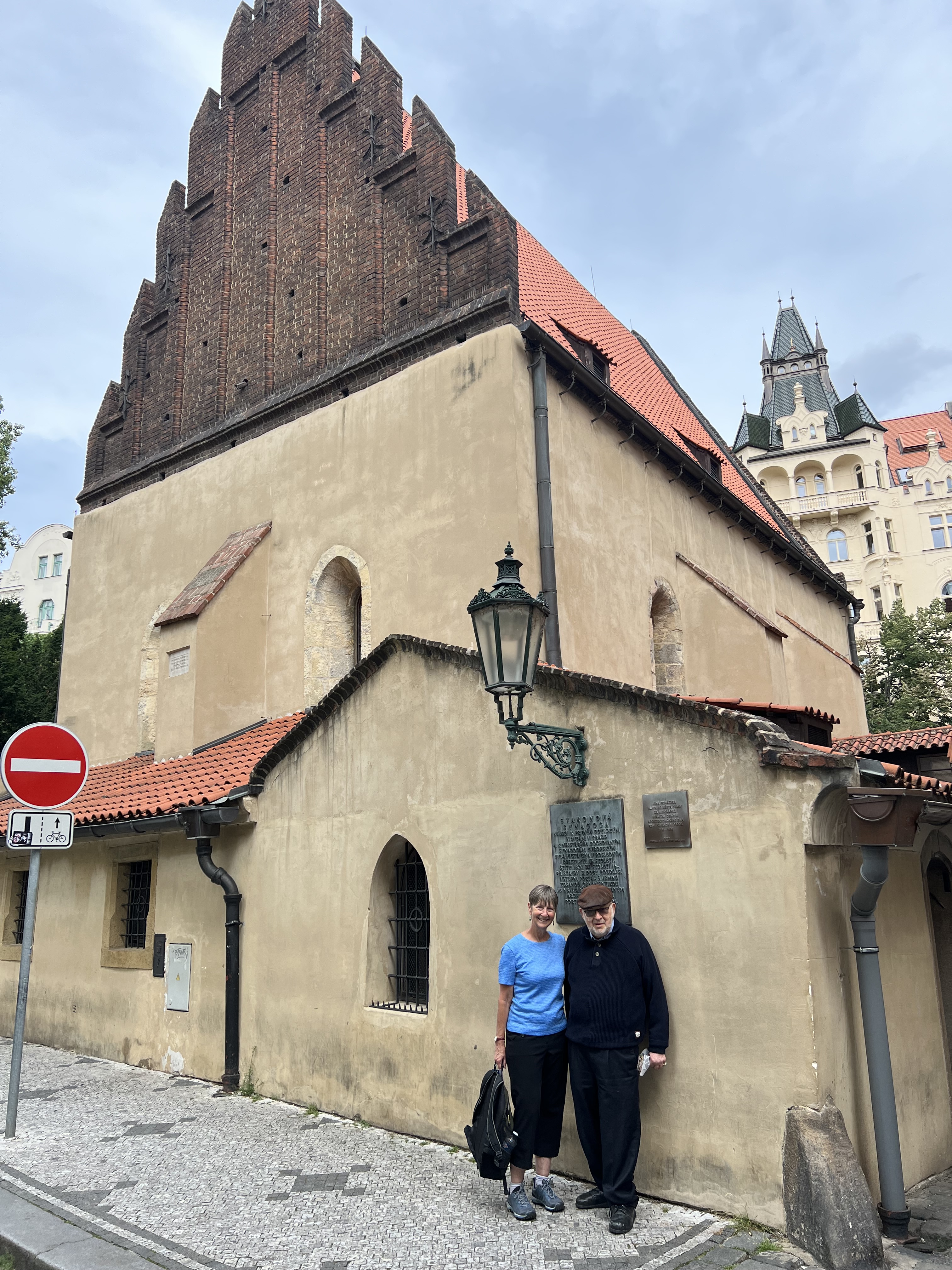
The answers were not completely absent from the week. We spent Shabbat in Prague with my friend and colleague, Rabbi Ron Hoffberg and the Masorti community there. Before Shabbat, Rabbi Hoffberg gave us a tour of the Jewish quarter. We saw four synagogues including the New Old Synagogue, the Jewish cemetery, and the stairs to the attic where the Golem is locked away. We viewed Prague from the perspective of the Jewish history there.

Once we joined our bike tour group, there was still acknowledgment of Jewish presence. In every historical explanation by a guide, there would be a mention: Franz Joseph was a strong protector of the Jews. All of these apartment buildings were inhabited by Jews who were welcomed into Linz for their merchant and banking skills. Sigmund Freud was a prized son of Vienna until “World War II forced him to leave.” See this statue of Princess Sisi and that of the great liberator of Vienna, Jan Sabieski – oh, and here is the representation of a Jew forced to clean the cobblestones with a tiny brush, very sad”. “Over here was a very large Jewish ghetto and around the corner is Bratislava’s Memorial to the Jews.”
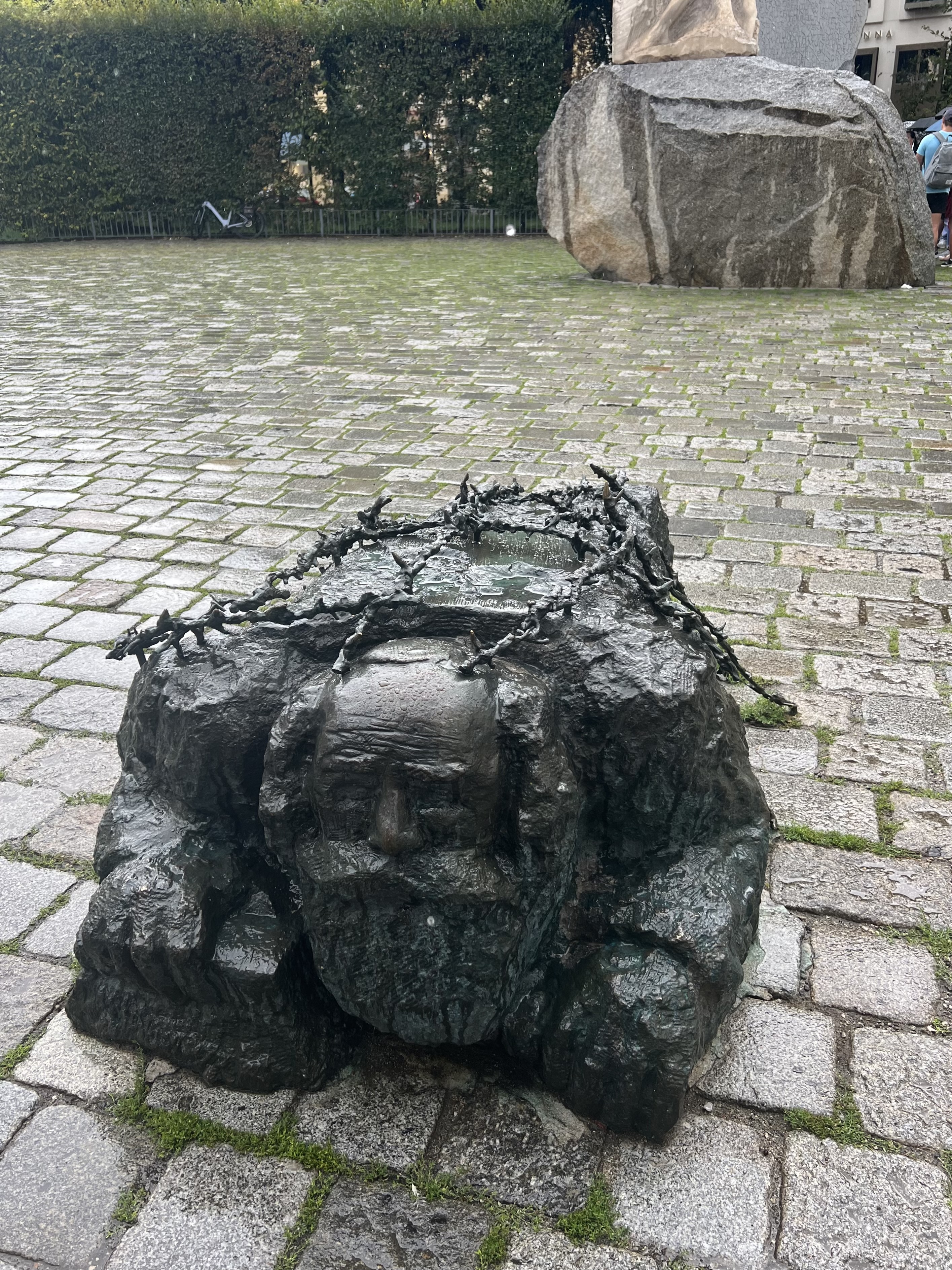
The monologue in my mind offered quite a different tour:
Consider this quaint village. Did they round up their Jews or hide them?
Cycle in a windy, cold downpour through the Bavarian forests. How did Jewish refugees ever get warm when they were on the run?
Admire the large and prospering farm along the bike path. Did Jews hide in the barn or the haystacks?
The interior of this abbey is inspiring. Did the nuns here hide Jewish children or turn them in? View the sweeping interior of yet another Catholic Church. I wonder what the priests taught their parish about the Jews.
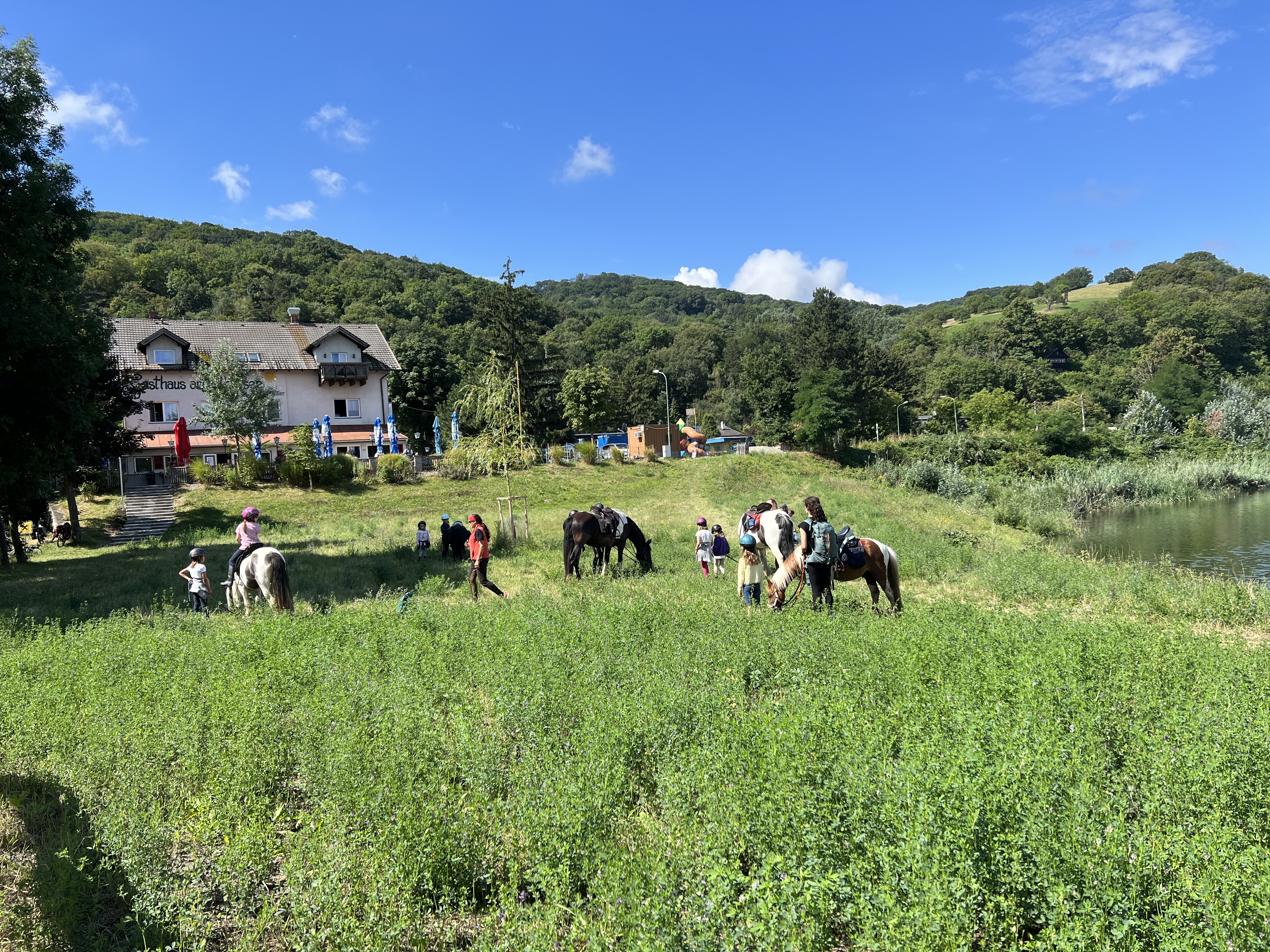


I thought that I was alone in these thoughts. But yesterday, our group had a walking tour of Budapest, and were guided to the haunting sculpture Shoes along the Danube. These bronze shoes are a memorial to the Budapest Jews who were rounded up at the very end of the War, and shot and killed at the edge of the Danube where the river turned red with their blood. Afterward, many members of our group came to just give me a hug or ask a question. I felt held and understood by very good human beings.

Last night, our guides asked everyone to share a highlight of the week. People spoke about cycling up a very hard mountain pass, or riding through the vineyards to a wine tasting. One of my fellow travelers began his memory by reflecting that we should all take seriously the sculpture of the shoes that we had seen earlier that day. He said that we are privileged to be able to travel the world, but we should be mindful that we are living in dark times. We should remember the fellowship of our travelers and live our lives to prove that kindness is stronger than hate.
In his few meaningful words, the two simultaneous travelers in my mind and heart united as one.
Wherever you are and whatever you are enjoying this summer, remember the superpower of kindness.
Rabbi Paula Mack Drill
The year of the unicorn (aka “Succeeding successfully”)
When we set out to create a job description for the search for our new rabbi, someone (it may have been our creative president Matt Schiering) suggested that we might as well be looking to replace a unicorn.
I certainly think quite highly of Rabbi Paula Drill, and I am beyond grateful for the partnership we have shared and the many ways in which having her as a co-rabbi has improved my life professionally and personally. But a unicorn?

As we follow Moses through the final year of his tenure leading the Israelites, we are reminded that he is irreplaceable. “There never arose another prophet like Moses….” Joshua is poised to succeed Moses, but not to replace him. Joshua will be a different leader for a different time with a different mission.
All this talk about Moses, Rabbi Drill and unicorns has left me reflecting on the origin story of Rabbi Drill‘s relationship with our community. We weren’t looking for a unicorn, and we didn’t hire one. We hired someone whom we knew could build relationships in the context of our Jewish tradition. There were challenges, doubts and growing pains as we introduced a new leader to our community. Personally, my guiding principle was that Rabbi Drill’s success would be my success. I believed my burden would be lighter, my life would have greater balance, and her achievements would add to the reputation of the OJC community as a place with which people wanted to connect. Our leadership understood that her success connecting, building relationships and offering more pathways into community would benefit our entire community and help us grow. It mattered not that Rabbi Drill started out only coming to OJC one Shabbat each month; it mattered that she was willing to connect with people on their time about their lives and their searches for meaning. Our faith was rewarded!

The partnership model that Rabbi Drill and I promoted from her earliest years here required a true cultural shift away from a hierarchical structure of leadership. We advocated to avoid the “assistant rabbi” title, ultimately establishing a co-rabbi relationship. We were inspired by the Jewish model of learning in partnership (“chavruta”), and by the pairs of rabbinic sages who challenged each other to grow, to refine their knowledge, and to consider alternate perspectives. I believe our synagogue became a kinder, more thoughtful place because of the partnership and team approach that we modeled.
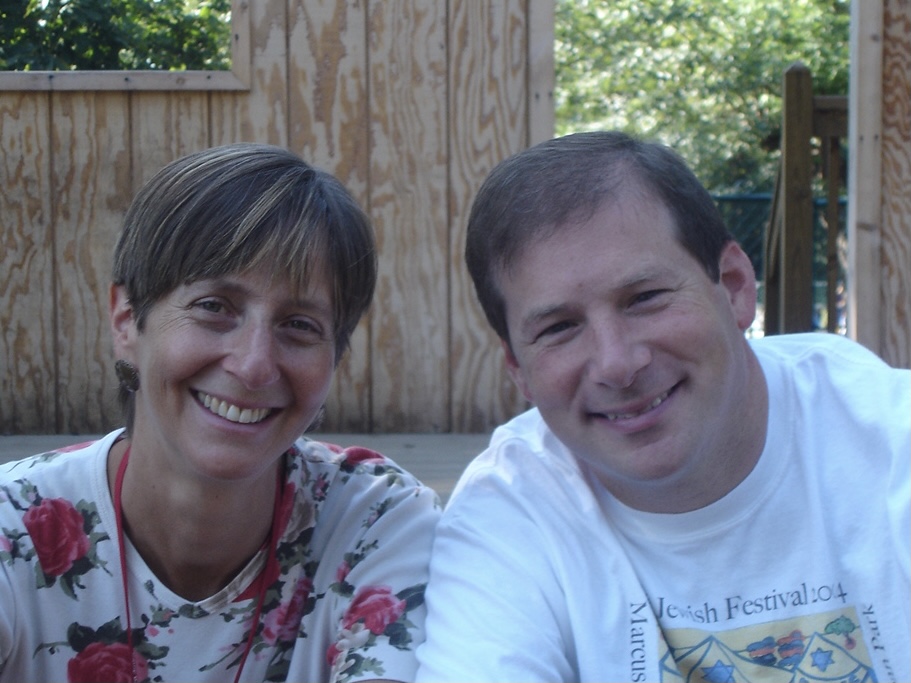
For our succession plan to be successful, we need to remember what has made us successful as a community to date. We need to remember how Rabbi Drill’s tenure became the success it was. It should come as no surprise that the survey we recently sent to the congregation revealed that the rabbinic role most important to our community, by a wide margin, is for the rabbi to share a personal connection with us. We want to be seen, heard, understood and appreciated by someone who can help us forge our own connection with community, tradition and God.

If it takes a unicorn to fill that need, then let the search for the next unicorn begin. If anyone can find one, it’s us!
Rabbi Craig Scheff
Wise Aging
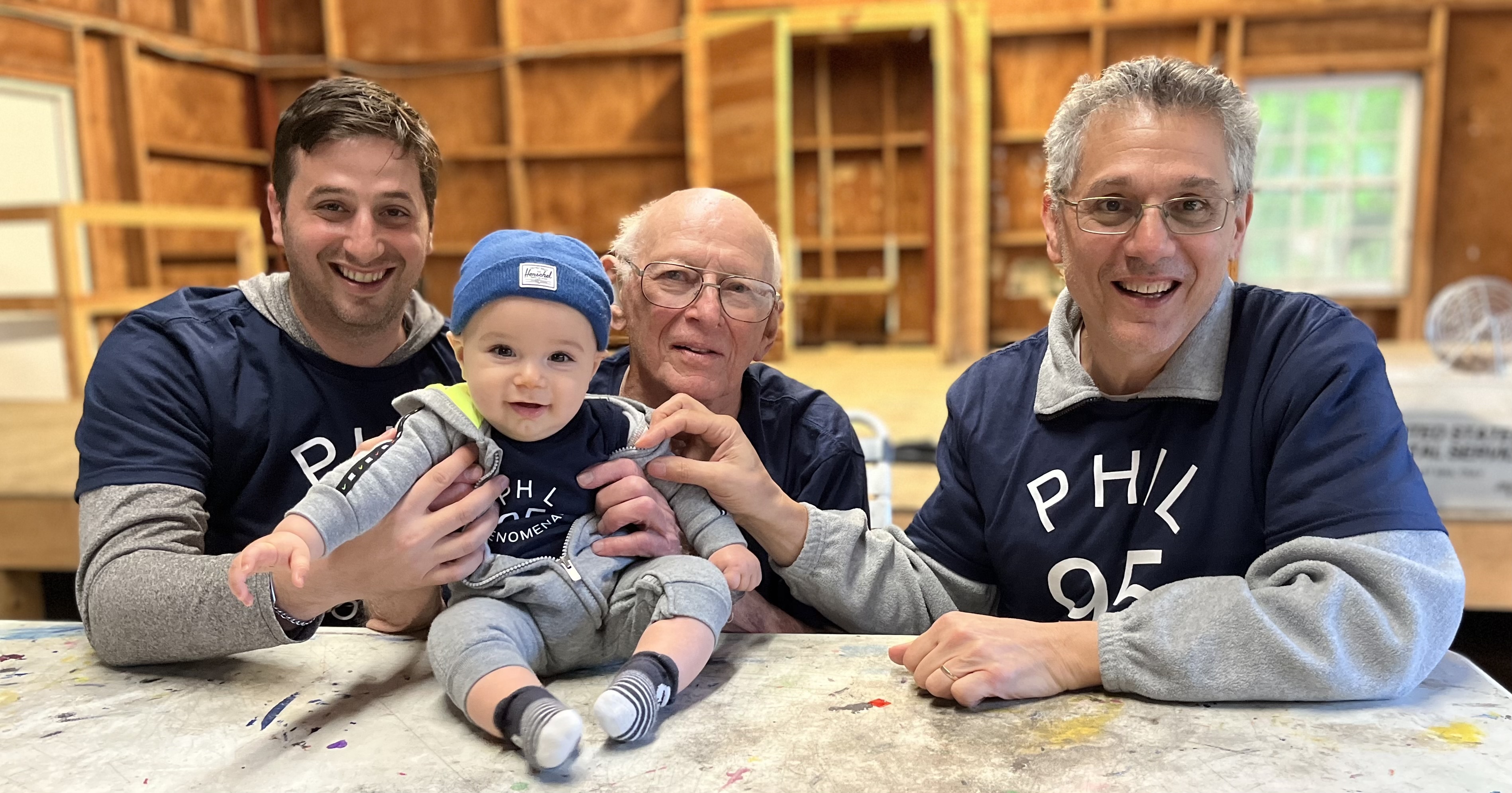
My father-in-law, Phil Drill, will turn 96 in August. He works every day at his third-generation construction company, bidding jobs and managing projects. No one is doing him a favor, no one is condescending to give “the old man” a desk and a chair. Project managers and developers consistently seek his opinions and expertise. On weekends, he and my mother-in-law commute to their place in New York City where he goes to a studio to sculpt and where they see movies and plays that most of us have not yet heard of. Twice a week, back in New Jersey, he does Pilates. Every morning before work, he walks his dog Murphy two miles, and many evenings, he cycles around his neighborhood on the bicycle that his kids got him as a present for his 90th birthday. It was his request.

Yes, Phil is 96 years old. He has gotten older but he has not become old.
You could say that he is blessed with relatively good health and excellent longevity genes. True. But Phil’s way of embracing every day is more about his attitude than anything else.
Getting older is a fact of nature. But getting old is a choice we all make.

Phil is my inspiration for the class I am teaching at Orangetown Jewish Center this summer, “Wise Aging”. Having learned a great deal from the book by the same name authored by Rabbi Rachel Cowan, z”l and Dr. Linda Thal, I decided to delve into Jewish texts that teach us the secrets of growing older without taking on a declinist view of being old. Yes, we lose things as we age: people we love, full use of our bodies, memory, professional identity, purpose, independence, confidence. You can make this list as easily as I can.
If we adopt the amazing mantra of “the best is yet to be” and accept the inevitable losses as reality, we can take on a different view of aging, a spiritual view. We can see our tasks as shining up our souls and focusing on what is most valuable rather than grasping at what we are losing.
We never know how a class will land when we offer it. This class on wise aging clearly hit the mark. Close to forty participants from younger boomers to elders have been gathering on Monday mornings in a hybrid format. Interestingly, the in-person participants outnumber the virtual students for the first time since before Covid. The class seems to be so highly valued that I will be continuing it monthly in the fall. (Join us this Monday, July 10 at 11:00 am for the final summertime class.)
Poet Stanley Kunitz writes, “Years ago I came to the realization that the most poignant of all lyrical tensions stems from the awareness that we are living and dying at once.” This statement may seem jarring to you, yet I find it to be “very Jewish”. In Judaism, meaning is found in living, not in dying; yet awareness of mortality is essential. Our rabbis teach: “Live every day as if it were your last.” Do something of worth today. Make this day meaningful by a kind word, a phone call, a poem read or written. Jewish thought stubbornly insists that we are here for a purpose, that we are partners with God, that we are meant to be kind to others and to be reverent of life.
In Psalm 92 we read, “Tzadik katamar yifrach… The righteous flourish like the date palm, thrive like a cedar in Lebanon… In old age they remain fruitful, still fresh and bountiful, proclaiming: Adonai is upright, my rock in whom there is no flaw.” Rabbi Abraham Joshua Heschel wrote about this verse, “One who lives with a sense for the Presence knows that to get older does not mean to lose time but to gain time. And, also, that in all of one’s deeds, a person’s chief task is to sanctify time. All it takes to sanctify time is God, a soul, and a moment. And the three are always here.”
What is the secret to such resilience and graceful aging? How does one make such a choice? Join us to learn together monthly on Monday mornings as we strive to find meaningful answers.
To find out more about the class (in-person and on Zoom), contact me Rabbi.Drill@theojc.org.
Here’s to joy and resilience, Rabbi Paula Mack Drill
You had to be there
A tip of my Red Sox cap to Yankees’ pitcher Domingo German, who threw a perfect game last night (retiring 27 Oakland batters without issuing a walk or giving up a hit). Baseball is the one sport where on any given night something can happen that you as a fan may have never seen before. At the beginning of every major-league game, an average pitcher facing a lineup of average hitters has a .000983 percent chance of pitching a perfect game. This perfect game was only the 24th in the history of the sport!

The only way to truly appreciate such a feat is to be present to it in the moment. It’s simply not the same on replay. Whether you are a fan of the team or not, you hang on every pitch over the last 12 outs of the game to see something that few have ever achieved. A friend texted me earlier today to tell me that he and his son had turned the game off after the first inning last night to go to bed — something they never do — in preparation for an early morning flight. I understand the terrible disappointment they are feeling today.
A few weeks ago, something poignant happened during services that moved our president Matt Schiering to note in his announcements that we never know what we might miss if we are not in synagogue on any given day. There are so many Shabbat mornings when I walk out of the building after the service thinking the very same thing to myself. You simply never know what you are going to be a part of, and if you aren’t here, you never know what you’re going to miss.
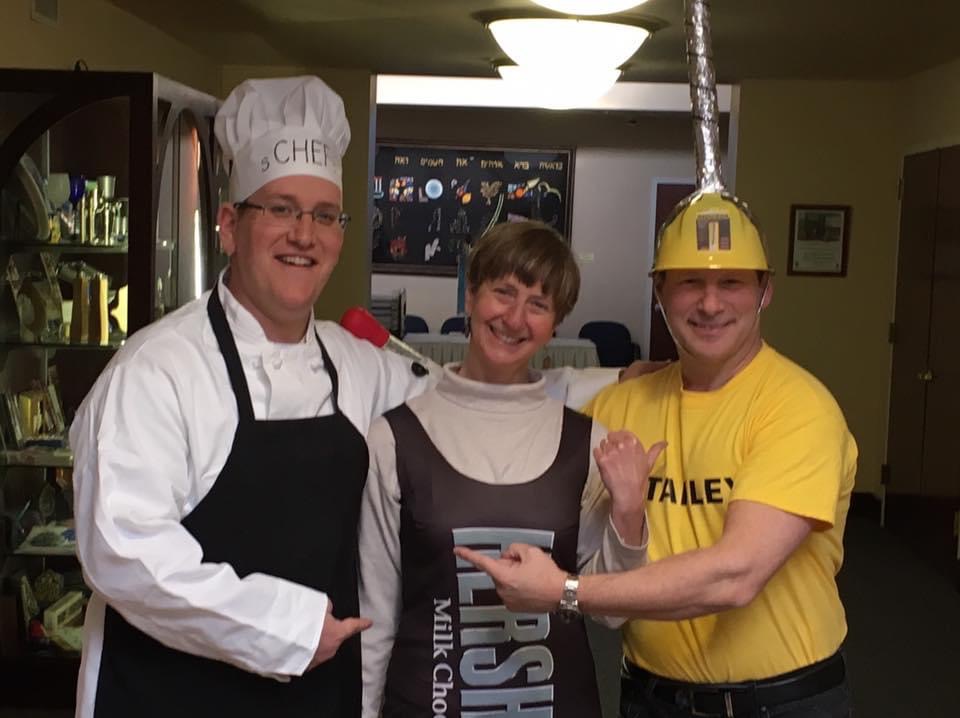
It might be as simple as a 6 year-old girl making her way across the aisle to sit with an unrelated 60 year-old woman. It may be a 95 year-old man standing in front of the Torah to give thanks for another birthday. It may be a person who is deaf reading from the Torah in front of the congregation for the very first time. It may be the naming of a baby belonging to a family you’ve never met, or a 50 year-old person returning to the synagogue where they grew up for the first time in 35 years.

The synagogue experience is not necessarily about prayer. Or mourning, or music, or meditation or memory. Or celebration, or causes or community. Or food or friendship. Or obligation. Or study. Or a heartfelt moment of vulnerability. The synagogue experience may be about any one of these things, about all of these things, or about something else entirely.
Only you can conclude what the synagogue experience is for you. To understand the meaning of it for yourself, you have to be there. If you sleep late, check out early, or pass entirely, know you might be missing something special, something you will probably never experience at a ballpark or anywhere other than the synagogue.
Shabbat shalom,
Rabbi Craig Scheff
The Lead Story
Earlier this year, a chaver (friend) of our synagogue informed the rabbis that he was ending his official affiliation with our synagogue. The reason he offered was that, despite loving so many things about the synagogue and its clergy, he wanted a less “activist” (his word) synagogue for his family. I’ve always advocated that people should find houses of worship and communities where they would be motivated to connect, to attend, and to add meaning to their lives. I found it particularly sad that, especially in this day and age, one would seek a faith community that would not “actively” pursue its stated mission and the values of our tradition.
Our sage Hillel famously taught (about two thousand years ago and in the face of immense social and political upheaval): “If am not for myself, who will be for me? And if I am only for myself, what am I? And if not now, when?”

As participants in Jewish community, we have all likely felt at one time or another that we must be our own best advocates, because others so rarely advocate for us. And, naturally, our own preservation and security must come first if we are to be any good to ourselves or anyone else.
Hillel’s teaching reflects his understanding that our values and way of life must also serve the betterment of our society in general and of all humanity. That is the fulfillment of Isaiah’s prophetic call that we must be a “light unto the nations.” That is our understanding of the responsibility that comes along with the “chosen-ness” to be a “kingdom of priests,” ministering to the needs of God and the rest of the world.
What has become equally apparent is that in our times there are fewer and fewer institutions that are willing to lead and leaders who are willing to recognize or accept the influence they may have beyond their own walls. Our communities are sorely lacking the leadership that models the values we espouse. As a faith-based institution with a sustained record of dedication to and service in the community, we are uniquely placed to lead. As leaders of a faith-based community with a sizeable constituency, a stable presence, a fair amount of goodwill with our neighbors, and a track record for partnering well with others, your rabbis see it as their duty to speak to those issues that affect the public welfare and to embrace the value that we must protect the image of God reflected in every individual. As leaders of a faith community, Rabbi Drill, Rabbi Hersh and I see it as our duty to actively pursue the values that our tradition dictates we prioritize.
This “activism” does not come at the expense of our responsibilities to offer personal connections to God, to our synagogue or to each other. Rather, it offers our community’s constituents the opportunity to “walk the talk,” to put into practice the potentially transformative effects of engaging in learning, prayer and community building.

We are called to battle antisemitism in the public arena. We are equally called to protect the vulnerable; to stand as partners with the leaders of the LGBTQ+ community; to advocate for women’s reproductive rights; to feed the hungry, to clothe the naked and to welcome the stranger. And pikuach nefesh, saving lives, supersedes them all.
Last week, Rabbi Drill and I attended an interfaith conference sponsored by UJA Federation of New York and the JCRC (Jewish Community Relations Council) of New York entitled “Facing the Gun Violence Epidemic: the Voices of Faith and Community.“ Reverend Charles Galbreath of Brooklyn urged us to heed the words of Zachariah, to imagine a world where children can play on city streets without fear and to work as faith leaders towards that vision. Michael Dowling, CEO of Northwell Health, urged us to see our responsibility as faith leaders as extending beyond our own churches and synagogues. Our esteemed panelists coming from a range of disciplines put before us the reality that the solution to ending gun violence lies beyond restricting access to automatic weapons. The solution lies in addressing many systemic issues ranging well beyond our mental health systems and the administration of law enforcement. The overriding message of the conference was that, beyond the politicization of these and other ills, each one of us has a role to play in ensuring the safety–the lives–of others. That role needs to be taught, informed and modeled by our houses of worship.

Where do we start? With ourselves and our priorities. Is that where it ends? No, we must extend our caring to addressing the needs of others. When do we start? If you are reading this, you already have.
Here is a link to the all resources that we received last week, including an action guide, should you want to take the next step. Lead on.
Rabbi Craig Scheff
A Poem on Yom HaShoah
Last night, OJC experienced a particularly emotional Sonia and Israel Neiman Shoah Memorial Project as we learned with Dan Grunfeld, author of By the Grace of the Game. Dan presented the inspiring story of his family’s Holocaust legacy and the trajectory of his father, the great Ernie Grunfeld of NY Knicks fame. He shared the tragic lessons of the Shoah together with his anyu’s (grandmother’s) lesson for life: Have hope!
At the beginning of the program, Rabbi Scheff read a poem that I wrote for the day. I share it here now.
She Read the News Every Day
She read the news every day.
On Shabbes, it was all they talked about.
Still, on Sunday morning she took the baby early so her daughter-in-law could sleep late
They built towers of blocks and she showed him how to make a house with playing cards
At night she made a big dinner for all of them
And they ate merrily, laughing and loud, as always.
He listened to the radio each night as he enjoyed his cigar.
It was all they talked about in the cafés and restaurants where he met clients for lunch.
Still, every morning, he knotted his tie just so, matching his pocket square to the exact shade of blue
He carried the leather brief bag with his initials on the side and enjoyed the blossoming trees on his short walk to the office
Coming home to his family, and his wife’s cooking, where he presided at the head of the table.
Until they didn’t.
Some were able to buy their way out.
Some hid in unthinkable circumstances.
Some went out to work and never came home.
Some were awakened in the middle of the night and shoved onto the street.
And we, in our hubris, hold them responsible.
We would have left sooner, we are sure.
We would have understood the signs and saved our families.
I am not so sure anymore.
I read the news and talk in the cafés
And still I wake early with the baby to let my daughter-in-law sleep late.
I cook a large dinner, and we eat merrily.
Rabbi Paula Mack Drill
 Three Rabbis Walk Into A Shul
Recent Comments