To bean or not to bean, that is the question!
One year ago, the Committee on Jewish Law and Standards of the Conservative movement adopted the position that the eating of legumes, rice and corn (kitniyot) on Passover is a valid legal option for Ashkenazic Jews. Instead of deciding at that time whether to adopt or reject the practice for our community (which is my role as mara d’atra, the religious decisor of our community), I decided to invite our Ritual and Jewish Living Committee–along with anyone else in the community who so desired–to study the topic with me. While the decision was ultimately mine to make, I had no preconceived opinion on the matter and thus invited the input of our community members to help me reach a conclusion.
People tend to be emotionally bound to custom, sometimes even to the exclusion of rational analysis. I appreciate that. We hold tightly onto family customs and tend to reject those things that challenge our sense of tradition, regardless of how or why such practices came about. I was therefore somewhat surprised that only a group of about 10 people made the commitment to study the topic with me. I anticipated far more interest! Nevertheless, our minyan of learners tackled the responsum written by Rabbis Amy Levin and Avram Israel Reiner. Our monthly studies delved into the details of the legal opinion, which reached the following conclusions:
1. Only that which can be made into matzah can become hametz. Wheat, barley, spelt, oats and rye are the only flours that can be used for matzah. Therefore, it is established that rice, beans and legumes cannot fall into the category of hametz. Moreover, the authorities agree that the presence of kitniyot on a plate does not render the plate, the meal or the home unkosher, even for those who observe the custom not to eat kitniyot.
2. The legal authorities of medieval Ashkenaz recognized that forbidding kitniyot was an added restriction to the Passover laws, possibly based in the fear that certain varieties of wheat might possibly get mixed with varieties of kitniyot. Some authorities considered the measure excessive, but the more restrictive custom ultimately prevailed.
3. In the 18th century the debate was revived. The opponents of the restrictive position argued that the high cost of matzah prevented some from experiencing the requisite joy of the holiday, whereas kitniyot were readily available, affordable and not prohibited by law. For the benefit of the masses, they argued, the stumbling block to holiday joy should be removed.
4. The original reason for the restrictive custom is lost. If the reason was concern about the possible admixture with wheat, such confusion does not exist in production and packaging today. But a compelling justification is needed to overturn a long-standing custom. That justification, according to the authors, is the enhancement of our joy. Beans are a significant source of protein for those who don’t eat meat and for those who can’t afford meat, especially considering how prices are inflated as they are on Passover. The enjoyment of food and adequate sources of protein is part of the joy we are meant to experience. Additionally, protecting people’s pocketbooks from those who would seek to gouge is in fact a Jewish value worthy of legal consideration.

Given these legal conclusions and the input provided by those who participated in our studies, I offer my own opinion, which will represent a change in the official position of our community going forward. (Please note: This does not mean you are doing something “wrong” in the eyes of our community should your personal practice differ!)
While I recognize that many people will continue personal practice according to their inherited family custom, I believe there is great value in adopting this change in custom. I don’t believe in change just for the sake of change; but I also will not reject change simply because it is hard or because it is something to which we are unaccustomed. Nor will I reject what is considered a more lenient position out of fear that greater leniency will follow. All too often, necessary change is stifled by the sometimes irrational hold of our emotional attachment to the ways of the past. I choose not to oppose change simply for the sake of opposing change. That is not the way of authentic Jewish thought.
On a practical level, I am in favor of Jewish law that encourages adherence to the law; the more our Passover laws allow people to keep Passover, the better that is for everyone. Contrary to the ways in which some observe Passover, we are not meant to be reliving slavery for seven days or for the days leading up to the holiday. There is no joy or satisfaction to be derived from being more restricted or burdened by the holiday’s laws. Are we supposed to feel different from others and from the way we live for the other 51 weeks of the year? Yes. But Passover is meant to be a time of joy, despite the remembrance of our affliction.
Most importantly, changing dietary habits and sensitivities in our society dictate that alternate sources of protein should be made available if they are not hametz. Moreover, the exorbitant cost of keeping kosher in general, and of kosher meat in particular–not to mention the premiums imposed for Passover–is a compelling justification for offering consumers a more affordable way to stock their pantries.
Finally, I am mindful that this ruling will not necessarily impact individuals in their homes. They can continue to keep Passover as they always have. And even in our synagogue, as studied in the law, serving kitniyot among our foods does not affect the other foods served. So even in the synagogue, those who do not eat kitniyot will still be able to observe Passover in their own way at all times.
Please note that there are controls and restrictions on the purchasing of kitniyot for the holiday. Specifically, fresh corn and beans may be purchased before and during Passover, like other fresh vegetables; dried kitniyot (legumes, rice and corn) can be purchased in bags or boxes and sifted before Passover; canned kitniyot may only be purchased with Passover certification due to the canning process; frozen raw kitniyot (corn, edamame) may be purchased in bags before the holiday without a heksher, though one should still inspect contents before use; and all processed foods (like tofu) require Passover certification.
I am grateful to those who shared this process with me. I believe that the process of seriously engaging with our tradition is as important as any result of such deliberation. May we all have a happy and kosher Passover, whether we are among the bean counters or not!
Rabbi Craig Scheff
#JDAIM Spotlight 4 – Beth Steinberg, Director of Shutaf
Beth is our Scholar in Residence this Shabbat, February 24 and 25, as we honor Jewish Disabilities Awareness and Inclusion Month. Join us for Friday evening services at 6:00 pm, Shabbat morning at 9:00 am and stay after Kiddush for more learning with Beth.

My son’s challenges are significant but I’m not afraid.
I am unsure about the future. His happy adulthood, my happy years as an older adult. What are his rights, what do I deserve, what will be the responsibilities his older brothers will shoulder? Will he be happy?
I worry he might not be happy. But he’s almost always happy. That makes me less afraid.
When I write about Akiva – his needs, his challenges, my challenges – I choose my words carefully but I am not afraid. Except for when I hit ‘publish.’
When I talk about our journey as a family – the tough moments, the tearful moments, the moments that I just wish it were different – I try to be honest. I know honesty is important. I know many people pity us, pity him, don’t truly understand what it means to be his parent, his full-time advocate, his person, his people, his caring community. We’re the people who help him shower and dress, who care for him when he is sick, who sing songs with him. We’re the people who love him. Sometimes, I wish it were different but I am not afraid.
When I post a picture of Akiva, I choose the happy ones, the ones where his cute, uneven teeth, his often crossed-eyes, his sometimes grubby face, are softened by the happy smile on his face. He’s kinda funny-looking but aren’t we all?
I am not afraid to show the face of disability – his disabilities that is – via my son. I am not taking advantage of his well-being. I am letting the world know that disability is happy, disability is every emotion and more. Just like not having a disability is so many things and so many emotions and so many experiences.
I am not afraid of exposing us, of sharing him. While I know he’s unaware of this exposure, I know that showing him to the world, my extended world, will help ease fears and misconceptions about disability. I hope.
But I am afraid of a world that treasures beauty. Where skinny bodies and 6-pack abs, along with being blonde and gorgeous, is regurgitated on television and in movies. There are few positive images shown of real people who look different, as opposed to actors playing a part.
I’m afraid for other parents of children, teens and adults with disabilities. Those who feel unsure that the world will appreciate their loved ones. That the world will look kindly on their stories. Their tales of difference and challenge, of unusual beauty lost and found.
I’m afraid of a world that divides people up according to who can and who can’t. A world that divides those with disabilities according to who’s got this and who’s got that. A world that decides who’s high-functioning – whatever that really means – and who’s not. A world that sentences you and judges you for your difference without knowing what that really means.
So, I work past the fears. I tell his story. I tell our story. I invite you in, to read, listen and comment, so that you can understand and appreciate. So you can smile at the different-looking-behaving-whatever person the next time you see them on the street and be glad that they’re a member of your community. Because their people, those who love them, need you to try to be less afraid.
“And a rock feels no pain. And an island never cries.” Paul Simon
Beth Steinberg
http://blogs.timesofisrael.com/i-am-not-afraid-finding-strength-in-difference/
JDAIM Spotlight 3 – Kenny Hersh

In this mission to remain positive, I want to acknowledge that there are certain situations when grief is deep and time is a key component in the healing. And I also want to acknowledge that there are instances when a positive disposition is not enough.
I’d like to share with you the power of positive thinking and the importance of seeing the good. I’d like to share with you the story of my father-in-law, Kenny Hersh. As a child growing up in New Jersey and, later in life, in Providence, Kenny was someone who took full advantage of every day. He trained and ran 5Ks, was the first one on the dance floor at a simhah, played clarinet in a klezmer band, could manually mix paints at work to match any color, and volunteered at his shul. He was an incredible father, a loving husband to his wife Leah, and for better or worse, a Yankees fan. After working as a high school guidance counselor for a few years, Kenny eventually joined Leah’s family business, American Wallpaper in Fall River, MA. After a series of inexplicable falls and some problems with his coordination, Kenny visited medical experts in Providence and Boston. Through a series of tests, Kenny was diagnosed with Primary Lateral Sclerosis, PLS. A degenerative neurological condition that weakens voluntary muscles. Although relieved to finally have a diagnosis, the condition would mean increasing difficulty with basic tasks like walking, eating, and speaking.
That was more than 10 years ago. And yet, despite the challenges, despite the muscle stiffness, despite the difficulty speaking, despite the mobility issues, despite the fact that he often communicates through his ipad, despite the slips and falls on to icy sidewalks, despite that nearly everything takes longer and can be more frustrating, Kenny continues to be an unstoppable and unignorable presence in our family.
Whether you just met Kenny or you’ve known him all your life, it takes only a few minutes and a few keystrokes to appreciate Kenny’s charm, his humor, his kindness, his compassion, and his intelligence. Kenny continues to go to the gym, using the stair climber to reach the top of a 110-story building every week. Kenny continues to, despite all logic, drive and put in a day’s work at the family business. Kenny continues to be a comedic force at family meals, Kenny continues to be an ezer knegdo, a perfect partner to his wife Leah, a wise and loving parent to his six children and children-in-law, and perhaps most importantly, the most playful and treat-giving saba to his eight grandchildren. Rather than wallow in his sadness, Kenny makes the most out of every day, with a spirit and a love of life that is enviable.
I recently asked Kenny, if he ever got frustrated. “Of course! There are things I miss, but the thing that I find most frustrating is the inability to speak. I love to talk and that is frustrating. I would trade off being in a wheelchair to be able to speak freely again. It is especially hard dealing with my wonderful grandchildren. I would love to be able to read to Nadav and Eliana in English, Spanish, or Hebrew. What joy I miss in not being able to sing with them and talk with them. What a pleasure it would be to walk with them on the beach and swim with them; to run with them, to fly a kite with them and crawl on the floor with them. As I have seen with Micah, [his 7-year-old grandchild], once he was able to read, our relationship really grew as we were able to laugh together and have a “conversation.” I look forward to the day when I can do that with all my grandchildren. I think that there are choices when put in a situation like this: crawl under the covers and hibernate or try to work around the challenges and move forward and enjoy an exciting life. I choose the latter. I don’t want a pity party, but just the realization that I am still the same person I always was, but with a disability. I have so much to be thankful for and get inner strength from my wife, children, and grandchildren. They make me want to push the envelope to be an important part of their lives. Our friends and community in Providence and around the country give me support and make me feel included as an intelligent and mindful part of their lives. And of course, having fun and being able to laugh makes this ride much easier.”
My friends, I do not deny that there are problems in the world. I do not deny that there are times when we feel that we have insurmountable challenges. And I do not deny that at times we have to embrace that sadness. But in 5777, I implore you to also look for the positive in the world. Just by the virtue of where and when we live we are blessed with so much. It is okay to not be burdened by sorrow all the time. It is okay to focus on the positive. Not because we need to ignore the negative. Adarabah, to the contrary, because it is only by recognizing the good that we can tackle the bad. It is only by crying that we can feel the joy more deeply. It is only by rejoicing, that we can be there to understand someone’s sorrow more deeply. Let us cry together. Let us rejoice together. Let us feel the full spectrum of human emotion in the new year.
Rabbi Michael Fel
You can lead a wheelchair to water, but…..

There are those times though… I’m human, I fail, I fall short. In my family, we have a Christmas Eve tradition of meeting all the Hartmans (my in-laws) for dinner at a kosher restaurant in NYC. This year, the night was unseasonably warm and dry. Some rain earlier in the day had cleared out. The parking near midtown was typically tricky so we had several blocks to traverse to get from our parking garage to the restaurant. Our start into the city from home was typically late so we were in a bit of a rush. It’s those times when I’m a bit stressed that the young boy with sharp teeth comes back. I was going to set the pace and it would be brisk. I was going to push the wheelchair myself. Well, I should have thought that one through. The second curb that we came to was hidden under dark puddle of rain water… at least I hope it was rain water. I approached at “lift off” speed. Unfortunately, my wheelchair didn’t “lift off” … the wheelchair stopped cold. You know what else was cold? The water was cold! I know because I bounced out of my wheelchair and was sitting in that puddle and soaked to the skin. My wife and a kind stranger helped me back into the wheelchair. I hadn’t learned my lesson yet though. I was still intent on pushing myself. That wasn’t the last time I fell out of my wheelchair that night…twice more. I was very stubborn; I was very wet; I was very cold. Ever sit through a 2-and-a-half-hour dinner with wet pants? After you were three years old? That was a 4-scotch dinner. The story I tell now has Hara pushing me into the puddle and trying to drown me for the insurance….
As Bruce Wayne’s father said to him, “Why do we fall…? So we can learn to pick ourselves up” Forgive me for having the audacity to think I could improve on Thomas Wayne’s quote… “Why do we fall…? So we can learn to accept the blessing of help from others.” But you should still watch out for the sharp teeth.
I’ve enjoyed telling you this story. I hope you’ve found it fun and amusing. It’s true in all its absurdity but I would be remiss if I didn’t add a serious aside. The blessing in allowing someone to help me is only fully realized by me when I am confident that I could achieve the same physical result without help. In other words, if physical barriers exist to my access to a place that I reasonably want to go on my own (i.e., reasonable means not necessarily access to the peak of Mt. Everest) and the place is accessible to the average Joe, my joy and fulfillment are diminished. It’s complicated, I know….
Michael Pucci
Jewish Disabilities Awareness – Spotlight 1
To grapple with my limited visual world, I make greater use of hearing and touch, and occasionally, even a bit of sight. While many people presume that blind people have enhanced levels of these senses, that is often not the case for me. My tricks using these other senses are successful because of my increased focus, not greater capability. Some of these skills develop through instinct, more through notable attentiveness. Listening for sounds is important. Individuals have different footsteps. Among those with leather soles, men are always heavier- sounding than women, and children are in a class by themselves. If I hear you walk on a hard floor first thing in the morning, I’ll probably recognize you at lunch time. Rubber soles? Forget about it. Voices and speech patterns are also clearly distinctive. If you introduce yourself to me often enough, eventually, I recognize your voice; a pleasant thing for both of us. One of my new mottos, pertaining to the fact that I cannot, with confidence, discern the words or symbols “Men” or “Women” on a restroom door, is “thank God for urinals!” 😉 In fact, finding the restroom is at times a bit of a challenge, especially in a place where I have never been before. Even though there are many amusing stories about my escapades finding the right restroom, the question “Where is the restroom?” is easily answered by plenty of friendly waiters who are happy to direct me. Good luck asking the ensuing question on the return trip- “Where is my table?”! The important thing to remember, I’ve learned, is always look around and count the number of tables along the route to the restroom. Counting is always a very important tool. Most notably, counting the number of steps on my way up a staircase and remembering that number on my way back down, is a great way to help keep me on my feet. If my companion leads, counts, and announces the number of steps, that is truly, as long as it is precise, very helpful. Another strategy that often leads to amusing outcomes is using my sense of touch. For example, it is not unusual to see me tapping my fingers around on the dining table until I find the salt shaker. Touch, in circumstances like this works quite well. I’ve learned however, that an important area in which I can get in trouble using this technique is when “looking” at a woman! 😉 I can go on and on with anecdotes; hopefully, you have gotten at least a bit of the picture.
So, how can you be most sensitive to my needs? I think that the following observation applies to most all physically challenged people: remember we all want to work on our feelings of independence. Saying “Can I help you?” is always a thoughtful thing to do. When you hear “no” in response, don’t push. On some occasions, I don’t just say “no,” but rather “I don’t know,” followed by “if I can do it myself, I’d much prefer that. If I find I need help, I’ll ask you.” You can always help me most by using words, not by grabbing or otherwise touching me to guide me, and remembering that your words should not include gestures. “Over there” is rarely helpful. “Watch out” or “look out,” are for obvious reasons, not useful phrases when communicating with me. I feel least “exceptional” when I can be most like everyone else.
Weaving our Community: the Weft and the Warp


I write this post from Ben Gurion Airport at Gate C-9, waiting for the flight home to be with our OJC community for Shabbat. I look forward to sharing with everyone the depth of learning I experienced during the past four days in Israel.
Thirty committed Jewish lay leaders and professionals from Rockland County sat in a beautiful room overlooking the Mediterranean in the ancient town of Jaffa for many hours each day. We represented twelve different Jewish organizations and with the assistance of SIT (Systematic Inventive Thinking), we learned to innovate, discuss, plan and activate. But most of all, we learned to weave.
The purpose of our seminar was to weave the Rockland Jewish community together with enough strength and beauty to last m’dor l’dor, from generation to generation.
How exactly were we weaving? What did we hook onto the wood and anchors of our loom? How did we interlace the warp and weft of the threads? Our warp was our call, our strivings, actions and teaching. Our weft consisted of our anchors, the safe people and places, our Jewish homes, our synagogues and schools and organizations.
The trick about weaving is that from where we stand below, it looks like chaos. There are knotted threads, frayed or cut, mistakes, uneven spots, mismatched colors. But on the front side, the top side, the side that is hidden from our view, perhaps even the side that God sees, there the weaving is perfect. The patterns are clear, the colors blended, the stitching precise. Our work thus requires just a little bit of faith.
We went to Israel to learn how to weave because our homeland has been the wellspring of Jewish inspiration for thousands of years. We were inspired indeed by start-ups and innovators and programs for social justice . We learned to pull out the essence of the ideals undergirding the innovation and collaboration and imagine putting it to use in Rockland.


We heard from the company SpaceIL that is building Israel’s lunar rover and from TOM, Tikkun Olam Make-a-thon. We learned about Dror Yisrael, urban educational kibbutzim and Ruach Chadasha, program to revitalize young artistic life in Jerusalem. And so much more…
Inspired by the innovation all around us, I look back across the ocean toward home just before boarding and start thinking about ways to make the life of our Rockland Jewish community strong and vibrant. I am grateful to my OJC partner on this journey, Matt Schiering as well as fellow OJC congregants representing Federation, Carol Blau and Andrea Weinberger. We all invite all of you to join us!

The weaving work has only just begun…
Shabbat shalom, Rabbi Paula Mack Drill
Leading a faith community
The traditional names for the synagogue–beit knesset, beit tefilah, beit midrash–connote a house of assembly, a house of worship and a house of inquiry and learning. These days, the synagogue is also considered the center of a faith community.
What does it mean to me to be a faith community? It means collectively embracing a hopeful and optimistic view of the world, where faith in God, in people, and in the potential Godliness of every person shapes values, morals and personal choices. In keeping with the ethical codes of our sages, it means giving others the benefit of the doubt without taking unreasonable risk to one’s own well being.
Judaism’s prophetic tradition envisioned a world order where all people would ultimately see God as one and recognize one another as the creation of that one God. In post-Biblical times, this vision of an era to come (olam ha-ba) was transformed into an other-worldly vision, one that could only arrive through divine intervention. Some even embraced the idea that a super-human or semi-divine figure would be needed to bring about this new world order.
Our sages of Rabbinic Judaism brought us back to our emphasis on human agency. We don’t rely on divine fiat to bring about the days of the era to come. Our messianic age is not ushered in by God, but by those of us here doing the work of God.
Israel and America are two potential entities through which this new world order can be brought about. There is nothing wrong with America or Israel wanting to put themselves “first” in this new order, so long as being first doesn’t mean being exclusive. Being first in this order means leading the way for all of humanity to ultimately be a part of the same vision, the same order. If I am first, and no one is following, then I am also last. Isolation and exclusivity did not fit with the prophets’ notion that Judaism’s values would serve as a light drawing humanity to unite as one.
As a leader of a faith community, I will continue to have faith in God; in people; and in policies that move us closer to a world order where all people search for the image of God in others. Our assembly, our worship, our inquiry and learning all point us in this direction as a worldview. Your vision of where we need to go as a society, as a country, as a world or as Jews may differ from mine; but as someone (who doesn’t see the world as I do) recently told me, I must speak the words that are in my heart. They are the wisdom of my experiences and my truths, and my responsibility to espouse in leading a faith community.
I don’t seek to be political in my views or to take sides. Different times demand that different values be prioritized and championed. I will speak out against Islamic fundamentalism that threatens my security and I will call out Jewish fundamentalism that chips away at my identity. I will warn against Islamophobia and I will defend against anti-Semitism. I will advocate for the rights of women to control their own bodies and I will demand the need for people to make responsible choices. I will educate for Jewish continuity and I will explore new ways to welcome interfaith households. I will support the rights of countries to protect their citizens, and I will march to demand the protection of the stranger, the vulnerable and those who can’t protect themselves. I will teach towards a greater awareness of the needs of people with disabilities and I will push for us to see one another as people first. I will own responsibility for my actions and I will accept the collective responsibility we have to our neighbors.
These are the values, among others, that I believe our faith community must advance in moving our world toward a better era for humankind. May that time come soon and in our day.

Shabbat shalom,
Rabbi Craig Scheff
Forward March… and then…
I offer the words of this post just as I offered the words of my sermon this past Shabbat: as a prayer. Shabbat Parashat Sh’mot was the day after the inauguration of the 45th president and on the day of the Women’s March on Washington. I began with an intention from a poem by Neshama Carlebach written for this past Shabbat: “May we sing and pray with all that we are, loud enough for the whole world to hear, but soft enough to hear the Angels join us.” Writing words both loud and soft enough requires that I write with humility but also with confidence. Words offered with heartfelt integrity have the potential to be unifying and healing.
There are many reading these words now who believe that the world is ending. I remind you of President Obama’s words when he told us that the only thing that is the end of the world is the end of the world. If you are one who is worrying about the new administration in Washington, I am writing for you.
There are also those reading these words who believe that perhaps Washington needs a bit of a shake up and that something good could happen from a little less business as usual. If you are one who is optimistic about our new president, I am writing for you too.
Because regardless of how we voted, the thing that unites all of us is a belief in acceptance, tolerance, and protection of the vulnerable among us.
Twenty-five members of my extended family marched in New York City on Saturday, from my five-year old nephew to my mother-in-law’s best friend who is in her eighties.

Many OJC congregants marched in Washington and in New York. Many marchers were gathered by organizations with which I am affiliated: National Council of Jewish Women, American Jewish World Service, Planned Parenthood, Hazon, National Organization of Women (NOW), and National Association of Social Workers. In sum, there were more than 600 marches around the world, on every continent. Estimates suggest that there were one million five hundred thousand marchers world-wide.
There is a difference between a march and a protest: one moves forward, the other pushes back.
I shared with my congregation the Women’s March Statement of Principles; ideals to make us a great nation, not to devolve into anger. https://www.womensmarch.com/principles/ The Mission Statement of the March explains that when we walk together, we recognize that our vibrant, diverse communities are the strength of our country. Defending the most marginalized among us is defending all of us. To me, these ideas sound a lot like Jewish values of protecting the widow, orphan and stranger among us.
I asked my sister-in-law Rebecca to share with me why she organized our family and then took a train from Boston to march together down Fifth Avenue. She wrote that she was marching to support women and women’s rights, but not just for women. By marching, she wrote: “I am being visible, making a declaration, being heard. All humans’ rights and dignity matter to me and that is why I felt compelled to do something more active and visible this year. I don’t want to remain silent about something that really matters.”

Ideas about the march connect powerfully to the Torah portion we read this past Shabbat. In Sh’mot, we begin to hear the story of Moshe who ran out of Egypt to Midian and then walked back in to take his people out, to take the Israelite slaves on a walk toward redemption. Moshe is certainly the hero of the entire book, but a counter narrative exists just below the surface, the story of five heroines who put the Exodus into motion. (Read more about these women in Sh’mot Chapter 1:15 through 2:10.)
Midwives Shifra and Puah are ordered by Pharaoh to kill newborn Israelite boys but they refuse to follow through. In their refusal to obey, they teach that there are moral limits to power and serve as models of civil disobedience.
Yocheved gives birth to a baby boy. Seeing in him beauty and promise (as all mothers see in their children), she refuses to throw him in the Nile. Her actions to hide her baby show bravery and resilience. Placing her child in a basket on the river shows a stubborn refusal to relent in the face of an unfair fate.
Miriam, who later gains the appellation of Prophetess, runs along the side of the river to make sure her baby brother survives. She has the chutzpah to approach the daughter of the Pharaoh and offer a nursemaid, her mother, for the baby drawn from the Nile by the princess. She refuses to be helpless in a hopeless situation.
Bat-Paro, the daughter of Pharaoh, is perhaps the most courageous of all these women. When she opens the tiny basket and takes the baby to be her own, she is showing disobedience toward her father, the very one who decreed the infanticide. She knew who that baby was, yet still she saved its life. A midrash imagines God speaking to Bat-Paro, “Moses was not your son yet you called him your son. You are not my daughter but I shall call you my daughter.” In rabbinic tradition, she is one of the few characters of the Torah who is so righteous that she entered into paradise in her lifetime.

As Jews, our ancestors moved from slavery in Egypt toward freedom. They were not freed by standing still; they had to walk toward their redemption, one step at a time. For those of us today who wish to make history, we too must walk. This past Saturday was not about having a symbolic march in Washington as an end-goal. Success for this march began the day after January 21.
Success will be measured by the way that we stand for people at risk: people of color, identify with the LGBTQ community, belong to religious minorities, or are people with disabilities. Success will be measured in our strong statements against acts of hatred and violence against minority people, including anti-Semitic actions such as the bomb threats against JCCs nationwide. Success will be measured by the ways in which those of us who disagree about policy find compassionate and empathic ways to listen to each other, to hear the differences but recognize that we all want a United States where everyone feels secure and at home. And success will be measured by how quickly we awaken from our leisure induced comas to become alert and active participants in our government.
Jewish history is about our people’s moving from one place to another, from one reality to another. I’m ready to walk into this new chapter of American history. I choose to do it through marching forward. I hope that you will join me. There is a difference between a march and a protest: one moves forward, the other pushes back.
I look forward to the conversation,
Rabbi Paula Mack Drill
I am one of four
I am one of four, the third of four to be exact. Being one of four is part of the way I see myself in the world, a central component of my identity and the way I have come to understand people and relationships. My mother is the oldest of three. Her place as the firstborn sibling to a younger brother and sister has shaped her sense of responsibility and the ways in which she derives satisfaction and meaning in the world.
A few weeks ago, my mother lost her younger sister. My aunt Debbie was much more than that to us all. As one of my sons phrased it, she was his grandmother-once-removed. Despite the loss, my mother will always be one of three.
The shiva period afforded siblings and cousins the opportunity to reunite in appreciating the many blessings that come along with being part of a big family. In one particular conversation, my first cousin-once-removed (that’s my mother’s cousin) shared with me that, despite losing a younger sister decades ago, she describes herself to this day as one of four when asked about her family.
As the narrative of Joseph and his brothers builds towards its climax, Jacob, facing a famine with no end in sight, sends his ten older sons to Egypt for food. Joseph, the vizier in charge of dispensing rations, recognizes his brothers and decides to test them, accusing them of being spies. They respond in one voice: “We your servants are twelve brothers, sons of one man in Canaan; the youngest is with our father, and the one is not” (Genesis 42:13). Leaving aside the fact that the brothers exclude their sister Dinah (a topic for another blog), the brothers see themselves as twelve; it is their identity, even though their brother Joseph has been absent for years and they have passed him off as dead.
In speaking with people who have lost a child, I have learned that parents will often shape answers to questions about their families based on what is most comfortable for them in the moment, on who is asking, and on whether they feel like engaging about their loss. No matter the public response in the moment, these parents count their deceased children as part of the family, still shaping the identity of the family unit.
Such is the nature of memory in the Jewish tradition. In times both happy and sad, we strive to keep the souls of our departed loved ones as a presence in our lives—shaping our identities, defining our priorities, inspiring gratitude for the gifts we possess that can never be taken away.
May our memories of our loved ones be for a blessing to us,
Rabbi Craig Scheff
OJC Israel Experience Day 10: Reflections of a Community
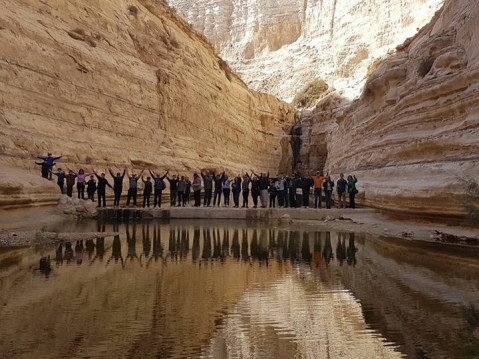
If someone were to ask me to describe the Orangetown Jewish Center, I might say to them, “Let me tell you about a group of people who traveled to Israel together. We are a microcosm of the greater synagogue community.”
We are a diverse group of people from age 6 to 89 who related to each other as one family. We are curious, ready to learn, and easily moved. We look out for each other and we sought the best in each other. Over the course of 10 days, we found it.

We love Israel with our eyes and our hearts wide open. We are proud Jews who accept that the Jewish people practice our faith in many different ways. We are proud Zionists who know that Israel is a complicated place, but overall, it is our home.
We have a lot of fun! And it goes without saying, we love to eat!
Today, Zalman asked us, “What did you come with and what are you taking with you?”.
I know that the pilgrims on this trip will continue answering this question for a long time to come. All of us are changed. We know more about Israel than when we first arrived, and we most certainly know something new about ourselves.
Coming here to Israel is a privilege. Our ancestors yearned to come to this land for 2000 years but could not and so we carry them with us whenever we come to Israel.
Maybe the next time OJC comes will be your time?

As the sun sets over the Mediterranean Sea, we are packing and getting ready for our final dinner before heading to the airport. We hope to see you at services at the OJC on Shabbat so that we can share our pilgrimage experience with you and celebrate the end of Chanukah together.
Chodesh tov and (almost) Shabbat shalom,
Rabbi Paula Mack Drill
 Three Rabbis Walk Into A Shul
Recent Comments