Three Weeks, Why?
What a lachrymose people we can be. In three weeks we will sit on the floor as mourners, crying about the destruction of a Temple two millennia ago. “How lonely sits the city that once was filled with people. She has become a widow. She cries alone at night, and tears scar her cheeks. None of her beloved are left to comfort her.” [Eicha, the Book of Lamentations] Isn’t it sad enough to fast and mourn through Tisha B’Av, the Ninth Day of Av?

But, no. Instead we position ourselves for ongoing sorrow. We establish a mood of mourning with no weddings or community celebrations for three complete weeks leading up to a crescendo of grief on Tisha B’Av. This period of time began yesterday with the fast of Shiva Asar b’Tamuz, the 17th of Tamuz, commemorating the day that the Romans breached the walls of Jerusalem in 70 CE, the beginning of the end of Jewish sovereignty for the next 2000 years.
Why do we do this? Why do we, as a religious people, enforce sadness?
One answer to this question can be found in the Talmud where we read, “All who mourn over Jerusalem merit to see her in her joy.” [B.T. Ta’anit 30b]. Commentators on this statement note that we do not read that we will see Jerusalem’s joy in the future; we read that we merit today seeing her in her joy. At a wedding, at the height of joy, we smash a glass to recall the destruction of Jerusalem. We are meant to truly appreciate the enormity of loss, the fragility of life, the precariousness of our plans and yet still embrace life. When we recognize how difficult life is and still insist on making meaning and contributions to the world, we thereby experience life in its fullness and joy.
In the Jewish Artist’s Way class this morning, one student asked about a heartbreaking realization. She explained, “Thanks to this class, I write my morning journal pages and plan an enjoyable artist’s date. I feel peaceful and creative. Then I listen to the news and hear about a world gone crazy. What meaning can my contentment hold in a world filled with violence and hatred? How can I harmonize these two opposing forces?
The wise answers that came from fellow classmates all derived from one central idea: we cannot fix things out of our control. But we can make the world a better place by staying present and appreciative. We choose to do what we can in our own corners of the world. We decide to be kind and compassionate and loving. To live in this world is to live in vulnerability and yet still be tender and courageous, thoughtful and creative.
The act of grieving teaches us how to be joyful. The act of remembering tells us that we can choose to reaffirm our faith despite the reality of life around us. Perhaps Judaism teaches us to mourn so that we can learn how to truly live.
May we all find profound meaning and also joy in the weeks ahead,
Rabbi Paula Mack Drill
The Honoring Months
We are in the midst of months of honoring. My calendar is filled with dinners and galas throughout May and June. Every Jewish organization in Rockland and New York State chooses worthy honorees and invites the community to attend and support. Our own Rabbi Craig Scheff was honored by the Jewish Community Center with the highly esteemed J-Award. Jewish Family Service, Rockland Jewish Academy, Holocaust Museum and Study Center, Torah Fund of Conservative Judaism, Israel Bonds and Federation of Men’s Clubs have all celebrated community members for their contributions. This past week I attended the Annual Meeting of the Jewish Federation of Rockland County to honor Melton graduates and Leadership Development Institute graduates. Many OJCers were among the honorees.


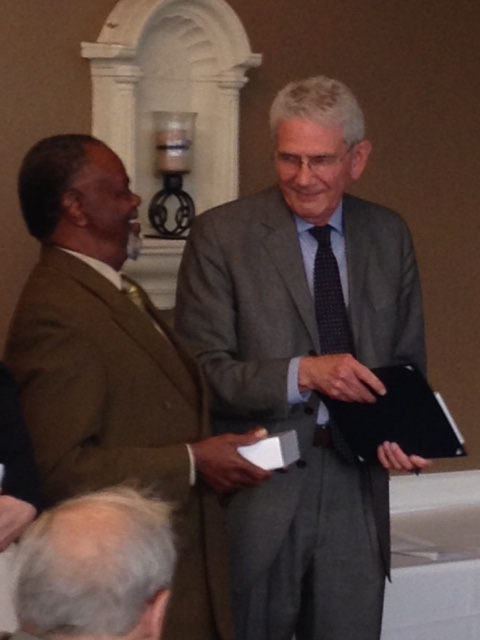
Rabbi Scheff and I attended the METNY USY Scholarship Dinner where our colleague and friend Rabbi Paul and Gerri Kurland of Nanuet Hebrew Center were honored. Organizations that are not Jewishly-based, of course, also honor people in fundraisers. This week I attended an NYCLU dinner honoring Oscar Cohen and Willie Trotman for their trailblazing work on behalf of the children of East Ramapo Central School District. NAMI Rockland, Jawonio, United Hospice of Rockland and the Center for Safety and Change celebrate their accomplishments with honorees.

It is such a hectic time of the year. As I plug yet another destination into my GPS, I often wish that I were hitting that top line “Go Home” instead. But I think of your rabbis’ attendance at these many communal events as our modeling a core value of the OJC. In Pirke Avot, Ethics of the Fathers, we read: Do not separate yourself from community.
The Orangetown Jewish Center is our home, but that home is buoyed and supported by a greater community where values are taught, new ideas are spun, important work is begun.
When we make our best effort to attend and support, we are saying that the success of the greater community is our success. Our hard work here at the OJC is just a piece of ensuring the vitality and vibrancy of our community.
And beyond the value of community, there is the value of simcha. Many days and weeks pass by with repeating schedules and commitments. Moments of joy are like punctuation marks at the end of run-on sentences! We look forward, we participate and then our spirits lift to a different plateau. We are present in many sad and difficult moments of people’s lives. How wonderful to balance the times of sorrow with times of celebration! Let these spring months of galas remind us to embrace opportunities to honor those we respect and love and celebrate with our community.
L’simcha, to joy, Rabbi Paula Mack Drill
Loss and Learning in Community

“I looked forward to seeing her in Spanish class eighth period every day,” began one girl. She’d always make me smile. When we talked, she’d brighten my day,” one eighth grader read. Another girl said, “She could always make me laugh even when I was in a bad mood.” Reading solemnly from their heartfelt letters, the children moved me with their innocence. The descriptions went on and on: She loved talking about movies and books. She was selfless, strong and kind-hearted. She always had a smile on her face. She would stick by you and support you one hundred percent.
These middle school children should have been writing these words on the autograph page of their eighth grade yearbook. Instead, they were memorializing Emily Levine who died suddenly last summer from an unperceived congenital heart defect, three months after she became a bat mitzvah at the Orangetown Jewish Center. (This past Shabbat was the anniversary of Emily’s becoming a bat mitzvah. Her sister Cara read from her Torah portion, Bamidbar.)


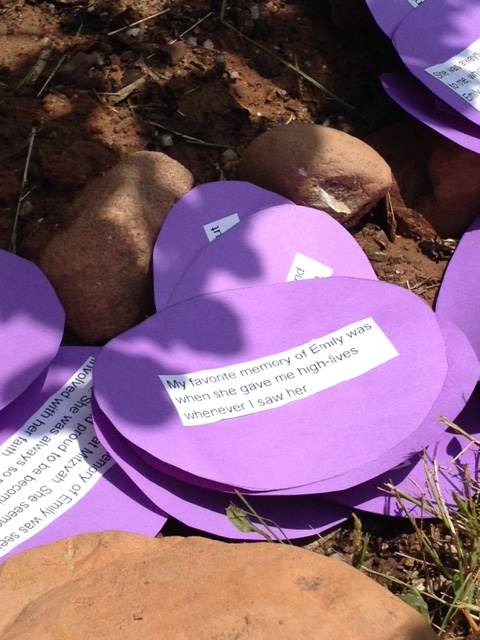
We stood in a circle around a flowering dogwood planted in Emily’s memory. Her friends placed purple circles with their thoughts of Emily around the base of the tree, like Jewish people visiting a grave and placing stones to show that loved ones remembered.
It was a beautiful ceremony, simple and sweet.
I wondered how these children will ultimately weave this experience into their lives. The sudden death of a thirteen-year old peer is shocking, unusual, inexplicable. Is the experience truly theirs to hold? Doesn’t Emily’s death and its inscrutable meaning belong to her parents Cindy and Marc and her sisters Cara and Jordyn? This ritual moment was one of thousands of moments of grief that Emily’s immediate family has experienced over this year. Doesn’t the loss belong to them?
I ached for these children, young and innocent. So many parents work very hard to protect their children from the harsh realities of the world. What need had the children of recalling the sorrow of loss?
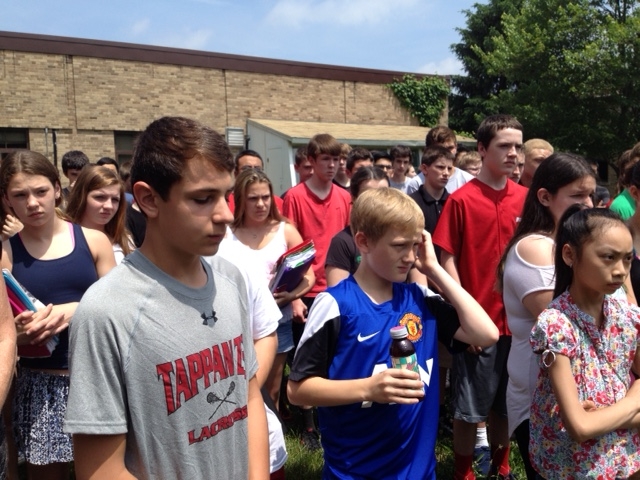
Jewishly, the answer to my questions is clear. Emily’s classmates need to learn that loss is a part of life. There is no turning away.
Rabbi Scheff’s yizkor sermon this past Monday on Shavuot brought comfort and more answers. Community, he said, provides us with a narrative to remind us that we are part of something bigger than ourselves. Yes, we must experience others’ sorrow when we are part of a community but we also experience their joy. And in so doing, our lives are broader and deeper than they would otherwise be. Rabbi Scheff was speaking about the Orangetown Jewish Center community but his words teach about all communities. At South Orangetown Middle School today, a class of eighth graders circled around a baby dogwood tree and learned that being part of a community is the only way we can live fully and completely, doing our part to make this world a better place, one corner at a time.

With blessings of the comfort that sweet memories offer, Rabbi Paula Mack Drill
Ben Shloshim, l’Koach
By a surprising coincidence of timing, this week I celebrated two thirtieth anniversaries. In Columbus Ohio, I celebrated the thirtieth year of the Wexner Foundation together with 1200 Jews who were graduates of the Israel Fellowship Program, the Heritage Program or, like me, were alumni of the Graduate Fellowship. I flew home on Monday night to drive into New York City for a two day Rabbinical Assembly celebration of the thirtieth anniversary of the ordination of women.
Why such a big deal about thirty? (Believe me, I ask myself that question as I consider that Jonathan and I will celebrate thirty years of marriage this May.) In Ethics of the Fathers, one chapter lists developmentally significant ages and identifies each with a unique characteristic: “At five, the study of Torah. At ten, Mishnah. At thirteen, responsibility for mitzvot. At fifteen, Talmud.” The list continues until it declares: “Ben shloshim, l’koach.” At thirty years, the age of strength.
A midrash asks why thirty is the age of strength. The answer begins with a list of those who rose to greatness upon reaching thirty: Joseph began to serve Pharaoh at thirty. Priests began service in the Beit Mikdash at thirty. David became King of Israel at thirty. Then the midrash asks: why at thirty did they rise to greatness? The answer is stunning: Because at thirty, they were humbled and heartbroken.
This teaching played like a leitmotif in my mind throughout four days of intense learning, listening and rejoicing. True leadership requires humility and vulnerability. At the Wexner conference, much of the message was about leading through change – change in our lives, organizations and the world. Yes, leadership requires optimism, grit, resilience, and creativity. But in order to respond to the fierce urgency of now, we must first and foremost cultivate empathy to the other.
I felt challenged by questions of how to move people from caring about an issue to acting on it. I understood that in order for Jews to sit in a room together, we must acknowledge that all of us think about our Judaism from our own prisms. Partners in leadership must be asked to fine tune skills and generously use their gifts.
Shimon Perez was the great anniversary surprise. He told us that Israel is not just a country. Israel, he asserted, is an idea. He promised us that there are two things in the world that we can experience only if we close our eyes a little bit: love and peace. The common thread throughout the Wexner learning was that the leader who can lead through change must be humble and vulnerable enough to recognize the potential greatness in others.
At the conference of the Rabbinical Assembly, we learned sweet Torah, discussed models of successful change, and heard from inspiring thinkers and teachers, including one of my heroes, Letty Cotin Pogrebin, in conversation with her daughter Abigail Pogrebin. We celebrated with great joy the change that affected the whole Jewish world thirty years ago when Rabbi Amy Eilberg (another hero of mine) became the first woman ordained in the Conservative Movement after years of halakhic and sociological study and debate.
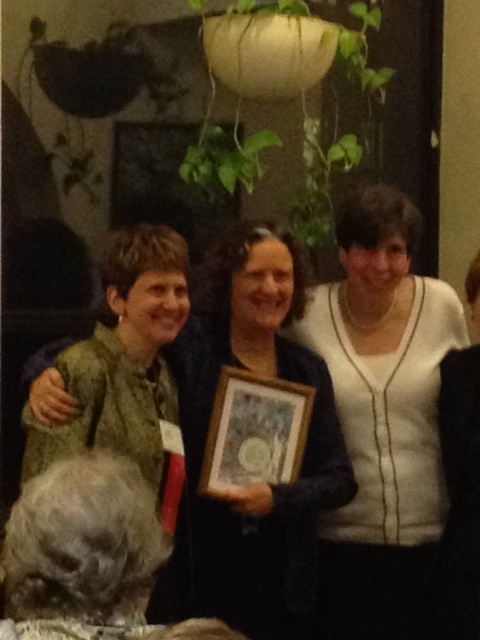

At the same time, we acknowledged that there is much work still to do in the arena of an equal place for men and women, boys and girls, in our congregations, schools, camps and communities. Rabbi Pamela Barbash taught that egalitarianism is not about women’s participation; rather, it is about increasing the adherence and participation of all Jews through obligation, study and mitzvot. I was reminded that women’s rise to a place beside men in Judaism would have never begun without the humility and vulnerability of men who became empathic allies to the cause as they studied and interpreted the Torah through the eyes of modern Jews.
Rabbi Scheff and I delighted in seeing OJC rabbinic interns, now our colleagues over these two days. We reconnected with friends and classmates, ate and prayed together, and recharged our leadership batteries. We’ll be teaching about the halakha, the sociology and the moral questions of the 30th anniversary of Women’s Ordination during Sisterhood Shabbat, June 19–20. We might even give you a version of the session that we taught about men and women as equal partners in pulpit life! Both rabbis look forward to sharing with our community the learning that filled us at the RA.
Kol tuv, All the best, Rabbi Paula Mack Drill
Keepers of the Flame
Consider the candle and how it can both define and defy the darkness. — Anne Frank
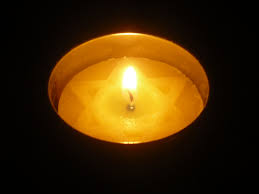
The sanctuary is silent and dark except for pages turning softly and six candles burning on the bima. Hour after hour, congregants come to serve as Keepers of the Flame, praying, reading, writing, honoring. It is Yom HaShoah, Holocaust Memorial Day.
After last night’s evening minyan, the Holocaust Committee facilitated a poignant, meaningful program. Congregants spoke about the OJC Kaddish Project, explaining how they had committed to knowing the story of a child killed in the Holocaust. They chose a yahrzeit date for that child and promise to light a candle and say kaddish for him or her every year. [For more information on the Kaddish Project, contact Sandy Borowsky ojcschool@gmail.com.] Sixth graders presented their stories, reports and posters about the Righteous Gentiles they studied. Rabbi Scheff chanted El Maleh and six candles were lit to mark the beginning of the twenty five hour vigil.

And now it is my turn.
It is uncomfortable to be in the sanctuary at 6:00 am when I yearn for sleep, but who am I to complain when I am here by choice, when the hours of a day are all left to my discretion?
It is a bit cold in the sanctuary, but who am I to complain when I can pull on a sweater, when the time of feeling chilled will soon end?
It is lonely here in the sanctuary, but who am I to complain when the ones I love are safe and healthy and right where they are supposed to be?
And then it is 6:45, time for morning minyan. Our prayers are an act of defiance.
I lay tefillin
with a silent minyan.
The sanctuary seems empty except for the ten of us.
Six candles are our witnesses.
We lay tefillin and daven shacharit
and fill our beautiful sanctuary
with six million souls who join us
as true witnesses.
We lay tefillin and daven shacharit and leyn Torah.
God enters the sanctuary with The Words,
quietly pleased, relieved that we remember.
God is the True Witness. Baruch Dayan HaEmet.
In ways mundane and transcendent, it is impossible to wrap my mind or my soul around the reality of the Shoah. The best path seems to stop seeking answers and focus instead on action: loving, whole-hearted actions anchored in the hope of a better world.
May their memories be for a blessing.
Rabbi Paula Mack Drill
Your Best is Good Enough
Many of us have powerful memories of our childhood Passover seders. Here is mine: Nana Edith bustles about the kitchen, finishing off the matzah balls, putting the hand-grated horseradish on the seder plate and arranging the vegetables around the gefilte fish. After a chorus of, “Sit down, Mom. Come and sit down,” Nana finally sits across the large dining room table from Poppy. We open our Maxwell House haggadahs and Poppy chants the Pesach Kiddush. I peek down toward the end of the table at my beloved Nana. She is snoring lightly, her cheek resting on her palm. We are ready to be redeemed from slavery. She is at last redeemed from the weeks of cleaning and preparation. But she is too tired to celebrate Passover.
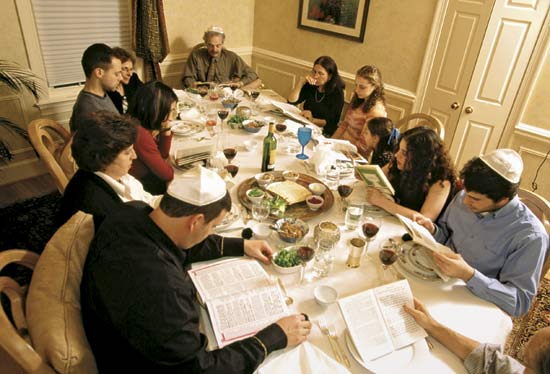
For generations, the great tradition of Passover has been all about missing the point. Too many of us get trapped into thinking that the main endeavor of the Passover holiday entails sweeping attics, vacuuming bedrooms, packing up half-filled bottles of catsup and shlepping boxes of dishes from the basement to cupboards emptied and scoured clean. And if we don’t turn our houses over according to strict Jewish law, we still manage to get caught up in the pressure of preparation. Our friends finish their Passover shopping the day after Purim and brag about three dozen matzah balls in the freezer. We worry about keeping the brisket from drying out and whether our sponge cake will rise as high as our mother’s used to do.
None of this is the main point.
The main point of Passover is that we were slaves in Egypt for four hundred years and God took us out with a strong hand and an outstretched arm. We are commanded to remember this narrative and teach it to the next generation, ensuring that the Jewish people will never forget our origins. We tell the story over and over about how we began as slaves to ensure that others do not suffer as we did. We marvel at all of the miracles God performed, plagues and parted seas, and we understand that we are surrounded by daily miracles. We are thankful to God for delivering us from Egypt and remember to be grateful for all the good that is ours.

Rabbi Yitz Greenberg writes about Passover in The Jewish Way: “By the magic of shared values and shared story, the Exodus is not some ancient event, however influential. It is the ever-recurring redemption; it is the once and future redemption of humanity.”
So, yes, I have been sweeping and vacuuming, packing and shlepping. I have resisted panicking over the masterful shopping of boastful friends but I am actually quite worried about the height of my sponge cake. How do I stay focused on the main point? First, I remember my own best advice regarding Passover cleaning and cooking mantra: “My best is good enough.”
Then, I remind myself that the physical preparation for Pesach is just a metaphor for the spiritual preparation with which I am meant to engage. At Passover, my soul is redeemed from the slavery of the everyday (think: calendars, iPhones, To Do lists, and unreasonable expectations). Once a year, in the month of Nisan, I remember that I am blessed with the greatest gift of all. I am free. I remember this truth every time I tell the story of the Exodus. And that is the point of Passover.
Wishing everyone a beautiful, freeing and meaningful Passover, Rabbi Paula Mack Drill
Travels with Aunt Sheila
Would a visit to Europe be possible for me without mixed feelings and conflicted responses to being a tourist?

To celebrate a significant birthday and to visit my daughter Sarah, Aunt Sheila and I traveled this past week to Budapest and Munich. I stayed in touch with the family on What’s App, sending descriptions of the sights and the people (and the food!) and pictures of the Opera House, the Chain Bridge lions and Sarah and her boyfriend Sagi.
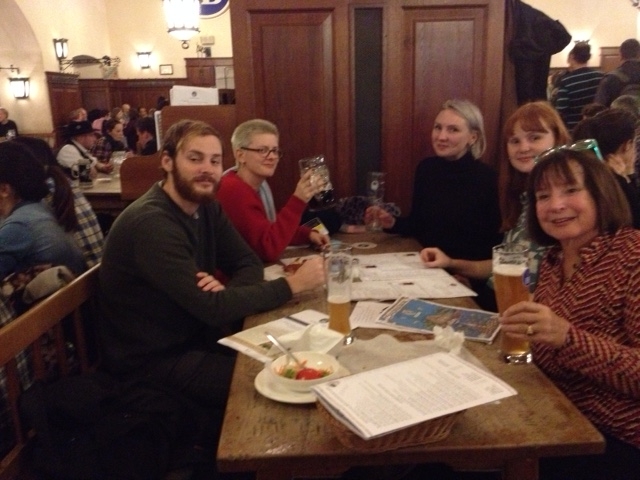
After Budapest, when Aunt Sheila and I arrived in Munich, I sent pictures of our adventure at the Hofbräuhaus and a description of drinking a beer and eating pretzels with young Australian backpackers, Meghan and Stephen. My son Josh responded to that day’s post, “How do you feel about enjoying yourself in Germany?”
Josh’s question resonated because it had been sitting in me, just under the surface since the trip began. It did indeed feel strange to me, very strange. Since the upsurge in threatening and deadly anti-Semitic events in many European capitals, it is clear to me that too many are ready to forget and even negate the lessons of the Holocaust. But even without these foreboding times in Europe, walking the streets of cities culpable during the Shoah has always seemed fraught with anxiety to me.
“Your brother’s blood cries out from the ground to Me!” How could I eat a rugelach and drink a latte in the very spot where Nazis tormented and desecrated the lives of my people? But should I not allow new generations to be absolved of the guilt of their parents? Do I desire all of Europe to be a silent, sacred burial ground? Where in this whole world could I possibly go where the ground below my feet would not have a bloody story of suffering to tell?
And so I accepted the fact of dissonance.
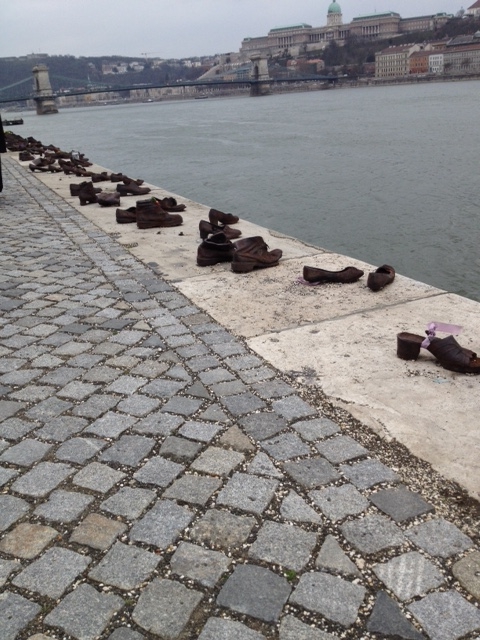
In Budapest, we enjoyed the view from St. Stephen’s Basilica and the thermal baths at Gellert. But we also read every plaque on every wall, judging its historical honesty. We toured the Great Synagogue and the Raoul Wallenberg Memorial, asking pointedly Jewish questions. We walked to the sculpture of shoes along the Danube where 8000 Jews were shot dead into the river by the Hungarian BRIGADE just before liberation. We stood in silence.

In Munich, we were charmed by the chimes of the Glockenspiel in Marienplatz and enjoyed the Museum of Modern Art. But we also traveled for the day to Dachau. Listening intently to the descriptions and voices of survivors on the audio tour, we walked every path, counting the empty outlines of barracks intended to hold 6,000 Jews and some political opponents and resisters. When the American Army liberated Dachau, 41,500 had been murdered and 32,000 living dead were housed there. Aunt Sheila wept during the documentary and I chanted El Maleh inside the Jewish Memorial.
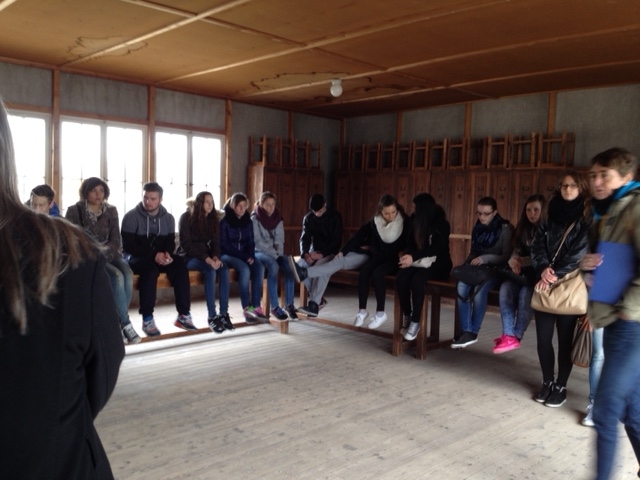

German student groups were with teachers and guides in great numbers. And inside the Maintenance Building that houses the museum, we turned a corner and suddenly met up with our “dear chums” Meghan and Stephen, the travelers from Australia. Aunt Sheila and I had to go to Dachau, we understood it as our obligation. But Meghan and Stephen chose to go to Dachau. When Aunt Sheila embraced them as long lost friends, I saw the way that their visit to Dachau redeemed the day.
People are capable of evil. Places like Dachau preserve the reality of that evil. And those who choose to understand the history of Jewish suffering in the Shoah will be our partners in fighting for the good.
When we got in the taxi to return to our hotel, the affable driver asked, “Did you enjoy your day?” Aunt Sheila answered, “It was not an enjoyable day, but it was an important day. It was a necessary day.”
Life is filled with conflicting ideas and emotions. To live a complete life, perhaps our job is not to avoid conflict but to learn how to live with it.
Thank you, Aunt Sheila, for a trip that taught me this lesson and so much more.

Snow Storms as a Metaphor for Life
Some Purim! As I begin writing this post, the OJC building is empty. It was supposed to be filled just about now with hundreds of happy kids in costume. The teens who planned the carnival are at home, disappointed… and yet…

This morning’s Purim minyan was cancelled. Rabbi Scheff, Hersh and I davened
with two other people and chanted from the megillah, our half-hearted “Boos” not doing much to blot out Haman’s name…and yet…
Tuesday’s Catch a Rising Star celebration in Religious School had to be postponed, and I know that I won’t have the chance to stand on my head for them until next year… and yet…
I’m looking out of my office window as more snow piles up on my car. I wonder if I’ll get home tonight. (I did!) Driving in the snow is never pleasant… and yet…
It has been a hard winter, true. It is easy to feel our energy depleted by dire forecasts of ice and snow and States of Emergency over the past six weeks and our optimism buried under inches of snow…and yet…
Snow reminds us that we are not in control of everything. A power greater than us is in charge. We humans tend to forget about God as we dash about in our lives, planning, controlling, building, accomplishing. I am not saying that I know what God is; rather, I am saying that I am not God. Snow reminds me.
Snow happens every winter and yet we bemoan its arrival. Illness, brokenness, loss and sorrow happen in every life and yet we cry out, “Why me?” Turbulence happens because we are not ultimately in control. So when difficult things happen, we can choose to see them either as a blessing or a curse. Or we can practice saying “and yet” and see everything as both – blessing and curse.
Rabbi Rami Shapiro teaches on the verse “See, this day I set before you blessing and curse…” [Devarim 11:26]:
If we truly see this day as it is, then we will see that it contains both blessing and curse, light and shadow, good and bad, suffering and joy. Most of us are conditioned to hope for the former and anticipate the latter. We call this being realistic. It isn’t. It is conditioned thinking that has nothing to do with reality. Reality is both blessing and curse. You cannot have one without the other.
So what are the “and yets” of the snowiest Purim in the history of the OJC?
Our teens were disappointed when safety dictated that the carnival would be cancelled for today, and yet they immediately started planning with Youth Director Sharon Rappaport to come up with Plan B. They learned an invaluable lesson about resiliency when dealing with the unexpected.
We had no minyan this morning, and yet dozens of congregants tuned into the live feed of the megillah reading provided by our Men’s Club. We received emails from congregants in New York who were snowbound and in Florida who are snowbirds, all rejoicing in being able to “join us!”
Religious School kids were disappointed by the delay in their annual talent show, and yet they’ll be celebrating this coming Tuesday instead.
Driving in the snow is never fun, and yet I arrived home safely. Lucky for me, I learned to drive in Maine by a father who made sure I knew how to turn into a skid and how to rock out of a snowbank!

How blessed we are to turn to a tradition that teaches us to see both blessing and curse, but to choose blessing!
With blessings to all, Rabbi Paula Mack Drill
Justice, Justice You Shall Pursue
Rabbi Abraham Isaac Kook said, “I don’t speak because I have the power to speak; I speak because I don’t have the power to remain silent.” From the beginning of my work with Rockland Clergy for Social Justice, I have felt the powerful call to speak out against the injustice being done to the children, their families, and the educators of the East Ramapo Central School District. In speaking out about the constitutionally given right to an education for all children in Rockland County, I have joined my voice to an interfaith coalition of Rockland clergy, to the congregants of the Orangetown Jewish Center, to all Jews who pursue tzedek (righteousness), and to all people of conscience.
Rockland Clergy for Social Justice (RC4SJ) is an interfaith coalition of Jewish, Christian and Muslim faith leaders who began working together over a year ago with a single unifying focus: the 9000 public school children of East Ramapo who are not receiving an adequate education that will prepare them to be successful citizens of our country.
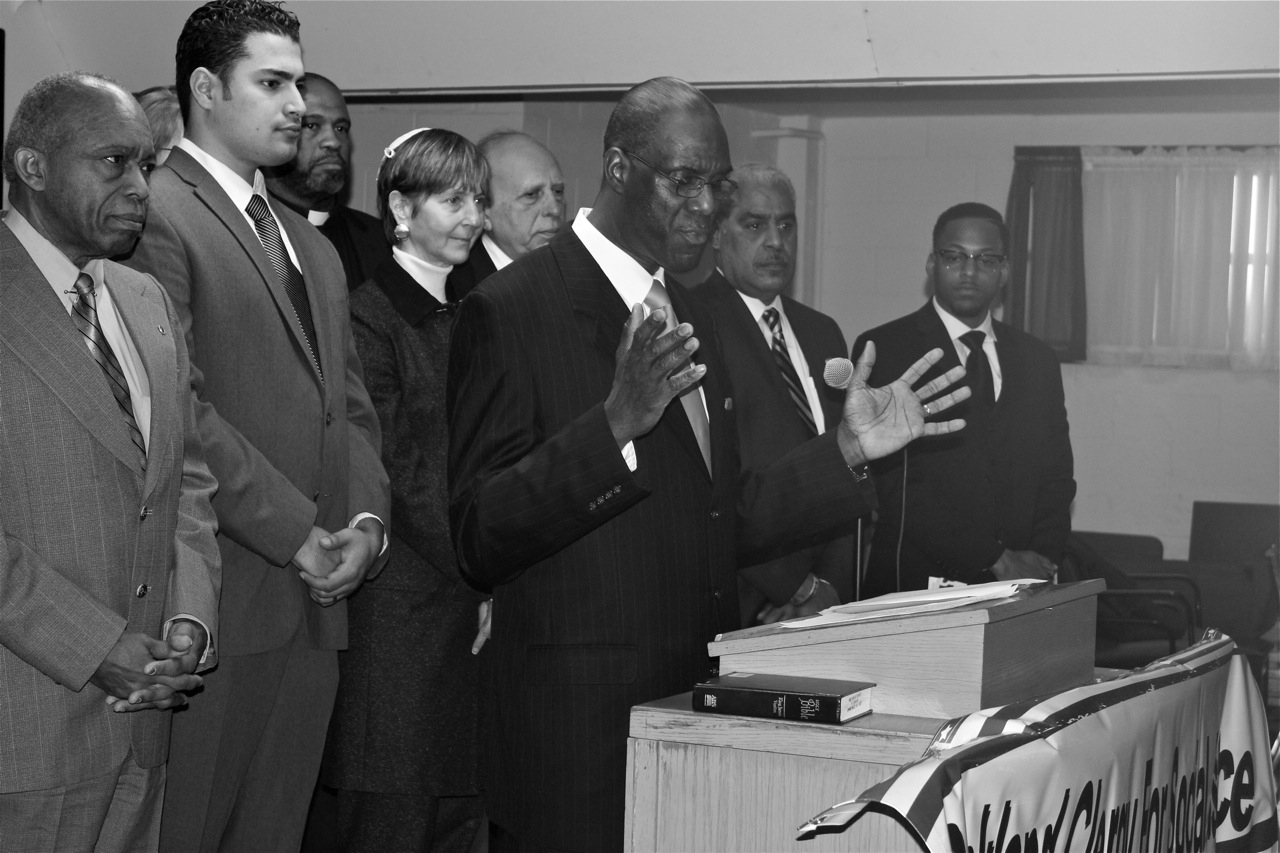
Today RC4SJ held a press conference at the First Baptist Church of Spring Valley to support the courageous work of State Legislators Ellen Jaffee, David Carlucci, and Ken Zebrowski. Since November, when special monitor Hank Greenberg presented his findings on the dysfunctional school district, they have been working to write legislation to ensure compliance with state and federal law, financial integrity and transparency and functional school governance. Our press conference, planned weeks ago to announce RC4SJ’s upcoming lobbying trip to Albany on March 3, coincidentally happened at the exact time that our county legislators introduced their bill. http://www.capitalnewyork.com/article/albany/2015/02/8562498/rockland-pols-introduce-east-ramapo-oversight-bill
The bill shows the commitment of Jaffee, Carlucci and Zebrowski to implementing both the spirit and letter of Hank Greenberg’s recommendations. To read the bill as it has been introduced, click here: http://open.nysenate.gov/legislation/bill/A5355-2015.

When I spoke at the press conference today, I began by recalling my feeling of dedication to 9000 children when I stood on the very same dais last year. 9000 seemed like a very large number, a compelling reason to stand up and speak up. Today, however, those 9000 children have become personal. Through my volunteer experiences together with fellow OJCers at the Kakiat School Early Childhood Center, I have come to know the children we are fighting for. Kindergarten children who need a full day of education receive instead two hours a day, one half hour of which is taken up with breakfast or lunch. The valiant, dedicated administrators and teachers at the ECC work to provide learning to children, who number thirty in a class without an aide. 9000 is not just a number. 9000 is Kiran, a bright, precocious five year old who would be reading chapter books already if he had more education hours. 9000 is Tyron, a child who has fine motor difficulties. I help him at the learning centers to hold scissors straight and cut paper. I wonder who helps him on the vast majority of days when I am not there. 9000 is Rosie, an imaginative little artist. My heart sinks when I think about Rosie entering grade school without art or music to continue fueling her curiosity. 9000 is not a number. It’s personal. https://www.youtube.com/watch?v=6CxColw3FnI
RC4SJ will be traveling once again to Albany on March 3, hoping to build on today’s momentum and seeking support from other legislative leaders and the Executive Chamber in Albany for the bill introduced today by Jaffee, Carlucci.and Zebrowski.
Last Friday, Governor Cuomo came to East Ramapo and bravely announced that he expected to sign legislation before June of this year. He said that he is grateful to special monitor Hank Greenberg for providing us with facts. I agree that having facts gives us with the leverage to create change. But facts are only the beginning. To see this through to a happy ending for the public school students of ERCSD, we will need passion, dedication to justice and clear vision of a moral high ground.
“Tzedek, tzedek, tirdof. Justice, justice, you will pursue.”
Rabbi Paula Mack Drill
Great Stories in the Great Book
I love a good story, don’t you? Author Stephen King says that there are books full of great writing that don’t have very good stories.
I hope it is not blasphemy to say that the Torah is just the opposite: not always such great writing but the best of all stories.

Let me suggest that the writing style of the Torah would not necessarily have passed muster with my seventh grade English teacher. The Torah is filled with poor editing, run on sentences, lack of transitions and confusing noun-verb match-ups. Throughout the ages, rabbis have gleaned meaning from repetitions, gaps, misplaced narrative and stylistic flaws and shared it all the commentaries and midrashim (stories from between the lines) that Jews cherish.
But good stories? The Torah is filled with good stories. Good stories are the ones that we remember. We remember them all our lives. We know the ending, but we still want to hear the story again and again. The Jewish people know that Adam and Eve are going to eat that fruit. Isaac is almost going to be sacrificed, but God stops his father at the last moment. Joseph is going to reveal himself to his brothers in Egypt after he toys with them a bit. We love to hear these stories again and again; we’ve been reading and reading and then re-rolling our Torah for centuries. The Torah is the word of God, but it would not endure without good stories.
This week we are poised between two of the greatest stories of our Torah. Last week, God split the sea for the Israelites to pass through and this week we receive Torah at Sinai. I thrilled last Shabbat when we stood together in synagogue to chant the Song of the Sea, and I am excited to stand again this week to hear the Ten Commandments. My love for Torah is something that I don’t often question. It’s kind of like breathing.

Last week, however, at Conversations with Clergy in the Community at Adele Garber’s home in Nyack, one of our congregants challenged my easy acceptance of the ultimate worth of Torah. He asked what Rabbi Scheff and I “get out of” studying Torah. Truthfully, we had to stop and think about it. Both of us answered in terms of the stories of the Torah, and our answers were like two sides of the same coin. Rabbi Scheff said that in the Torah we find the stories of our lives. The heroes of our narratives are not saints, not perfect gods. They are real people dealing with real challenges. The lessons of their stories teach us about coming closer to our best selves, to each other and to God. I said that in addition to learning from the real lives of realistic people, the stories of Torah connect us to eternal truths, to an understanding of what God expects of us.
In the Great Stories we know who lives, who dies, who finds love, who doesn’t. . . and yet we want to know again. In the Great Stories of our Torah, we have the opportunity to hear not only what we want to know, but what God wants us to know!
Join us at the Orangetown Jewish Center to learn from the greatest stories of the Greatest Book ever written. Come on Shabbat morning to learn from a sermon. Study every Thursday in Text and Context or on the second Monday of the month in Women of the Torah. This month, Rabbi Hersh is teaching creation narratives in Thursday evening Conversations with Clergy. Contact Rabbi Scheff or me if you would like a suggestion about which class might be best for you!
Meanwhile, I’ll meet you at Sinai!
Shabbat shalom, Rabbi Paula Mack Drill
 Three Rabbis Walk Into A Shul
Recent Comments