Simple Abundance in a Time of Lack
In a time lacking in truth and certainty and filled with anguish and despair, no one should be shamefaced in attempting to give back to this world, through her work, a portion of its lost heart. — Louise Bogan
As the crisis in Israel continues to unfold, I am feeling acutely aware of how much I currently lack. I lack peace of mind. I lack my typical sense of expansiveness and contentment. I lack a sense of wellbeing regarding those I love in Israel. I lack confidence about the place of the Jewish people in the world. I lack optimism about the United Nations and international leaders. I lack hope for secure borders and true peace for Israel in my lifetime.

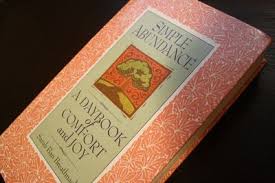
Perhaps it is Divine Providence or maybe just luck, but exactly now, when I feel the emptiness of that glass half filled, I am teaching a summer course at the Orangetown Jewish Center called Simple Abundance. In a class based on the book by Sarah Ban Breathnach, twenty-five students share Monday mornings as a time to focus on all of our blessings. Anchoring Breathnach’s work in Jewish values and texts, we talk about the principles of gratitude, simplicity, order, harmony, beauty and joy as a way to realize that we possess all that we need to be genuinely happy.
In Breathnach’s words: “When I surrendered my desire for security and sought serenity instead, I looked at my life with open eyes. I saw that I had much for which to be grateful. I felt humbled by my riches and regretted that I took for granted the abundance that already existed in my life.”
Just before teaching the first class, I thought that I could not possibly facilitate a learning experience about finding personal joy when Israel was in crisis. As soon as I began teaching, however, the connections being made and the kindnesses being shown shifted my understanding of what was actually taking place. In our corner of the world, we were bringing God into our midst and sharing ways in which we could be our best possible selves.
I cannot change the make-up of the United Nations Human Rights Council. I don’t know how to solve the complicated issues of Israel in her dangerous neighborhood. I cannot protect all of my children and friends in Israel from harm.
But I can do something. I can maintain my best self in the midst of the fear, anxiety and loss in Israel. It is so much easier to fall into despair. I realized through the path toward simple abundance that the courageous response to world events is to be optimistic and positive. Rabbi Scheff declared at our Kiddush time discussion about Israel this past Shabbat, “I am an idealist and I make no apology for that. When I give up hope, I might as well stop this work that I do.”
Be courageous! Reclaim optimism. Empower yourself by taking one small action for Israel and for yourself. Join us for the next Simple Abundance class on August 4th at 11:00 am.
Praying for the peace of Israel, Rabbi Paula Mack Drill
Israel Bonds Rabbinic Cabinet Mission, Day Three
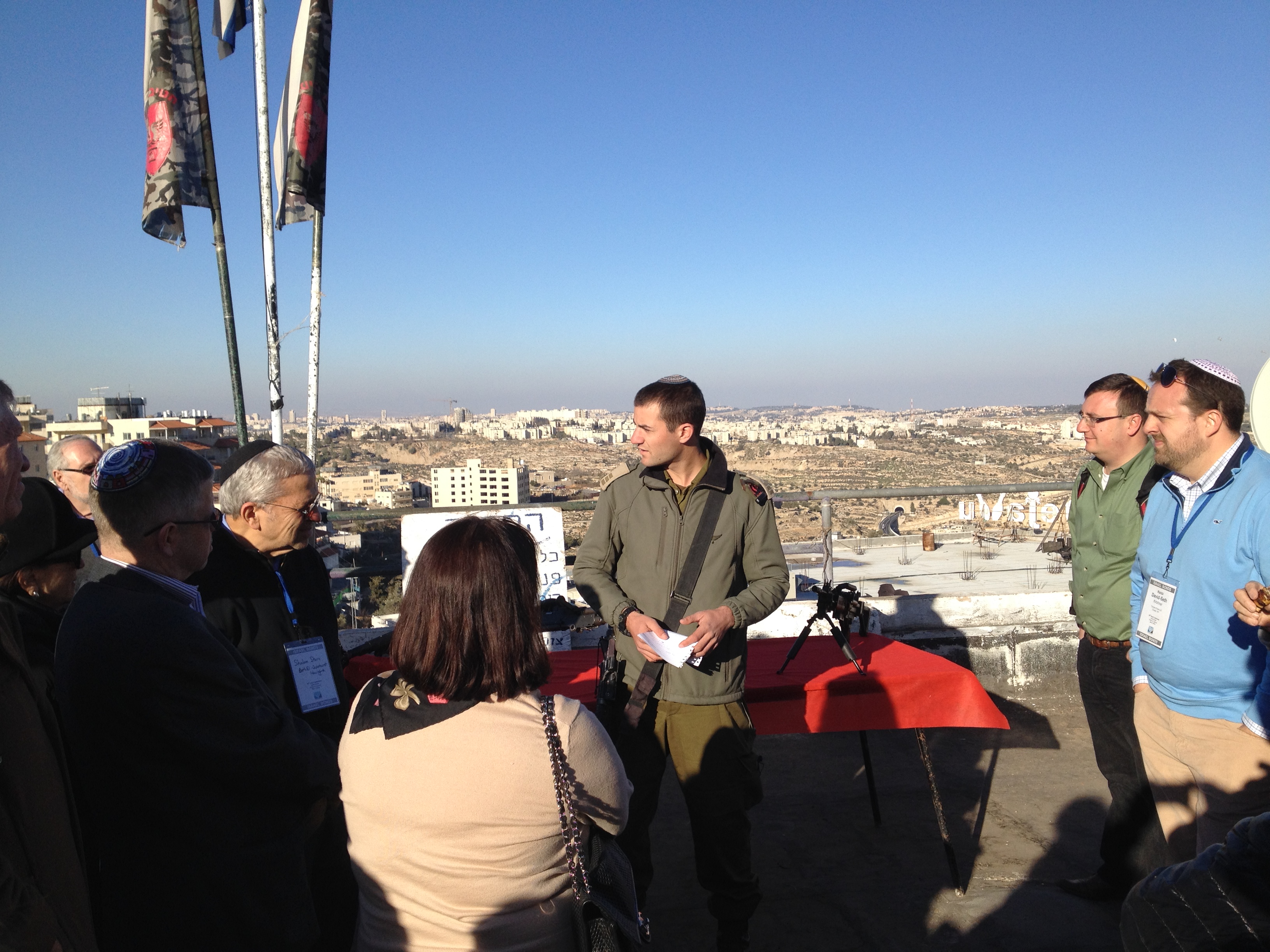
Israel Bonds Rabbinic Cabinet Mission, Day One
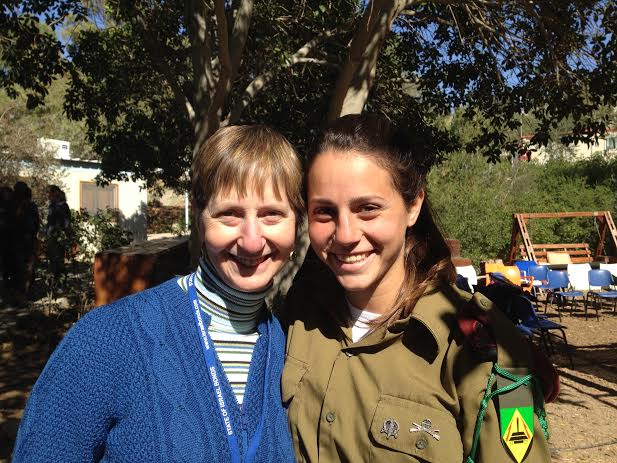
There are many reasons to be grateful for the gift of being in Israel: First, it is always a privilege to be here – something I never take for granted. Second, it isn’t snowing here in Tel Aviv (sorry, everyone!). Third, I get to see my daughter who is being released from her base for two days to join me on Wednesday and Thursday of this week. Those reasons are all valid and meaningful. Tonight, however, I am grateful for a different reason.
I am filled with gratitude because I am traveling with thirty-two rabbis of all Jewish streams with the specific purpose of gaining an insider’s view of the work that is accomplished in this country with the income of Israel Bonds. Rabbi Marty Pasternak, Executive Director of the Synagogue Division of Bonds, jokingly introduced us to the itinerary, pointing out that rabbis are going to love putting on hard hats and gaining entrance to construction sites. While I am sure that hard hats, flashlights and tunnels would float Jonathan Drill’s boat, it is the opportunity to learn and to make connections with rabbis that really make me excited about this mission.
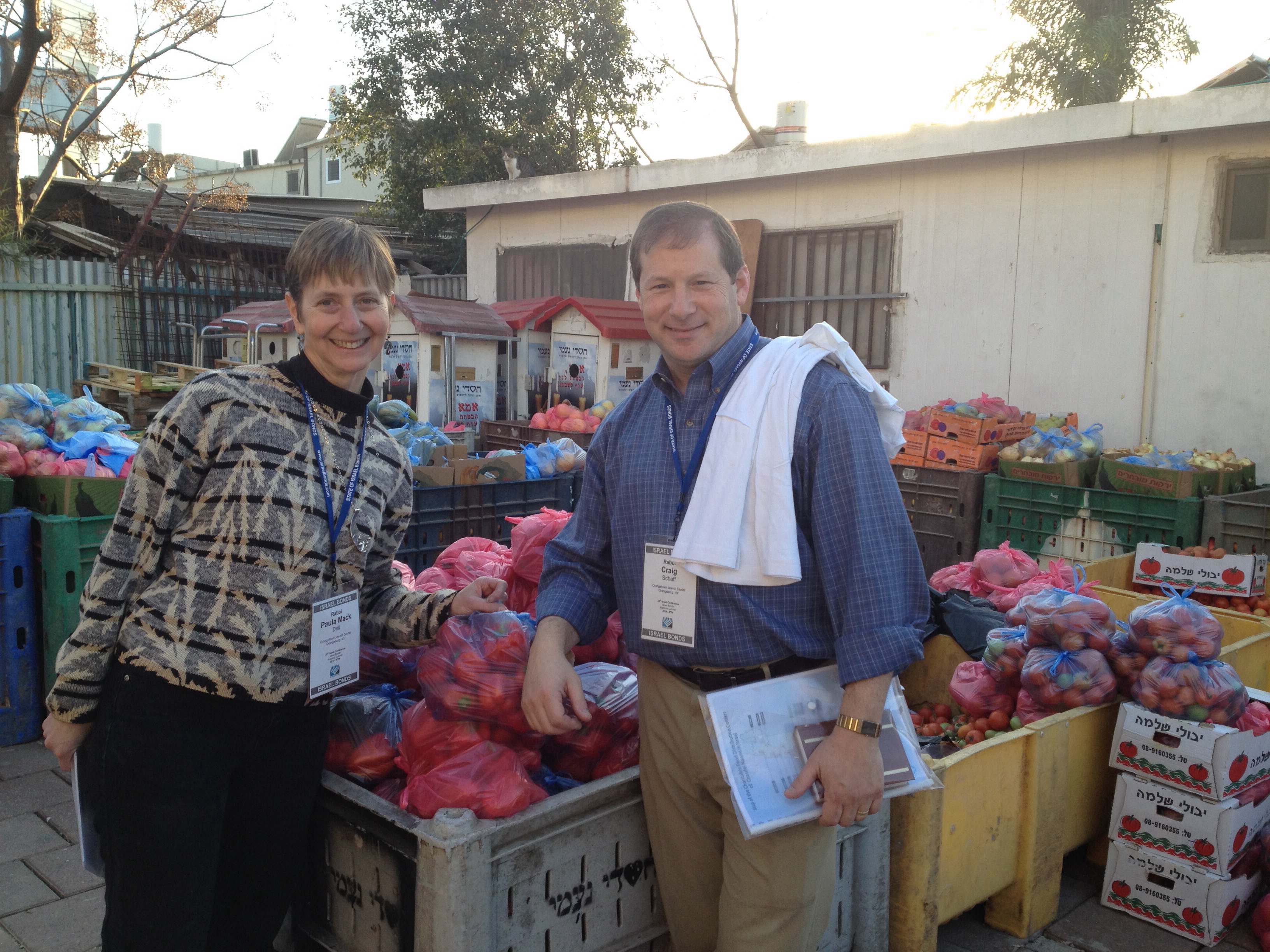
Our trip began with an opportunity for hands on chesed, an annual addition made to the itinerary by Rabbi Scheff. We visited one of the food distribution sites of Chasdei Naomi where we sorted produce and packed boxes of food staples for pick up by families in need. The work was satisfying but it felt like a mitzvah lifted higher by the introduction we received in a breathtaking talk given by founder Rabbi Yosef Cohen. Rabbi Cohen told us about growing up in the kind of poverty that one cannot understand unless one has known it. With tears of pure emotion, he shared stories of his youth that influenced him to found this agency that today distributes 300 tons of food to 10,000 hungry families, supporting Israelis in need with various kinds of assistance. For more information, see http://www.chasdei-naomi.org. Rabbi Cohen described bringing home a fresh loaf of bread and his mother’s putting it on a top shelf so that they would finish the older stale loaf before it went bad and precious food was wasted. He never had fresh bread as a child. Today he ensures that children do not go hungry. I was proud to be part of his mission, even for a few hours today.
There was, of course, much more learning, but you will all have an opportunity to hear many stories from Rabbi Scheff and me. For now, it is after eleven here with a 6:00 am wake-up call for morning minyan.
Laila tov from here and tzahariyim tovim there. Good night and good afternoon,
Rabbi Paula Mack Drill
Stop that Horse!
I love the story of the rebbe who sees one of his young students galloping through their town on the back of a fast horse. “Where are you going with so much speed?” calls the rebbe.
“I have no idea,” shouts back the young student. “Ask the horse!”

So often, this is exactly what life feels like for me! I have no idea where my life is flying to; I just hold on to my routines and schedules and To Do lists for dear life and they take me at full speed from day to day.
I was thinking about this story today because yet another snow storm called a halt to my full-tilt gallop. At home this morning with a sun-filled winter wonderland outside my window, I sat quietly and asked myself if I know the direction in which I am running. Note that I am not asking for a destination. I would just like to know that I am guiding the horse and not the other way around.
What is important and valuable enough in our lives to convince us to grab the reins and take charge? Can we change our routines just a little bit to bring something new into our days, something rewarding and meaningful? Can we find the way for Jewish living and connection to God to be at the center of our journey rather than another activity on the To Do List of our lives?
A congregant recently shared with me that she had been living life full tilt, but had forgotten to nourish her soul. She loves and cares for her family, does meaningful work, and takes the time to keep her body healthy. Her life is full and rich. She shared that she started to feel that something was missing and realized that she had not been in synagogue since Yom Kippur. She returned one Shabbat morning for a simcha and has been in services every Saturday since. “The quiet and the peace of the service gives me something I cannot otherwise find. I love my life, and take good care of myself physically, intellectually and emotionally. But I came to know that I must take care of my soul as well,” she explained to me.
This congregant reined in the horse. She asked, “Where exactly am I headed?” She reminded me to do the same, and I in turn pass on her wisdom to you.
B’yedidut, With friendship, Rabbi Paula Mack Drill
Lessons Learned from Loss
I dedicate my writing this week to the memory of Abraham Mordecai Akselrad, z”l
It is fair to say that I attend more funerals than the average person. I am usually in the room with the family tearing the black ribbon, standing behind the lectern, driving the first car behind the hearse in the processional. The honor of performing the mitzvah of kavod la-met (honor to the dead) or of nichum avelim (comfort to the mourners) is very great but it is also very difficult. As rabbi, I gain strength knowing that I can truly help in many ways: standing steady for a family when the world is tilting, explaining a ritual with compassion, educating a community about how to pay a shiva call, or calling a grieving daughter a month after shiva has ended.
This past week, I remembered with full force what it means to perform these mitzvot, but without the designation of “Rabbi” as I did so. I realized with humility how performing kavod la-met or nichum avelim as a rabbi provides a layer of protection to me as a person in such sad times.
Just before Shabbat last week, Jonathan and I lost a dear friend of thirty years after a heroic battle with cancer. Abe Akselrad loved life completely and fought for every day and every hour he could spend with his wife Claire, his four children, son-in-law, and two grandchildren. The entire community of our synagogue in Caldwell attended Abe’s funeral this past Sunday, and he was buried in a downpour.
As friend in the pews rather than rabbi at the podium, I learned many lessons that I want to share with you. I believe that in the OJC community, we are supportive, appropriate and understanding of the laws of mourning and comfort. But we can also improve and grow. In that spirit, I share my learning of this past week.
One of my friends called me on Friday midday and asked how she could help the family who were overwhelmed by people stopping by with their sorrow, their condolences and their fruit platters. I suggested that they hang a sign on the door: “According to Jewish custom, it is not traditional to visit a family until after the funeral has taken place.” When Jon and I entered the funeral chapel, we saw long lines waiting to enter the room where the family sat before the service. We chose to enter the chapel directly instead and sit quietly. After the service, I saw friends clinging to Claire, crying with her, when I thought that she probably wanted to just get into the limousine and prepare herself for the cemetery. I thought about the way all of us have a need to ensure that the bereaved know we are there for them. Sometimes our need to be known outweighs common sense about what true comfort means. Claire and her family would never complain. I know that they have felt the love of family and friends. My first lesson is that all of us need to check our motivation in comforting very carefully: are we acting out of our own need or what we believe to be the needs of the bereaved?
As Jonathan and I sat in a row waiting for the service to begin, we were joined by friends from the Caldwell synagogue. At the end of my row was our friend Rabbi Michael Jay. Both of us have been well-schooled by Rabbi Scheff to sit silently in the presence of the dead. As rows all around us filled with chatting people, our row, anchored by Michael’s and my respectful silence, remained relatively quiet. The second lesson is that we can carry our learning wherever we go and model behavior that shows compassionate understanding of mourning ritual.
Presiding at the funeral was Rabbi Alan Silverstein of Congregation Agudath Israel, the Drill family’s rabbi for more than thirty years. He spoke about Abe as a congregant and as a cherished friend; he presided at the baby namings and bris and b’nai mitzvah of all four Akselrads, and at the oldest, Aviva’s wedding. His words brought comfort and an uplift of the heart not just because they were beautiful, heartfelt words, but because Rabbi Silverstein was speaking from a true relationship with the family. The third lesson I share today is that I came away from the funeral affirmed in the rabbinate that Rabbi Scheff and I have created at the Orangetown Jewish Center. We know you. We know your passions and your sorrows, your celebrations and your questions. “Relationship” is the mantra of our rabbinates. . . and for good reason. Truly knowing you allows us to be there with our full selves, as rabbi and as person, in your greatest joys and times of need. If we don’t yet “truly know” you, call one of us for a cup of coffee or a meeting at the shul. We do not want to wait for a time of loss to establish our relationship with you. Visit with us to make a meaningful relationship so that we can continue to build our community together.
Shabbat shalom, Rabbi Paula Mack Drill
Celebrating December 25
The answer to your question is: “Yes, of course we had Chinese food!” The Kosher Chinese take-out was bustling and I heard a call from the back that they had run out of vegetable lo mein and General Tzo’s chicken. Luckily, I had called my order in two days earlier. And yes, we saw a movie too.
Before these traditional Jewish ways of celebrating Christmas, however, my family participated in a newer tradition. It is one that I hope catches on. We volunteered our time. At lunchtime, we visited a nearby nursing home where we transported residents to physical therapy and to a music program. I fed lunch to residents in a dining room where they were short-staffed. As I fed them lunch, I sang to the residents and responded to their questions and reminiscences. Even if they were confused, I found a way to honor their communication. One of our friends and her seven year old daughter played many games of Checkers and Gin Rummy. I am certain that our acts of kindness made a difference in the days of these elderly nursing home residents.
It occurs to me, however, that the most important recipients of our chesed might have been the staff. Everywhere we went in the building, we asked the staff, “Do you celebrate Christmas? Thank you for your work today.” We were asked why we had come to the nursing home, and our answer of coming to help on a day that was someone else’s holiday was met with delight.
I was thinking about my experience at the end of the day (yes, pleasantly full of vegetable lo mein!) and found an article in The Forward written by our good friend Rabbi Jesse Olitzky, one of the rabbis at the Jacksonville Jewish Center in Florida. Most of us remember Rabbi Olitzky as one of our treasured rabbinic interns here at the OJC. Rabbi Olitzky wrote: “Instead of taking the day off because others are celebrating their holiday, make it a day of meaning, a day of doing good, and a day committed to repairing the world. . . Before you take advantage of a day off, make it a day on by helping others.”
I add just one more thought to Rabbi Olitzky’s wisdom: Don’t wait for next December 25 before you find a way to repair just a small corner of the world. Many of our congregants volunteer in beautiful, quiet ways: reading to a person who is blind, visiting with a congregant in a rehabilitation center, clowning around in hospitals, sorting clothing and home goods at People to People. If you need ideas on how to participate in acts of Chesed, contact me at Rabbi.Drill@theojc.org. I’ll be proud to put you in contact with our Chesed Committee, Helping Hands or one of the many worthwhile organizations and institutions here in Rockland County. Make it a secular New Year’s Resolution to volunteer your time and skills! You won’t believe how good it feels!
Women Rabbis Lean In at JTS
I was one of sixty women, all members of the Rabbinical Assembly of Conservative Judaism, who gathered at the Jewish Theological Seminary on Monday and Tuesday, December 9 and 10 to connect, learn and replenish our minds and souls. The title of the conference was “Leaning In, Leaning Out, Learning from Each Other.” The learning, prayer, and opportunity to connect were all valuable.

But that is not what is on my mind as I think about the conference in the days since it ended. I am thinking about what it means to be present, completely and wholly present. In her opening talk, Rabbi Amy Eilberg, the first ordained woman of the Conservative Movement of Judaism, explained to us that her work has been about cultivating compassion. That work, she asserted, can only happen through true listening, through being present to another and thereby to God. She reminded us that careers in the rabbinate are guided by what we believe God wants of us more than by ambition.
I spent the rest of the day asking myself how I could ever know what God wants of me. As I listened to fellow rabbis, talked in small groups, and took notes, I asked myself the question about what God wants. And then the answer came to me as I pictured myself in our sanctuary at the OJC. Above the ark, the words are carved: “Shiviti Adonai l’negdi tamid.” I place God before me always.
I can know what God wants of me by being quiet enough, in the sanctuary of my soul, to listen. And to do that? I must be present. I must be in the moment with each of you, with the children of the Religious School, with the youngest children and their grown-ups at Early Kabbalat Shabbat. I must be fully present in your loved one’s hospital room, at your kitchen table or across the table from you at Starbucks. I must be present in the moments we share on the telephone.
And then, at the end of our moment, I must listen to my soul deeply enough to reassure myself that I am doing what God wants of me. Did I listen to you? Was I fully present to you?
It is not easy to be fully present in the year 2013. As we rabbis sat in a room, sharing our dreams, our insecurities, our prayers, many of us focused on the faces of whoever was speaking. If I place God before me always, then I must look for God in the faces of my fellows.
But a great number of us were typing away on i-pads, laptops, phones. Several in the room were tweeting. A difficult conversation erupted about this fact when confidentiality was breached with tweets that quoted what specific women were saying. Those who were tweeting defended their actions by stating the importance of sharing what was happening in the room with the public. I wonder how we can be in this moment, however, when we are already shaping it to share it with a nameless public. I understand that tweeting is meant to connect us, but doesn’t it distance us instead?
One rabbi said that she is more focused when she is tweeting than when she is just listening. There is a difference, however, between being focused and being present. Rabbi Eilberg had just told us that we must remember to be present to others. The result of the conversation was to shut down the tweeters. Sometimes it is valuable and important to get the word out. I understand the value of social media; after all, here I am blogging to you all! But sometimes it is much more important to get the word in. Lean in, lean out. Utimately, we chose to lean in, to lean within, to be present to each other and to ourselves — with the hope and prayer of being present to God.
Gratitude, Light and Miracles at the OJC
Like you, I cannot count the number of emails and posts I have received regarding the confluence of Thanksgiving and Chanukah this year. Before I delete them all from my in-box or my attention, I want to consider the importance of this week for us as Jews, Americans, and members (or friends) of an amazing synagogue in Rockland County, New York.
GRATITUDE: Two holidays falling together on one day helped me ponder the gratitude I feel about being an American who is free to be an observant Jew. In our family, we take turns around a table filled with three generations, sharing what we are thankful for. This year, we then turned to a chanukiyah sculpted by my father-in-law and chanted the blessings of the holiday. We had too much to eat, laughed at family stories told year after year and held quiet conversations to catch up with family members who live far away. We are blessed and recognized it with thankfulness.
LIGHT: The rabbis taught that the soul is God’s candle. When we kindle the lights with the shamash each night, it is clear to see the wisdom in this teaching. The flame is not diminished in the least as it touches the wicks of each night’s candle, causing each one to light. So too with us. When we share the light of our unique souls, we are not diminished in the least. Rather, we spread light to others.
MIRACLES: This past Shabbat, Rabbi Scheff spoke about the requirement of human initiative to bring about miracles large and small in our day. Consider the fact that Mitzvah Day has turned into Mitzvah-Week-and-a-Half and we can see how many congregants have taken the steps to bring about moments that should not be taken for granted.
Mitzvah-Week-and-a-Half began on Sunday, November 17 when a dozen congregants joined Rabbi Scheff in Israel for the annual Orangetown Jewish Center Mitzvah Mission. Members of the group carried with them cozy hats knit by our congregants for children in Kfar Ahava, our beloved residential program for children who must be removed from abusive or neglectful homes. Watches were wrapped with gift cards created by our sixth grade Religious School students as b’nai mitzvah gifts for the children. Teenager Tamar Weinger (traveling with her dad) brought rainbow looms with her and taught the children how to make the bracelets that are all the rage. Members of the Mission spent important time at the residence, renewing bonds, assisting children in a mitzvah project of their own, and celebrating the milestones of Kfar Ahava. They also volunteered with Leket Yisrael and toured a handicap-accessible nature path in the north. I hope that you read all about the adventures and miracles created by our fellow congregants in Rabbi Scheff’s daily letters from Israel.
Like all important Jewish days, Mitzvah Day began at sundown of the day before. Young children and their grownups gathered with Rabbi Ami and Loni Hersh and their boys for Havdalah and a movie. While the kids were engrossed in the movie, the adults created blankets for hospitals and nursing homes.

At the same time, our Ruach group (grades four and five) led by April Kupferman met to bake for the homeless.
Mitzvah Day, November 24, was an example of the OJC at its very best. A dozen congregants were trained in CPR at the Orangetown Ambulance Corps while one hundred congregants donated blood.
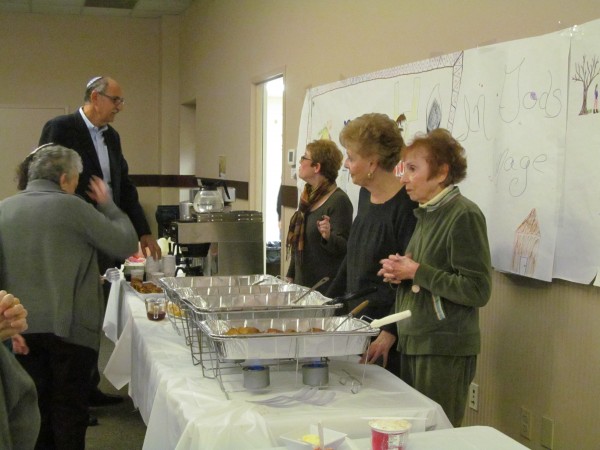
After a breakfast and presentation about Leket Yisrael, congregants participated in a variety of activities in the synagogue as well as at a local nursing home, the Hi Tor Animal Shelter and the Salmon House, one of the Jawonio Group Homes for adults with disabilities. In each gesture and interaction, our congregants were empowered to know that they can change the world. We can argue over the definition of “miracle” — but to me, the day was miraculous.
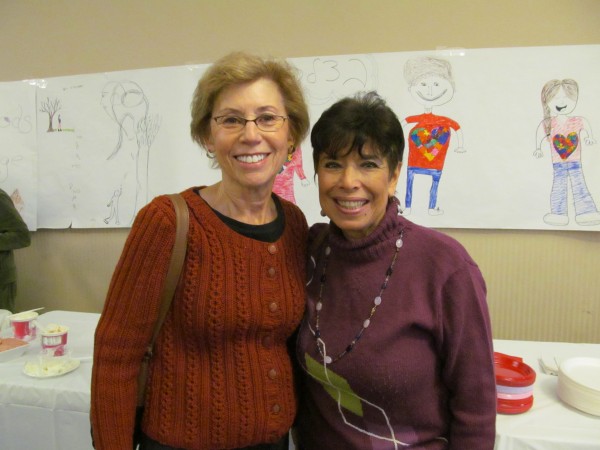
Kol hakavod to Lorraine Brown and Carolyn Wodar and their amazing team of volunteers for creating a meaningful, successful day.
We didn’t stop there! Tuesday evening, November 26 was the OJC’s first hosting for Helping Hands of this new season. For eight years, we have participated in this important interfaith Rockland County initiative that provides warm, dry places to sleep and hot meals to people who are homeless in our neighborhood. OJC takes it to a different level under the enthusiastic guidance of Gabi Lewy, Geof Cantor, Jack Teadore, Susan Edelstein and Bruce Machlis who gather a large crew of volunteers to shop, set up, cook, greet and stay overnight (thank you Bruce and Liza Machlis!). Helping Hands guests at the OJC experience gourmet meals, donated warm clothing, and the respectful friendship of a crew of teens who participate year after year.
Opportunities for your own miracle making abound at the OJC! Contact Adele Garber or Maddy Roimisher to find out how you can give your time and energy to the Chesed Committee. Maybe next year, when Thanksgiving and Chanukah no longer coincide, I’ll be writing about Mitzvah Year instead of Mitzvah-Week-and-a-Half!
Join us on Tuesday, December 3 from 6:30 to 7:30 pm as we light Chanukah candles together as our amazing OJC community celebrates our countless miracles!
Rabbi Paula Mack Drill
Prayer for the People of the Philippines
This past Shabbat, we shared a kavannah (intention) for the people of the Philippines.
How often we read the words of liturgy or psalms and let them roll over us rather than move through us. This week, when we read from psalms, we read the verses with a different consciousness and a more attentive heart.
We read in Psalm 107: By his word God raised a storm wind that made the waves surge. Mounting up to the heaven, plunging down to the depths, disgorging in their misery, they reeled and staggered.
What did King David see or know to give rise to such words? From the anguish of his outpouring, we understand something about the tragic results of a terrifying and powerful storm in the Philippines this past week. Let us not consider Typhoon Haiyan as one more news item that moves quickly from the front page and from our attention. Let us stay vigilant to the tragedy of the moment for the people of the Philippines, survivors there and worried family members here and around the world.
Let us turn our prayers to all those affected by the devestation. We pray for their courage, resilience and optimism. We pray for those bringing aid: food and shelter and kind words. We pray for the wisdom of world wide leaders as funds raised for this island find their way to those in need.
We pray for our own broken hearts to remain open to the needs of those around us whether far or near. We remember that all people are created in God’s image. May the holy spark within each person give light to all those in need.
Together we say: Amen.
Mentoring as a Commitment to the Future
This past week, I traveled to Seattle, Washington for a site visit to Hertzl-Ner Tamid Congregation where Rabbi Jill Levy serves as Director of Congregational Learning. Rabbi Levy, ordained three years ago, and I have been having monthly mentoring sessions this
year by phone as part of a commitment by the Wexner Foundation to sustained and purposeful mentoring. As most of you know, Rabbi Scheff and I have consistently mentored JTS Rabbinical School students and Davidson School of Education students for the past six years. (I myself am a product of being mentored by Rabbi Scheff when I was a fourth-year student.) The art of mentoring demands time, thoughtful processing of experience and a willingness to look at our own practice on a daily basis. Why do we do it? Beyond the gifts of future rabbis and educators bringing their enthusiasm and energy to our community as they learn, there is also the gift of your two rabbis' putting a stamp on the future. We feel strongly that what we are doing in our Conservative synagogue here in Rockland County is inspiring and also portable. Something very right is happening at the Orangetown Jewish Center in Orangeburg, New York. In John Gardner's well-known book On Leadership, mentors are compared to farmers. "Mentors are growers... good farmers rather than
inventors or mechanics. Growers have to accept that the main ingredients and processes with which they work are not under their own control.
They are in a patient partnership with nature, with an eye to the weather and a feeling for cultivation."

As mentors, we hope to help identify upon what those successes are based and help our students figure outhow to re-create these successes in their own way. Serving as a mentor to one student at a time means that we are establishing positive energy for the future of Conservative Judaism.
This mentoring business is truly holy work! Our many congregants who take the time to get to know our interns each year, to teach them, to learn from them and with them, are a part of this incredible process of committing to the future!
Rabbi Paula Mack Drill
 Two Rabbis, One Voice, Three Opinions
Recent Comments