The Gateway to a New Year
There’s nothing like a fresh pair of eyes, or four pairs, to get a new perspective on the things you take for granted.
Last week, I had the pleasure of hosting one of my Israeli sisters, along with her husband and two sons, for a few days of New York-style fun.
On Tuesday morning, we toured the USS Intrepid Museum. I’d been there just last year, but seeing the exhibits through the eyes of the Israelis, I was struck with a new sense of pride. We marveled at the stories of courage, ingenuity and sacrifices of the many Americans who have served our country in air, at sea, and in space.

Next, we visited the Statue of Liberty, and I was reminded that Lady Liberty was not erected to represent a person; rather, she is there to represent an idea.

From the pier we walked west on Fulton Street. As we headed towards the Freedom Tower and the 9/11 memorial, I couldn’t shake the memories in my head, images of ash-covered people walking the streets like zombies on a Tuesday morning 17 years ago.

The Twin Towers once stood like a gateway to our land, much like the two mountains between which the Israelites marched as they entered the Promised Land, with blessings pronounced to them from one and curses from the other. They too represented an idea; to me, they represented the indomitable spirit of America. That same undying spirit is represented today in the energy of the descending memorial pools and in the tower that now skyrockets to the heavens to accompany the souls of all those lost on that tragic day.

For the past 15 years, I have stood with fellow local clergy and Tappan’s first responders in remembrance on the mornings of 9/11. This year, I pray they will forgive my absence from the public ceremony, and I hope our non-Jewish neighbors will be reminded that the Jewish community means no disrespect by its absence, as it will be busy celebrating its holy day of Rosh Hashanah.
That being said, I hope you will join us this second day of Rosh Hashanah during our service to give honor to the memory of those who died, to pay tribute to those who secure our safety and our freedom, and to express our gratitude for the blessings we share as Jews in America. Sometimes we take for granted the lives we have in this country, as Americans and as Jews. Sometimes, in the thick of the public debates and political rancor, we forget the good that is all around us.
If you plan to be with our community on the second day of Rosh Hashanah, please consider arriving early, even if it means you’ll leave earlier than usual. We will be interrupting our regular service to make space for communal and individual remembrance with silence, song and shofar. Be on time (8:30am) to honor the day and to participate in our commemoration and prayer.
May our Rosh Hashanah usher in a year that brings us healing, wholeness, peace, and an appreciation of all our blessings.
Rabbi Craig Scheff
Incest, Ethics and Yom Kippur
Over the past year, our synagogue’s Committee on Jewish Living and Ritual, along with anyone else so motivated, has engaged with me in a monthly study of the traditional Torah reading assigned to the afternoon service of Yom Kippur, and of the approved alternate reading found in many high holiday mahzors. The goal of this process was to arrive at a decision as to whether our community should keep to the traditional reading or adopt the suggested alternative. While it is solely my responsibility as Mara d’Atra (“Teacher of the Place” or Halachic decisor) to make a final determination, I did not want to do so without considering input from those people who were seriously engaged with this question.
So what’s the big deal, you might ask? I realize that most people are not even present to hear the reading that takes place just a couple hours before the blowing of the shofar, when the majority of us are busy passing the last part of the fast day with a nap. The fact is, however, that since the time of the Talmud some 1500 years ago our traditional communities have been reading the same passage, Leviticus 18:1-30, during the Yom Kippur mincha (afternoon service). This reading follows closely on the heels of the passage we read Yom Kippur morning, which details the service of the High Priest and the Yom Kippur ritual of atonement.
The traditional afternoon reading of Leviticus 18 does not, however, contain a readily apparent connection to Yom Kippur. The passage focuses on guarding against the adoption of our neighboring cultures’ illicit and immoral practices. Specifically, the assigned portion details prohibited sexual unions, including the prohibition that a man may not lie with another man in the manner that he lies with a woman. The Torah seems to be giving voice to its revulsion at the erotic components of pagan society centuries ago.

In rationalizing its place in our service, commentators have pointed out that just as we focus on our spiritual purity and renewal of our relationships on this holy day, so must we recommit ourselves to examining our conduct in our most intimate relationships.
There is no doubt that the social and sexual mores of that time certainly influenced the choice of this passage for this particular occasion. Note, the Torah does not dictate the reading for Yom Kippur; it is the Rabbis (men) of the Talmud who did so.
Clearly, we don’t simply skip or excise passages of the Torah that make us uncomfortable. We confront Leviticus 18 as we read the Torah throughout the year, and we wrestle with it to make sense of it in our day and age. Its relation to Yom Kippur, however, has been called into question. And an alternative reading of Leviticus 19 has been included in many mahzors.
Leviticus 19 commences with the command “Be holy, for I the Lord your God am holy.” The passage contains Judaism’s central ethical teachings, detailing the kinds of behaviors that we should strive to adopt in order to achieve lives of greater holiness, and concluding with the command to love your neighbor as yourself.
The argument has been advanced that, whereas the reading for Yom Kippur morning is about ritual purity, this alternate afternoon reading provides a complement by stressing the importance of ethical purity. For those seriously engaged in self-reflection and atonement, an examination of our personal ethics certainly seems like an important endeavor.

Change should never be made simply for the sake of change or convenience. That being said, we should not avoid all change simply because we fear the slippery slope. Change in custom may be warranted when enforcement of the status quo has the consequence of undermining the purpose of the custom.
As a reader of Torah, I have never been comfortable reading about incest and bestiality on Yom Kippur to a tired and hungry crowd. It does not enhance my experience of the day in any way; and I think my feelings mirror those of the majority of people who attend this particular service. On the other hand, reading about the kinds of behaviors I must cultivate in order to be a more ethical person feels like a far more relevant and inspiring pursuit for this particular day.

At the end of our year of studying the issue, my “advisory board” voted in favor change toward adopting the alternative reading of Leviticus 19. But as I stated above, the decision is mine alone.
There is no doubt that I find the content of the alternative reading more suitable to Yom Kippur contemplation. And there is no doubt that I place value on the process of change itself; it trains us to guard against complacency. But the ultimate reason for my decision to adopt this change is my desire to capitalize on an opportunity. On the one day of the year that finds more of our constituents in synagogue and exposed to Torah, I hope we will be captivated in greater numbers by the beauty and relevance of Torah in our lives. I hope we will be inspired to examine our interactions daily, and recognize the ways in which the ethics of Leviticus 19 inform the most mundane aspects of our lives.
With this in mind, perhaps you’ll join us for mincha on Yom Kippur at 5:15pm for a short Torah study and the reading we are implementing. And perhaps you’ll consider picking up a Bible and studying the Holiness Code of Leviticus 19 in anticipation of the holy day. And perhaps, in so doing, you’ll make my decision the right one for you.
Rabbi Craig Scheff
Mas’ei: These are the voyages
Over the past week, I had an opportunity to share some vacation travel with my two older sons. Aside from being a time to rest, relax and rejuvenate, it was also an opportunity to experience a new city, reconnect with my adult children, and revisit relationships with extended family and friends.
Sharing space and time with others for an extended period, especially in close proximity, was an excellent exercise in self-awareness. The experience brought on a heightened consciousness of personal habits and a test of comfort with making conversation or with the lack thereof. Even our pace of movement as a group was something to be considered and negotiated.
Our destination was more familiar to some and brand new to others. This imbalance dictated that some would step up to lead while others would be relegated to follow. Some accepted their roles with complete comfort; others were forced to confront the insecurities that can accompany such powerlessness. While some of us sought to take in the experience from an intellectual perspective, diving deep into each historical site and building, others of us preferred the bird’s eye view, preferring the forest to the trees of the landscape.
Now, imagine that we were two million travelers instead of just three! These challenges (relatively insignificant, especially given that the context was a vacation!) must have been multiplied exponentially for the Israelite families journeying from Egypt to the Promised Land. The Torah, however, goes to great lengths to recount the places that served as mileposts of the trek and the people who led the migration. Let’s not lose sight of the many emotions and dynamics that had to be addressed by individuals, families and communities along the way.
And the next time we venture to a new place or choose to share an experience with others in a new configuration, perhaps we can examine our own responses more closely, especially relative to others. Perhaps we’ll come to appreciate the journey as much as, if not more than, the destination.
Shabbat shalom,
Rabbi Craig Scheff
Now is not always the right time
Ramah, the camping arm of Conservative Judaism, has occupied the headlines of the Jewish press over the last week. At issue is Ramah’s educational approach regarding Israel and Zionism. In particular, IfNotNow (INN), an organization whose stated goal is to end American support for Israel’s current policies with respect to the Palestinians, has begun training Jewish camp counselors to effect change in the Israel education of Jewish summer camps.Three months ago, a group of Ramah alumni involved with INN approached the Ramah national leadership seeking a commitment from Ramah to change its Israel education to include the Palestinian narrative. As news of INN’s camp counselor training program became public, the Ramah leadership issued a statement distancing itself from any partnership with INN and affirming its commitment to teaching Ahavat Yisrael, a love of Israel. Backlash came from both the right and the left. From one extreme, Ramah was being ordered to conduct a purge of any counselors who might express any sympathies to the Palestinian cause; from the other side, Ramah was being accused of betraying alumni who felt they had been labeled as anti-Zionist at best and anti-Semitic at worst.
Change, no matter how warranted, typically takes time in established institutions. Change requires education, building consensus, and the development of stakeholders who can model the proposed change as a natural and mission-driven extension of the institution itself. Change imposed from outside the institutional framework will, more often than not, fail, especially if it is expected to take effect immediately.
The Ramah camping movement, one of the great and long-lasting successes of Conservative Judaism and a breeding ground for ideas, leadership and best practices, is well aware of the changing landscape of the Jewish world, and in particular as it relates to Israel. Hundreds of young Israeli emissaries (shlchim) staff the Ramah camps each summer, bringing with them their many perspectives on Jewish identity, Zionism and Israel. The shlichim are not screened for their political leanings in advance of their placement. Each Ramah camp has its own board, its own professional leadership, its own unique demographic of staff, campers and families. Each camp has met the challenges of change in its own way, always sensitive to the Ramah mission, the camp’s constituent communities, and the reality that staff and campers come from a diversity of religious and educational backgrounds. To this day, the camp cultures differ in their religious and educational philosophies, even as they pursue the same mission.
The Ramah camps also face the challenge of educating students—campers and staff—who range in age from 6 to 60, many of whom live together in community. Learning takes place in formal, informal and experiential settings. The unintended curriculum is often more important than the intended curriculum, as so much of the learning occurs in the context of late-night one on one conversations. It is in the context of personal relationships that nuanced opinions are best expressed and best able to be heard. That is the true magic of Ramah.
Ramah directors across the camps, I believe, sympathize with those Ramah alumni who want to see staff and older campers engage in Israel discussions that reflect the complexity and nuance of the Israeli-Palestinian conflict. However, in light of INN’s demands for immediate and sweeping change, it should come as no surprise that the Ramah leadership felt the need to make a strong statement in response, officially distancing Ramah camps from any organizational or philosophical partnership, especially considering that INN’s platform specifically states that it does not take a position regarding the support of Israeli statehood. Critics may have cause to say that Ramah leadership’s latest statement was an attempt to appease the majority of its base and its financial supporters. Even if this were to be true, it doesn’t mean that Ramah has abandoned its dedication to pluralism and to permitting a diversity of opinions.
The world of Jewish education is still learning how to address the moral challenges of Israeli statehood and Jewish power. The Shalom Hartman Institute, as far as I am concerned, has done an excellent job of creating informative, nuanced and challenging educational materials for adults. (Check out the iEngage Israel curricula; our synagogue community has already implemented three of its courses to a positive reception.) Adapting these conversations for middle schoolers or high school students is going to take time and expertise, especially given the widely diverse ages and backgrounds of the intended students.
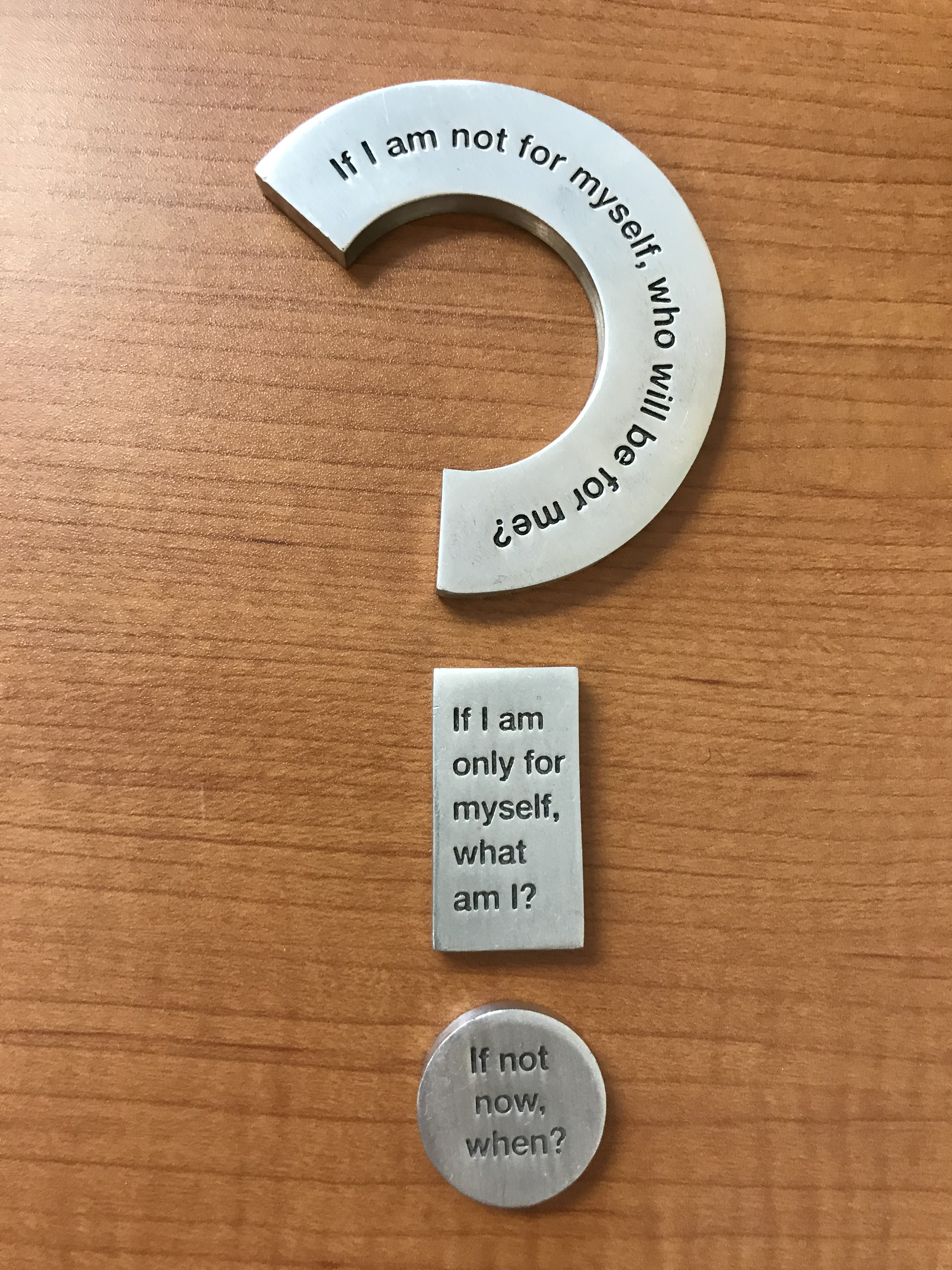
I firmly believe that now is the time to wrestle with the question of how to teach about Israel’s conflicts. But the answer to that question, especially when it comes to good Israel education, is certainly not one to be arrived at in a matter of months. Ramah camps are as good a place as any to advance this discussion—but not necessarily this summer or even next. Not if it is going to be done well, with the result producing the best informed Israel lovers and advocates for our future.
Rabbi Craig Scheff
Abiding in the amazement
Cain kills Abel; God asks Cain where is his brother; Cain claims not to know, and challenges God by proclaiming he is not Abel’s keeper. God replies that the blood of Abel is calling out. The Midrash boldly suggests an alternative reading: the blood of Abel is yelling at (or against) God, accusing God of standing by and permitting the injustice. (Genesis Rabbah 22:9)
As has been pointed out with respect to the Shoah, we are quick to ask where God was; less frequently do we ask where was Humanity.
As Holocaust survivors, my grandparents have never held God responsible for the deaths of family members or for their earlier years of torment. They do, however, consider their lives and their descendants miracles of God. They’ve never claimed to be more righteous or deserving of God’s attention or intervention; but they accept their gifts of life as miraculous nonetheless. For them, every day — despite the aches and pains, the losses of loved ones and the toll of the mundane — is a miracle.
Just off of Yom Hashoah and Yom Ha’atzmaut, I wrestle with my seemingly conflicting understanding of God. In reflecting on the Shoah, I say God was not accountable, except to the extent that God made room in the world for our free will. That conscious act created the possibility for the distinctiveness of good versus bad, of right versus wrong, of exultation versus disappointment. Put another way, in making room for evil, God created the possibility for us to live lives of meaning, as opposed to merely existing.
And yet, when it comes to the birth of the State of Israel — as is the case of the birth of my children — I proclaim that God was “in the room.” Despite the many sleepless nights that follow those births, I abide in the amazement of the miracle, as my grandparents do and as we as a people do, every single day.
I personally cannot believe in a God that would desire the suffering of the innocent or the young, of family or friends. I choose to believe in the God that invites me to choose life over death, blessings above curses. My God is the God that abides in the blessings I bring when I offer comfort, strength and healing energy. My God is the God that is revealed when I come together in community to offer prayer and to mobilize in action. My God is the God that is felt in the hearts of the suffering when they feel me acting as their keeper.

Do you wish to help a friend, but don’t know how? Do you wonder where God is in the suffering? Choose life. Recite Psalm 121 daily at 7:30pm with and for Rabbi Drill as she, with God’s and our help, experiences a refuah shleimah (complete healing), and add a psalm of healing for those in your life who are in need. Give someone else the gift of life, and donate blood. Perform an act of kindness in the name of a loved one. Remember someone you love. Abide in the amazement of something you once called a miracle.
Shabbat shalom, and a speedy recovery, my friend,
Rabbi Craig Scheff
The CaLL
Draw near
Place before Me
Your vulnerability and regret
Your wholeness and gratitude
Stand in My presence
With outstretched hands
Offer Me your heart
Do You not recognize the companion of Your soul?
From every stranger, neighbor, friend and lover
I summon,
In every dawn and dusk
I reveal,
In every breath
I call
Return to
The garden
The mountain
The sanctuary
The body
The heart
The makom-place
where You will find me waiting
I CaLL to You, with a small “a-aleph”
To remind You that I am,
That We are One
In all things
Raise Your body to the heavens
Stretch Your fingers to the skies
Wave Your offering to the universe;
But look to Your palms
And discover:
I have sacrificed for You
My heart
“AND THE LORD CaLLED TO MOSES….” (Leviticus 1:1)

AIPAC is opening the tent to you
The custom of kriah, or tearing or rending our garments, is a critical element of mourning in Judaism. Judaism mandates that we ritually tear our clothes, in a physical manifestation and expression of the complicated and painful feelings of frustration, sadness, and anger at the death of a close relative. Nowadays, many Jews opt to wear a black ribbon which is torn in place of clothing. Traditionally this tearing, or kriah, happens right before the start of the funeral, in a private room where the family acknowledges that God is the True Judge. And apparently, as I found out on my recent trip to Israel in December, in many communities it is also traditional to tear your clothes upon seeing the Kotel, the Western Wall.
I was in Israel on the AIPAC Leffell Fellows Seminar, a trip for rabbinical students from the major Reform, Conservative, and Orthodox rabbinical schools. The trip, which featured incredible speakers like David Horowitz of the Times of Israel, Yossi Klein Halevi of “Like Dreamers,” Dr. Einat Wilf, and Rabbi Tamar Elad-Appelbaum, was both about providing the fellows with access to a spectacular range of speakers and experiences, and the opportunity to experience Israel with and through rabbinical students of significantly different political views and religious lifestyles. Some of my peers on the trip shared my exact political and religious predilections, but more often than not, we differed significantly. Some speakers who blew me away with their perspectives and erudition bored my peers, while a few speakers who deeply frustrated me deeply inspired the rabbi-to-be sitting next to me at dinner. The experience of learning about Israel from and, more importantly, with those who do not see Israel the way I do made for a moving seminar.

One of the most powerful moments was when, in anticipation of our trip to the Kotel tunnels, a few of the Orthodox fellows asked if they could have a moment to tear kriah at the Kotel. I was dumbfounded. I understood the words, I could figure out what they meant, but I had never even heard of the custom. Though I am still just a rabbinical student, I was almost completely floored by the idea that there was a custom that I had never heard of, especially given that I’ve spent almost 3 full years of my adult life living in Israel. As we stood outside the main entrance to the Kotel, before entering either the men’s or women’s sections, so as to allow all who wanted to participate, regardless of gender, our Orthodox peers explained the custom, citing from a classical code of Jewish Law, the Mishneh Torah: “One who sees the Temple in its destruction recites the verse ‘Our holy Temple, our pride, where our fathers praised You, has been consumed by fire; And all that was dear to us is ruined’ (Isaiah 64:10) and tears their garment.” (MT, Fasts, 5:16). As they recited the verse, they tore the left side of their white shirts just below the neck, as if mourning the loss of a beloved family member, and then we went on to the next stop on our whirlwind tour.
For those Orthodox fellows, this experience was nothing new; it was routine, mundane, mandated. They simply wanted to share their observance of this obligation with us. For me, however, this was an important moment to dwell upon. How had I spent so much time living so close to the Kotel and never heard of this practice? Had my education been lacking? Did my teachers fail me? Did I fail my students by not teaching them this practice? Moreover, especially given the difficulty many Conservative Jews have in regards to the Kotel, had no one considered that this custom might be relevant and necessary for contemporary Conservative Judaism? Our tradition teaches that the Temple was destroyed because of sinat chinam, senseless hatred; and for increasingly large numbers, the Kotel Foundation’s policies against pluralism represent a modern type of sinat chinam. But instead of avoiding the Kotel altogether, as some might choose to do, we must actually look at it, recognizing that the state it is in right now is imperfect and represents the ruination of that which we hold dear. This ritual is a beautiful if painful way of engaging with our traditional values and our modern sensibilities and hoping towards something better.
While I cannot say for certain whether or not this custom will become a part of my regular practice when I go to the Kotel in the future, I know for certain that the next time I lead a trip to Israel, I will bring this custom, and the perspectives of my peers who taught it to me, with me. Even more so, I know for certain that I never would have gained this insight had it not been for the experience of attending the Leffell Fellows Seminar through AIPAC. By gathering Jews of completely different religious and political outlooks, AIPAC allowed and encouraged all of us to broaden our religious horizons, and pushed us to see Israel through the eyes of our peers. By building a wide open tent and inviting each of us in, our AIPAC experience gave each of us permission to share our perspectives, forge new connections, and hold new hopes for Israel. And that is certainly worth tearing a shirt for.
Perhaps you’ll consider an AIPAC experience. Policy Conference is March 4 through 6 in Washington, D.C. It is not too late to register. Join Rabbi Scheff and me, and experience the many diverse ways in which AIPAC is strengthening the American Jewish connection to Israel.
Jeremy Fineberg, Rabbinic Intern
Answering the call
I so clearly remember the day I decided to pursue the rabbinate as a profession. It wasn’t a moment of revelation as much as it was an invitation to recognition. There was no event that suddenly awakened some personal transformation. Instead, there was a suggestion (from my big sister to be exact) that I had been denying my true nature, distracting myself with the pursuit of others’ dreams for me. In that moment, I had a choice: I could ignore the suggestion and continue on my path; or I could take a closer look, be present to the moment, diverge from my course long enough to envision an alternate direction.

You might think that the miracle of the burnish bush, as the event is described in this week’s Torah portion, is found in the fact that God spoke to Moses from the bush, or that the bush itself was not consumed. Experience has taught me, however, that a miracle can be found in Moses’ decision to divert from his path long enough to consider a change in course. “Let me divert from my course and examine this magnificent sight,” he says. Certainly, a revelation to Moses of God’s existence takes place; but even more impressive is Moses’ presence in the moment to recognize the invitation to consider his life’s course. The events of his life might have led Moses to a happy life as a shepherd in Midian; but his true calling was to a different path. His acceptance of the invitation to consider that path was not a given.
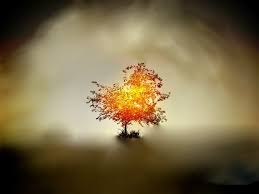
The burning bush has always been a symbol present in my life, though I was not always conscious to its relevance. It was the emblem of the summer camp I attended (thank you, Camp Ramah in New England); it was at the heart of a blessing I was given upon becoming a bar mitzvah; it lies at the center of the atarah (collar of my tallit) my mother made for me when I was in college; it is the logo of the Jewish Theological Seminary. Some might go so far as to say it was even a sign, pointing the way to my ultimate destination.

My decision to become a rabbi certainly did not come as a surprise to those who knew me well or who watched me grow up. The signposts were everywhere to be seen. But the combination of experiences that shaped my life did not necessitate one particular path. The invitation to recognize my life’s “true calling” would have passed had I not chosen to give it my attention.
I do not believe that we have only one calling in our lives. We may find contentment down multiple life paths. But each interaction in our lives offers us a choice of paths to travel. Our aversion to change and uncertainty may sometimes limit the options we perceive, getting in the way of our ability to entertain even a minor detour from our current path. But life presents us with multiple burning bushes just calling out to be examined. And we are invited to stop, look and consider the alternate directions our lives’ circumstances have presented us.
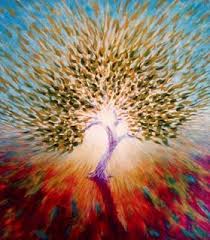
Dare we heed the call?
Rabbi Craig Scheff
Light one candle
Okay, I admit it. It is one of my least favorite songs, and by far my least favorite Hanukkah song in a world sorely lacking good Hanukkah songs. Please don’t take my dislike personally if Peter, Paul and Mary’s lyrics happen to be among your favorites. That being said, there is something to this idea of “lighting one candle,” especially considering the Talmudic debate surrounding the procedure for lighting the lights of the holiday. While we often quote the opinions of Beit Hillel (one candle on the first night, ascending to eight on the last) and Beit Shammai (eight candles on the first night descending to one on the last), we rarely reference the fact that the average person was expected to light only one light for the household each night (Shabbat 21b).
I actually love this idea of lighting one candle. After all, when the Maccabees lit the Temple’s menorah, they had no way of knowing how many days the oil would last, if it would even last a day. But they rekindled it anyway. It didn’t matter to them how many days the oil would last! Hanukkah could have been three, five or seven days and it wouldn’t have mattered. Their goal wasn’t eight. All that mattered was that they displayed the courage to kindle the lamp for one more day. That act of defiance, resilience and hope—to push back against the darkness one more day with no guarantee that the light would be burning on the day after—is the true miracle of the holiday for me, epitomizing the Jewish spirit throughout time.
Today, the day after the Hanukkah lights have gone out for this year, is the winter solstice. The Northern Hemisphere is tilted farthest away from the sun, resulting in the shortest “day”—and longest night—of the year. From where will the light come to push against the darkness? Hopefully, we’ve been storing up on the oil necessary to kindle a lamp, if only for a day. As a big Star Wars fan, I will share with you (spoiler alert?) that one of the things I love most about this movie is the message it sends about the responsibility that each of us bears to serve as a shamash for one day, for one other person.
While ruminating on my disdain (a little too harsh?) for Peter, Paul and Mary’s song, I came across another set of lyrics by Ronnie Spector (lead singer of the Ronettes) for another song with the same title:
Make the sun rise tomorrow with your faith in today
You can soften a sorrow if you just light the way
All it takes is a candle to turn darkness to light
Like the promise of the dawn
On a long winter’s night.
Figures, she wrote it as a Christmas song.
Happy solstice, and may all your winter days be bright,
Rabbi Craig Scheff
2017 Mitzvah Mission – Shabbat
Friday morning in Jerusalem, our OJC track team greeted the day with a brisk 3-mile run (4 for Steve!) down and up a scenic trail through Jerusalem’s original train station and its surrounding neighborhoods. After morning tefillah and breakfast, we boarded the bus promptly (they are so good!) at 9am.

Pantry Packers, run by Colel Chabad, is a food distribution facility that packages and delivers food to the most needy citizens identified by their municipalities. Divided into 3 teams, we donned aprons and hairnets, and got to work. In an hour and a half we bagged, sealed, labeled, date-stamped and boxed 500 packages of grains for delivery to the needy. We had fun, even as we remained conscious of the sad reality that necessitates our efforts.



Our driver Nati delivered us next to the shuk in Machaneh Yehuda, where the bustling market place was teeming with shoppers prepping for Shabbat. We were individually assigned different categories of food to acquire and contribute to our Shabbat afternoon potluck lunch. Among the throngs of people, we still managed to bump into familiar faces!

After a brief afternoon breather back at the hotel, we rode to the Old City and arrived at Ezrat Yisrael, at the southern end of the Western Wall, to welcome Shabbat in song as a community. The sun dipped below the horizon behind us. While we appreciated the beauty and peace of the space we occupied, many of us felt the discomfort of being separated and hidden away from the thousands of Jews just north of us in the main plaza sharing the same words we sang. More about that on a different occasion.

The walk back to the hotel got us good and hungry! We made kiddush, attracting the warm and welcoming gestures of a group of Messianic Jews who wanted us to join them in Bim Bam and Am Yisrael Chai—interesting!!! We delighted in blessing the younger generation that had joined us for Shabbat. After dinner, our group sat in a private hall and shared highlights of the week.
Shabbat morning, we attended Moreshet Yisrael, the nearest Conservative Masorti congregation. Jeff Lance served as a greeter and gabbai, and we were warmly received with several honors to the Torah.
We sat on 7th floor terrace for hours, eating and laughing, enjoying the leisure of Shabbat, until darkness fell on Jerusalem and we recited Havdallah together. Warm goodbyes, expressions of appreciation and gratitude, and most of us were on the way to the airport.

As I descend into Newark, I already look forward to the next time in which we make the ascent together.
Shavua tov,
Rabbi Craig Scheff
 Three Rabbis Walk Into A Shul
Recent Comments