Talmud and AIPAC
During the week before leaving for the AIPAC Policy Conference, I received several e-mails from progressive rabbinical organizations, asking me to protest AIPAC in one way or another. During the first day of the conference, my worried son texted me: “Have you seen a large group of INN activists protesting outside? There’s stuff all over Facebook about it.” (If Not Now is a social- media-fueled group of Jewish millennials who stage protests against the occupation of the West Bank.) I did not sign any petitions against AIPAC. I did not see the protesters outside. I was busy inside, participating in a conference that welcomed disagreement and civil discourse in true Jewish fashion.

AIPAC this year reminded me of Talmud. The rabbis on the pages disagreed with each other across generations and locations, but they argued together, on the pages of our common text, the Talmud.

The Israel advocates who gathered at the Washington Convention Center and the Verizon Center represented the plethora of opinion that is Judaism and American politics today. Among the 18,000 participants who support a strong alliance between America and Israel, there were Jews and non-Jews. Progressive, conservative, Republican, Democrat, Reform, Conservative, Orthodox, and secular Jews gathered. 3,000 college students participated. Five hundred rabbis representing the spectrum from Ultra-Orthodoxy to Reform ate lunch together. Jews who support the current government in Israel and Jews who do not were present. Jews who support the current administration in America and Jews who do not were also present.
Jonathan Greenblatt, CEO of Anti Defamation League invited the leaders of If Not Now to a conversation when they protested in the lobby of the ADL building last year. The protesters rejected his offer, and Greenblatt responded: “It’s nice to get attention but it’s better to get things done. Protests are nice but proposals are better. Slogans are easy but strategies are hard. If you really want to move the needle you’ve got to make things happen.”
I agree. I spoke this past Shabbat about today’s world fueled by high levels of knowledge but low levels of understanding. Information is easily accessed with the touch of a smart phone, but grabbing the buzz words off headlines does not mean that people with very strong opinions actually understand what they are protesting. As Dr. Zohar Raviv of Birthright Israel says, “We have become surfers without diving licenses.” Young Jews standing outside the AIPAC Conference to protest the settlements in the West Bank meant well, but they could have had a bigger impact if they had participated in the conference itself. They would have learned new ideas and ways of understanding the crazy Zionist idea of the nineteenth century that became the modern State of Israel. They would have gleaned ways to conceptualize the cauldron that is the Middle East from voices of the left and of the right. And they would have been heard. We follow rules of courtesy and civility at AIPAC, but every voice is heard.


I yearn for the day to come soon when we will find a two-State solution. I disagree with a policy that includes building more settlements. I would certainly love for my son in the IDF to serve Israel in a time of quiet. I did not go to AIPAC to support either the Prime Minister’s government in Israel or the current administration in the U.S. I went to AIPAC to ensure that the strong alliance between Israel and America, necessary to both countries I love, will be preserved via strong non-partisan support on Capitol Hill.
This past week, the courageous ones came under the roof. If Not Now protested outside. I wonder how many of those idealistic young Jews know the complete quotation from Hillel in Ethics of the Fathers from which they coined their name: “If I am not for myself, who will be for me? But if I am only for myself, who am I? If not now, when?” Deep diving would require the protesters to consider the entire thought, not just the convenient last phrase. Next year, perhaps we’ll all be able to talk together, unafraid and willing to learn.
With blessings and prayers for peace, Rabbi Paula Mack Drill
Weaving our Community: the Weft and the Warp


I write this post from Ben Gurion Airport at Gate C-9, waiting for the flight home to be with our OJC community for Shabbat. I look forward to sharing with everyone the depth of learning I experienced during the past four days in Israel.
Thirty committed Jewish lay leaders and professionals from Rockland County sat in a beautiful room overlooking the Mediterranean in the ancient town of Jaffa for many hours each day. We represented twelve different Jewish organizations and with the assistance of SIT (Systematic Inventive Thinking), we learned to innovate, discuss, plan and activate. But most of all, we learned to weave.
The purpose of our seminar was to weave the Rockland Jewish community together with enough strength and beauty to last m’dor l’dor, from generation to generation.
How exactly were we weaving? What did we hook onto the wood and anchors of our loom? How did we interlace the warp and weft of the threads? Our warp was our call, our strivings, actions and teaching. Our weft consisted of our anchors, the safe people and places, our Jewish homes, our synagogues and schools and organizations.
The trick about weaving is that from where we stand below, it looks like chaos. There are knotted threads, frayed or cut, mistakes, uneven spots, mismatched colors. But on the front side, the top side, the side that is hidden from our view, perhaps even the side that God sees, there the weaving is perfect. The patterns are clear, the colors blended, the stitching precise. Our work thus requires just a little bit of faith.
We went to Israel to learn how to weave because our homeland has been the wellspring of Jewish inspiration for thousands of years. We were inspired indeed by start-ups and innovators and programs for social justice . We learned to pull out the essence of the ideals undergirding the innovation and collaboration and imagine putting it to use in Rockland.


We heard from the company SpaceIL that is building Israel’s lunar rover and from TOM, Tikkun Olam Make-a-thon. We learned about Dror Yisrael, urban educational kibbutzim and Ruach Chadasha, program to revitalize young artistic life in Jerusalem. And so much more…
Inspired by the innovation all around us, I look back across the ocean toward home just before boarding and start thinking about ways to make the life of our Rockland Jewish community strong and vibrant. I am grateful to my OJC partner on this journey, Matt Schiering as well as fellow OJC congregants representing Federation, Carol Blau and Andrea Weinberger. We all invite all of you to join us!

The weaving work has only just begun…
Shabbat shalom, Rabbi Paula Mack Drill
Forward March… and then…
I offer the words of this post just as I offered the words of my sermon this past Shabbat: as a prayer. Shabbat Parashat Sh’mot was the day after the inauguration of the 45th president and on the day of the Women’s March on Washington. I began with an intention from a poem by Neshama Carlebach written for this past Shabbat: “May we sing and pray with all that we are, loud enough for the whole world to hear, but soft enough to hear the Angels join us.” Writing words both loud and soft enough requires that I write with humility but also with confidence. Words offered with heartfelt integrity have the potential to be unifying and healing.
There are many reading these words now who believe that the world is ending. I remind you of President Obama’s words when he told us that the only thing that is the end of the world is the end of the world. If you are one who is worrying about the new administration in Washington, I am writing for you.
There are also those reading these words who believe that perhaps Washington needs a bit of a shake up and that something good could happen from a little less business as usual. If you are one who is optimistic about our new president, I am writing for you too.
Because regardless of how we voted, the thing that unites all of us is a belief in acceptance, tolerance, and protection of the vulnerable among us.
Twenty-five members of my extended family marched in New York City on Saturday, from my five-year old nephew to my mother-in-law’s best friend who is in her eighties.
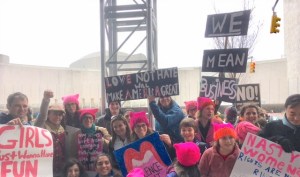
Many OJC congregants marched in Washington and in New York. Many marchers were gathered by organizations with which I am affiliated: National Council of Jewish Women, American Jewish World Service, Planned Parenthood, Hazon, National Organization of Women (NOW), and National Association of Social Workers. In sum, there were more than 600 marches around the world, on every continent. Estimates suggest that there were one million five hundred thousand marchers world-wide.
There is a difference between a march and a protest: one moves forward, the other pushes back.
I shared with my congregation the Women’s March Statement of Principles; ideals to make us a great nation, not to devolve into anger. https://www.womensmarch.com/principles/ The Mission Statement of the March explains that when we walk together, we recognize that our vibrant, diverse communities are the strength of our country. Defending the most marginalized among us is defending all of us. To me, these ideas sound a lot like Jewish values of protecting the widow, orphan and stranger among us.
I asked my sister-in-law Rebecca to share with me why she organized our family and then took a train from Boston to march together down Fifth Avenue. She wrote that she was marching to support women and women’s rights, but not just for women. By marching, she wrote: “I am being visible, making a declaration, being heard. All humans’ rights and dignity matter to me and that is why I felt compelled to do something more active and visible this year. I don’t want to remain silent about something that really matters.”

Ideas about the march connect powerfully to the Torah portion we read this past Shabbat. In Sh’mot, we begin to hear the story of Moshe who ran out of Egypt to Midian and then walked back in to take his people out, to take the Israelite slaves on a walk toward redemption. Moshe is certainly the hero of the entire book, but a counter narrative exists just below the surface, the story of five heroines who put the Exodus into motion. (Read more about these women in Sh’mot Chapter 1:15 through 2:10.)
Midwives Shifra and Puah are ordered by Pharaoh to kill newborn Israelite boys but they refuse to follow through. In their refusal to obey, they teach that there are moral limits to power and serve as models of civil disobedience.
Yocheved gives birth to a baby boy. Seeing in him beauty and promise (as all mothers see in their children), she refuses to throw him in the Nile. Her actions to hide her baby show bravery and resilience. Placing her child in a basket on the river shows a stubborn refusal to relent in the face of an unfair fate.
Miriam, who later gains the appellation of Prophetess, runs along the side of the river to make sure her baby brother survives. She has the chutzpah to approach the daughter of the Pharaoh and offer a nursemaid, her mother, for the baby drawn from the Nile by the princess. She refuses to be helpless in a hopeless situation.
Bat-Paro, the daughter of Pharaoh, is perhaps the most courageous of all these women. When she opens the tiny basket and takes the baby to be her own, she is showing disobedience toward her father, the very one who decreed the infanticide. She knew who that baby was, yet still she saved its life. A midrash imagines God speaking to Bat-Paro, “Moses was not your son yet you called him your son. You are not my daughter but I shall call you my daughter.” In rabbinic tradition, she is one of the few characters of the Torah who is so righteous that she entered into paradise in her lifetime.

As Jews, our ancestors moved from slavery in Egypt toward freedom. They were not freed by standing still; they had to walk toward their redemption, one step at a time. For those of us today who wish to make history, we too must walk. This past Saturday was not about having a symbolic march in Washington as an end-goal. Success for this march began the day after January 21.
Success will be measured by the way that we stand for people at risk: people of color, identify with the LGBTQ community, belong to religious minorities, or are people with disabilities. Success will be measured in our strong statements against acts of hatred and violence against minority people, including anti-Semitic actions such as the bomb threats against JCCs nationwide. Success will be measured by the ways in which those of us who disagree about policy find compassionate and empathic ways to listen to each other, to hear the differences but recognize that we all want a United States where everyone feels secure and at home. And success will be measured by how quickly we awaken from our leisure induced comas to become alert and active participants in our government.
Jewish history is about our people’s moving from one place to another, from one reality to another. I’m ready to walk into this new chapter of American history. I choose to do it through marching forward. I hope that you will join me. There is a difference between a march and a protest: one moves forward, the other pushes back.
I look forward to the conversation,
Rabbi Paula Mack Drill
OJC Israel Experience Day 10: Reflections of a Community
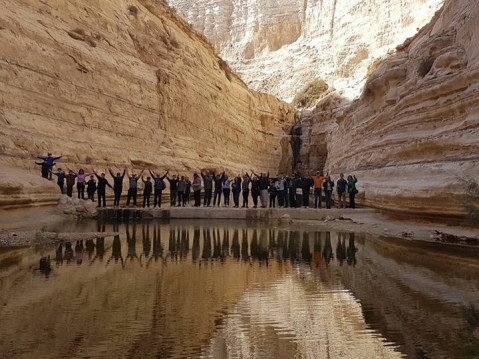
If someone were to ask me to describe the Orangetown Jewish Center, I might say to them, “Let me tell you about a group of people who traveled to Israel together. We are a microcosm of the greater synagogue community.”
We are a diverse group of people from age 6 to 89 who related to each other as one family. We are curious, ready to learn, and easily moved. We look out for each other and we sought the best in each other. Over the course of 10 days, we found it.

We love Israel with our eyes and our hearts wide open. We are proud Jews who accept that the Jewish people practice our faith in many different ways. We are proud Zionists who know that Israel is a complicated place, but overall, it is our home.
We have a lot of fun! And it goes without saying, we love to eat!
Today, Zalman asked us, “What did you come with and what are you taking with you?”.
I know that the pilgrims on this trip will continue answering this question for a long time to come. All of us are changed. We know more about Israel than when we first arrived, and we most certainly know something new about ourselves.
Coming here to Israel is a privilege. Our ancestors yearned to come to this land for 2000 years but could not and so we carry them with us whenever we come to Israel.
Maybe the next time OJC comes will be your time?
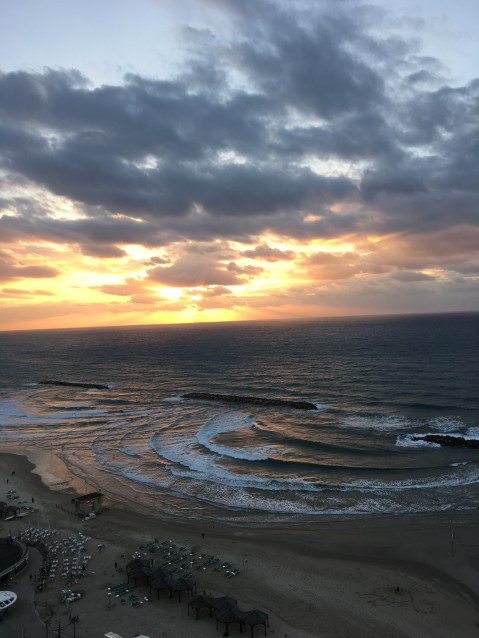
As the sun sets over the Mediterranean Sea, we are packing and getting ready for our final dinner before heading to the airport. We hope to see you at services at the OJC on Shabbat so that we can share our pilgrimage experience with you and celebrate the end of Chanukah together.
Chodesh tov and (almost) Shabbat shalom,
Rabbi Paula Mack Drill
OJC Israel Experience Day Nine: The Old and the New
As the tumultuous last days of the year 2016 unfold and unravel around us, here in Tel Aviv, Israel, we were focused and anchored, spending the day energized by this city. We saw a place where Jewish life is lived with diversity and creativity, where secular identity is steeped in Torah and religious identity is shaped by universal realities.
We learned about the establishment of this new city literally carved out of the sand by seashell lottery.
And we learned the history of what happened in 1948 to make this country, our homeland, a reality.
Hertzl said: “All the deeds of men are dreams at first, and become dreams in the end.” What a powerful description of the founding of the state of Israel.


At Independence Hall, when we stood to sing Hatikva, many of us cried. Even those of us who have experienced the presentation multiple times cried. In the recording of the 1948 Declaration of the State, one hears the orchestra play without any voices singing the words. Why? All of those present were weeping with a combination of joy and anxiety after Ben Gurion read the Declaration of Independence and Shehechiyanu was recited. Those present could not find their voices. Today, voices from all over the world sing Hatikva every hour on the hour. In so doing, we take our place in the history of Israel, singing on behalf of those here on May 14, 1948 who wept instead of singing.
We left Independence Hall to walk the streets of Tel Aviv and explore the Carmel Market.


A visit to Ayalon, the underground bullet factory in Rehovot, brought us full circle to the miracle and the sacrifice that was the War of Independence.
Our day together was capped off by candle lighting for the fifth night of Chanukah and dinner with the members of Kehillat Sinai, a Masorti kehillah (synagogue community) in the center of Tel Aviv. Rabbi Eliahu Peretz greeted us and shared a bit about this small egalitarian community.


How fortunate we are at the Orangetown Jewish Center to be well-versed in the complexity of Jewish life and the challenges of pluralism and acceptance here in Israel. Our visit was one of being graciously hosted, but more importantly, bringing the strength and commitment of our synagogue to a sister synagogue in Israel.
As people set off to explore nightlife in Tel Aviv, we have a great deal to think about. What is most important, I think, is to love Israel and support her… and see her with a realistic perspective. There is much work to be done here, and as our congregation continues to volunteer here, visit, advocate, get educated, support financially, and see some of our children make aliya, we fulfill our obligation (each in our own way) to our homeland.
From the lights of Tel Aviv to the lights in your windows, happy Chanukah!
Rabbi Paula Mack Drill
OJC Israel Experience Day 8: Lessons from the Edge
People say that life is lived on the edge here in Israel. Today we learned to specific examples of living on the edge.
We were welcomed into an example of a traditional tent for Bedouin hospitality (and of course The requisite camel rides) in order to experience something about this proud people who live on the edge of Israeli society.
Zalman, our guide, taught us about the complexity of the situation: How does a traditionally nomadic people manage in a land of boundaries and governmentally established cities and towns? How does one generation pass on ancient tradition to the next generation that desires to be part of modern society? How is one people citizens and soldiers yet outsiders, tent-dwellers yet also students in university, shepherds but also hopelessly unemployed? We enjoyed coffee and baklava even as we came to understand the precariousness of Bedouin culture in the Middle East.


We visited Kibbutz Alumim along the Gaza border and learned about life on the edge: of the boundary of the state of Israel, of the socialist tradition of kibbutzim, of living a religious life as kibbutzniks, and of the potential for a normal life despite the threat of tunnels and missiles from neighboring Gaza.
Yes, it was an intense day. But we also laughed a lot, starting out with Zeke’s masterful joke telling on the bus, the kids’ coaxing all of us into participating in a mannequin challenge (if you don’t know what that is, ask a 12-year-old!) and continuing through our hilarious escapades atop camels.
As for me personally, I had to say goodbye to Josh who returned to base this afternoon, but rejoiced in the opportunity to light candles with Sarah and Sagi in their new apartment in Tel Aviv.


I have so much gratitude to my fellow travelers on this pilgrimage in the land of Israel. We are experiencing a week beyond all expectations.
Thinking of everyone on night four of Hanukkah from the shore of the Mediterranean sea,
Rabbi Paula Mack Drill
OJC Israel Experience: Lessons of the Desert

Micah blew shofar to begin our day.
Looking out over the amazing Makhtesh Ramon (Ramon Crater), eight year old Micah Fox blew his new shofar with perfect pitch and rhythm. Zalman (our guide) read to us from The Little Prince:
One sits down on a desert sand dune, sees nothing, hears nothing. Yet through the silence something throbs, and gleams… “What makes the desert beautiful,” said the little prince, “is that somewhere it hides a well.”
And so began a day of desert exploration: political, spiritual, physical and emotional. At Sde Boker we learned about the vision David Ben Gurion had about the future of Israel; that the settlement of the Negev was the most important national, security and economical mission.
We hiked along the canyon bed and up the side of the cliffs at Ein Avdat. Members of the group hiked according to their level of comfort. Regardless of who decided to hike up the stairs and ladders, all were inspired by our almost nonagenarian, Marvin Shapiro, who hiked to the very top. Ice cream was everyone’s reward!
In the town of Yerucham, we were welcomed into the home of Jo Jo and Mazal for a delicious lunch and Jo Jo’s family history of aliya in the 50s from Tunisia. Our afternoon concluded with text study about why the Torah was given in the desert. Like all Jewish questions, they were many answers! Meet me at the OJC in about five months when we begin reading the book of Bamidbar on Shabbat mornings; I promise to share the answers that we developed at the shore of Yerucham Lake on the edge of the desert.
I feel so blessed to have been welcomed lovingly into a group that has been traveling already together for almost a week. As we are about to light candles for the third night of Chanukah, we will all be thinking about Rabbi and Nancy Scheff. Earlier today in Florida, Rabbi Scheff officiated at the funeral of his beloved Aunt Debbie. May the entire family find comfort in being together and sharing beautiful memories.
Kol tuv from the edge of the desert,
Rabbi Paula Mack Drill
Breast Cancer Awareness Does Not End on October 31
Time collapses each time I have my annual mammogram. Months and years fold in upon themselves like an accordion. My last mammogram was a year ago and yet, as I signed in at the reception desk today, it felt like I had just checked in not a month before. How does the just-been-here-just-done-this feeling surface every year?

Millie Ibarra walked 39 miles for Avon Breast Cancer Walk 2016
Millie Ibarra, our family nanny and dear friend, is a ten-year breast cancer survivor. I made my mammogram appointment today, November 30, to honor her birthday. I know that it has been more than ten years since Millie’s diagnosis, but when I put on the robe before the mammogram, time collapsed for me. It felt like just a moment ago that I was sitting in an office at UMDNJ with her, listening to Dr. Clark tell us that Millie had stage four breast cancer.
My mother and maternal aunt both died of metastasized breast cancer. I bring them with me into the cold, antiseptic room with the spaceship-like imaging machine every year, wishing that they had benefited from all the advances in breast cancer diagnosis and treatment of the past decades. Although my mother’s twentieth yahrzeit is in two weeks, it feels like just a minute ago that she was on the phone, telling me that the cancer had spread and that it was time for me to come home to help her. I packed up Josh, just five months old, left the older three at home with Jon and flew to Maine. Time collapses.
For my mom and my aunt and Millie and my friends, and for the scores of women at the Orangetown Jewish Center who are fighting or have fought breast cancer, I religiously make my annual mammogram appointment . And I go on time. I say a prayer, smile bravely through the test and leave, hearing the precious words, “Looks good! We’ll mail the report.” The Breast Center provides bouquets for every woman and I always choose yellow roses, my mother’s favorite.
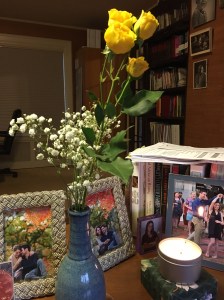
One year, the technician could not find any yellow roses amidst the pinks and reds. When I burst into tears, she put her arm around me. “Don’t take any roses this year,” she said. “Next year, take two”. I am one of the lucky ones; the seven in eight, not the one in eight.
Breast cancer awareness does not end on October 31st each year. Women (and men who are at risk) must stay vigilant all through the year. The courageous women of Orangetown Jewish Center who established the Pink Bag Project take care of each other and anyone who is diagnosed as time goes on.


On December 9 and 10, they are bringing Pink Bag Project Shabbat to us at Orangetown Jewish Center. Melissa Rosen, Director of National Outreach of Sharsheret, will join us for Shabbat to teach about breast and ovarian cancer awareness, research, treatment and family support. The purpose of this Shabbat is to share ways to support caregivers of family and friends who are ill. Join us on Friday, December 9 at 6:00 pm for services and Dinner and Dialogue (RSVP today to Diane Goldstein, dolphin99@optonline.net) and on December 10 for Shabbat learning during services and after kiddush.


And if it has been more than a year, if you have let time slip by, consider making your mammogram appointment today.
With prayers for good health,
Rabbi Paula Mack Drill
Refugees: Take Just One Action
On Rosh Hashana at the Orangetown Jewish Center, I spoke about the worldwide refugee crisis. (Please contact me at Rabbi.Drill@theojc.org if you would like to see the full text of the sermon.) It was a difficult sermon to give because I did not have a decisive answer to offer to this overwhelming, multi-faceted issue. I spoke anyway because I believe that as a rabbi, I have a moral obligation to present the world as an integral part of Judaism. Judaism speaks to our lives, our beliefs, our decisions. I figured that if I am struggling with an issue, probably you are too.
The basic facts of the crisis: 21 million people in the world today have crossed international borders in search of refuge and more than 65 million have been displaced. Sixty five million means that 40,000 people are fleeing every day and 51% of them are children.
The despair that drives people to flee their homes is heartbreaking. Persecuted because of race, religion, nationality, political opinion, or social group, refugees survive terrible ordeals: torture, upheaval, perilous journeys, and tremendous loss.
The largest numbers of refugees are from Syria but crises exist as well for families threatened by civil war in Darfur, Myanmar Muslims in Burma, women and children in Central America fleeing gang violence and human trafficking, minorities in Sudan, Eretria and Afghanistan.
What do we do with overwhelming issues too big for any person or group of people? We take one action. We fix one piece of the problem. In the words of Ruth Messinger, “We do not indulge in the luxury of being overwhelmed.”
In my sermon, I pledged to continue learning and talking about refugees. Happily, many congregants have been in touch to say that they would like to take one action, to set aside the politics and help just one person or one family. Many have asked for specific ways to help.
Tzedaka: Give to http://www.hias.org/ or to http://www.womenforwomen.org. If you find compelling organizations doing resettlement work, please be in touch so that I can continue building a list of places to contribute.
Establish a working committee at the OJC: Engage a friend and offer to co-chair a Synagogue Welcome Campaign through HIAS, educating our community and establishing social justice work on behalf of refugees. More than 200 congregations already participate.
Get involved with individuals. Fill out the form at http://www.hias.org/volunteer and receive information about how you can help in one of these ways:
- Serving as an English language conversation partner with newly resettled refugees and asylum seekers (2-3 hours per week for a year)
- Participating in a letter writing program to asylum seekers in detention (once a month)
- Providing pro bono legal assistance to HIAS clients pursuing asylum or other humanitarian protection in the United States (commitment ranges from 25-150 hours, depending on case type)
- Providing volunteer translation or interpretation for HIAS legal cases (short term opportunities available)
Participate in resettling a family. Call HIAS in New York City: 212-967-4100.
Support a Jewish Yemenite refugee family here in Rockland County. Volunteer to drive to appointments, tutor for the Citizenship test, or help children with school work. Contact Leslie Goldress at igoldress@optonline.net. You can donate to help with rent, tuition and buying clothing for the holidays; make checks payable to “Kahal Adat Teiman” and send to my attention at the OJC.
Organize a visit to MOMA to learn more. An exhibit called “Insecurities” is now showing through January 22, Insecurities Exhibit at MOMA addressing contemporary notions of shelter and calling into question what “safety” means.
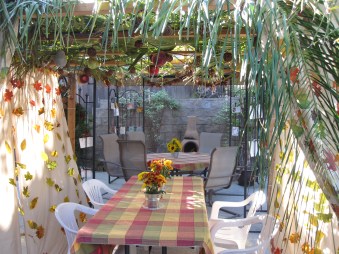
Today, I spoke with our Religious School children about Sukkot as a time when we welcome guests into our sukkah. The refugee question seemed quite clear to them. One fifth grader said, “We have homes, they don’t. We have food, they don’t.” A third grader suggested inviting a refugee child into our sukkah. Our impermanent sukkah with a roof through which we see the sky offers more protection than many of the shelters in refugee camps.
The tagline of HIAS calls to us as individuals: Once, we helped refugees because they were Jewish. Today we help refugees because we are Jewish.
There is plenty to do if we set aside the larger critical issue and consider the number – 21 million – as 21 million individual people. We can ask ourselves, what could we do for just one person?
With blessings for a meaningful start to the year 5777,
Rabbi Paula Mack Drill
Optimism: Naïve or Courageous?
When every prior effort has failed, what is required to continue trying? Where does one find the energy to believe that change for good is possible despite a history of dashed hopes? How is it possible for people of shared good intentions to sit together at a table and dream of a different kind of reality for Rockland County? The answer is: strong minded optimism.
Yesterday I attended a meeting called by Dr. Penny Jennings, Commissioner of the Rockland County Human Rights Commission. She believes that government’s job is not to make change but to support change efforts. New to her post, Dr. Jennings hopes that by bringing together a group of interfaith leaders, she can kick-start efforts to unify our community.

When I received the invitation, I could have said: been there, done that. Instead, I found myself moved by Dr. Jennings’ dedication to change. From the moment Rabbi Scheff and I met her last month at the rally against hate on the New City Courthouse steps, we saw that Dr. Jennings is a catalyst for action, a skilled listener and empathic thinker. I knew that I wanted to be on her team.
Once again I found myself in a board room surrounded by people of good intentions brainstorming ways to heal the divisiveness, insularity, and prejudice that mar our home in Rockland County.
Once again I found myself in discussions about brokenness, distrust and fear without the presence of the people whose voices are required in the room. We need leadership of the Chasidic communities at the table in order to have robust, honest conversation, in order for real change to happen. We must find a way to change hearts and minds enough to successfully bring into the room people who do not want to be there.


Dr. Jennings, however, pointed out that we have to begin somewhere. “Someone has to extend the olive branch and I don’t mind being the one to do it.” Evan Bernstein, Regional Director, and Etzion Neuer, Deputy Regional Director of the New York office of the Anti-Defamation League, brought their wisdom and experience to the table.
But most of all, Dr. Jennings listened to the community and religious leaders gathered at her table. She engaged us in an honest conversation about the most pressing issues of human rights and social justice in our county.
We talked about paths to change and barriers as well.
We all agreed on our destination: a hospitable environment where bad behavior will not be tolerated. Rockland County will be a place where we are gracious to our neighbors. We will have mutual respect. We will have a knowledge of each other’s values and concerns.
Government cannot legislate loving one’s neighbor, but it can legislate against acts of hatred. Attitude shifts can happen in a multitude of small steps. Doing nothing except giving in to frustration and anger cannot be the most reasonable response. The issues in Rockland County are not going away, and neither are we. Rockland County is our home.
After a discussion about the many difficulties in reaching our goals, Dr. Jennings offered the most profound statement of the day: “Oy vey!”
As a rabbi in this county, I am committed to working toward change. As a rabbi of the Orangetown Jewish Center, I am proud to represent our congregation in its desire to be a part of the work that is required.
In these weeks before the High Holy Days, it seems to me that nothing could be more important. In a world where the tone of discourse has become ugly, it is required of us to remember the power of respectful communication. It is essential to defy hatred and refuse to be part of intolerant behavior.
Is being optimistic naïve? I believe that optimism is a courageous choice. Join me in optimism. The alternative, helplessness and hopelessness, is not a real choice.
L’shana tova, a good year for all, Rabbi Paula Mack Drill
 Three Rabbis Walk Into A Shul
Recent Comments