Grateful for Gatherings
Last week, I attended the Rabbinical Assembly Convention in Philadelphia, during which I had the opportunity to take a guided tour of the Eastern State Penitentiary. This prison, the first “Penitentiary” in the United States, opened in 1829 and was designed to promote repentance and rehabilitation. Prisoners were to be kept in solitary confinement, each with their own cell and exercise yard, and given no contact with others aside from the guards who would teach them skilled labor and bring their food. Our tour guide reminded us to consider the disconnect between intent and outcome: the intent was to give prisoners time for reflection and reform while protecting their privacy. However, as we now know, solitary confinement is one of the harshest and cruelest forms of punishment. Solitary confinement was eventually abandoned by Eastern State amid growing skepticism and criticism, high costs, and capacity demands.
Incarcerated individuals began sharing cells, sports fields, workshops, and other spaces. One such space was a synagogue, constructed by the prisoners with support from outside benefactors and religious leaders. By 1916, Jewish prisoners were holding weekly Shabbat services, and a few years later, a former exercise yard and workshop was turned into a permanent synagogue.
The synagogue’s history is on display in a new exhibit at the Penitentiary called “Freedom Through Faith: Judaism at Eastern State and Beyond”. The exhibit describes the formation and operation of the Jewish community and synagogue at the Penitentiary, and its impact on religious freedom within prisons across the country. My group concluded our tour by exploring this exhibit and davening mincha in the synagogue, in front of the original ark which was constructed by the inmates 100 years ago.
As I pulled up my siddur on my phone, I noticed this line of instruction above the mincha Amidah:
צריך שיחשוב בשעת התפילה בדברים המכניעים את הלב…
During prayer, one must think about things which humble the heart…
Standing in the Eastern State Penitentiary synagogue, it was all too easy to follow that direction. My heart was extremely humbled by learning about the suffering that inmates experienced, the psychological damage inflicted by solitary confinement, and the faith demonstrated by those who, even in that setting, recognized the importance of gathering as a community; the people who built such a space with their own two hands and actively supported and participated in the Jewish community for years.
I’ve never considered Thanksgiving a particularly religious holiday. But maybe any act of gathering can be part of a spiritual practice. God says during the final day of Creation, “It is not good for the human to be alone.” As if we needed proof, the troubling history of Eastern State’s system of solitary confinement attests to God’s claim. It is not good for us to be alone. Judaism encourages us to gather as often as possible–for services, for moments of celebration and consolation, and even for everyday meals. Eastern State’s Jewish residents took it upon themselves to fulfil this spiritual need of gathering. Many of us will do the same this week, albeit under very different circumstances, and for Thanksgiving traditions, not necessarily Shabbat services. So as we prepare to gather with friends and family, may we recognize the blessing of being able to gather, and may we be reinvigorated by spending time with our loved ones.
Chag HaHodaya Sameach to all who celebrate!
Rabbi Claire Shoyer

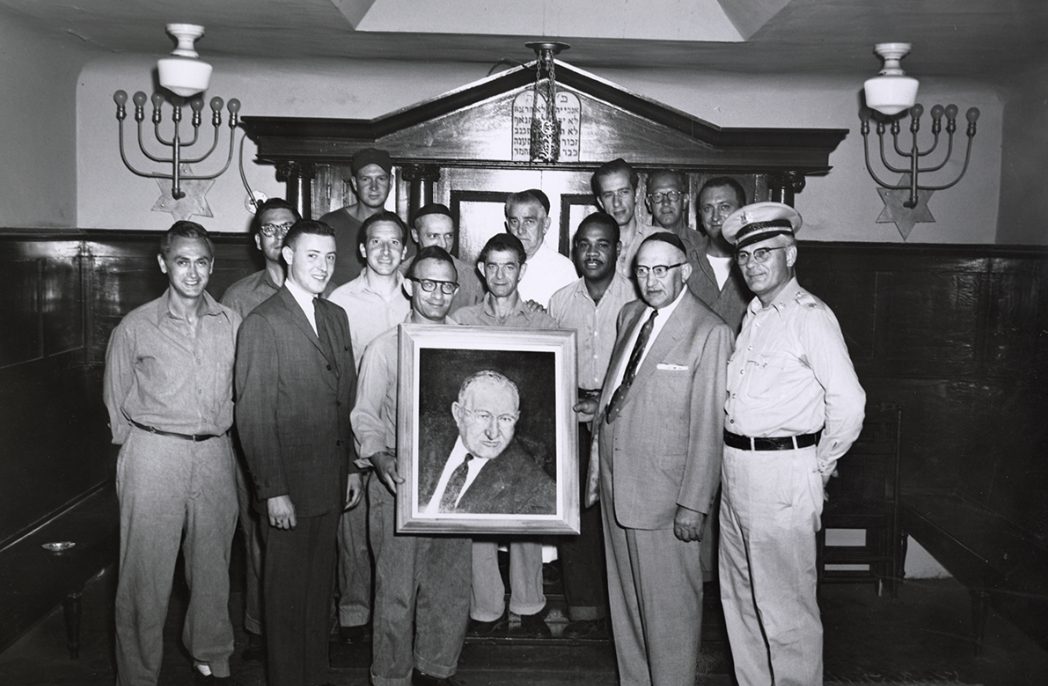
(First photo is of our group in the synagogue. The walls and plaster ceiling have been restored to match historical photos; the ark is original. Second photo is a rabbi and a group of incarcerated members of this Jewish community while the synagogue was operational.)

One response to “Grateful for Gatherings”
Leave a Reply
Recent Comments
 | Helen Kuttner on Grateful for Gatherings |
 | Rabbi Paula Mack Dri… on Time to reflect |
 | Beth Fishman on Time to reflect |
 | Susan Kirshner on Time to reflect |
 | Wendy Cowen-Smith on Time to reflect |


Inspiring story for the season.
Hodaya Sameach.