Riding the rush to the future
This Friday I begin a three month sabbatical. For those unaware, my professional partner Rabbi Paula Drill and I each have this opportunity for renewal every four years, and we are grateful to our congregation’s leadership and community for recognizing the mutual benefits of the sabbatical to us and to the synagogue. My last sabbatical began in December 2019 and ended in March 2020. I “re-entered” our synagogue’s life just as the COVID-19 pandemic made its presence felt in the community.

Since then, the challenges we have faced as a congregation have been unlike anything we had ever experienced, and unlike anything I ever imagined I would encounter in my rabbinate. The unpredictable and unprecedented challenges often left our congregation and our rabbinates in a reactive mode. The triage approach to pastoring to the community had us on our heels and running on adrenaline, often feeling spent after the rush. Despite the many challenges, our congregation has survived and thrived, revealing untapped strengths and unveiling creative modes of connection. In many ways, we are a stronger community than we were four years ago.

In the early 2000’s, mental health experts identified phases of individual and collective emotional response to disaster, and our individual responses to the pandemic fit the framework well. They labeled and described several of these phases as follows:
- The “Heroics” phase, characterized by adrenaline-induced rescue behavior; high activity; low productivity; a greater sense of altruism.
- The “Disillusionment” phase, where stress and fatigue take their toll; optimism turns into discouragement, resentment, frustration and anger; the larger community returns to business as usual.
- The “Reconstruction” phase, a time of individuals and communities beginning to assume responsibility for rebuilding their lives and adjusting to new circumstances; the recognition of growth and opportunity.

As I think back over the last four years, I believe we defied the suggested model in one very significant way. We largely avoided the “Disillusionment” phase by initiating a strategic planning process while still in our “Heroic” phase and the “Honeymoon” phase of good will that followed. We had enough vision and faith to look beyond our reactive mode and to look to the future proactively. Our “Inventory” phase was a time of taking stock and already planning for the reinvention of our congregation. Seeing the very best of our community and its individuals in action, and in ways that were so aligned with our mission and values, we knew that our core strengths would carry us beyond the pandemic and into the future.

This year, the busy holiday season ended with the tragic and traumatic events of October 7, the hostage ordeal and the days of war that would follow. Our typically quiet month of Cheshvan was suddenly a period that demanded heroics – mobilization, giving, energy, programming. We have responded as I knew we would, with passion, love and generosity. And once again, we are capitalizing on our core strengths and our best resources (you!) to look past this moment, to plan for the future, beyond my sabbatical and even beyond Rabbi Drill’s retirement.
I have no crystal ball. I can’t say what lies ahead for Israel and the Palestinians, and I can’t tell you what our synagogue will look like four years from now (when I’ll be preparing for my next sabbatical!). I can say with certainty, however, that we will still be here, doing what we do best, learning, growing, responding and looking to the future with vision, confidence and hope.
Believe it or not, I miss you already.
Rabbi Craig Scheff
When Asked How I Am, What Do I Say?
“What am I supposed to say when people ask how I am?” I complained to my Israeli friend, “I have no idea how to answer that question these days. Am I supposed to say I’m fine? Am I supposed to say I am not fine?”
“In Israel,” he said, “we are answering, ‘K’mo kulam’,” like everyone.
How are you? Like everyone.
I tried it on for size for a day. I wondered if it was fair for me to say that my feelings were like everyone’s feelings. Here in America, I am on the mezzanine, not even in the orchestra, and certainly not on the main stage.

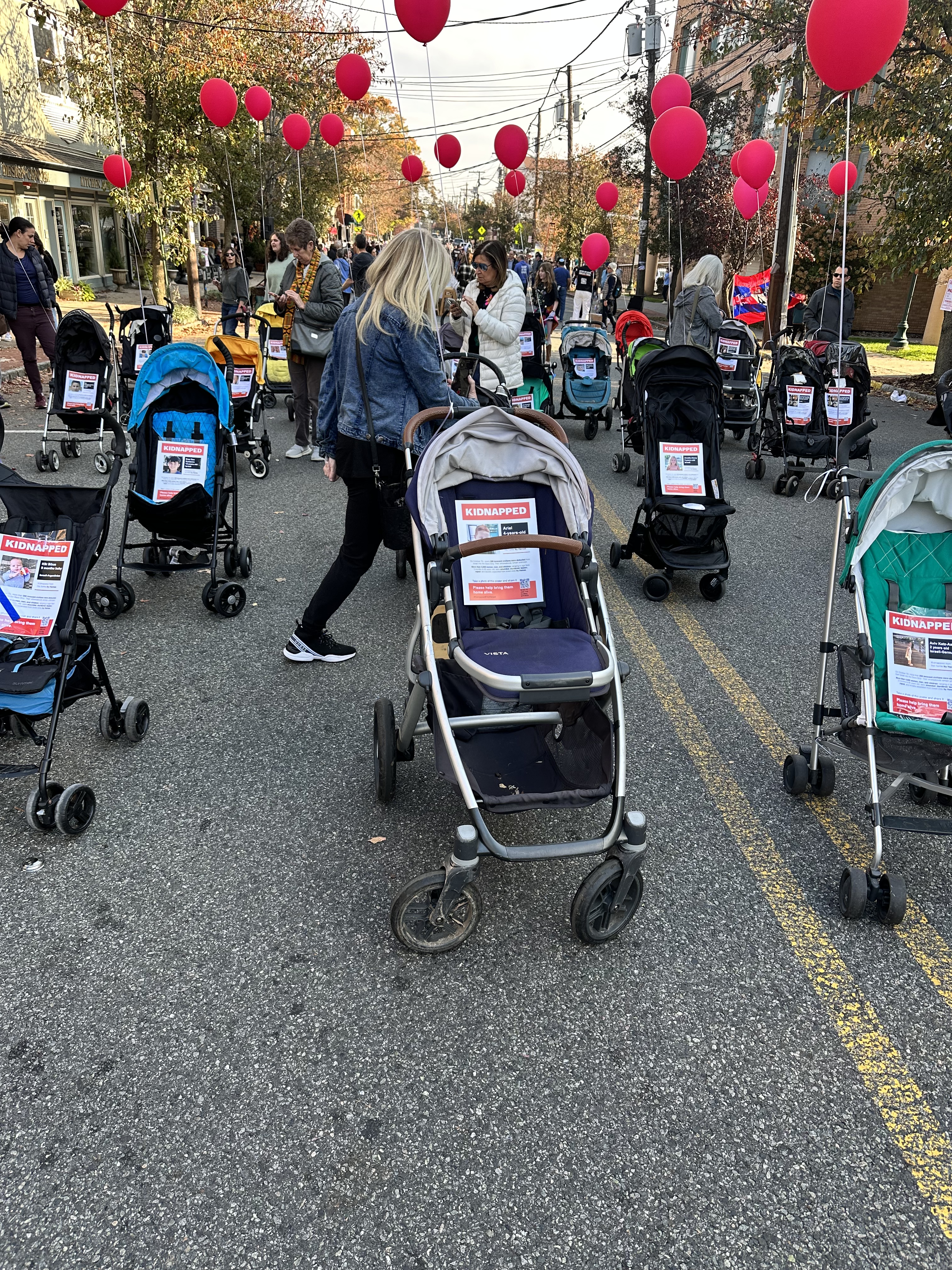
My heart is broken regarding the massacres and kidnappings of October 7. I worry about the IDF soldiers in Gaza. I feel hopeless about the mounting number of casualties and deaths of Palestinians in Gaza. My anxiety is high regarding the unleashing of virulent antisemitism here in America and around the world.
I don’t sleep well at night. I wake up from the middle of horrible dreams.
But my situation is not the same as my cousins’ whose four adult children are all serving on the front lines. I cannot compare myself to my son-in-law‘s mother whose entire community, her entire personal and professional world, was devastated on October 7. I am not my dear friend who had to move to safety from her home and whose son and son-in-law are both serving in the IDF at the same time.
And although I teach that there is no hierarchy of suffering, I know that my suffering is not the same, and can never be weighted as heavily, as those families whose loved ones have been murdered and abducted.
So I faltered for a couple of days when people asked me how I was.
Now, it is true that a rabbi in a community carries the weight of a congregation’s fear and concern. We are looked to for optimism and hope when we might feel quite lacking in those categories ourselves. We are asked questions for which there are no answers.
But still, I did not feel that I deserved to say, “K’mo kulam.”

And then one Friday evening at minyan, I led the community in the traditional words we say to a mourner. L’cha Dodi ended and we turned toward the man in shivah for his mother. We said, “HaMakom yinachem etchem b’toch sha’ar avalei Tzion v’Yerushalayim.” May God comfort you among all of the mourners of Zion and Jerusalem.
We say these words so often, counting on them to offer comfort to those who are bereft. On this particular night, I paused and considered their intention. I did not say these words to tell this particular man that his sorrow was exactly like all other Jews who were mourning. I meant that he is not alone in his grief. As a Jew, he was one of a great number of people at any given time who are held by God in our grief. We are all connected. That very fact offers comfort.
And the next day I went back to answering the question, how are you with the answer “k’mo kulam”.
I am not alone in my grief. And neither are you.
Rabbi Paula Mack Drill

 Three Rabbis Walk Into A Shul
Recent Comments