A mother’s prayer
Perhaps it was the timing of coming together in these post-October 7 days.
Perhaps it was an escape from all the protests that seem to want to besmirch or obliterate our Jewish identities.
Perhaps it was the complicated vibe of Yom Hazikaron (Israel’s memorial day) and Yom Ha’atzmaut (Israel’s independence day) juxtapositioned back to back, and our desire to connect to that vibe from afar.
Perhaps it was that so many of us were without our mothers, either because of distance or loss, or without children.
Perhaps it was because a young Jewish mother was sitting in front of us on this Mother’s Day morning, having left three of her children overseas, singing to her husband who sat across from her and to us, needing to open her heart and share her music about parents and children and wanting to feel safe in a place she calls home and loving the land and all its problems and wanting no war and wanting her husband to return safely from reserves and believing in peace and needing to spread word about the power of love.

Whatever the reason, what started out in concept as an opportunity to acknowledge Israel’s two days of remembrance and gratitude during this uniquely complicated time was instantaneously transformed into a holy moment. We could not have anticipated the flood of emotion, the sense of hearts opening in our midst, the tear-streaked and smiling faces from the moment Yoni and Nina (“Yonina”) began to sing Al Kol Eleh (“For all these things, watch over me my good Lord, for the honey and the thorn, for the bitter and the sweet”). What might have been a forty-five minute singalong of Israel songs became a timeless ritual of holding our collective breath, inhaling deeply with a sense of wonder, awe and reverence for it all, and then exhaling the exhaustion, anxiety and sadness, only to repeat the exercise with each song.
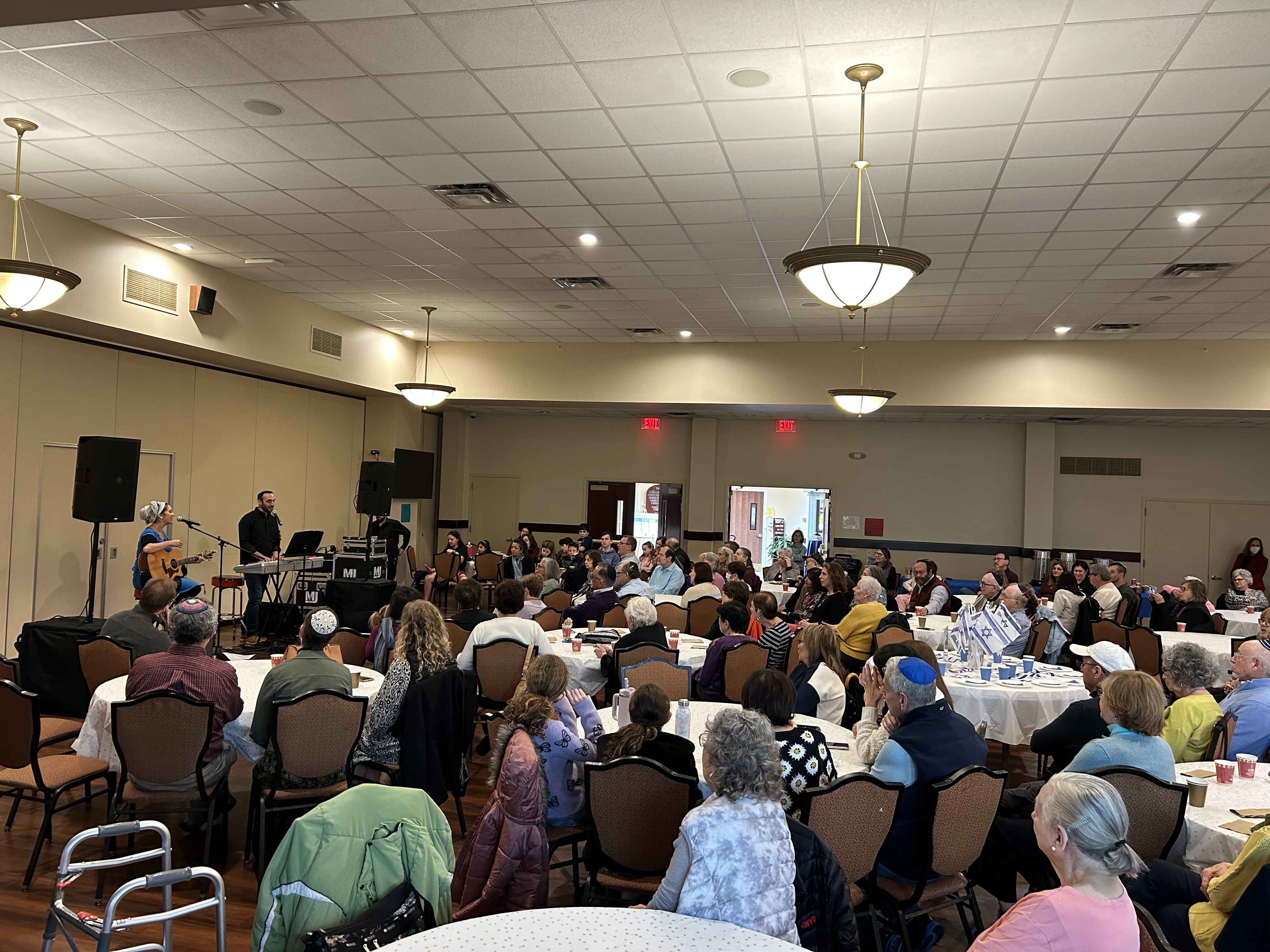
Yoni and Nina came to us with Rabbi Hersh’s urging early in the spring of 2020. They performed via Zoom monthly on Friday morning to help us connect heading into Shabbat in a time when we could not yet gather physically. Their music, for many of us, has continued to feed us, uplift us, connect us. While we felt this personal appearance was a homecoming for them of sorts, I know they felt the conflict of being away from their one home, their parents, and their children.
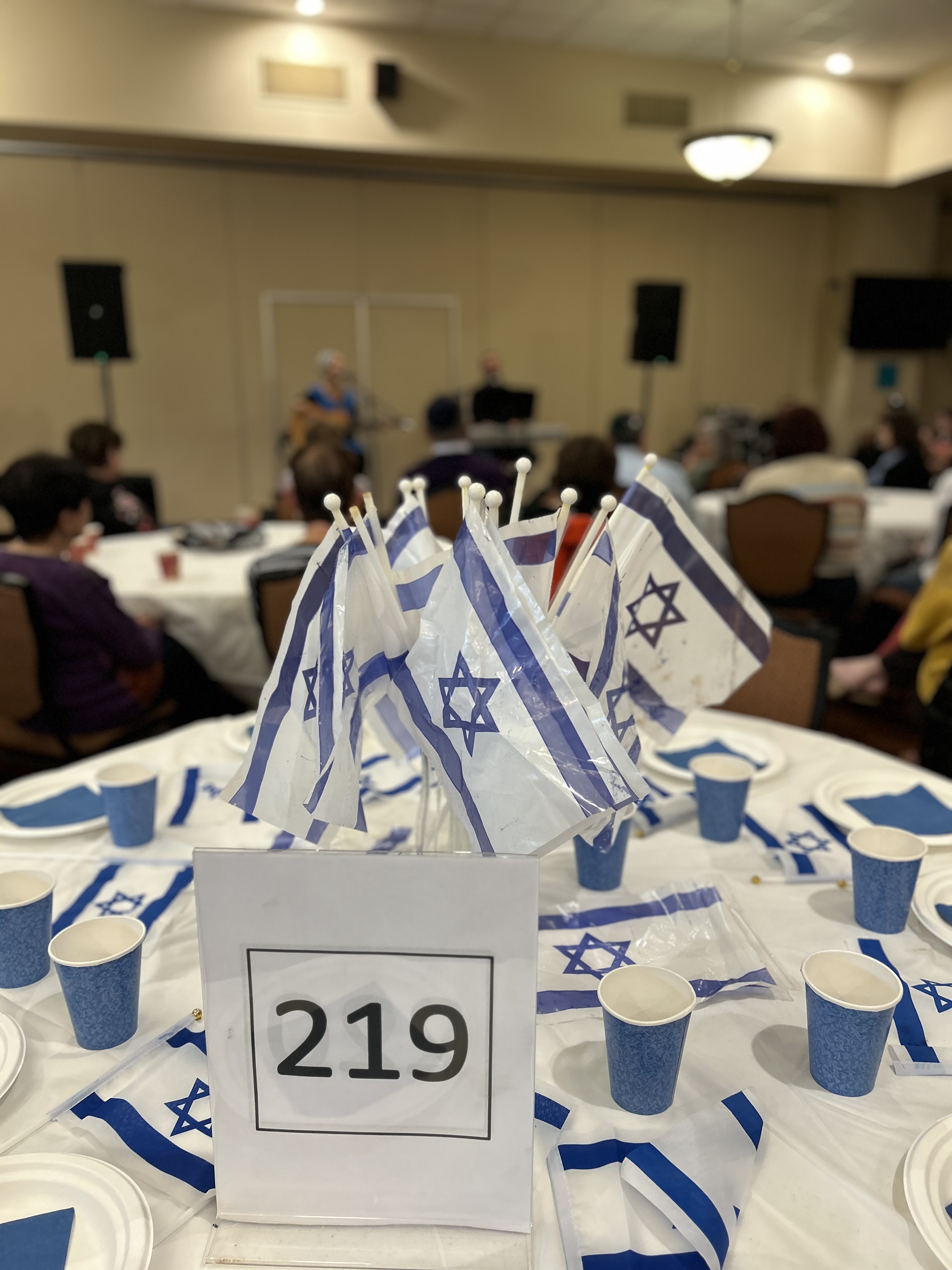
For ninety perfect minutes, with the help of their music, lyrics and heartfelt stories, we ascended together out of the time and space that restricts us. We were all home with one another, all connected to our mothers and fathers, all feeling the love we give away coming back to us, all absorbing the resilience and hope shared by these two loving artists.
In their song Melaketet kochavim (“collecting stars”), Nina and Yoni sing to each other from afar, a mother caring for children and home, a father fighting a war, both hoping to reunite safely and soon, holding onto hope that their dreams will soon be realized:
So now I am gathering all of my strength
of kindness, and of faith
that good days are yet to come
that the songs of joy will return to us
and I hug the children tightly
to protect from the storms outside
and in all the craziness
under black skies
I gather stars
Inhale. Read the words and hear the song. Exhale. Repeat.

Happy 76th birthday, Israel. May this year be better than the last, one in which your children’s dreams come true, one in which your hope is realized.
Rabbi Craig Scheff
A tale of two sirens
I welcome my younger sister, Randi Galron, as a contributor to this post. Her words will appear italicized in the text.
The first siren introduced herself into my life with no warning. On a quiet and sunny Tel Aviv afternoon in October 1973, as the nine year-old version of me was busy playing a board game with my older sisters, she came through our living room windows, bounced off the walls and took up residence in our floors. The siren grew stronger as she grabbed hold of my feet, causing me to lose my balance. The room had tilted, or so it seemed, as panicked neighbors stopped at our door just long enough to tell us to move down the apartment house stairs to the bomb shelter in the building’s bowels. We sat silently in the dark, dank space for hours until the siren returned to inform us we could emerge, but only to prepare ourselves more adequately for the many times she would return over the next few weeks to send us scurrying back underground.
Every April I steel myself for the visit of the second siren. She comes to visit me in a different way, never catching me off guard. I can anticipate her arrival down to the minute; nevertheless, I am left feeling shaken when she passes. Over the years of my rabbinate, I have busied myself in the month of April with programs, speakers, and songs of Israel. Once the Passover dishes are put back into storage, Yom Hazikaron, Yom Ha’atzmaut, and even Lag B’Omer powerfully reconnect me to Israel and to my Israeli family, friends and places that have become such a foundational piece of my Jewish and spiritual identity. Nothing, however, brings me back to Israel more powerfully than the siren sounded on the morning of Yom Hashoah (Holocaust Remembrance Day). A small piece of me wants to avoid the moment, but the larger piece of me that is insistent upon standing inside it wins out every time.

April 8, 9:09 am, Tel Aviv, Israel
It’s 9:09 am and Craig just texted me. What’s he doing awake at this hour? It’s only 2 am in the States. Riiiiight, he’s the “Keeper of the flame,” a 24 hour vigil that his synagogue observes every Yom Hashoah. I join his “watch” on Zoom and we continue to text. As he writes to me about his reflections, I share my own feelings about what it’s like to have my two sons in the Israeli army at the same time. That both my boys are fighting for and protecting our Jewish homeland is a tremendous legacy to all those who perished. I share with him a picture or two to capture the meaning of this powerful day for me.

April 8, 2:46 am EST, Orangeburg, New York
In a few minutes, the siren will sound in Israel. Most of the country will come to a standstill. Drivers on the highways will pull over to step out of their cars. Merchants will cease their business dealings. The elderly will stand by the young, quietly paying their respects to the fallen.
9:53 am, Tel Aviv
Only 7 minutes to go before the siren. Just a few minutes to quickly finish up what I’m doing to prepare for a moment of reflection and to pay respect to our families and all those who perished in the Holocaust. The time is 9:59 am and from my office on the 48th floor of the midtown office building in Tel Aviv I can already see civilians and soldiers lining the bridge that leads from the Azrieli mall to the Kiryah.
10:00 am, Tel Aviv
The sharp shrill of the siren that pierces the air. The steady siren that symbolizes our mourning and calls us to remember. It’s different from the rise and fall of the air raid “red alert” sirens we hear and heard only a couple of days ago to alert us that our small country is under attack. This siren pierces your heart and stops your breath for an instant. This siren causes the tiny hairs on the back of your neck to stand. This siren calls our entire nation to a halt. An entire nation stopping in its tracks – people, cars, radios, phone calls, the construction site I see down below – all of it. I stand with my head lowered, hands at my sides. I close my eyes. In the background I can hear the faint beating of my heart and I remind myself to take a breath. I try to settle the thoughts and emotions swirling through my mind. I picture the faces of my loved ones, the face of my grandfather who is no longer with us, faces of friends, faces of those whom I don’t even know. But, I remember them. From my office window, I look out at the Ayalon highway. Cars are pulled off to the side, their doors opened, their passengers standing at attention like monuments. I feel a tear on my cheek.

3:00 am, Orangeburg
I stand in our sanctuary before the candles, and I listen to the siren from my sister Randi’s phone. As the alarm pierces the still surroundings, her reverberation connects her listeners one to another, across space and time. Though I stand here seven hours behind, I am transported to that time outside of time, that place outside of space, where the souls of the living and the dead come face-to-face. And even as they are bound up with each other in that moment, the one gazes expectantly, while the other averts its eyes. “Have you learned?” asks the one. The other holds its breath, releases and answers, “I thought I had, but perhaps not.”
While Yom Hashoah and Yom Haatzmaut are inextricably linked on the Jewish calendar, separated only by a week, and while it is so often said that the State of Israel arose from the ashes of the Holocaust like a phoenix, I do not like to perpetuate the idea that Israel exists today due to the Holocaust. There can be no denying that the Holocaust accelerated the realization of a dream that was centuries old, but that dream had already gained major traction in the years leading up to World War II. Even so, the siren of the 1973 Yom Kippur War that lives in my memory and the siren of our annual Yom Hashoah commemoration remind me that Israel’s security and legitimacy–her rootedness in our Jewish past and her aspirations for a Jewish future–are what ultimately give me the luxury of feeling secure as a Jew in the world today.

Randi, kiss your boys for me, and thank them for standing guard on my behalf.
Shalom al Yisrael,
Rabbi Craig Scheff
Remember to rejoice
Israel gives Memorial Day it’s due.
Yom Hazikaron, Israeli society’s day to remember it’s fallen soldiers and those lives lost to terrorist attacks, weighs heavily on Israel’s communal heart. As the sun goes down on the day, however, a switch is flipped, and an unbridled joy sweeps across the country. Riding a wave of relief, young and old take to the streets to sing and dance, that same communal heart racing to celebrate Yom Ha’atzmaut, Israel’s independence day.
In Israel, our six degrees of separation are reduced to two. Everyone knows someone who has experienced the personal loss of a family member, friend or acquaintance to war or terror. So while the community shifts into celebration mode, many individuals remain clenched in the pain and sadness of the national day of mourning. And those who are dancing know that some among their friends can’t bring themselves to do so. Still, the memorial day adds meaning and purpose to the independence day that follows. It is the broken glass at the wedding. The joy of the second is an informed joy, and the loss remembered is appreciated for what it has made possible. The losses have not been in vain; the sacrifices are not unnoticed or unappreciated. Sadly, Yom Hazikaron is the silver platter upon which Yom Haatzmaut is served, and the platter needs to gleam freshly polished if the main dish is to be enjoyed.
I wonder what these two days will look like when Israel is 340 years old. Will we still be reading names of fallen soldiers and victims of terrorism before celebrating Jewish sovereignty, or will Israel have achieved six degrees of separation from the suffering? And what might that look like? Could Israel’s national days become back to back days for barbecuing and hitting the malls for sales? Somehow, I don’t think so. I imagine that even, God willing, when there are no fresh names to read, and the thousands who have died in sacrifice are generations in the past, the proximity of these two days will carry the same impact as the moment “If I forget you, Jerusalem, let my right hand wither” is recited under the chuppah.
If you’ve ever come to our synagogue, you’ve passed by the Camp Shanks memorial, a site erected in honor of those soldiers who passed through Camp Shanks on their way to Europe in World War II. I see it every day of my life (except sick days or a rainy Shabbat). It is a powerful reminder that even a country without enemies on its borders has endured loss and has demanded sacrifice, which all too often go unappreciated. I don’t know how many years 9/11 will continue to be remembered by so many of us as a day of solemn assembly. I don’t think that the degrees of separation from personal loss should diminish the respect and appreciation we show for the sacrifices that have assured our freedoms.
This year, at 9:45am on Memorial Day, immediately following an 8:45am morning service at which a memorial prayer will be recited as part of our Torah service, I will walk down the street to stand at the Walkway of American Heroes. I will be surrounded by veterans and families of veterans, by those who have known loss and those who have known service, by local community members who make remembrance a part of their joy. I hope I will be surrounded by you.
Rabbi Craig Scheff
 Three Rabbis Walk Into A Shul
Recent Comments