It all started with a ramp
It all started with a ramp, or a lack thereof.
Scotty grew up in the synagogue community, a kid everyone loved. Neither the cerebral palsy diagnosis he received as a baby nor the wheelchair that carried him from his earliest days ever dampened his spirit, his smile, his radiance. Scotty’s determination to play an equal part in our community life demanded so much commitment and effort on his part and that of his family. On the Shabbat morning he celebrated becoming a bar mitzvah, Scotty needed to be lifted in his wheelchair by four family friends up onto the bimah. With each small triumph, and each obstacle overcome, our community celebrated his courage; yet, with each “step” Scotty took, we became more aware of how relatively little we had done, and how far we had to go, to become a truly inclusive community.
In Parashat Ki Tavo, we learn of the Hebrew formula that each Israelite was required to recite upon offering the thanksgiving gift of first fruits in the Promised Land. In one sense, this set liturgy can be seen as unifying and inclusive, creating a ceremony equally accessible and empowering to all. In practice, however, it became clear that not all Israelites could participate in the ceremony in the intended manner. The Mishnah informs us that originally this formula was only to be recited in Hebrew (Sotah 7:2-3). In time, a prompter was provided for those who could not recite the Hebrew. Eventually, to save those individuals in need of prompting the embarrassment of appearing inept, it became standard practice for all to repeat the formula after the prompter (Bikkurim 3:7).
The ramp came first. Then a total redesign of our sanctuary lowered the bimah and brought our podium to the floor. Mezuzot on the bottom halves of our doors; a separate accessible bathroom and remotely activated doors; removable sanctuary seats that will allow space for wheelchairs amongst the congregation, as opposed to being accommodated in a back corner–all these conscious modifications were intended to make our space more welcoming to all. With each step of progress, however, we become more aware of, and sensitive to, the challenges ahead.
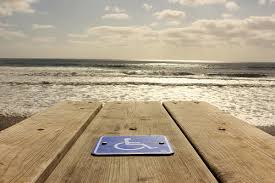
In this week’s parasha, Nitzavim, we are told that the Torah is not in the heavens (“Lo bashamayim hi,” Deut. 30:12), that one should need not climb to the sky to bring it down. Yet, despite all our best intentions, greater access to our bimah awakened us to the fact that–for the one sitting in a wheelchair who approaches our Torah reader’s table–the Torah might as well be in the heavens. It is too high to see for those who cannot stand from their chair. If we had only begun our thought process from the perspective of the one seeking access, the entire design might look different today.
We have much for which we can be proud as we continue to shape our spaces and reshape our understanding of tradition. Our sages certainly understood the need to react according to changing needs and evolve. Our understanding of inclusivity, however, must begin with the perspective of the one who is bringing the gifts of their presence. The reactive approach to others’ needs may be admirable, but it potentially demands too much sacrifice and too high a personal cost for the one seeking access. He might even turn away before placing himself in the situation of asking for accommodation. True empathy would have us examine and shape our rituals, traditions and customs proactively, so that no person seeking access is left feeling like they are fighting for, or being granted, accommodation.
Scotty, you deserved so much more than a ramp.
Rabbi CraigScheff
Teacher Appreciation Life
From the second night of Passover, some of us have been “counting the Omer,” a period of seven weeks that culminates on the fiftieth day with the holiday of Shavuot. The omer was actually a measure of barley that was presented from the new barley crop to the High Priest in the time of the Temple, in fulfillment of the commandment in Leviticus 23:15 (from this week’s Torah portion, Emor). It has come to be known, however, as the period of forty-nine days we are commanded to count. Some people simply refer to this time as the sefirah (the counting). On a spiritual level, our mystics have imbued this practice over the centuries with multiple layers of meaning, focused especially on inner growth and ethical improvement. While it is not an easy ritual to incorporate into one’s life, even with the assistance of electronic reminders, I find it very satisfying to arrive at the holiday of Shavuot, when we celebrate receiving the Ten Commandments, knowing that I have been so conscious of the passage of time and so connected to the calendar.

The sefirah is also observed as a time of semi-mourning, during which Jewish law forbids haircuts, shaving, listening to instrumental music, weddings, parties, and dinners with dancing. According to the Talmud, a plague killed 24,000 of Rabbi Akiva’s students in the early part of the second century during this time on the calendar. Tradition tells us they were punished for their inability to disagree with each other with respect. The thirty-third day of the sefirah is said to be the day in which the plague was lifted. Today (actually tonight into tomorrow!) we celebrate this thirty-third day–lamed (thirty) and gimmel (three), thus “Lag Ba’Omer”–by breaking from our mourning to cut our hair, shave (if our spouses force us to), dance to live music, and maybe even get married!
While I can’t speak to whether Rabbi Akiva’s students were the victims of Divine anger or of Roman swords during what was an historical period of rebellion, upheaval and suffering, I can appreciate the seriousness of the lesson our tradition conveys. Yesterday, our schools celebrated the national holiday known as “Teacher Appreciation Day.” As we find ourselves celebrating Lag Ba’Omer in the midst of Teacher Appreciation Week, I know what Rabbi Akiva’s students would offer us from the Jewish tradition:
Who is wise? Those who learn from every person. Who is honored? Those who honor all people. Do not disdain any person, for every person has his hour. Any person from whom we learn even a letter is considered to be our teacher; and anyone who is our teacher is considered to have given us life. Search out life teachers; in the process, you may discover new friends, while rendering yourself a more accepting, giving and forgiving person.
Appreciate your teachers—and every person’s potential to be your teacher—every day. Maybe that is the ultimate lesson we can as we strive each day to merit receiving Torah. Thank you, Mrs. Tuttle.
Rabbi Craig Scheff
Holy days
When I was much younger, in my junior high and high school years, the last days of the Passover holiday were a time I truly cherished. Even if school was in session, my father would allow me the days off from school to be with him in synagogue for holiday services. It was school policy that no new material or exams could be assigned on the holy days, and my parents were willing to make sure that policy was observed. After all, as I was the only student in my class of 550 students to utilize the excused absence, there wasn’t much incentive for teachers to abide by the policy.
There are 13 “holy days” on the Jewish calendar: the first and last 2 days of Passover; the 2 days of Shavuot; the first and last 2 days of Sukkot; the 2 days of Rosh Hashanah; and Yom Kippur. Schools are closed on the 3 days of the “high holy days” in most New York and New Jersey districts, and some of these holy days occasionally fall on weekends (especially this year). Given that our calendar and dietary rules are two of the things which serve to best distinguish Jewish people from others, one would think that the Passover holiday would be an ideal time to avoid school and find our way to synagogue (where we are serving the very tastiest of Passover cakes this Friday and Saturday). When Jon Stewart of The Daily Show claims that Easter crushes Passover as holidays go, he skips the fact that Easter always takes up a Sunday, whereas 4 of the days of Passover are excused absences from school!

So maybe you scheduled a family vacation on some kosher-for-Passover island to avoid all the extra work that accompanies this holiday. But if you can’t join us this Friday and/or Saturday to celebrate our freedom, you have another opportunity that is 45 days away! As we count up to the holiday of Shavuot to celebrate the giving of the Torah, please consider that our next festival’s 2 holy days fall on Sunday and Monday of Memorial Day weekend! That means that you (and your children!) can pull an all-nighter with us at our Tikkun Leyl Shavuot (our all-night learning session from Saturday night through Sunday morning), catch up on your sleep through the day, and then join us on Monday for services and a Shavuot/Memorial Day barbecue picnic! Okay, so dairy is the prescribed holiday food, but we can make an exception for one meal if it means that we can bring true meaning to our religious and secular holidays. Besides, the opportunity to celebrate receiving the Torah, to recite Yizkor in remembrance of our own loved ones, to give honor to our fallen troops and to be together as a community–all in one day? Who could ask for anything more?!

And maybe, just maybe, the experience will inspire you to give your kids a holy day off from school when we celebrate Simchat Torah on Tuesday, October 6.
Rabbi Craig Scheff
A new year, a new web site, my first blog…

 Three Rabbis Walk Into A Shul
Recent Comments