Our Yiddish library
We welcome, once again, our rabbinic intern Lindsay Goldman as a guest contributor to our blog!
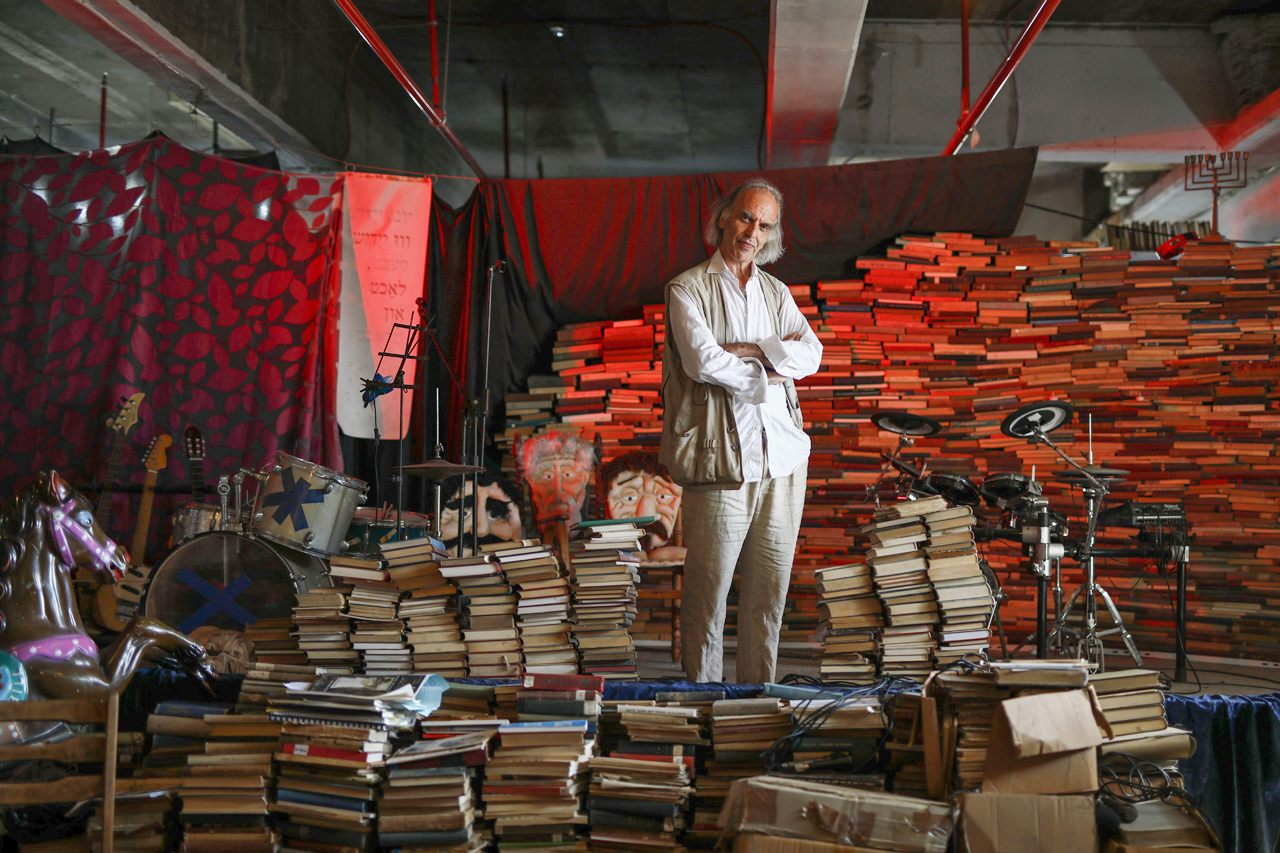
There is a Yiddish library inside the walls of the Tel Aviv bus station. It’s on the fifth floor among the artists’ collective that began when the artists were offered old storefronts as cheap studio spaces. When I was living in Jerusalem before the start of Covid in 2020, we went on a field trip to the library and it was exactly what I expected–a dimly lit room covered with old tchotchkes and floor-to-ceiling stacks of used books. It felt old and stale. While my friends oohed and aahed at the plethora of Yiddish books, I was pretty creeped out. I had never felt a connection to Yiddish or to my ancestors in the shtetls in Eastern Europe. They had all passed away before I was born and it felt like thousands of years existed between us, though it was probably closer to 80 or 90.
More importantly, however, I believe the disconnect came from how I imagined they would feel about how I am living my life today. I am a single woman living in New York City becoming a rabbi. Would they be proud? Furious? Disgraced? In my head, they and their beliefs–about the way the world works and about what I can or cannot do–were old and stale.
I am pursuing my master’s degree in Jewish Gender and Women’s Studies along with my ordination. This semester fewer classes were offered to fulfill my requirements, so I was compelled to sign up for a class entitled “Modern Hebrew and Yiddish Women’s Literature.” Each week we explore a different female author, mostly poets, who either wrote in Hebrew or in Yiddish. As we studied Celia Dropkin, our first Yiddish poet, I was quite moved. Her writing about her womanness and about her body felt incredibly modern, like something that could have been written today. She writes about love and sexuality in a way that felt radical for her time, and especially for Yiddish language literature. It felt fresh. And I learned she was not alone in this exploration of thought and language.
The dusty Yiddish library didn’t feel like my story, but Yiddish was the language my great-grandparents spoke so that my grandparents wouldn’t understand what their parents were talking about. Today my siblings and I speak in Hebrew so that our parents won’t know what we are talking about. Every Shabbat, I light my great-grandmother’s candlesticks and say the same Hebrew words she said week after week. But this week after reading Dropkin’s words, I began to wonder what my great-grandmother and my great-great-grandmothers thought about, what they prayed for, and what they talked with their female friends about. And I realized that perhaps we’re more similar than I had ever known.
Lindsay Goldman, OJC Resnick Intern
 Three Rabbis Walk Into A Shul
Recent Comments