OJC Mitzvah Mission 2016, Day Three
Day 3 of our 11th annual mitzvah mission to Israel was graced with a brilliant blue sky and a warming sun, so any work outdoors today was going to be welcome. It was great to be back at Ahava, seeing familiar faces of children and counselors who anticipate our arrival each November, hearing “the group from Orangetown” being acknowledged with familiarity and gratitude, and sweating a little from our physical labor.
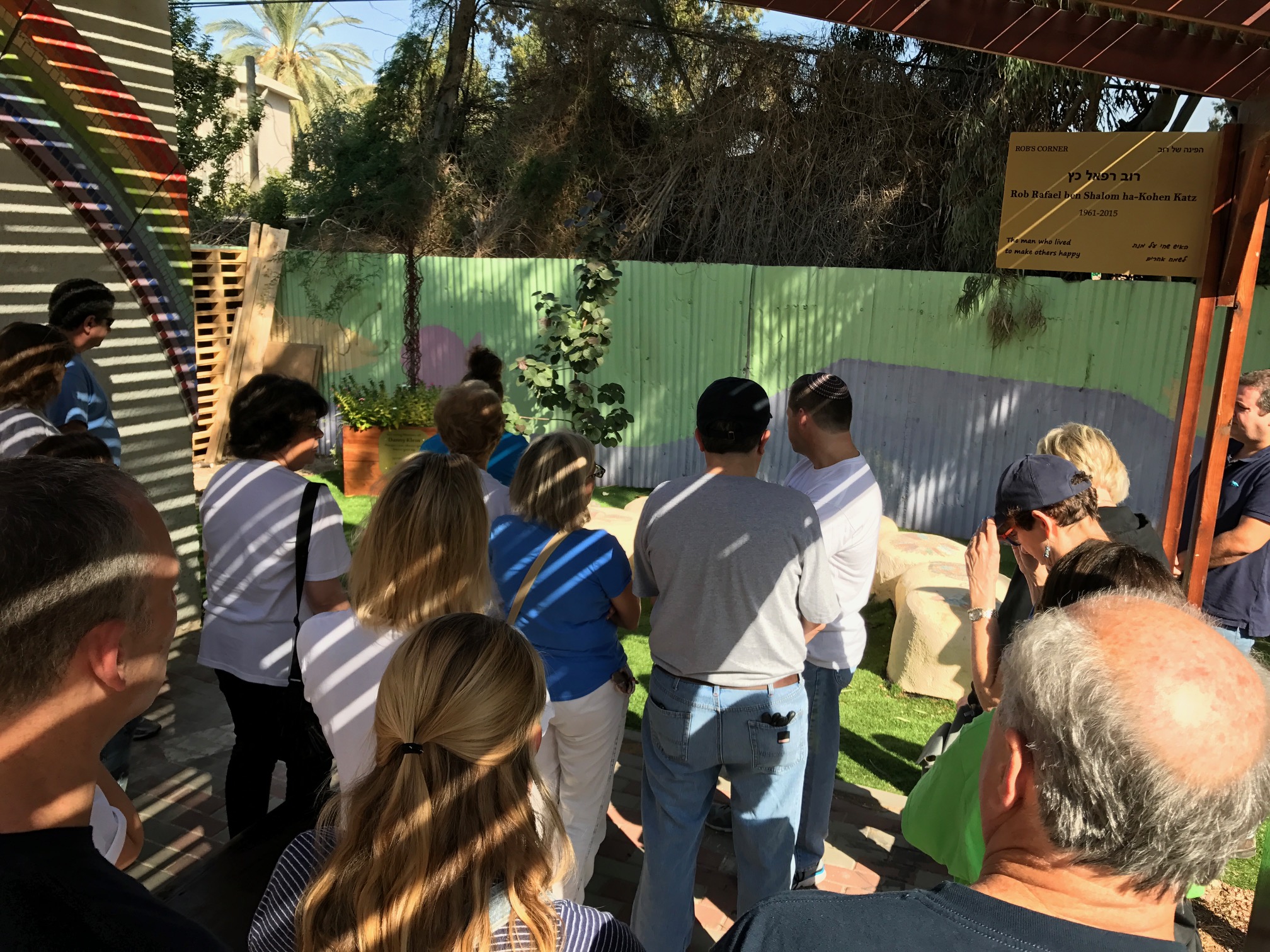
We started the day in “Rob’s Corner,” which we created and dedicated last year in memory of Rob Katz z”l and Danny Klein z”l. Being there today was particularly poignant, given that this date was Rob’s birthday, and this was where he celebrated for nearly the last decade. This home for children “at risk” held a special place in his heart, and Rob was beloved by the administrators, staff and children alike. We quietly prayed, and rededicated our efforts to honor the legacies of 2 beloved people, to stretch beyond our comfort zones and to give freely to others.
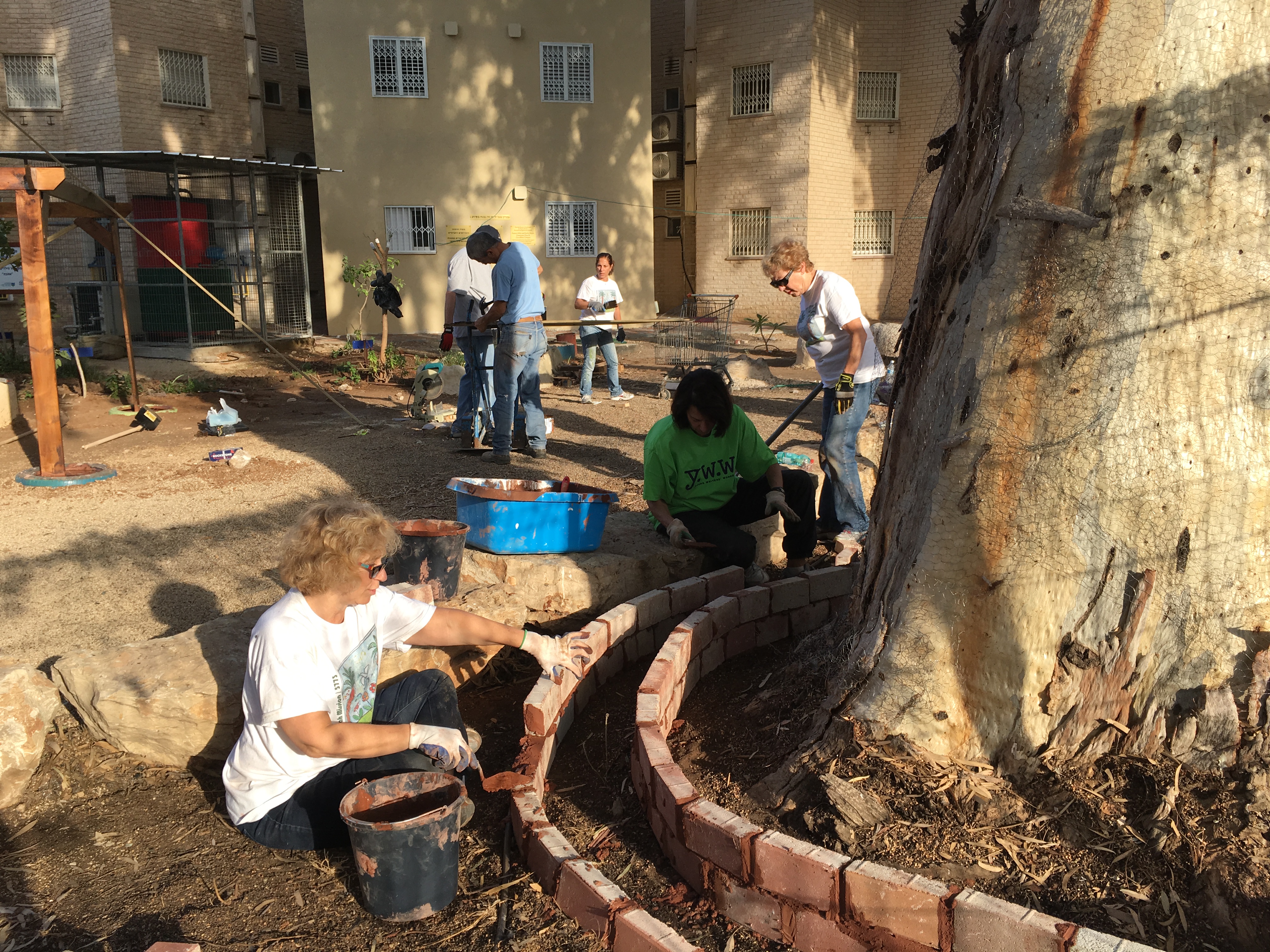
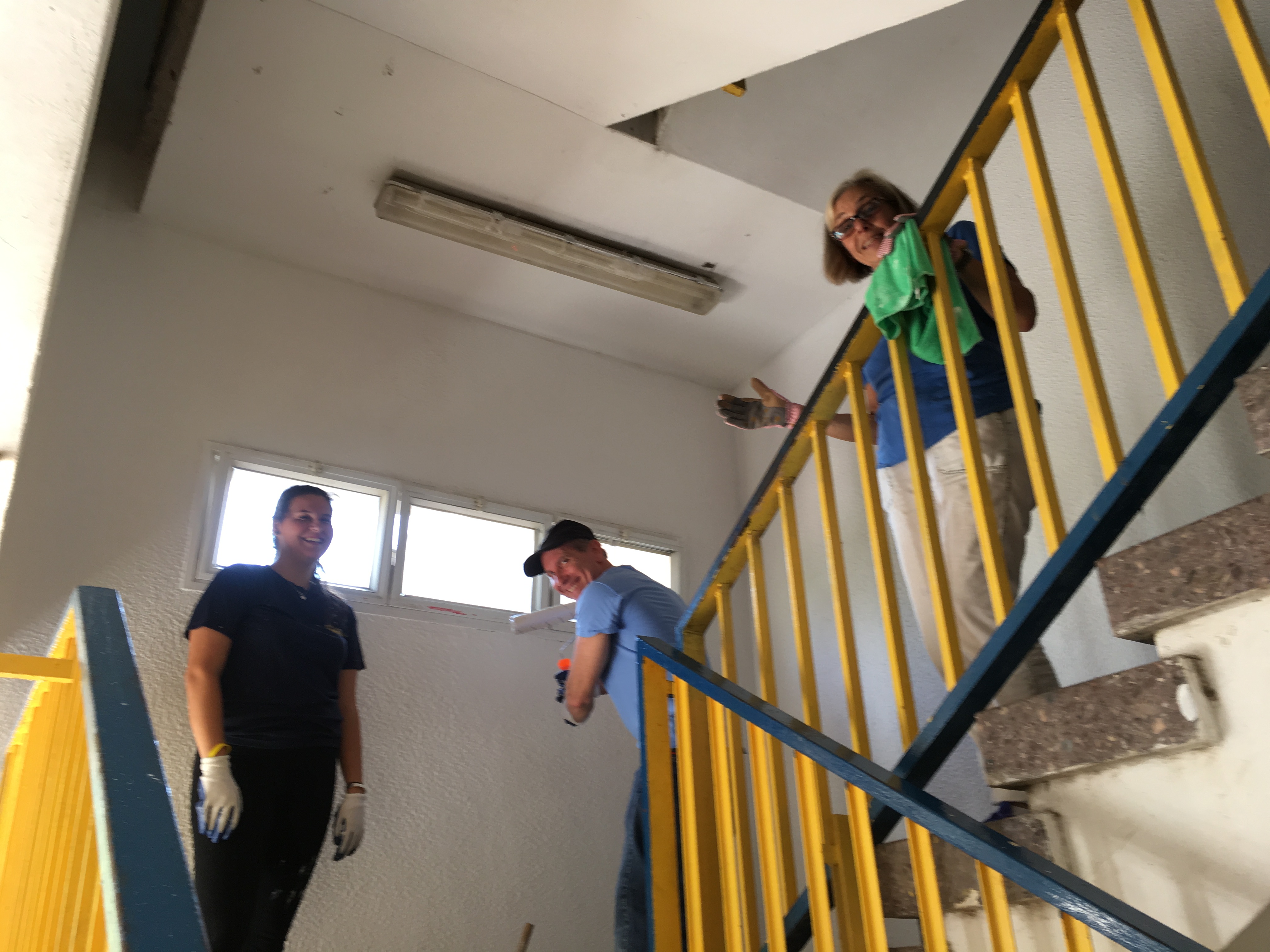
The Ahava stories of resiliency and generosity–those of the children and of their caregivers–continually inspire us; but we have come to recognize that we inspire them as well. The work of our hands can be seen all around the village, and the village administrators have expanded their vision of what is possible. As a result, our projects have become more intricate, artistic and interesting, and the village facilities more beautiful.


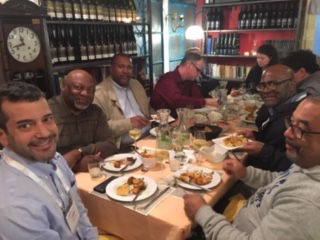
Our group broke into pairs to share lunch with the children and their caregiver families, and our experiences in this setting are always quite diverse. Some home settings are quite functional, familial and warm; others exhibit difficult dynamics of disciplining adults and oppositional children. I happened to sit next to a talkative 15 year-old boy who shared with me that, before coming to Ahava, he had been in a residential facility that could not teach him to address his challenges. In contrast, three years at Ahava, along with the loving discipline of his second family, have given him the skills and confidence to overcome his past and to look ahead with a sense of hope.
Tomorrow we return to Ahava to complete our flower gardens, trellises, planting, painting, photography project, bracelet-making and mosaics. We’ll celebrate with, and offer gifts to, this year’s bar mitzvah class. We pray that God will bless the work of our hands so that it–and we–may serve as a legacy to the benefit of others.
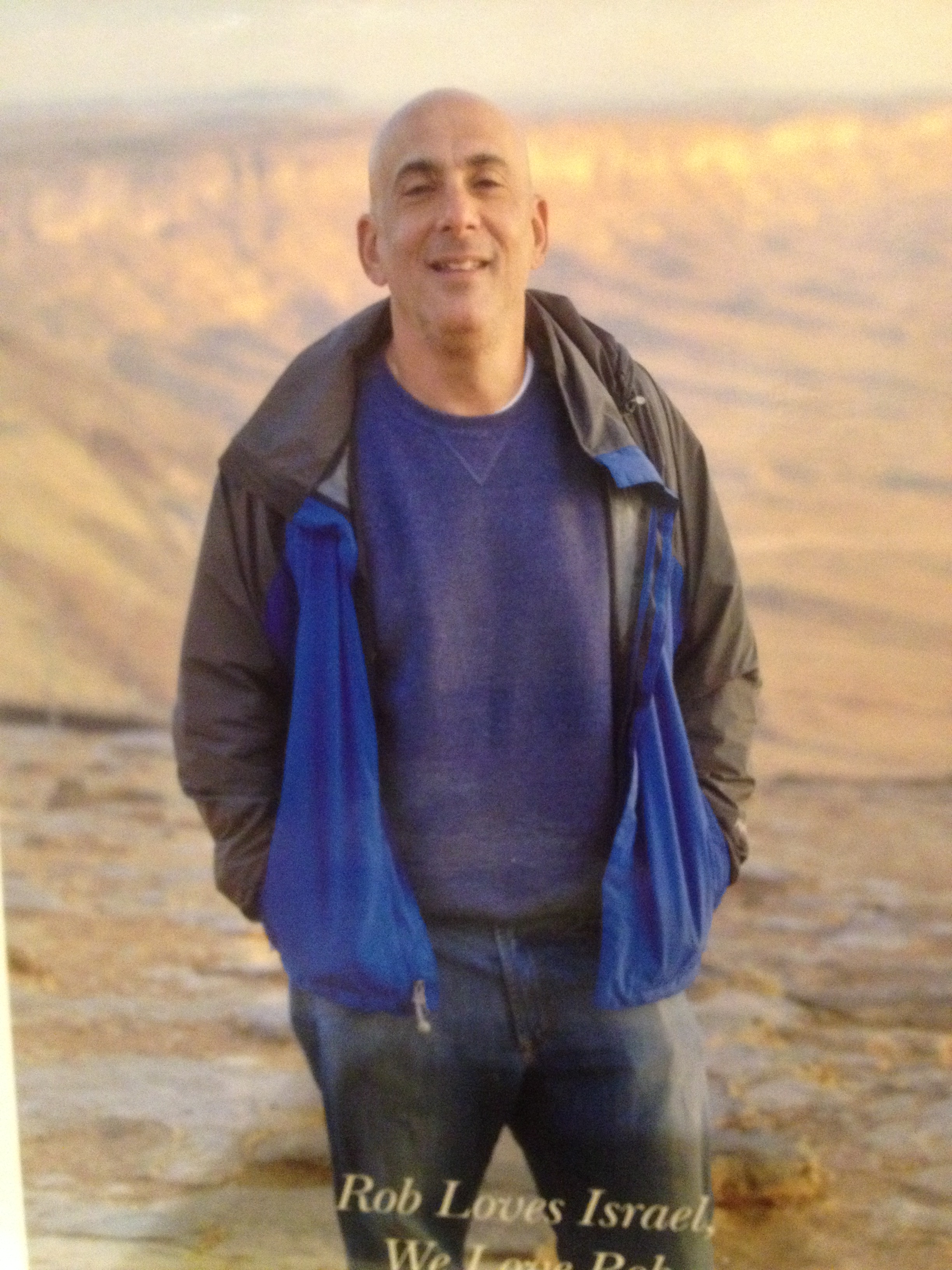
Happy birthday, Rob. Miss you.
Rabbi Craig Scheff
Day 2 – On a mitzvah mission
Part of the beauty of this group is that sometimes, honestly, we don’t know exactly where we are going or what to expect. “Roll with it,” we tell ourselves, because our intention first and foremost is just to be here, and when we show up to support an organization that is doing some good for someone, chances are we’ll do some good as well.

ALEH is that organization that collects small change on El Al flights in order to make a big difference in the lives of those with disabilities. We chose ALEH as our first project, and started our day south of Tel Aviv, in Gadera, where we met the special people who give hours of their lives, 6 to 8 each day, to teach, care for and grow with individuals from infancy to 60 who experience a wide range of disabilities. We entered ALEH’s school after a brief introduction and instantly found ourselves bewildered by the severity of the disabilities–physical, cognitive and emotional–of the people with whom we had chosen to interact. The “projects” we were meant to undertake with the consumers were frustrating and futile attempts to establish some level of communication. The discomfort was evident in our body language.

Until, that is, we started seeing each child, teen and young adult as individuals. First, we strung beads, guiding their hands, or pushed them gently in their swings. Next we held their hands. And finally, we danced. The sounds and smiles, followed by the jumping and swaying, gave expression to the excitement we all felt in connecting. (Sorry, no pictures allowed of the consumers.)

And when the songleader led the residents in the Hebrew song “Thank you for all You, God, created,” several of us were reduced to tears. How astonishing to hear such expressions of gratitude from those with such challenges in their lives–for God’s goodness, for their teachers, for each other, for us. How could we ever be the same?
We took a deep breath to recover from the emotion of the morning by finding respite in the shade of my sister’s back yard. We filled our bellies with pizza, pita and falafel while enjoying the home hospitality and Randi’s story about our family history, dating back to 1949, on the moshav. Thank you, Randi and Avi, for opening your home!
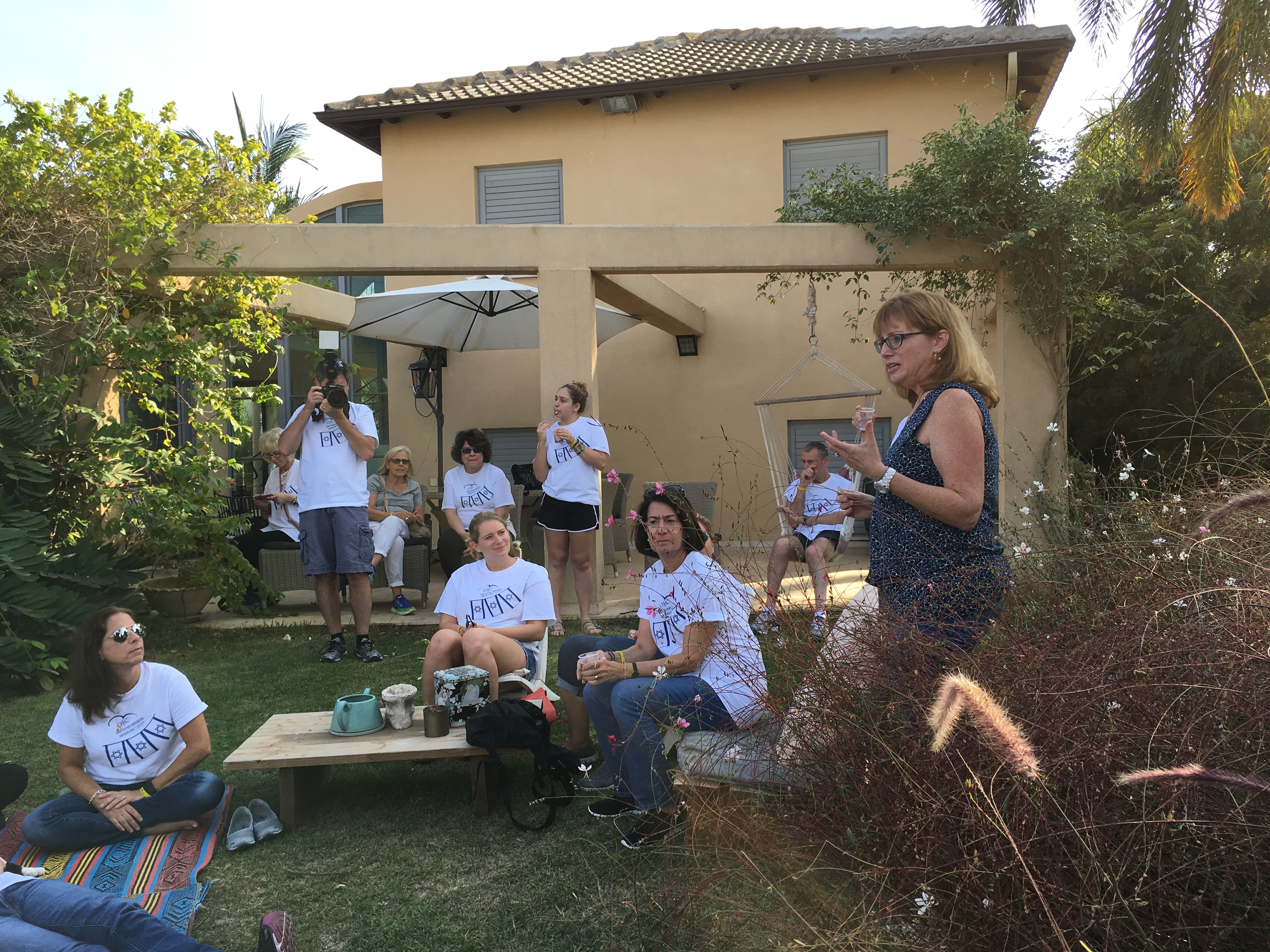
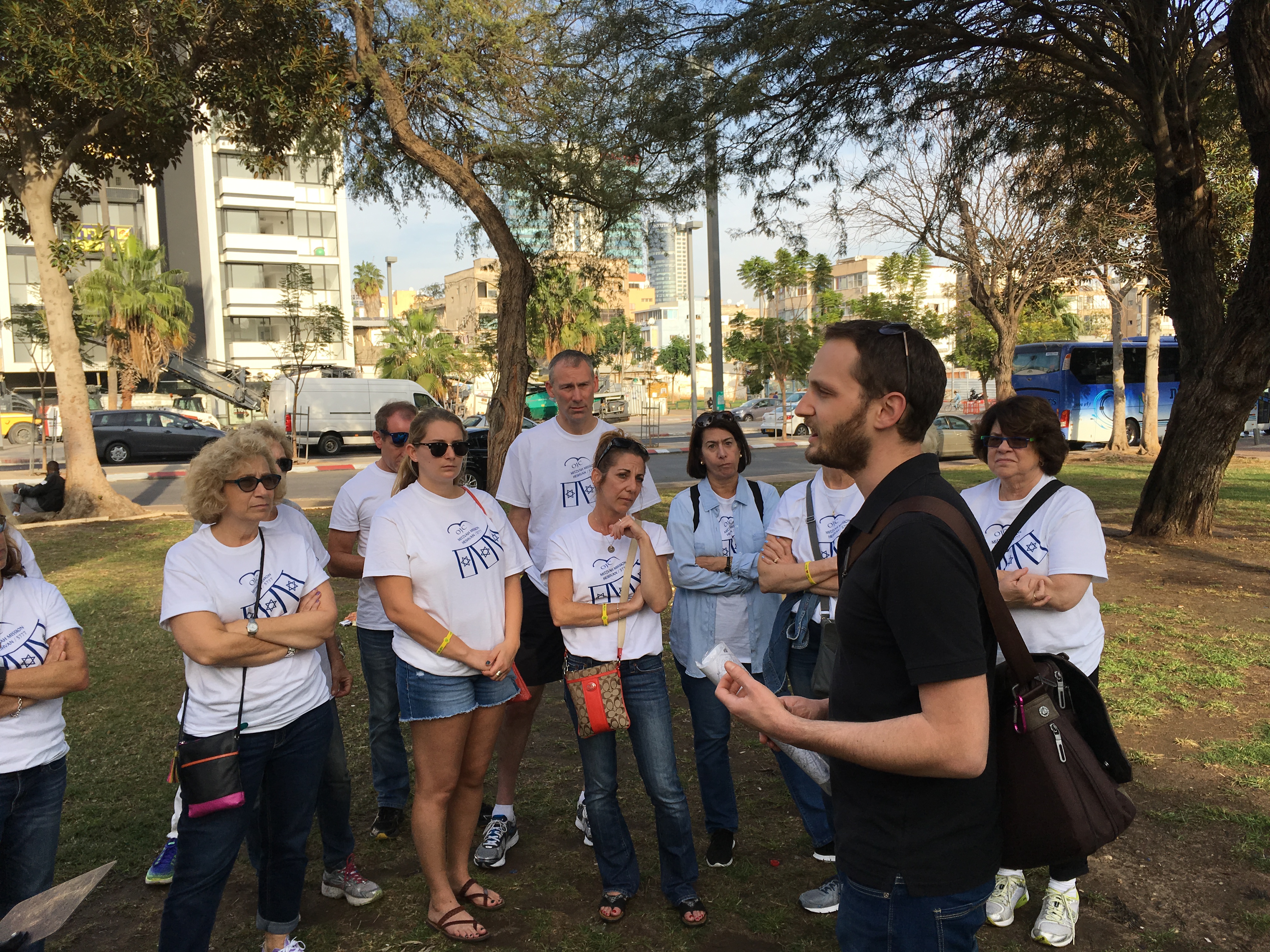
By 2:30, we felt like it was Day 3 of the mission, but we had one more stop to make before heading to Haifa. BINAH (“wisdom”) is a “secular yeshiva” in Tel Aviv where Israelis of all sorts join in Jewish study, social action and community empowerment. “A Home for the Creation of the Nation’s Soul” is the vision towards which the movement works, and “secular” Israelis are lining up to reclaim their Jewish heritage as expressed through this vision. We toured the depressed area of Neve Sha’anan, near Tel Aviv’s central bus station, to learn how this neighborhood came to be the haven for asylum seekers and migrant workers from the African continent.
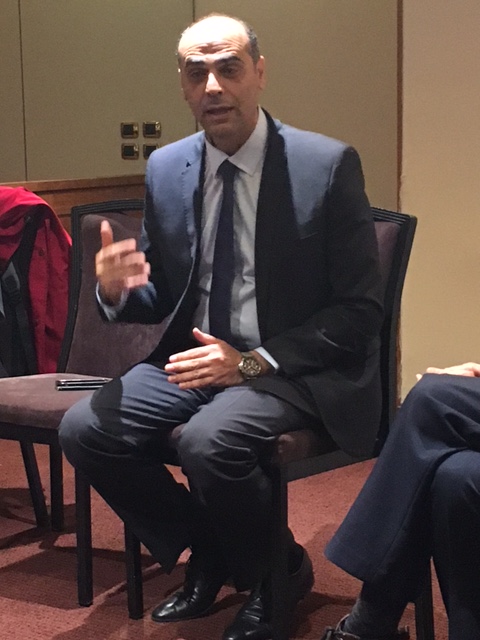
Once at the yeshiva, we engaged in a text study that led us to reflect on how Israel wrestles with preserving its character as a Jewish state while representing the highest ideals of our tradition, remembering that Israel is, by and large, a nation of refugees. Needless to say, Israel and the Zionist dream is still a work in progress.
All in a day’s work. Small change, big difference.
Rabbi Craig Scheff
Partners for Peace, Day Four



In the beginning
In the beginning
Of God’s creation
There was potential:
Energy, chaos, intention…
And then there was light —
And darkness
And differentiation
Not a day nor a night measured by a sun or a planet’s rotation
Just the eve of something great,
With order to follow,
And the actualization of a vision
On the eve of completion,
humankind became a part of that vision,
little less than divine, but still
There was potential:
Energy, chaos, intention…
And light —
And darkness
And differentiation
And days measured by a sun and a planet’s rotation
Yet still an understanding of what it means to be
Just the eve of something great,
Without being rooted in time
With order to follow
And chaos still looming
And a vision not yet actualized
But in progress.
Shabbat
Shalom,
Rabbi Craig Scheff
It all started with a ramp
It all started with a ramp, or a lack thereof.
Scotty grew up in the synagogue community, a kid everyone loved. Neither the cerebral palsy diagnosis he received as a baby nor the wheelchair that carried him from his earliest days ever dampened his spirit, his smile, his radiance. Scotty’s determination to play an equal part in our community life demanded so much commitment and effort on his part and that of his family. On the Shabbat morning he celebrated becoming a bar mitzvah, Scotty needed to be lifted in his wheelchair by four family friends up onto the bimah. With each small triumph, and each obstacle overcome, our community celebrated his courage; yet, with each “step” Scotty took, we became more aware of how relatively little we had done, and how far we had to go, to become a truly inclusive community.
In Parashat Ki Tavo, we learn of the Hebrew formula that each Israelite was required to recite upon offering the thanksgiving gift of first fruits in the Promised Land. In one sense, this set liturgy can be seen as unifying and inclusive, creating a ceremony equally accessible and empowering to all. In practice, however, it became clear that not all Israelites could participate in the ceremony in the intended manner. The Mishnah informs us that originally this formula was only to be recited in Hebrew (Sotah 7:2-3). In time, a prompter was provided for those who could not recite the Hebrew. Eventually, to save those individuals in need of prompting the embarrassment of appearing inept, it became standard practice for all to repeat the formula after the prompter (Bikkurim 3:7).
The ramp came first. Then a total redesign of our sanctuary lowered the bimah and brought our podium to the floor. Mezuzot on the bottom halves of our doors; a separate accessible bathroom and remotely activated doors; removable sanctuary seats that will allow space for wheelchairs amongst the congregation, as opposed to being accommodated in a back corner–all these conscious modifications were intended to make our space more welcoming to all. With each step of progress, however, we become more aware of, and sensitive to, the challenges ahead.
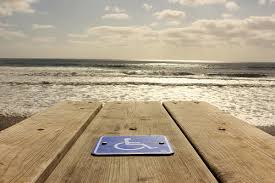
In this week’s parasha, Nitzavim, we are told that the Torah is not in the heavens (“Lo bashamayim hi,” Deut. 30:12), that one should need not climb to the sky to bring it down. Yet, despite all our best intentions, greater access to our bimah awakened us to the fact that–for the one sitting in a wheelchair who approaches our Torah reader’s table–the Torah might as well be in the heavens. It is too high to see for those who cannot stand from their chair. If we had only begun our thought process from the perspective of the one seeking access, the entire design might look different today.
We have much for which we can be proud as we continue to shape our spaces and reshape our understanding of tradition. Our sages certainly understood the need to react according to changing needs and evolve. Our understanding of inclusivity, however, must begin with the perspective of the one who is bringing the gifts of their presence. The reactive approach to others’ needs may be admirable, but it potentially demands too much sacrifice and too high a personal cost for the one seeking access. He might even turn away before placing himself in the situation of asking for accommodation. True empathy would have us examine and shape our rituals, traditions and customs proactively, so that no person seeking access is left feeling like they are fighting for, or being granted, accommodation.
Scotty, you deserved so much more than a ramp.
Rabbi CraigScheff
#whoweare
This past week, the Jewish Federation and Foundation of Rockland issued a statement, which we shared to our synagogue community, in response to the recent publication of the Movement for Black Lives’ platform. I had a feeling that the statement would elicit a range of responses, and my sense was rewarded with three messages, each very different in its perspective. With each passing day this week, following social media and the many (mostly Jewish) media outlets, I gained several more perspectives in response to the platform. I have tried to find my personal response inside these many perspectives, but none entirely gives voice to exactly how I feel. So perhaps, if I can lay out my responses for you, you can come to a conclusion of your own. I can, however, offer you from the outset one ultimate conclusion I have reached: if you truly care about where to stand on this issue, you must dive in deeply. Wading through the waters from the surface will only serve to reinforce preconceived notions and biases, in which case you might as well not even bother taking the swim.
To summarize the issue in its most basic terms, the published platform of the Movement for Black Lives (note: they are a subset of organizations affiliated with the Black Lives Matter movement, but they are NOT synonymous!), in an extensive and far-reaching statement of “policy demands for Black power, freedom and justice,” includes a section on investment and divestment: “We demand investments in the education, health and safety of Black people, instead of investments in the criminalizing, caging, and harming of Black people. We want investments in Black communities, determined by Black communities, and divestment from exploitative forces including prisons, fossil fuels, police, surveillance and exploitative corporations.” Among the many detailed demands put forth in this section, in calling for a decrease in military spending and aid, the platform singles out America’s complicity with Israel “in the genocide taking place against the Palestinian people.” The platform further states that “Israel is an apartheid state with over 50 laws on the books that sanction discrimination against the Palestinian people.”
So here is where the conversation gets tricky, especially in a community where so many people have pledged support for the Black Lives Matter effort but who also care about protecting Israel’s interests against deligitimization and the growing BDS (Boycott, Sanction and Divest) movement.
My observations:
- Everyone should read the entire Movement for Black Lives platform. It is important on so many levels, and there is so much to learn about the institutional challenges we as a society face in battling economic inequalities, social injustices, and racial biases in America. (Click here, please, to access the platform.)
- “Genocide” is a loaded term, especially for Jews. While others may look to expand the definition of the term for their own purposes, or are not sensitive to the impact of that word on others, some Jewish people go to the other extreme, claiming ownership of the word for their personal, unique and incomparable historic experience. Most Jews are extremely sensitive to the use of that word being directed at Jews or the Jewish state. In the words of my colleague Rabbi Shai Held, “The Occupation has caused immense suffering to Palestinians, and in my estimation, it has caused profound moral and religious rot in Israel. And the silencing and condemnation of so many serious, passionate Jews who have been critical of the Occupation has done profound damage to the American Jewish community (and to Israel too). But an occupation is decidedly not a genocide. And to suggest otherwise is to demonize and vilify the Jewish State based on what amounts to a libel.”
- Naming Israel an apartheid state is absurd, and exposes ignorance at best and bias at worst. Recent United Nations reports of Hamas using humanitarian aid for the purpose of building tunnels into Israel from Gaza should serve as a good reminder for why security fences and checkpoints exist in certain population areas. Moreover, the economic and political freedoms and legitimate opportunities that Arab Israelis, Muslims and Christians, Blacks and other minorities enjoy in Israel should render any accusations of apartheid as malicious and illegitimate. This is not intended to ignore the challenges faced in Israeli society, where prejudices and institutional inequalities also exist. But by any objective standards, these challenges do not render Israel an apartheid state.
- Any intersection of the Black Lives Matter with the BDS movement sells short and undercuts the legitimacy of the BLM movement. Most in the mainstream agree that BDS is veiled anti-Semitism, that it does not advance the chances of peace between Israelis and Palestinians, and that it does not acknowledge the realities of the region.
- Jews have historically walked proudly with other civil rights’ movements, especially in 1960s America, because of our own historical experience and the Torah’s socially progressive ethics. But the Movement for Black Lives is not the civil rights movement of the 1960s. It sees itself, in its own language, far more aligned with the more radical Black Power movement, engaged in a struggle against White supremacy and imperialism around the globe. To what degree, then, is this movement interested in partnerships with those who have been associated with privilege and imperialism? That question is yet to be answered.
- “All lives matter” is not an appropriate response to the “Black lives matter” assertion. Just as we, as Jews, see our historical experiences and suffering as unique, so too blacks have a unique history, experience and place in society today. We who are white Jews may be able to sympathize, but we cannot empathize with those who are black. I have learned this from the stories of black Jews in our community; I have learned this from white Jewish parents raising black Jewish children. They face a unique set of challenges in this society, Jewish or not. Yes, all lives matter. That is one of our central values as Jews. Even so, the obligation to the stranger in our midst is a separate Jewish value, equally as important. The plight of black people in our society warrants separate consideration.
My conclusion:
“We” are not mutually exclusive. “We” as a Jewish community are constituted by individuals of many colors, black, white, and others; we are Jewish and non-Jewish; we are liberal and conservative. As such, we need to recognize that when issues such as this one arise, some of us may be affected differently than others. Our internal response is as important as how we respond to the outside world. Unified or not, that response needs to reflect an understanding of, and be sensitive to, the diversity that “we” represent. Hopefully, our response can always reflect the unity of our shared values. If the 9th of Av, whose fast is observed Saturday night into Sunday, is to teach us anything, it should at least teach us that is who we are.
Shabbat shalom,
Rabbi Craig Scheff
Speaking as prophets
Today, Israel and those who love her mourn the brutal murder of 13 year-old Hallel Yaffa Ariel. The leadership once again searches for balance as it reels from the blow, struggling to arrive at the “appropriate” response. I would not dare offer an opinion on the matter, even if I could formulate one. As I prepare to share this message, another terrorist attack is unfolding in Bangladesh, with several already dead, dozens held hostage and ISIS claiming responsibility. I pray that the perpetrators be brought to justice and that the hostages emerge unscathed. But even as we struggle with how to respond to our neighbors and to the world in light of these events, I am still compelled to speak within our family to an issue that must remain at the top of our agenda as Jews. t is an issue of self-care. And such is the nature of these times. If we cannot care for our own well-being, we won’t be any good to anybody else. To that end:
Some of my colleagues believe that in this day and age rabbis must function as prophets, taking public stands on political and social issues from gun control to refugees to presidential campaigns. Judaism, no doubt, has what to say about all these topics of the day and more. As a rabbi, however, I see it as my task to educate about what Judaism says to all sides of these issues. After all, we know that Judaism rarely offers a single answer to any question, sometimes only offering another question in response. Being a rabbi certainly doesn’t qualify me as the authority on all topics that affect our society; being a Jew certainly doesn’t qualify me as owner of the only truth.


“You’re not Jews,” Haredi protesters shouted at the non-Orthodox worshipers
Jews of Israel and Jews of the Diaspora must take back from the hands of the self-proclaimed prophets ownership of God’s word. Each of us is a prophet, each of us hears God’s word. When we own this fact and tear down the false altars that have been erected by those who have hijacked our tradition, Torah will once again emanate from Zion, the word of God from Jerusalem. Her ways will be pleasant, and her pathways will be peace. Then we will certainly have what to tell the world.
A prayer in the wake of disaster
Tonight, however, this open heart is a curse. Because I feel the suffering of my sisters and brothers. And I absorb the taunts of those who wish my children harm. And I shudder at the sounds of laughter and rejoicing over spilled blood. And I don’t see in the face of my neighbor another who is content with being my neighbor. And the voices of reason that provided me with hope just hours ago have been drowned out by the crowd applauding the gun shots in the theater of the absurd.
So in this moment I find myself closing my open heart to protect myself from the pain of all that suffering. And as the heart closes, I feel it hardening in anger and despair.
Please, God, slow my racing heart and grant me a few hours’ rest. And in my sleep, soften my heart again. Because I need to love. And I can’t truly love–even my own children–so long as this hardened heart beats within me. And once I can feel again, let the blessing-curse of my empathy move me to heal the sick, to comfort the mourner, and to set out rebuilding a shattered world.
In the words of Jeremiah from this past week’s haftarah, “Heal me, Adonai, and I will be healed; save me and I will be saved.” Give me reason to praise You.

Remember to rejoice
Israel gives Memorial Day it’s due.
Yom Hazikaron, Israeli society’s day to remember it’s fallen soldiers and those lives lost to terrorist attacks, weighs heavily on Israel’s communal heart. As the sun goes down on the day, however, a switch is flipped, and an unbridled joy sweeps across the country. Riding a wave of relief, young and old take to the streets to sing and dance, that same communal heart racing to celebrate Yom Ha’atzmaut, Israel’s independence day.
In Israel, our six degrees of separation are reduced to two. Everyone knows someone who has experienced the personal loss of a family member, friend or acquaintance to war or terror. So while the community shifts into celebration mode, many individuals remain clenched in the pain and sadness of the national day of mourning. And those who are dancing know that some among their friends can’t bring themselves to do so. Still, the memorial day adds meaning and purpose to the independence day that follows. It is the broken glass at the wedding. The joy of the second is an informed joy, and the loss remembered is appreciated for what it has made possible. The losses have not been in vain; the sacrifices are not unnoticed or unappreciated. Sadly, Yom Hazikaron is the silver platter upon which Yom Haatzmaut is served, and the platter needs to gleam freshly polished if the main dish is to be enjoyed.
I wonder what these two days will look like when Israel is 340 years old. Will we still be reading names of fallen soldiers and victims of terrorism before celebrating Jewish sovereignty, or will Israel have achieved six degrees of separation from the suffering? And what might that look like? Could Israel’s national days become back to back days for barbecuing and hitting the malls for sales? Somehow, I don’t think so. I imagine that even, God willing, when there are no fresh names to read, and the thousands who have died in sacrifice are generations in the past, the proximity of these two days will carry the same impact as the moment “If I forget you, Jerusalem, let my right hand wither” is recited under the chuppah.
If you’ve ever come to our synagogue, you’ve passed by the Camp Shanks memorial, a site erected in honor of those soldiers who passed through Camp Shanks on their way to Europe in World War II. I see it every day of my life (except sick days or a rainy Shabbat). It is a powerful reminder that even a country without enemies on its borders has endured loss and has demanded sacrifice, which all too often go unappreciated. I don’t know how many years 9/11 will continue to be remembered by so many of us as a day of solemn assembly. I don’t think that the degrees of separation from personal loss should diminish the respect and appreciation we show for the sacrifices that have assured our freedoms.
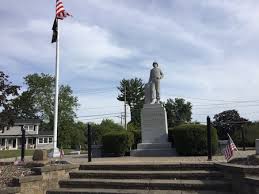
This year, at 9:45am on Memorial Day, immediately following an 8:45am morning service at which a memorial prayer will be recited as part of our Torah service, I will walk down the street to stand at the Walkway of American Heroes. I will be surrounded by veterans and families of veterans, by those who have known loss and those who have known service, by local community members who make remembrance a part of their joy. I hope I will be surrounded by you.
Rabbi Craig Scheff
You are invited to not pray!

That’s right, you read the title correctly. I am inviting you to not pray. Come to synagogue tomorrow morning, sit for an hour, or two, or three, and don’t pray. I am allowed to say that because, frankly, I have no idea what the English words “to pray” mean. The meaning of the words, I believe, will necessarily change depending on what is our definition of God. Implicit in the word “prayer” is some recognition that we are engaging in an effort to connect to something beyond ourselves, whether that something is above us, beyond us or within us. Are we asking for something, actually expecting a response? Are we seeking the granting of a wish? Are we hoping to gain a perspective that puts our lives into a context of something greater, thereby either maximizing or minimizing our significance, our achievements, or even our wrongdoings? Prayer is not necessarily an act of petition, supplication or thanksgiving. It may be all these things, it may be none of these things.
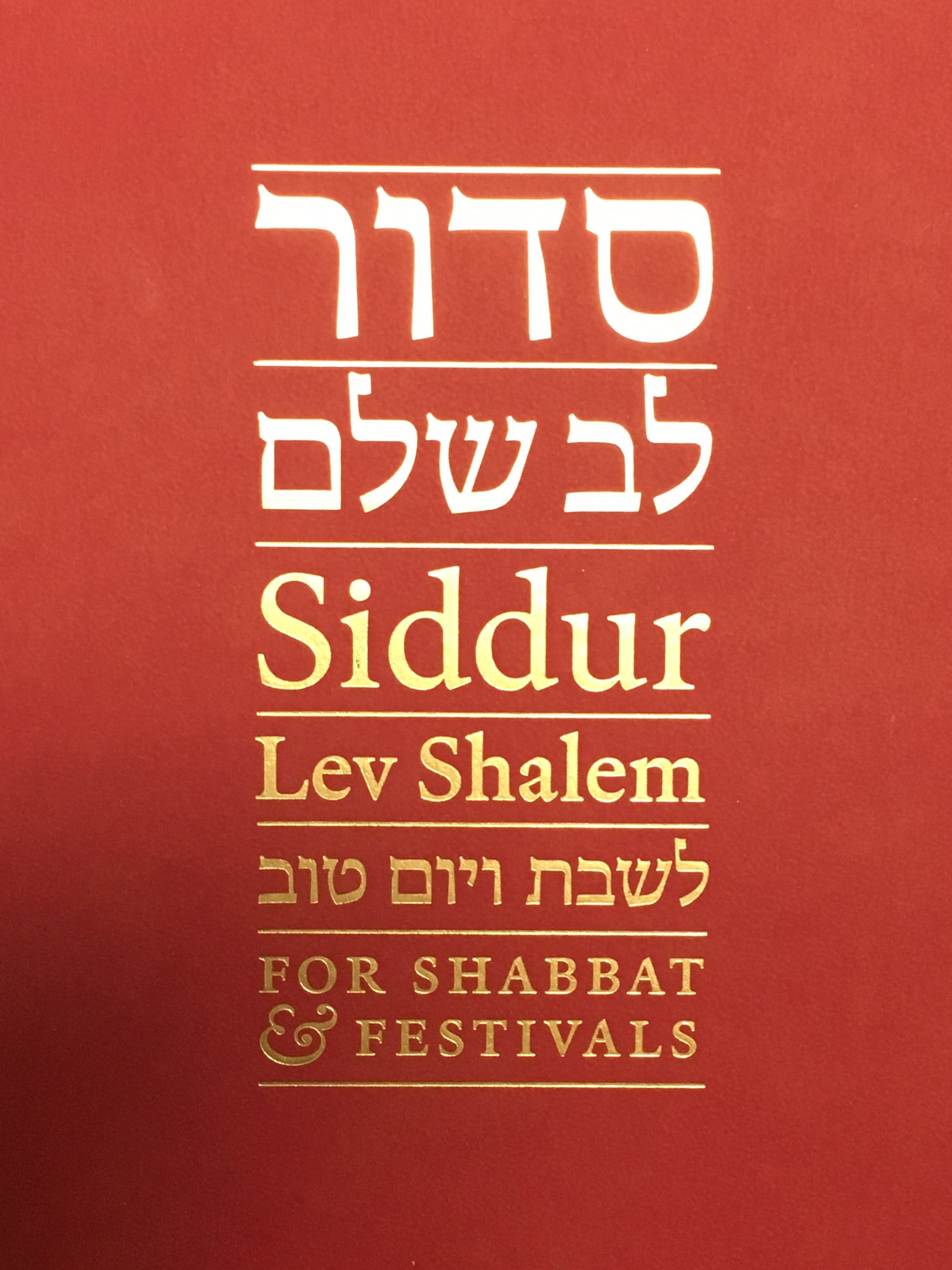
In our Siddur Lev Shalem, the new prayerbook published by the Rabbinical Assembly which we introduced to the congregation two weeks ago, the phrase Barukh Atah Adonai, commonly translated as “Praised are You, Lord,” is intentionally left untranslated. In the English text, the phrase appears simply as Barukh Atah Adonai. I love the affirmation of the idea that the words cannot be translated easily, if at all. How do we approach sacred purpose? How do we express shared values and shared search for meaning? How do we establish a space for safe vulnerability? How do we sing in gratitude for our freedom and in lament of those things that still enslave us? How do we find inspiration and comfort in the company of others who are as imperfect and broken as we are? That which we can’t translate into words is left to the service of the heart.
The beauty of our new siddur is found in its acknowledgment that there is no single way to pray. The book is an invitation to a dialogue with God, certainly, but it is also an invitation to meditation, to study, to quiet contemplation, to communal song. It is as modern, creative, and untraditional as we need our expression of faith to be. It is as ancient, as set and as traditional as we need our expression of faith to be. It is an invitation to explore our desire to connect emotionally, intellectually and socially to purpose, values, tradition, shared history and shared mission.
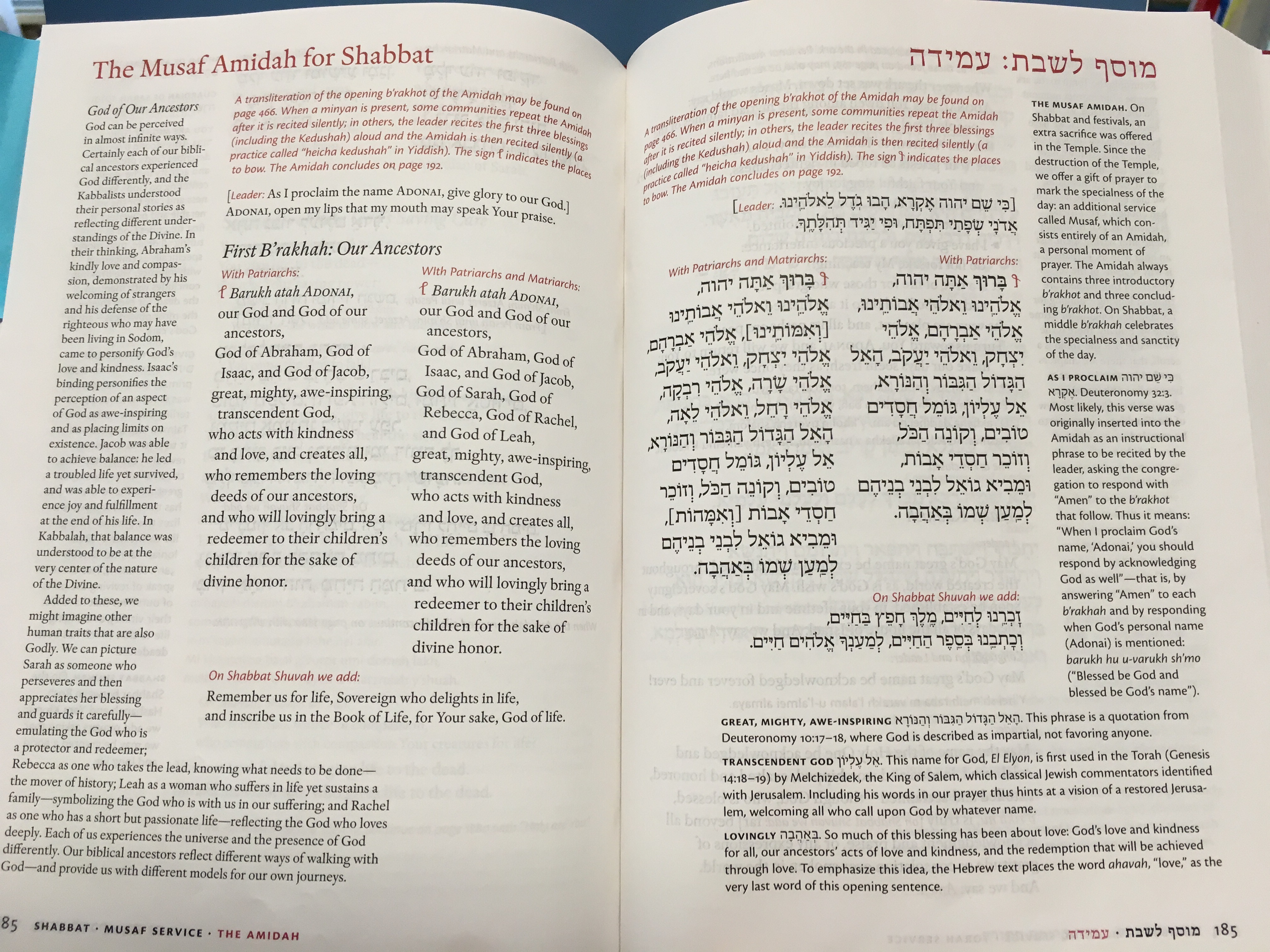
Jewish tefillah–self-examination–is time set aside from the mundane distractions in our lives. The siddur serves as the open doorway to that time–time for perspective, time for growth. Join us tomorrow morning for an hour or two or three. Join us for you. Join us to learn more about this new magnificent resource and our own personal searches for meaning. Join us to sing, learn, connect, and be. Join us, you know, to pray.
Shabbat shalom,
Rabbi Craig Scheff
 Three Rabbis Walk Into A Shul
Recent Comments