Referees and umpires
As coach of Rockland’s 16U basketball team in the JCC Maccabi Games last week, I saw my fair share of good refereeing; I also saw some really bad calls. Some went in our team’s favor and some went against us. Some calls were inconsequential to the game’s outcome and some changed the game’s momentum and possibly affected the results. I encountered coaches drawing technical fouls for inapproprate behavior (none for me!), and coaches bantering with the refs as if they knew each other well.
This week’s Torah portion instructs us to appoint judges who will administer the just application of our societal rules. Our society’s referees are commanded to rule justly, to shun partiality and to avoid the appearance of impropriety. It is a tall task, however, to ask judges to remain totally impartial. I certainly don’t expect a referee to give any of my players the benefit of the doubt if they are being disrespectful in any way to the referee, another player, or the game itself! In the same vein, why would an umpire want to make a call that I am expecting if all I do is complain about every call?
On a far more emotional level, how can an umpire not get caught up in the approving roar of the crowd or the emotional swell of a game’s momentum? What referee doesn’t get angry when voices from the sideline or the crowd are constantly berating them for the job they are doing? And what person won’t harbor some resentment from one bad set of interactions to the next encounter?

I instruct all my players that I will be the only one to address the referees. I greet them with a handshake. During the game, I ask for explanations of a ruling, as opposed to being overtly critical. I point out inconsistency in the application of the rules. I suggest that certain infractions by the opposing team be watched more carefully. And after the game, my players shake the hands of the “judges” and thank them for their service.
Sounds good, right? But what about the fact that I do all these things with the added hope that it will gain some measure of favor for my team? Am I not striving for some measure of impartiality, a psychological bribe of sorts?
In our day and age, there is more and more emphasis on instant replay, on removing the human element from the application of the rules. Removing the human, however, also means removing the humanity from the equation. In this month of Elul and in the time of judgment that is a few weeks away, we ask God to move from the seat of justice to the seat of mercy. We don’t want to be held to the strict application of the rules. We want a ref who will let us travel, or carry, or commit a foul once in a while without getting called for it. We want a judge who will, in fact, be partial to our humanity.
Rabbi Craig Scheff
Minyans without minions
Flying home from Israel a couple of weeks ago, I had an interesting conversation with a Modern Orthodox man from the Wesley Hills area of Rockland County. He shared with me that his learning community struggles to get a morning minyan (quorum of 10 for public prayer) on a daily basis, and that the community elected to pay five people to come on a daily basis to assure the presence of a minyan!
Our history is replete with stories of people looking for someone to serve as “the tenth” for a minyan. To this day there are many neighborhoods where it is not uncommon for someone to stop you in the street and ask “are you Jewish?” and “can you help make a minyan?”
 So I am about to share something with you now, but if you read the next line, you have to promise to read to the end, okay?
There is no mitzvah in the Torah that obligates a person to pray with a minyan!
Having said that, let me explain.
Public worship and the requirement of a minyan were rabbinic enactments some two thousand years ago. Their purpose was to encourage communal prayer; more specifically, the rabbis taught that our prayer, the Amidah, was accepted more favorably by God than individual prayer. The rabbis have long debated whether there is an actual obligation to pray with a minyan or whether it is simply more meritorious to do so! The Shulchan Aruch (OC 90:9) writes that a person should “make an effort” (yishtadel) to daven with a minyan, but does not state that “one must.” Even those who call it an obligation recognize many exemptions to the obligation: where someone is occupied with another mitzvah (obligation); where someone needs to travel further than 18 minutes by foot (and the rabbis disagree regarding whether this is exemption is based on distance or time!); or where someone is busy earning a living. Personally, I would add to the exemption list: when someone is occupied caring for the needs of another.
There are many added benefits to praying with a minyan. First and foremost, a minyan helps create community. A minyan also enables us to answer “amen” to Kaddish and Kedushah, both of which are the public sanctifications of God; a minyan enables us to read publicly from the Torah. Coming off a week with 3 shiva houses, we know that by having a daily minyan, our community fosters a culture of care, compassion and support for its families. All these benefits are wonderful by-products of coming together to offer our prayer. Some rabbis labelled as “bad neighbors” those who failed to support public worship when they were not exempted.

It is a mitzvah as well, however, to pray at home. And it is a mitzvah as well to come to the synagogue to pray with others, even if a minyan quorum of ten is not achieved. Our Tuesday morning 8:45 service rarely gets a minyan, but the people who are there pray, sing, teach, learn, meditate, give love and feel embraced. Our Thursday morning 6:45 service often has a minyan, but even when it doesn’t, the morning’s “regulars” count on seeing and connecting with each other and are glad to complete their prayers together. Our Sunday morning 8:45 service often comes up just short, but those of us there count on that time to breathe together. With or without a minyan, we benefit by coming together in prayer.
Some mourners feel a sense of disappointment when they come to say kaddish and we don’t get a minyan. I try to teach, however, that the mourners’ sacrifice, effort and intentions are what fulfills their obligation to their loved ones, regardless of whether they actually utter the words of the kaddish on a particular morning. Furthermore, a minyan that exists for the primary purpose of a mourner’s kaddish fails to meet the primary objective of public worship and will never shape the consciousness of the community.
Our community would love to achieve a quorum every day. And our success rate this summer has been pretty good in the evenings, thanks to the efforts of some pretty dedicated people. But I would rather fail even half the time than succeed by paying people to pray, or by counting the Torah as the 10th person as some communities have resorted to doing over the centuries (a practice dismissed as shtut, or foolishness, by most of our authorities, and resorted to by the minority only in cases where a community is on the verge of collapse!).
Twenty years ago most of our community lived within a three mile radius of the synagogue. Today, many of our congregants drive twenty minutes to be here. Forty minutes of driving for a fifteen minute service is hard to justify for some, just as the sages of old drew the line at an eighteen minute walk! I question nobody’s commitment to the synagogue or to the community on the basis of whether they attend our public prayer services.
That being said, I invite you once again to experience the benefits of public prayer. Find a place of prayer near you where you can draw near to others. Come create community with us, even one night per month. All who are willing receive a number correlating to one of the nights of the month, and each month we hope you will commit to attend our evening service on that date of the month. (If your number is 23, for example, you would attend the 23rd of each month, and we would see you tomorrow!) You even get an exemption on Shabbat and holidays. If you didn’t receive a number or don’t remember receiving one, reach out to me and I will make sure you get one. (Just don’t all jump for 31 at the same time!)
May we find ourselves in the company of good neighbors, and may we strive to be the same.
Rabbi Craig Scheff
True Solidarity
In an extraordinary display of unity, a broad cross-section of American Jewish organizations have joined to declare this coming Shabbat, beginning the evening of Friday, June 26 and ending the evening of June 27, to be a “Shabbat of solidarity with the African-American community.” In light of the horrific act of violence in Charleston, South Carolina, leaders across the North American Jewish community are asking their members to participate in this Sabbath of solidarity.
Among the suggested actions for rabbis, congregations and organizations, are to speak out in synagogues this coming Shabbat on the issue of racism in society and to express rejection of hateful extremism. All rabbis and congregations are encouraged to reach out to AME churches in their communities with expressions and demonstrations of support.
So would it surprise you to learn that our synagogue is not participating?
Solidarity is defined as “unity or agreement of feeling or action, especially among individuals with a common interest; mutual support within a group.” It would indeed be important for our own synagogue community to come together in a feeling of unity about our rejection of hateful extremism. And it certainly is nice that a large cross-section of the Jewish community is showing displaying unity about something! The solidarity we sorely need, however (and especially here in Rockland County), is the solidarity between our communities. This solidarity can only happen beyond the walls of our synagogue – not on a Sabbath, when we are far less likely to extend an open invitation to our brothers and sisters from across the spectrum of religions to a 2- or 3-hour service. It must happen during the week, in the synagogues, churches, mosques and streets. It must happen in places where we can all speak the languages of our own prayers at the same time, wear our particularity, share our melodies, join hands in a unified chorus, be identified clearly for who we are, and be seen just as clearly for what we advocate.

On Sunday night, at the First Baptist Church of Spring Valley, nearly a quarter of the crowd of 200 who came together to pray for the victims and their families was Jewish. We stood, we held hands, we watched people sway and cry out in devotion, and we cried ourselves (okay, at least Nancy and I did) at the sight of gratitude trumping hatred and God’s love overcoming retribution. The four rabbis sitting in the congregation were asked to rise, be acknowledged and join the ministers and choir on the stage. And the largely African-American crowd cheered when Rabbi Ariel Russo was invited as a female rabbi – something many of the Spring Valley residents had never seen – to offer words of blessing. I was grateful that my sons experienced something so transformative in their teens; it was so apparent how moved they were. They learned the true meaning of solidarity, and I believe they will never be the same for the experience.

On Monday night, at Spring Valley’s Memorial Park, hundreds gathered to demand a vote on legislation that would bring state oversight to the embattled school district of East Ramapo. One of our congregants consciously chose to wear his kippah. He wanted to be certain he would be identified in the crowd as a Jew standing for the values we cherish as Jews. We marched through the streets of Spring Valley – young and old, black and white, Christian and Jewish. It was so apparent how moved his thirteen year-old son was to be a part of the experience, and to be acknowledged by so many for being a Jewish person willing to step up for a cause.
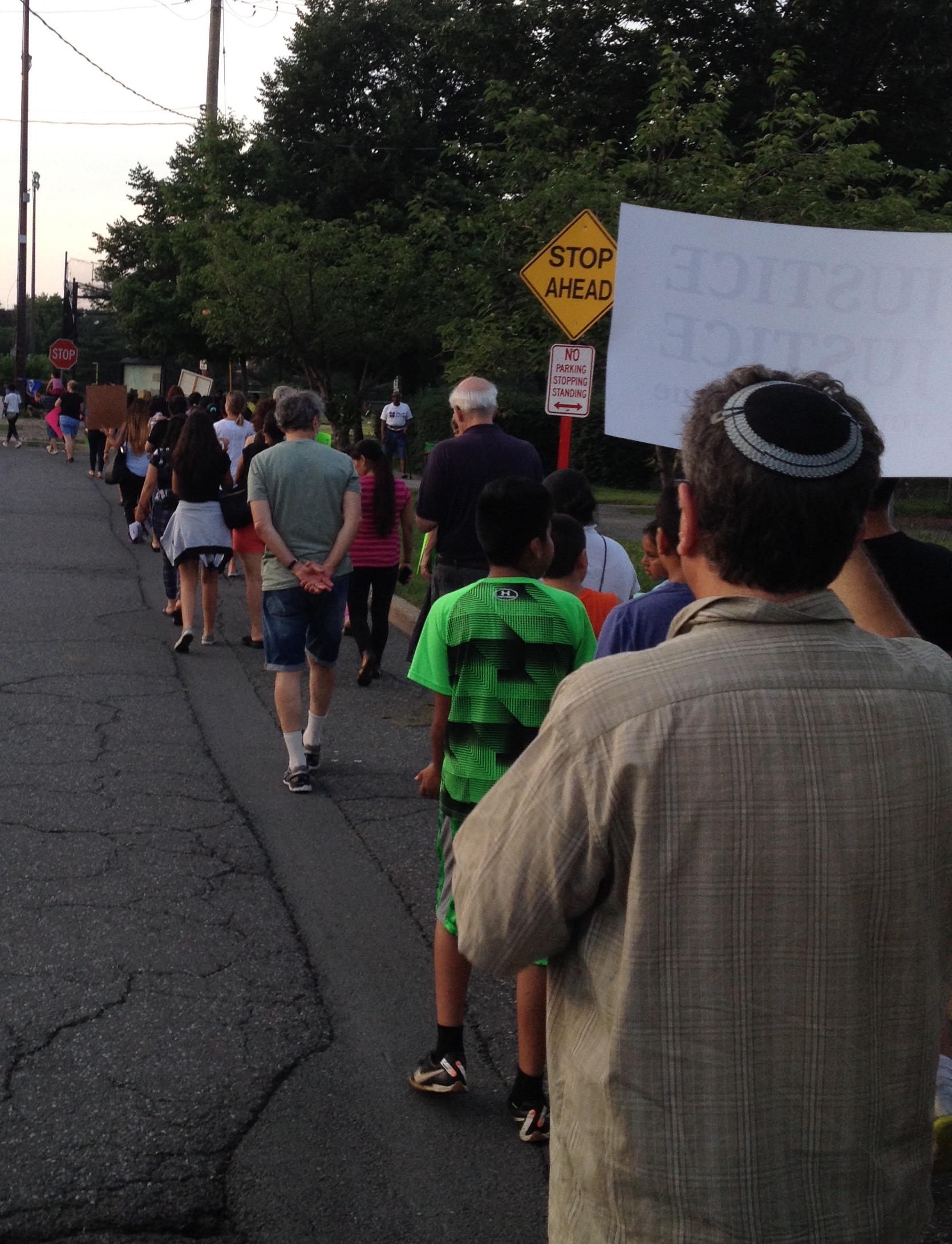
Whether our prayer vigil effected change or our legislative efforts in the short run are successful, I believe we have established a new framework for future community relations. We have expressed our shared values in more than words. We have stood together for consideration, deliberation, transparency, education and tolerance. We have stood together against discrimination, extremism, and political favoritism. And at least in the minds of some, we have shattered stereotypes that have supported ignorance, suspicion and hatred.
Solidarity Shabbat? I say Solidarity Sunday to Friday. And on Shabbat, all will be One.
Rabbi Craig Scheff
Scout’s honor
I did not know that this something was missing from our grounds. When Jared and his father Matt presented the idea to our synagogue board, I started having an inkling of what it might feel like. As the grounds were prepared for their new guests, I felt the energy of those involved in the project–younger and older, Jewish and not–and my anticipation grew. But nothing could prepare me for the sight of seeing those flags flying at the entrance to our synagogue. And there are few things about which I have ever felt as proud as the sight of those flags outside my bedroom window each morning as I roll up the shade.

It took a scout to have the vision. To be exact, it took an Eagle Scout. Ironic, given that as the Israelites send out scouts to see the land promised to them, their shortsightedness and narrow vision caused the great majority of the scouts to see themselves as unqualified for the task. In contrast, our scout inspired a community, excited the leadership, and motivated us to achieve the possible.

There is something to these stars and stripes, the blue ones on white, and the red, white and blue ones. They remind us of sacrifices made, traditions upheld, identity shared and loyalty earned. For many, they call up feelings of pride and courage; for others, they stir up conflict, enmity and resentment. Even among the standard bearers, the flag can be a source of disagreement as to which of our freedoms requires protection at any moment in time, and as to how we go about providing that protection. (This is what happens when you see the final scene of A Few Good Men three times in the same week!)

As for me, the two flags represent companions to the mezuzah on my doorpost, a gateway through which I will pass each day as I leave my home. And I will be reminded in my coming and my going to scout my world with the lasting hope that I can advance the cause of liberty and justice for all.
Shabbat shalom,
Rabbi Craig Scheff
Friendly competition
Nine- and ten-year old athletes crowded into the gymnasium, each JCC delegation sporting a different color. They nervously fiddled with their gloves and rackets, either trying not to look at their opponents around the court, or staring down the competition they would soon be facing. (Or perhaps they were just checking out each other’s $130 shoes?!)
As the mini-athletes took the field for the opening ceremony this past Sunday, they smiled large for the cameras, proudly displaying their hometown banners, clearly excited about kicking off the first (hopefully annual!) JCC Mini-Maccabi Games. Welcoming the 200-plus athletes and their families (from as far away as Baltimore) to JCC Rockland, I asked them if they knew the Hebrew word chaver. “Friend,” many of them exuberantly called back to me. Actually, they were 9 and 10, so it sounded more like “frieeeeeeend!” Yes, friend.

But to the teachers of our tradition, I explained, the word chaver meant much more than someone with whom we play and socialize. The chaver is also our competition, the one who challenges us to be our best, the one who forces us to refine our strengths and inspires us to give our best effort. In the Jewish tradition, we learn with a chaver who will not always agree with us or accept our argument. Our study partner is expected to push back, to challenge our assumptions, to introduce us to new ways of thought.
On the fields of play, our teammates may indeed be our friends and playmates. They may also, however, force us to grow, challenge us to be better, and sometimes require us to face our shortcomings. And the same may be true of our opponents. If they care about us and our development (and that is an important Jewish assumption in this equation), they too may be our chaverim. They may teach us how to win and lose graciously, help us develop resilience, remind us how much harder we must work if we expect to succeed.

Not everyone can be a winner all the time. And we need not–and should not–protect our children from the experience of losing in life. Certainly we want them to experience success in areas that bring them satisfaction. As parents, teachers and mentors it is our job to help our children find situations where they will experience success, or at a minimum help them learn confidence, recognize growth and feel satisfaction in their efforts. It is also our responsibility, however, to to teach them how to own and use failure.

Whether you win or lose, it is NOT how you play the game. It’s about what the experience of playing teaches you about yourself. That’s what a worthy and true chaver–even one on the opposing team–can help you learn.
Rabbi Craig Scheff
Teacher Appreciation Life
From the second night of Passover, some of us have been “counting the Omer,” a period of seven weeks that culminates on the fiftieth day with the holiday of Shavuot. The omer was actually a measure of barley that was presented from the new barley crop to the High Priest in the time of the Temple, in fulfillment of the commandment in Leviticus 23:15 (from this week’s Torah portion, Emor). It has come to be known, however, as the period of forty-nine days we are commanded to count. Some people simply refer to this time as the sefirah (the counting). On a spiritual level, our mystics have imbued this practice over the centuries with multiple layers of meaning, focused especially on inner growth and ethical improvement. While it is not an easy ritual to incorporate into one’s life, even with the assistance of electronic reminders, I find it very satisfying to arrive at the holiday of Shavuot, when we celebrate receiving the Ten Commandments, knowing that I have been so conscious of the passage of time and so connected to the calendar.

The sefirah is also observed as a time of semi-mourning, during which Jewish law forbids haircuts, shaving, listening to instrumental music, weddings, parties, and dinners with dancing. According to the Talmud, a plague killed 24,000 of Rabbi Akiva’s students in the early part of the second century during this time on the calendar. Tradition tells us they were punished for their inability to disagree with each other with respect. The thirty-third day of the sefirah is said to be the day in which the plague was lifted. Today (actually tonight into tomorrow!) we celebrate this thirty-third day–lamed (thirty) and gimmel (three), thus “Lag Ba’Omer”–by breaking from our mourning to cut our hair, shave (if our spouses force us to), dance to live music, and maybe even get married!
While I can’t speak to whether Rabbi Akiva’s students were the victims of Divine anger or of Roman swords during what was an historical period of rebellion, upheaval and suffering, I can appreciate the seriousness of the lesson our tradition conveys. Yesterday, our schools celebrated the national holiday known as “Teacher Appreciation Day.” As we find ourselves celebrating Lag Ba’Omer in the midst of Teacher Appreciation Week, I know what Rabbi Akiva’s students would offer us from the Jewish tradition:
Who is wise? Those who learn from every person. Who is honored? Those who honor all people. Do not disdain any person, for every person has his hour. Any person from whom we learn even a letter is considered to be our teacher; and anyone who is our teacher is considered to have given us life. Search out life teachers; in the process, you may discover new friends, while rendering yourself a more accepting, giving and forgiving person.

Appreciate your teachers—and every person’s potential to be your teacher—every day. Maybe that is the ultimate lesson we can as we strive each day to merit receiving Torah. Thank you, Mrs. Tuttle.
Rabbi Craig Scheff
Not my God
The Torah’s narrator tells me that two sons of Aaron the High Priest brought a strange fire as an offering to God, an offering not commanded. A fire goes forth before God and devours Nadav and Avihu. Moses, in a moment of poor pastoral care, blames Nadav and Avihu for their failure to sanctify God when they had the opportunity to do so. Our rabbinic commentators, relying upon the juxtapositioning of the verses that follow, accuse the boys of being drunk or arrogant. All these readings justify one troubling presupposition: God willed the death of the boys.
Sorry, not my God. Even if the boys did something wrong, “God does not desire the death of the sinner.” And if the Torah’s narrator and commentators are just grasping at straws, trying to assign to God something beyond our limited comprehension, what kind of just God takes innocent life? How can I possibly believe in a God who would claim–or even permit the slaughter of–a million children’s lives? And if I pass off all that I don’t control as “bashert” (predetermined or meant to be), then what happens to my free will and ability to grow, learn, change and make a difference?
My God is a God that dwells within me. Perhaps there was a time in the early history of humanity, when God had to intercede in the course of history, make a big splash, split a sea, or bring food from the heavens to earn our faith. But that was before God made a covenant with the Jewish people that expressed God’s will for this world and the directions to fulfill it, making room for us to show our potential as humans created in the image of the Divine.
My God is the God that has blessed me with strength, resilience, perseverance and humanity. My God is the God that has made room for me in the world, empowering me to act, to influence, to show humanity its greatest potential.
The wonder of it all is that I still believe in the possibility of miracles. I can’t rely only them to ward off the consequences of our actions or to change the natural course of nature, or even to control the measure of randomness that exists in this world. I trust in those miracles, nevertheless, to keep me humbled and in awe, hopeful and striving. Israel’s establishment was such a miracle in my eyes; but it came about with sacrifice of thousands of lives whose agency enabled the miracle to happen.
I can’t blame my God for that which I don’t understand; I can’t accept everything as God’s will. My God mourns with me; hurts with me; cheers me on to get it right; rejoices with the display of my empathy, compassion and humanity. My God believes and anticipates with full faith the coming of my redemption. And even though I may tarry, my God believes in me, and waits.
Shabbat shalom,
Rabbi Craig Scheff
Holy days
When I was much younger, in my junior high and high school years, the last days of the Passover holiday were a time I truly cherished. Even if school was in session, my father would allow me the days off from school to be with him in synagogue for holiday services. It was school policy that no new material or exams could be assigned on the holy days, and my parents were willing to make sure that policy was observed. After all, as I was the only student in my class of 550 students to utilize the excused absence, there wasn’t much incentive for teachers to abide by the policy.
There are 13 “holy days” on the Jewish calendar: the first and last 2 days of Passover; the 2 days of Shavuot; the first and last 2 days of Sukkot; the 2 days of Rosh Hashanah; and Yom Kippur. Schools are closed on the 3 days of the “high holy days” in most New York and New Jersey districts, and some of these holy days occasionally fall on weekends (especially this year). Given that our calendar and dietary rules are two of the things which serve to best distinguish Jewish people from others, one would think that the Passover holiday would be an ideal time to avoid school and find our way to synagogue (where we are serving the very tastiest of Passover cakes this Friday and Saturday). When Jon Stewart of The Daily Show claims that Easter crushes Passover as holidays go, he skips the fact that Easter always takes up a Sunday, whereas 4 of the days of Passover are excused absences from school!

So maybe you scheduled a family vacation on some kosher-for-Passover island to avoid all the extra work that accompanies this holiday. But if you can’t join us this Friday and/or Saturday to celebrate our freedom, you have another opportunity that is 45 days away! As we count up to the holiday of Shavuot to celebrate the giving of the Torah, please consider that our next festival’s 2 holy days fall on Sunday and Monday of Memorial Day weekend! That means that you (and your children!) can pull an all-nighter with us at our Tikkun Leyl Shavuot (our all-night learning session from Saturday night through Sunday morning), catch up on your sleep through the day, and then join us on Monday for services and a Shavuot/Memorial Day barbecue picnic! Okay, so dairy is the prescribed holiday food, but we can make an exception for one meal if it means that we can bring true meaning to our religious and secular holidays. Besides, the opportunity to celebrate receiving the Torah, to recite Yizkor in remembrance of our own loved ones, to give honor to our fallen troops and to be together as a community–all in one day? Who could ask for anything more?!

And maybe, just maybe, the experience will inspire you to give your kids a holy day off from school when we celebrate Simchat Torah on Tuesday, October 6.
Rabbi Craig Scheff
Restoration
“What is certain is that you love bringing things back to life. It is a wonderful feeling to identify the undermining factors, eradicate them, and restore something to its true glory.” Tom Rath, StrengthsFinder 2.0 (Gallup Press, 2007, p. 153)

Strengthsfinder 2.0 is a popular assessment tool for identifying and applying an individual’s strengths. The book is based on the premise that we should spend more time in our professional lives building upon our strengths than trying to overcome our weaknesses. Everyone loves the story of an underdog overcoming overwhelming odds to achieve, but that model of success is not usually the best application of our resources! The quote above refers to the person who possesses a “restorative” talent, the ability to resuscitate and rekindle the vitality of relationships. Indeed, institutions can be revitalized; relationships can be resuscitated. This can only happen, however, when the right “match” is achieved—when a restorer is brought into a relationship where restoration is needed.

As an adjunct lecturer at the Jewish Theological Seminary, I work with students who are preparing to transition into new professional settings. Among my goals is to help budding cantors and rabbis recognize their own strengths, and identify the professional opportunities where they will experience fulfillment and success, and feel valued for what they bring to the task. Not every available opportunity is the right opportunity for every candidate. In the moments of rejection, we learn about the nature of relationships, the needs of our potential partner, and our own strengths and talents.
This week’s haftarah for Shabbat Hagadol, from the prophet Malachi, tells us that a day of restoration is approaching. The children of Israel seemingly stand back to back with God, too ashamed in their imperfection to face the Divine, perhaps anxious about the prospect of confronting their strained relationships. The prophet announces that God will provide a restorer in Elijah, one who will reconcile the open and eager hearts of parents and children to each other.
Passover, the season of restoration is once again upon us. Many of us are headed home at this time of year—children to parents, families to one another, even institutions to their missions–perhaps anxious about the prospect of confronting those with whom we have strained relationships. Not everyone is cut out for every task. Perhaps there is someone among us who is particularly “restorative” by nature, who will restore our hearts to each other?

Who among us is prepared to play the role of Elijah?
Chag sameach,
Rabbi Craig Scheff
A successful work in progress
This past Sunday night, our OJC community and friends celebrated our community. Yes, Rabbi Paula Drill was the honoree for the evening, but—sorry—the night was only in part about her. It was a love-fest that spanned the generations: a night of Jewish learning, music, food and appreciation of one another. The night was about our community: our heart, our simplicity, our humility, our relationships, our Torah, our mission and our vision.

In trying to summarize our community’s success, I realize that we have not relied upon any new strategies. We haven’t created any unique ways of doing business; nor have we abandoned our commitment to traditional models of Jewish life. It is the Jewish values exhibited in the building of the Mishkan (the Israelites’ portable sanctuary), described in this week’s Torah portion, that serve as the blueprint for our own community.
The very idea that the people can participate in a process that will invite God’s presence is enough to inspire participation. Perhaps there is an element of guilt or a desire for repentance in their motivation, but after the debacle of the Golden Calf, the Israelites have a chance to merit a legacy. And the project is as much about the process as it is about the ultimate edifice that is constructed. The freewill service to a higher calling adds meaning and the sense of God’s presence to a life that is otherwise enslaved to fear and uncertainty.
God instructs Moses to engage the community by inviting them to donate to the project whatever they are moved to share. Several opportunities are created for that giving by virtue of the many types of materials being collected and utilized in the project. Engagement is transformed into empowerment as each individual becomes a participant in the processes of manufacturing, design and construction.
The appointment of Betzalel as project manager, the inclusion of artisans, and the participation of the broader community creates a new dynamic for the Israelites’ engagement with the Divine One. Before this change, leadership was purely hierarchical, and the population was steps removed in relation to God. As a result of the new appointee, the community operates in partnership with its leadership. In partnerships, the success of one is the success of all. Relationships deepen between the volunteers who recognize that they are working together towards a shared vision; relationships also deepen between the volunteers and the leadership, who now recognize the value of the other’s contributions towards a shared goal.
Finally, there is the matter of expectations and of how we define our success. Success can’t be about the number of people who participate or about the amounts they contribute. Success is found in the knowledge that the process of building—serving, empowering, partnering and relating—is an ongoing effort.

On Sunday night, we celebrated a milestone for a community in process. God said, “Let them build Me a sanctuary that I may dwell among them.” As we continue the process of building a world deserving of God’s presence, may we continue to merit God’s presence among us.
Rabbi Craig Scheff
 Three Rabbis Walk Into A Shul
Recent Comments