Time to reflect
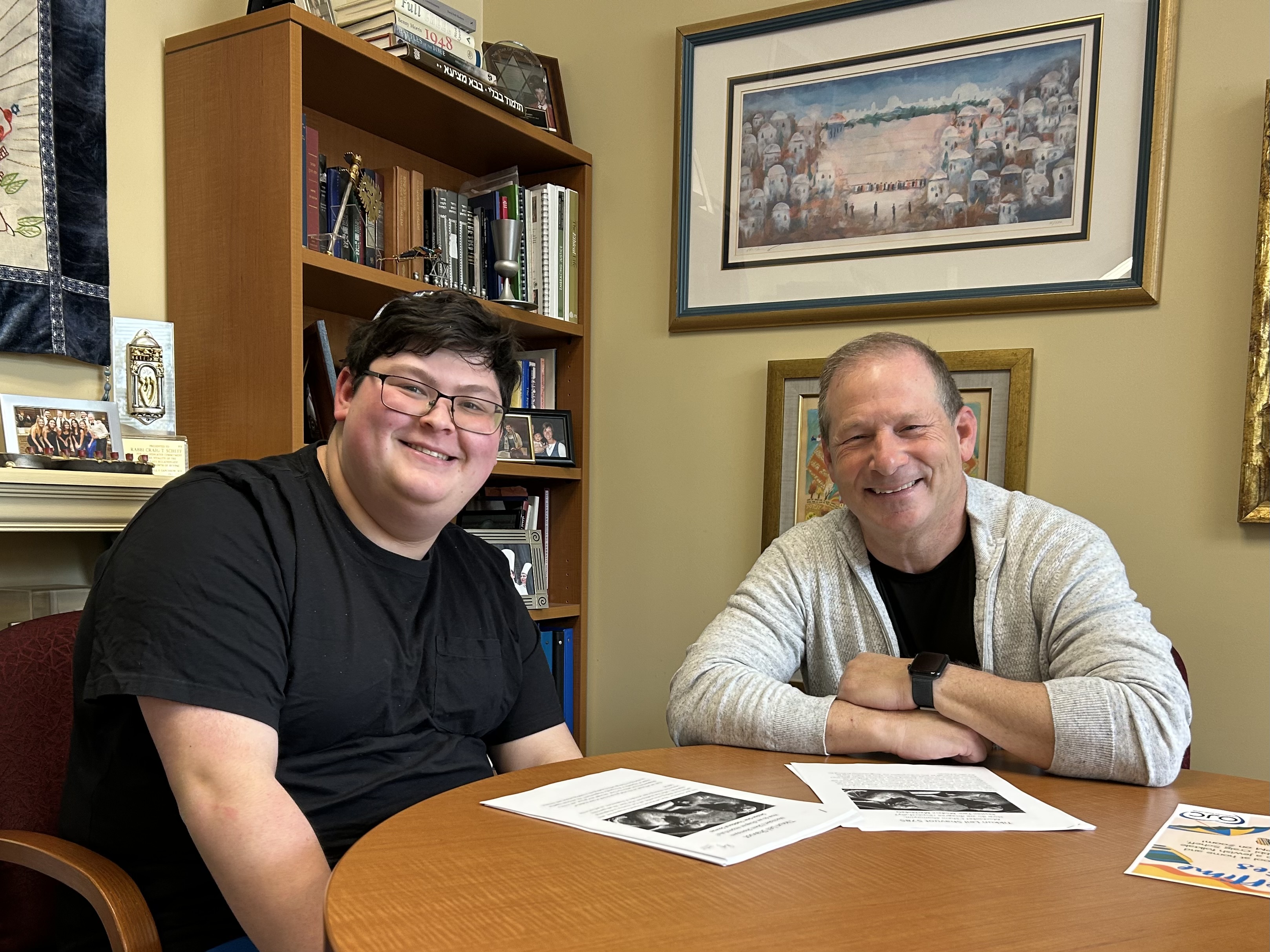
As we reach the end of another academic year, I wanted to share with you the words of Rafi Josselson, a high school senior at The Leffell School who spent the last nine weeks of his academic year interning with me here at the synagogue. As I have shared with his school administration, Rafi has surpassed all our expectations. His work ethic and product have matched that of so many of our previous rabbinic interns, many of whom were at least a decade older in years and in academic pursuit. We have learned from Rafi. His youth was no impediment to his wisdom, his charm and his contributions. I am happy to be re-starting this blog after a year’s hiatus with Rafi’s words, and I look forward to welcoming Rabbi Claire Shoyer as a contributor. Thank you, Rafi. We wish you the very best in all your pursuits!
Dear OJC,
Thank you all for allowing me to serve as your synagogue intern this spring. It’s been one of the best experiences of my life. I’ve grown professionally and personally throughout this experience. This wasn’t a difficult transition. Since this is my synagogue, I was already heavily involved. And so, unlike my peers who interned for six weeks, I have been interning for about nine weeks.
Like you, I am a congregant. But, for these nine weeks, I stepped “behind the curtain” to see the work that happens behind the scenes. Our hours are inconsistent. I have had nights when I am working until 9 or 10:30. There are days when I have gone into the city, to a funeral, or to someone’s house to sit shiva with them. My internship wasn’t just about doing stuff; most of my time was spent showing up.
I focused a tremendous amount of my time refining my leyning and oration skills. I have delivered four sermons to the congregation. I am proud of each one of them, but I have worked hard to get better at my delivery, pacing, and length. I hope you’ve noticed my growth in that area. I’ve also worked tirelessly on improving my leyning. I have read Torah or Haftarah almost every Shabbat, and I pushed myself to learn something new: Megillat Ruth.
I had the opportunity to interact with our youth through Kulanu. Being a day school student, my interaction with Kulanu in the past was limited. During this internship, I was very involved with our B’nai Yisrael (3rd-5th Grade) class. The work and energy that is expended for our children’s education is magical. It was a pleasure to work alongside Rabbi Kniaz in her final weeks with our Kulanu students. My experience was enhanced by our teachers, our Kulanu Assistant Ms. Maudeena Jones, and our students, all of whom are critical parts of the educational experience. I was so proud of our B’nai Yisrael students when, for their final project, they compiled a new book of the Tanakh to transmit to future generations. They joyously presented it to Rabbi Kniaz at their moving-up ceremony.
I’ve also noticed, as many of you have, that we as a synagogue are moving into a new stage. Even though she technically starts in July, I can assure you that Rabbi Shoyer and the rest of the OJC team are already busy planning engaging programming for next year. I also got to attend her JTS ordination. Rabbi Shoyer has worked so hard to get to this moment. She has spent five years in rabbinical school, including hundreds of hours in internships. But, as I have heard from so many rabbis before, you don’t learn how to be a rabbi until you are a rabbi. Therefore, as Rabbi Shoyer continues to grow and learn, I ask you: please give her time and space to grow into the rabbi she is meant to be.
Speaking of rabbis’ experiences, throughout the internship, I interviewed 14 rabbis to get a sense of their experiences, careers, and reflections on the title of “Rabbi”. I interviewed both Rabbi Scheff and Rabbi Drill for this project, and I interviewed two of our previous Rabbinic Interns, Rabbi Jesse Nagelberg and Rabbi Ben Varon. These people are the gold standard of what rabbis should be: caring, empathetic, dedicated, and involved. I am glad I had the chance to talk to them, and the OJC is lucky to have been led by them. You can read my takeaways from my interview project here.
To conclude, I want to share why I did this internship. First, I wanted to gain an understanding of the field of rabbinic work. But secondly, I wanted to give back to you, the OJC, which I believe is one of the most magical places on Earth. We aren’t perfect. And we have a lot more ahead of us. But I am confident that, together, we’ll keep OJC a welcoming, safe, and inclusive home for everybody.
Rafi
Our Yiddish library
We welcome, once again, our rabbinic intern Lindsay Goldman as a guest contributor to our blog!
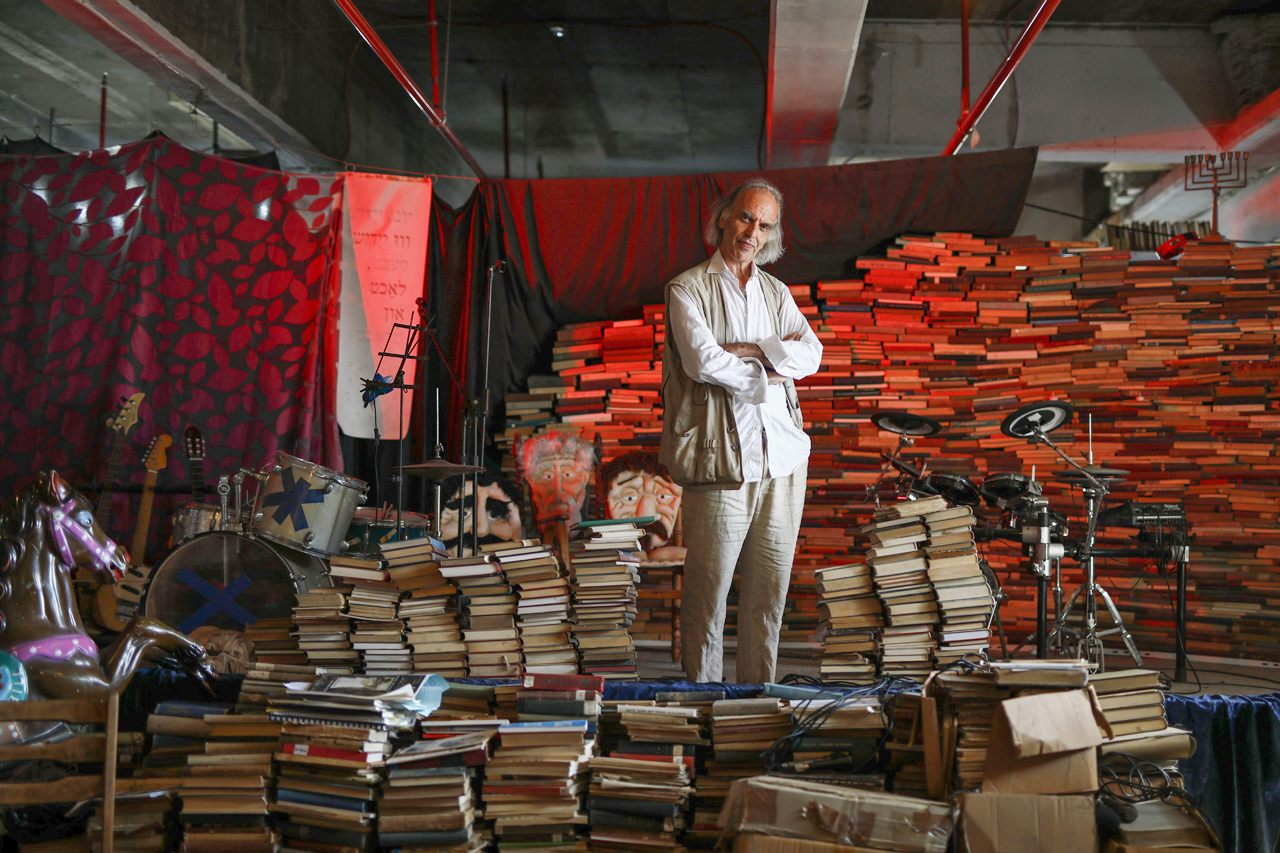
There is a Yiddish library inside the walls of the Tel Aviv bus station. It’s on the fifth floor among the artists’ collective that began when the artists were offered old storefronts as cheap studio spaces. When I was living in Jerusalem before the start of Covid in 2020, we went on a field trip to the library and it was exactly what I expected–a dimly lit room covered with old tchotchkes and floor-to-ceiling stacks of used books. It felt old and stale. While my friends oohed and aahed at the plethora of Yiddish books, I was pretty creeped out. I had never felt a connection to Yiddish or to my ancestors in the shtetls in Eastern Europe. They had all passed away before I was born and it felt like thousands of years existed between us, though it was probably closer to 80 or 90.
More importantly, however, I believe the disconnect came from how I imagined they would feel about how I am living my life today. I am a single woman living in New York City becoming a rabbi. Would they be proud? Furious? Disgraced? In my head, they and their beliefs–about the way the world works and about what I can or cannot do–were old and stale.
I am pursuing my master’s degree in Jewish Gender and Women’s Studies along with my ordination. This semester fewer classes were offered to fulfill my requirements, so I was compelled to sign up for a class entitled “Modern Hebrew and Yiddish Women’s Literature.” Each week we explore a different female author, mostly poets, who either wrote in Hebrew or in Yiddish. As we studied Celia Dropkin, our first Yiddish poet, I was quite moved. Her writing about her womanness and about her body felt incredibly modern, like something that could have been written today. She writes about love and sexuality in a way that felt radical for her time, and especially for Yiddish language literature. It felt fresh. And I learned she was not alone in this exploration of thought and language.
The dusty Yiddish library didn’t feel like my story, but Yiddish was the language my great-grandparents spoke so that my grandparents wouldn’t understand what their parents were talking about. Today my siblings and I speak in Hebrew so that our parents won’t know what we are talking about. Every Shabbat, I light my great-grandmother’s candlesticks and say the same Hebrew words she said week after week. But this week after reading Dropkin’s words, I began to wonder what my great-grandmother and my great-great-grandmothers thought about, what they prayed for, and what they talked with their female friends about. And I realized that perhaps we’re more similar than I had ever known.
Lindsay Goldman, OJC Resnick Intern
A personal approach to Halakhah
We are pleased to feature this contribution to our OJC Rabbis’ blog by Lindsay Goldman, this year’s rabbinic intern:
In my first year of rabbinical school my classmates and I all tried to prove to one another how frum (Yiddish: פֿרום, lit. ‘religious’, ‘pious’) we were. Someone told us they waited six hours between meat and milk, another classmate shared that they put on two different kinds of tefillin every day, and someone else said that they would not say amen to the blessing in the amidah if it included the matriarchs. We were trying to prove how much we belonged here at the Jewish Theological Seminary. However by second year, third year, and now in fourth year, we know that what it means to belong in this community looks different. We show that we belong by talking about our journey to and with our practice and our struggle along the way.
Every Wednesday at JTS is “Rabbinical School community time,” where we gather to discuss pressing issues in our future rabbinates over lunch. Last Wednesday we were each given a few minutes to fill out a survey about our ideas of halakhah. The survey was guided by the question: “Which of the following most closely aligns with what you think halakhah is?” This is not a question we are asked before being admitted to the institution, nor is this a question the answer to which we know about our rabbis or classmates, but it is a question that is essential to the way we live our lives. Does it matter what the halacha says if we don’t know how it impacts our lives?
The four multiple choice options that followed were:
- Halakhah is a direct expression of God’s will.
- Halakhah is a humanly-influenced approximation of God’s “will”.
- Halakhah is a human attempt to live in God’s presence.
- Halakhah is a collection of humanly created consensual norms.
Someone who believes that halakhah is God’s will approaches Jewish law drastically differently than one who assumes it is a compiled set of human norms. Students shared what it felt like when their idea of God’s will was conflicting with humanly created norms. And I added what it felt like when God’s divine will conflicts with the self compassion with which I want to treat myself.

I believe this conversation to figure out how we believe halakhah has a claim on us matters significantly more than the actual practice of Jewish law itself, or at the very least needs to be considered primarily. I am proud of how the dialogue has changed both within the institution and within myself over the last couple of years. I recall the flexibility of my Shabbat practice during the peak of Covid when I was keeping Shabbat without a community, differently than it was intended to be kept. I chose to consider my needs first and the needs of my relationship with God second because of what I believe about halakhah. I don’t know what God’s will is but I believe that being in relationship with human beings is God’s mission in the world. My life is built around trying to be in relationship with God, what I choose to put in my body, when I work and when I rest, as well as learning and teaching Torah. But if I do not have a relationship with myself, I do not feel I can connect as deeply to God.
I won’t spoil which answer students chose overwhelmingly because I want you to consider for yourself which of these options is true for you without any undue influences (but email me at lindsayjgoldman@gmail.com if you want to talk more about the results!). I encourage you to explore your practice and why you do what you do; I personally and strongly believe that the first step is to articulate what halakhah means to you.
Lindsay Goldman, OJC Rabbinic Intern
Getting fully dressed
OJC’s Rabbis are happy to offer this space for the words of our JTS Resnick Intern, Jesse Nagelberg
I lay my clothes on my bed – jeans and shirt with a collar.
I put in my contact lenses, brush my teeth, shave, and shower.
I put on cologne – yes, every day – and then my rings, my watch, and my kippah.
I finish getting dressed, including matching socks and shoes.
I am ready to begin the day.
This is my early morning routine and it has not changed – not even during the ten months since COVID-19 upended our lives and most of my days have been spent in my apartment. My routine may seem excessive since, typically, no one is going to see the details of my outfit, let alone smell whether I used cologne! But I want to feel prepared to conquer whatever the day will bring, just like I did when I left the house every day. Whether my day has involved working at OJC or Camp Ramah, studying, teaching, or chatting with friends; whatever the day has had in store, for me, being fully dressed for these daily activities has helped me to feel wide-eyed and alert.
The concept of Hiddur Mitzvah is that we can amplify our mitzvot by beautifying them. Shabbat Kiddush can be more special when using a cup made of metal or carefully constructed out of glass. Lighting Chanukah candles takes on more meaning when using a family heirloom or a Chanukiah we have a personal connection to. We can turn the mundane into a mitzvah when we dress it up a bit – literally and figuratively. We can not only show up; we can show up dressed nicely, organized and attentive. In that vein, we can be ready to notice the smallest details that enhance and beautify our lives.
If the last months have taught me anything, it is that there are small gems of learning to be found everywhere. We just have to open our eyes, our ears and our hearts and embrace them.
In his book The Insecurity of Freedom: Essays on Human Existence, Abraham Joshua Heschel writes, “What we need more than anything else is not textbooks but textpeople. It is the personality of the teacher which is the text that the pupils read; the text that they will never forget.”
Picking my head up out of my many rabbinical school books and papers has enabled me to notice many “textpeople” in recent weeks:
- During a Prayer through Music and Movement elective with OJC’s 6th and 7th graders, we have swapped songs that feel prayerful to us. Watching the students discover and introduce each other to music from different genres and decades has infused my life with new music and new ways to connect to the words of the siddur.
- After using an app on my phone for an extended period of time, I received a notification advising me, “It seems like you’ve been scrolling for a long time. Now is a good time to get away from the screen for a few minutes to breathe and relax.” It is amazing that the automatic intelligence function on this app actually prompted me to take a much-needed pause.
- The 8 year old child of a classmate unmuted his mom’s computer during a class about Moses’ encounter at the Burning Bush and engaged the professor in a discussion about Moses’ anxieties and intentions. I marvelled at the wisdom of this precocious child and how seriously my professor took his question and made it a part of the day’s learning.
- One of my family’s dogs, Callie, is on hyper-alert all day for stray geese, Amazon deliveries, and Zoom events to join. She is almost always “on”; but when she takes a break, she curls up on the couch and instinctively lays her head on the nearest pillow, literally sleeping like a person. Callie reminds me that at the end of the day, or at the end of a busy or stressful time, it is important to find a soft place to rest your head.

As we move ahead in 2021, children are back in school, either in person or virtually, after a well-deserved break from the screens and Zooms that have become the focal point of their day. Perhaps it is time for all of us to go back to “school” and be more alert to the teachings that surround us. We can show up, even from home, by getting dressed up. We can return to learning from all of the teachers in our lives — our friends and neighbors, our children and pets and even, occasionally, AI technology.
So what did you put on this morning, and how is it helping you recognize the gems to learn from in your life?
Jesse Nagelberg, OJC-JTS Resnick Intern
 Three Rabbis Walk Into A Shul
Recent Comments