Teacher Appreciation Life
From the second night of Passover, some of us have been “counting the Omer,” a period of seven weeks that culminates on the fiftieth day with the holiday of Shavuot. The omer was actually a measure of barley that was presented from the new barley crop to the High Priest in the time of the Temple, in fulfillment of the commandment in Leviticus 23:15 (from this week’s Torah portion, Emor). It has come to be known, however, as the period of forty-nine days we are commanded to count. Some people simply refer to this time as the sefirah (the counting). On a spiritual level, our mystics have imbued this practice over the centuries with multiple layers of meaning, focused especially on inner growth and ethical improvement. While it is not an easy ritual to incorporate into one’s life, even with the assistance of electronic reminders, I find it very satisfying to arrive at the holiday of Shavuot, when we celebrate receiving the Ten Commandments, knowing that I have been so conscious of the passage of time and so connected to the calendar.

The sefirah is also observed as a time of semi-mourning, during which Jewish law forbids haircuts, shaving, listening to instrumental music, weddings, parties, and dinners with dancing. According to the Talmud, a plague killed 24,000 of Rabbi Akiva’s students in the early part of the second century during this time on the calendar. Tradition tells us they were punished for their inability to disagree with each other with respect. The thirty-third day of the sefirah is said to be the day in which the plague was lifted. Today (actually tonight into tomorrow!) we celebrate this thirty-third day–lamed (thirty) and gimmel (three), thus “Lag Ba’Omer”–by breaking from our mourning to cut our hair, shave (if our spouses force us to), dance to live music, and maybe even get married!
While I can’t speak to whether Rabbi Akiva’s students were the victims of Divine anger or of Roman swords during what was an historical period of rebellion, upheaval and suffering, I can appreciate the seriousness of the lesson our tradition conveys. Yesterday, our schools celebrated the national holiday known as “Teacher Appreciation Day.” As we find ourselves celebrating Lag Ba’Omer in the midst of Teacher Appreciation Week, I know what Rabbi Akiva’s students would offer us from the Jewish tradition:
Who is wise? Those who learn from every person. Who is honored? Those who honor all people. Do not disdain any person, for every person has his hour. Any person from whom we learn even a letter is considered to be our teacher; and anyone who is our teacher is considered to have given us life. Search out life teachers; in the process, you may discover new friends, while rendering yourself a more accepting, giving and forgiving person.

Appreciate your teachers—and every person’s potential to be your teacher—every day. Maybe that is the ultimate lesson we can as we strive each day to merit receiving Torah. Thank you, Mrs. Tuttle.
Rabbi Craig Scheff
Not my God
The Torah’s narrator tells me that two sons of Aaron the High Priest brought a strange fire as an offering to God, an offering not commanded. A fire goes forth before God and devours Nadav and Avihu. Moses, in a moment of poor pastoral care, blames Nadav and Avihu for their failure to sanctify God when they had the opportunity to do so. Our rabbinic commentators, relying upon the juxtapositioning of the verses that follow, accuse the boys of being drunk or arrogant. All these readings justify one troubling presupposition: God willed the death of the boys.
Sorry, not my God. Even if the boys did something wrong, “God does not desire the death of the sinner.” And if the Torah’s narrator and commentators are just grasping at straws, trying to assign to God something beyond our limited comprehension, what kind of just God takes innocent life? How can I possibly believe in a God who would claim–or even permit the slaughter of–a million children’s lives? And if I pass off all that I don’t control as “bashert” (predetermined or meant to be), then what happens to my free will and ability to grow, learn, change and make a difference?
My God is a God that dwells within me. Perhaps there was a time in the early history of humanity, when God had to intercede in the course of history, make a big splash, split a sea, or bring food from the heavens to earn our faith. But that was before God made a covenant with the Jewish people that expressed God’s will for this world and the directions to fulfill it, making room for us to show our potential as humans created in the image of the Divine.
My God is the God that has blessed me with strength, resilience, perseverance and humanity. My God is the God that has made room for me in the world, empowering me to act, to influence, to show humanity its greatest potential.
The wonder of it all is that I still believe in the possibility of miracles. I can’t rely only them to ward off the consequences of our actions or to change the natural course of nature, or even to control the measure of randomness that exists in this world. I trust in those miracles, nevertheless, to keep me humbled and in awe, hopeful and striving. Israel’s establishment was such a miracle in my eyes; but it came about with sacrifice of thousands of lives whose agency enabled the miracle to happen.
I can’t blame my God for that which I don’t understand; I can’t accept everything as God’s will. My God mourns with me; hurts with me; cheers me on to get it right; rejoices with the display of my empathy, compassion and humanity. My God believes and anticipates with full faith the coming of my redemption. And even though I may tarry, my God believes in me, and waits.
Shabbat shalom,
Rabbi Craig Scheff
Holy days
When I was much younger, in my junior high and high school years, the last days of the Passover holiday were a time I truly cherished. Even if school was in session, my father would allow me the days off from school to be with him in synagogue for holiday services. It was school policy that no new material or exams could be assigned on the holy days, and my parents were willing to make sure that policy was observed. After all, as I was the only student in my class of 550 students to utilize the excused absence, there wasn’t much incentive for teachers to abide by the policy.
There are 13 “holy days” on the Jewish calendar: the first and last 2 days of Passover; the 2 days of Shavuot; the first and last 2 days of Sukkot; the 2 days of Rosh Hashanah; and Yom Kippur. Schools are closed on the 3 days of the “high holy days” in most New York and New Jersey districts, and some of these holy days occasionally fall on weekends (especially this year). Given that our calendar and dietary rules are two of the things which serve to best distinguish Jewish people from others, one would think that the Passover holiday would be an ideal time to avoid school and find our way to synagogue (where we are serving the very tastiest of Passover cakes this Friday and Saturday). When Jon Stewart of The Daily Show claims that Easter crushes Passover as holidays go, he skips the fact that Easter always takes up a Sunday, whereas 4 of the days of Passover are excused absences from school!

So maybe you scheduled a family vacation on some kosher-for-Passover island to avoid all the extra work that accompanies this holiday. But if you can’t join us this Friday and/or Saturday to celebrate our freedom, you have another opportunity that is 45 days away! As we count up to the holiday of Shavuot to celebrate the giving of the Torah, please consider that our next festival’s 2 holy days fall on Sunday and Monday of Memorial Day weekend! That means that you (and your children!) can pull an all-nighter with us at our Tikkun Leyl Shavuot (our all-night learning session from Saturday night through Sunday morning), catch up on your sleep through the day, and then join us on Monday for services and a Shavuot/Memorial Day barbecue picnic! Okay, so dairy is the prescribed holiday food, but we can make an exception for one meal if it means that we can bring true meaning to our religious and secular holidays. Besides, the opportunity to celebrate receiving the Torah, to recite Yizkor in remembrance of our own loved ones, to give honor to our fallen troops and to be together as a community–all in one day? Who could ask for anything more?!

And maybe, just maybe, the experience will inspire you to give your kids a holy day off from school when we celebrate Simchat Torah on Tuesday, October 6.
Rabbi Craig Scheff
Restoration
“What is certain is that you love bringing things back to life. It is a wonderful feeling to identify the undermining factors, eradicate them, and restore something to its true glory.” Tom Rath, StrengthsFinder 2.0 (Gallup Press, 2007, p. 153)

Strengthsfinder 2.0 is a popular assessment tool for identifying and applying an individual’s strengths. The book is based on the premise that we should spend more time in our professional lives building upon our strengths than trying to overcome our weaknesses. Everyone loves the story of an underdog overcoming overwhelming odds to achieve, but that model of success is not usually the best application of our resources! The quote above refers to the person who possesses a “restorative” talent, the ability to resuscitate and rekindle the vitality of relationships. Indeed, institutions can be revitalized; relationships can be resuscitated. This can only happen, however, when the right “match” is achieved—when a restorer is brought into a relationship where restoration is needed.

As an adjunct lecturer at the Jewish Theological Seminary, I work with students who are preparing to transition into new professional settings. Among my goals is to help budding cantors and rabbis recognize their own strengths, and identify the professional opportunities where they will experience fulfillment and success, and feel valued for what they bring to the task. Not every available opportunity is the right opportunity for every candidate. In the moments of rejection, we learn about the nature of relationships, the needs of our potential partner, and our own strengths and talents.
This week’s haftarah for Shabbat Hagadol, from the prophet Malachi, tells us that a day of restoration is approaching. The children of Israel seemingly stand back to back with God, too ashamed in their imperfection to face the Divine, perhaps anxious about the prospect of confronting their strained relationships. The prophet announces that God will provide a restorer in Elijah, one who will reconcile the open and eager hearts of parents and children to each other.
Passover, the season of restoration is once again upon us. Many of us are headed home at this time of year—children to parents, families to one another, even institutions to their missions–perhaps anxious about the prospect of confronting those with whom we have strained relationships. Not everyone is cut out for every task. Perhaps there is someone among us who is particularly “restorative” by nature, who will restore our hearts to each other?

Who among us is prepared to play the role of Elijah?
Chag sameach,
Rabbi Craig Scheff
A successful work in progress
This past Sunday night, our OJC community and friends celebrated our community. Yes, Rabbi Paula Drill was the honoree for the evening, but—sorry—the night was only in part about her. It was a love-fest that spanned the generations: a night of Jewish learning, music, food and appreciation of one another. The night was about our community: our heart, our simplicity, our humility, our relationships, our Torah, our mission and our vision.

In trying to summarize our community’s success, I realize that we have not relied upon any new strategies. We haven’t created any unique ways of doing business; nor have we abandoned our commitment to traditional models of Jewish life. It is the Jewish values exhibited in the building of the Mishkan (the Israelites’ portable sanctuary), described in this week’s Torah portion, that serve as the blueprint for our own community.
The very idea that the people can participate in a process that will invite God’s presence is enough to inspire participation. Perhaps there is an element of guilt or a desire for repentance in their motivation, but after the debacle of the Golden Calf, the Israelites have a chance to merit a legacy. And the project is as much about the process as it is about the ultimate edifice that is constructed. The freewill service to a higher calling adds meaning and the sense of God’s presence to a life that is otherwise enslaved to fear and uncertainty.
God instructs Moses to engage the community by inviting them to donate to the project whatever they are moved to share. Several opportunities are created for that giving by virtue of the many types of materials being collected and utilized in the project. Engagement is transformed into empowerment as each individual becomes a participant in the processes of manufacturing, design and construction.

The appointment of Betzalel as project manager, the inclusion of artisans, and the participation of the broader community creates a new dynamic for the Israelites’ engagement with the Divine One. Before this change, leadership was purely hierarchical, and the population was steps removed in relation to God. As a result of the new appointee, the community operates in partnership with its leadership. In partnerships, the success of one is the success of all. Relationships deepen between the volunteers who recognize that they are working together towards a shared vision; relationships also deepen between the volunteers and the leadership, who now recognize the value of the other’s contributions towards a shared goal.
Finally, there is the matter of expectations and of how we define our success. Success can’t be about the number of people who participate or about the amounts they contribute. Success is found in the knowledge that the process of building—serving, empowering, partnering and relating—is an ongoing effort.

On Sunday night, we celebrated a milestone for a community in process. God said, “Let them build Me a sanctuary that I may dwell among them.” As we continue the process of building a world deserving of God’s presence, may we continue to merit God’s presence among us.
Rabbi Craig Scheff
Purim fun, or not?
Growing up on the mean streets of New City, New York, I learned the hard way what it meant to be Jewish, short, skinny and unable to jump higher than 8 inches off the ground. In other words … wait for it . . . “scrappy” was my game. The experience hardened me to the outside world’s cold reality. A jaded, chip-on-my-shoulder, eat-or-be-eaten attitude pervaded everything I set out to accomplish. I learned to control most of my impulses, assuming a mild-mannered, soft-spoken persona everywhere I went. Everywhere, that is, except on the basketball court. Between the lines, I could be myself, let go of my inhibitions, run wild, heatedly pursue, charge at the hoop, display my bumps and bruises as badges of honor. Ironically, all that pent up anger, frustration and aggression that found its expression in my game was lauded as something good, something to be admired and copied.

Those of you who have seen me play over the years (with the 9- and 10-year-olds at recess, especially) have called me competitive, like a Mr. Hyde to Rabbi Jekyll. What you see is nothing, however, compared to the dark madness that once lurked in the soles of my high-top Converse sneakers (the white canvas ones). That’s just me having good, clean fun. Once I retired from competitive hoops at the age of 28 (the year I started rabbinical school), the cloud that once enveloped my heart lifted, and the beast was gone forever. Until . . . .

Rabbi Paula Mack Drill, whose thirteen years with the OJC we are celebrating this Purim, began her professional relationship with me at Camp Ramah in Nyack some 15 years ago. She was Program Director as I was Assistant Director, and Assistant Director (a position now full-time held by our own Rabbi Ami Hersh, the topic of another Purim spoof one day soon) as I was Camp Rabbi. We always had a great, easygoing, complementary style of working together. From Day One, people referred to us as the “Craig and Paula Show.” That relationship carried over into her internship here at the OJC, where I functioned formally as her mentor for the Seminary. The day she was ordained was a great day. I should have known something wasn’t quite right, however, when she informed me that her JTS GPA was .0185 higher than mine.

That single fact was the beginning of a disturbing pattern. Two-letter words like “XQ” were suddenly making their way into our Shabbat Scrabble games on triple word scores. She would casually mention to each congregant we met that she was older than me, taller than me (she took up heels), and could stand on her head longer than me. She would give her students colorful stickers and point out that I offered them nothing for their efforts. At the end of a day’s work she would ask me how many hours I had billed, as she filled my e-mail inbox with cc’s of every e-mail she sent out. I lashed back by working later, sleeping less, and leading more trips to Israel. I could feel the old Craig emerging, and it wasn’t pretty.
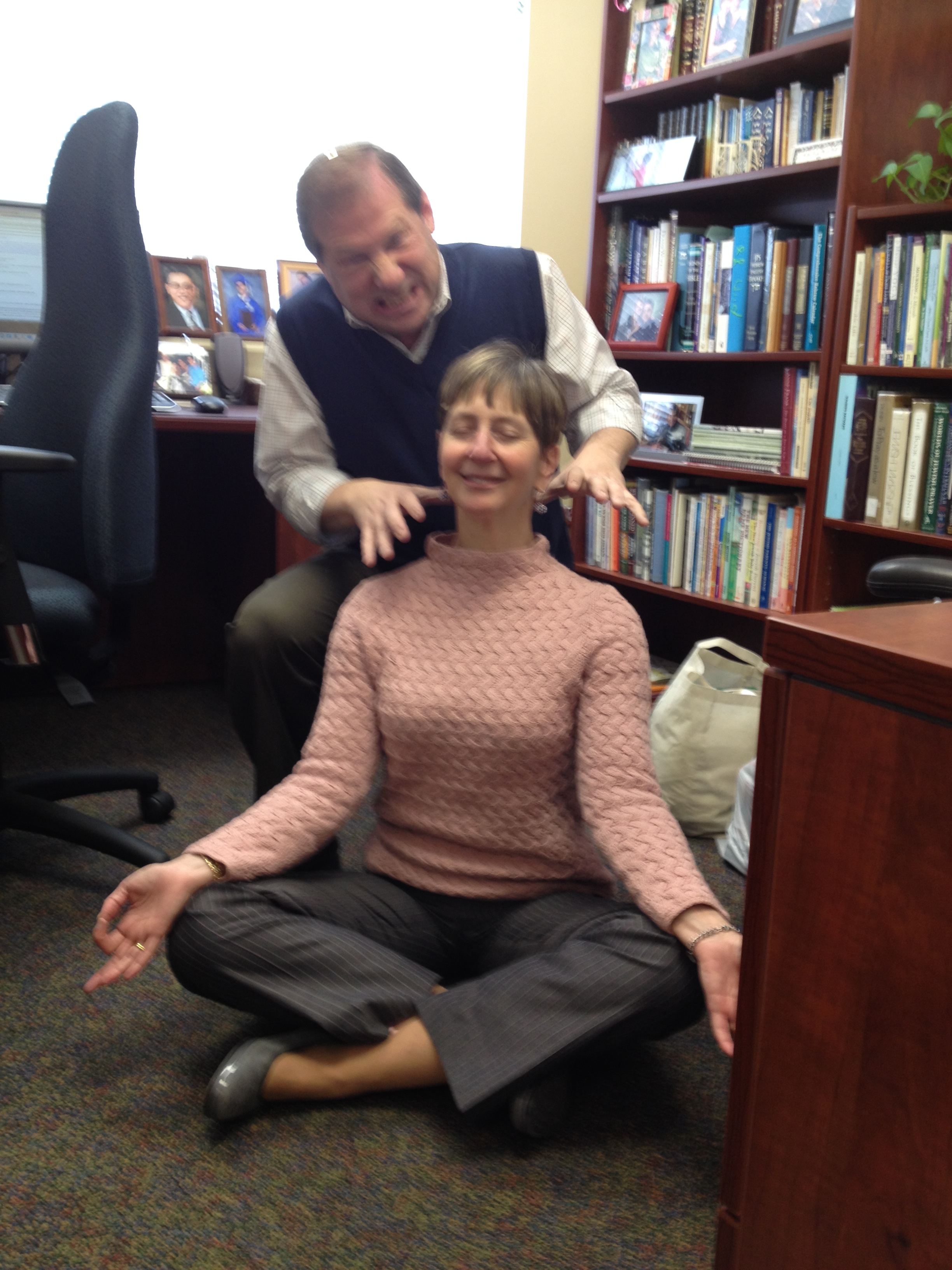
Rabbi Drill’s popularity has grown over the past 13 years. As has my therapy bill. But I have learned how to control the beast. Looking in the mirror each morning, I remind myself that I am good enough, that I am smart enough, and doggone it, people like me. Then I steel myself for the day ahead, trying to appreciate how good each day can be with Rabbi Drill at my side.

And then I pray . . . for the moment I will get her on the basketball court.

Happy Purim to all, and I hope you will join our community in celebrating Rabbi Drill’s 13 years with the OJC and the many ways in which she has enriched each of us and our community!
Rabbi Craig Scheff
Between the lines
Listening to a sports radio talk show this week, I heard Charles Barkley, one of the all-time great basketball players (known for his quote, among many notable quotes, “I am not a role model”), offer an important piece of wisdom. To paraphrase, he said that if we put a bunch of kids on a court together, no matter their color or nationality, they’d do just fine. “It’s the adults who screw everything up.”
Sadly, a group of kids suffered embarrassment this week because of the deeds of their adults. Little League Baseball stripped the U.S. championship from Chicago-based Jackie Robinson West and suspended its coach for violating a rule prohibiting the use of players who live outside the geographic area that the team represents. The kids played their game, had an experience of a lifetime, grew in so many ways, only to be told that their experience was not legitimate. What a crushing disillusionment for such young minds.

I learned so much participating in sports as a teen. I learned that there would always be someone bigger, stronger, faster and more skilled than me. I learned that success requires a lot of hard work and commitment. I learned that heart can take you far, but only so far. I learned that success takes sacrifice. I learned all these things without ever being the hero, leading the team, hitting a buzzer-beater or winning a championship. I even learned these lessons sitting on the bench and not being chosen for the team.

Years later, I would take all these lessons and channel them into a very different competitive endeavor, one that relied upon a very different skill set that didn’t involve my hands or my feet. Those years of competition–and yes, even of losing–taught me how to define success. I learned teamwork; I learned resilience. And the thing I remember most clearly is that my father let me figure it out all by myself.
Thanks Dad, and thanks to all the wonderful coaches out there teaching life lessons between the lines.
Rabbi Craig Scheff
On being a patriot
I am a patriot.
Call me sentimental, but I see the colors of the flag and my chest swells. I stand a bit taller and feel a bit stronger when I see someone in uniform pass by. Seeing that banner wave against the sky, I think of the dedication that so many show to the cause. I take pride in the victories and mourn the losses, even if I have not set foot on the field of battle myself.
As a patriot, I can be critical of my own cause. I can disagree with the strategies utilized, question the personnel employed, and even dislike the individual personalities of those entrusted with the helm. As one on the sidelines, entrusting others to carry the ball for me, I am relied upon to vote with my voice and with my checkbook. Amongst those who share my passion, I can express my frustrations and feelings of persecution. I can find solace in a community of people who believe that the cause is just, and that ultimately we will be vindicated as champions of all that can be good and right in the world.
As a patriot on foreign soil, however, I am far more guarded. I am not so quick to show my true colors. I take personally the barbs and accusations of excessive pride, privilege, self-absorption and insularity. Fending off the parries with rationalizations or excuses only comes across as empty defensiveness. Relativizing any potential wrongdoing by comparing the accusations with the injustices committed under other regimes is dismissed as inconsequential. My standard-bearers are held to a higher standard than most, and any wrongdoing—or potential thereof—is headline news.
Such is the price of those who dare to lead, who shed the label of underdog and take ownership of their place in history.
Wherever I stand, I stand with America; I stand with Israel; I stand with the Jewish people.
Rabbi Craig Scheff
(Go Pats!)
Is it time to go home yet?
In the aftermath of the Charlie Hebdo and Hyper Cacher murderous terrorist attacks just a week ago, Israel’s Prime Minister Netanyahu seized the opportunity during the massive unity rally that followed to invite (actually, to call upon) the Jews of France, 500,000 strong, to return home to Israel. With the fresh images of four Jewish bodies returning to Israel to be buried and armed guards filling the entryways to their children’s schools, along with the collective memory they carry of the events that took place 75 years ago, the Jews of France have good reason to consider flight as their best option. I have heard many say that the handwriting is on the wall, that the times are looking like the 1930’s, that we made the mistake of staying once before and look what it cost us — and I can’t say that I completely disagree. Every individual and family must decide what is best for them.
But this is not 1938. And we are a more powerful international community of Jews than ever before. And we have Israel waiting with open arms. And we have allies, Christians and even Muslims among them. And French President Francois Hollande certainly understands the national and international implications of a mass Jewish exodus. Aside from the “brain drain” that would result, should France lose its Western soul in the battle between radical Islam and modernity, other countries like Belgium, the Netherlands and Sweden are likely to follow soon thereafter. And let’s not forget that France is a nuclear power and a permanent member of the U.N. Security Council. France is already experiencing the annual emigration of thousands of Jews to Israel in recent years. Should the largest European Jewish community be decimated of its own free will, there is little doubt that the other Jewish communities of Europe will suffer a similar fate.

Are we ready for a new demographic reality, where all Jews live in Israel, the United States and Canada? On the one hand, I say why not. On the other hand, the French Jews attending Prime Minister Netanyahu’s appearance at the Great Synagogue followed his oration with an emotional singing of Hatikvah, and concluded with an equally stirring and heartfelt rendition of La Marseillaise. We must also ask ourselves what we would sacrifice and how long we would fight were our American values and freedoms suddenly challenged. And we must also ask ourselves how our mission in the world is fulfilled as Jews if we are only a light unto those who share our values; if we become an insular and insulated community; if we are only for ourselves. That is not, in my opinion, how we were meant to be a blessing.

Israel is our home and, thank God, our haven. But the Jewish experiment was meant to be shared with the rest of the world. And that means fighting and sacrificing for a certain way of life for ourselves and for those who have elected to adopt our values. I fight back by supporting the education of our local community through Rockland’s Holocaust Museum and Study Center; I fight back by using social media to share balanced and accurate reporting; I fight back by participating in AIPAC’s policy conference and lobbying efforts (March 1-3) to make sure that the United States will stand as a partner with Israel in the international arena; I fight back by voting for MERCAZ USA in the World Zionist Congress elections (ongoing) to promote a more progressive social agenda and more pluralistic religious agenda in Israel; I fight back by supporting organizations like the American Jewish Committee to advocate globally for Israel and the world’s Jewish communities; I fight back by leading trips to Israel (informational meeting Wednesday night for our December 2015 trip) so others can feel empowered by the greatest feelings of belonging, strength and hope.
I pray that, should the time come (God forbid) when it is time to go home, I will know it. Until then, I will proudly defend my right to be a Jew right here.
Rabbi Craig Scheff
Counting up to 2016
Okay, I admit that I am not a big fan of the countdown to the new year. I find the experience fairly anti-climactic. Jewish tradition teaches me that time spent anticipating a time to come is wasted time. What matters most is what we do with the time we have.
Our Talmudic sages teach that the reason we ascend from one candle on Chanukah’s first night to eight on the last night, as opposed to counting down the days of the holiday, is that we are meant to ascend in holiness, not to descend. We therefore count up our days after Passover to the day we celebrate receiving the Torah.
The lesson speaks to me. I don’t enjoy counting down the days left in a vacation. I much prefer to look ahead to each day of celebration, adding to the joy, as opposed to counting down the days to its conclusion.
On the eighth night of Chanukah, I lit a chanukiah in my grandparents’ kitchen, reflecting on their 75 years of marriage and a celebration of time that would bring most of their children, grandschildren, great-grandchildren and great-great-grandchildren together. Their lives have not been easy, though they have certainly had many causes for celebration. Surviviors of the Holocaust who have experienced their share of loss, their lives have been enriched by a generosity of spirit and a sincere appreciation for every relationship they share. A phone call today, a lunch date tomorrow, a card game the next day, a get-together with children on the weekend, a great grandson’s bar mitzvah in the summer — each day presents another opportunity to add a deposit to the time bank of our lives.

On this first day of 2015, we can start counting up to 2016. Each day can present an opportunity. Each experience can be a jewel added to a treasure chest of time and experience. May we never wish the time away, may we never miss today by wishing for tomorrow. May 2016 arrive after 365 days completed with a sense of accomplishment, appreciation and ascension.

Wishing you a happy and healthy 2015,
Rabbi Craig Scheff
 Three Rabbis Walk Into A Shul
Recent Comments